Start with the number that frames everything: roughly $1.8 billion. That is what X’s advertising business generated in 2025, according to figures derived from SpaceX’s S-1 filing and analyzed by the research firm Madison and Wall. Twitter — the same product, under its old name and old ownership — booked $4.7 billion across its final four quarters as a public company, growing at 21%. The ad business you are evaluating today is about half the machine it used to be.
And yet. At CES in January, X’s global head of advertising, Monique Pintarelli, told Digiday that 97 of the platform’s top 100 advertisers have returned, some of them spending at or above pre-acquisition levels. Both statements are true at the same time, and the reconciliation between them is where your media plan either makes money or quietly burns it. What follows is the honest read: what the cheap inventory is actually worth, what the brand-safety risk costs, and whether the AI rebuild changes the math.
Three Numbers, Three Stories
Ask “how big is X’s ad business?” and you will get three different answers depending on whom you ask.
- Madison and Wall, reading SpaceX’s S-1: $2.3 billion in 2023, $1.7 billion in 2024, $1.8 billion in 2025 — the filings-derived series, first surfaced in the investor note reported by B&T and AdNews.
- eMarketer: $2.26 billion in 2025, up 16.5% — a forecast published months before the filing existed, with $2.46 billion projected for 2026 and $2.64 billion for 2027. US ad revenue alone was forecast at $1.31 billion for 2025.
- X itself: on track to generate $2.9–3.1 billion by the end of 2025, per internal figures the company shared with Digiday — no breakdown, no definitions, no audit.
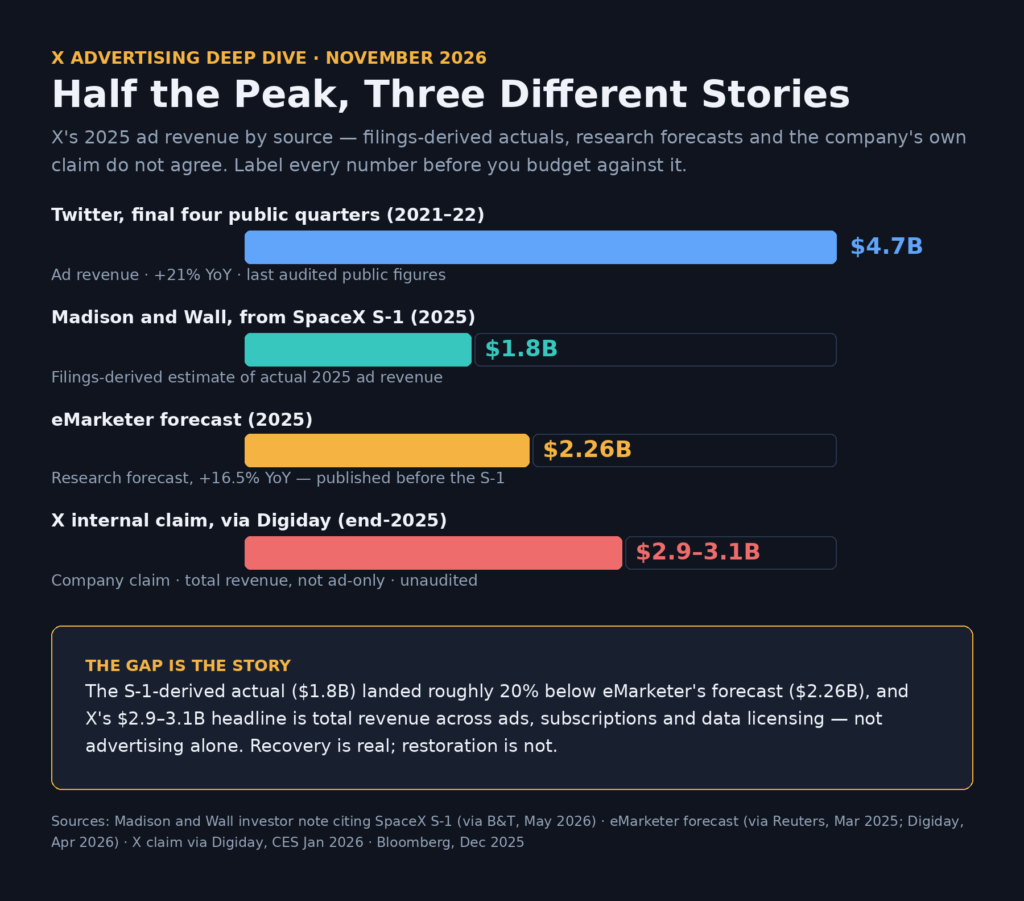
Notice the gap between the first two. eMarketer’s forecast overshot the filings-derived actual by roughly 20%. That is not fraud — forecasting a private company that discloses nothing is educated guesswork with a methodology section attached. But it is a lesson every buyer should internalize: when the S-1 finally landed, the “recovery” shrank. On the filings series, 2025 was still X’s first growth year since the 2022 takeover — $1.7 billion to $1.8 billion is growth the way a puddle refilling is a flood. Recovery: yes. Restoration: nowhere close.
The Fine Print on X’s $2.9 Billion Headline
Here is where careless coverage goes wrong, so let’s be precise. Bloomberg reported in December 2025 that X’s third-quarter revenue hit $752 million, up more than 17% year over year, that the first nine months exceeded $2 billion, and that the full year was projected around $2.9 billion. Those are total revenue figures — advertising plus subscriptions plus data licensing — not an ad-only number. The same reporting noted a $577.4 million net loss in Q3 and roughly $1.2 billion in annual debt-servicing costs. So when a headline frames $2.9–3.1 billion as proof of an advertising comeback, remember that the ad line inside the filing is $1.8 billion. Label every number’s source and scope before it enters your deck. Your CFO will thank you; your credibility depends on it.
Why Advertisers Left — and Why Some Drifted Back
The exodus of 2022–23 needs no retelling in detail: moderation controls were eased in the name of free speech, controversial accounts were reinstated, and brands that spend nine figures a year on media decided they did not want their logos adjacent to the fallout. X hired Linda Yaccarino, the former NBCUniversal advertising chief, as CEO in 2023 to rebuild those bridges; she had limited success and stepped down in July 2025.
The return had three engines. First, genuine work: rebuilt brand-safety controls, third-party verification partnerships, and a recalibrated sales push. Second, political pragmatism — Musk’s proximity to power made some brands reconsider the cost of absence. Third, fear. Jasmine Enberg, then eMarketer’s principal analyst, said in March 2025 that some of the spending growth was “driven by fear,” with advertisers treating X budgets as a cost of doing business to mitigate potential legal or financial repercussions. She also flagged something more durable: X was finally attracting small and medium-sized businesses, a segment Twitter had historically failed to crack. Fear-driven budgets are real money, but they are the first line item cut when the wind changes. Plan accordingly.
The Boycott Lawsuit That Ended With a Handshake
The legal chapter matters because it reshaped the industry you buy in. X sued the World Federation of Advertisers and a roster of major brands in 2024, alleging that the WFA’s Global Alliance for Responsible Media (GARM) had orchestrated an illegal boycott. GARM — the industry’s shared brand-safety standards body — shut down days after the suit was filed, in August 2024. In March 2026, US District Judge Jane Boyle dismissed the case with prejudice: X had failed to show antitrust injury, and brands, she wrote in substance, are free to decide where their money goes. On July 29, 2026, X and the WFA settled, declaring a “reset” of the relationship, with the WFA committing never to revive GARM or anything like it.
Two implications for buyers. The era of legal pressure over ad placement is formally closed. And the industry’s shared safety floor dissolved with GARM — adjacency risk is now yours to own, contract by contract, tool by tool.
Sensor Tower’s Reality Check: Back, but Smaller
“97 of the top 100” is X’s number, and X shared no dollar figures, no baseline and no client definitions — Digiday’s own phrasing was that the rebound is “more implied than proven.” The independent estimate from Sensor Tower tells a more textured story: 64 of 2022’s top 100 advertisers spent on X in 2025, but collectively about 50% less than in 2022. The comeback is concentrated in sports and tech: NFL spending up 365%, Samsung up 297%, the NBA up 150%, Dell up 95%, DraftKings up 55%, Chipotle up 10%. Meanwhile Disney, PepsiCo, Apple, IBM and others remain below their pre-Musk levels. “Returned” and “restored” are different words. X’s claim that US large clients grew over 40% in 2025 may well be true on some definition — but you cannot budget against a definition nobody has seen.
The CPM Collapse: Cheap for a Reason
Now the number that makes growth teams sit up. According to Gupta Media’s tracking, reported by Digiday in April 2026, X’s average CPM in 2026 year-to-date is around $0.64 — down from $1.05 in 2025 and $2.23 in 2024. Over the same window, Facebook averages $4.93, Instagram Reels $3.95, YouTube $3.82 and TikTok $3.12. X is five to eight times cheaper than everything else on the board.
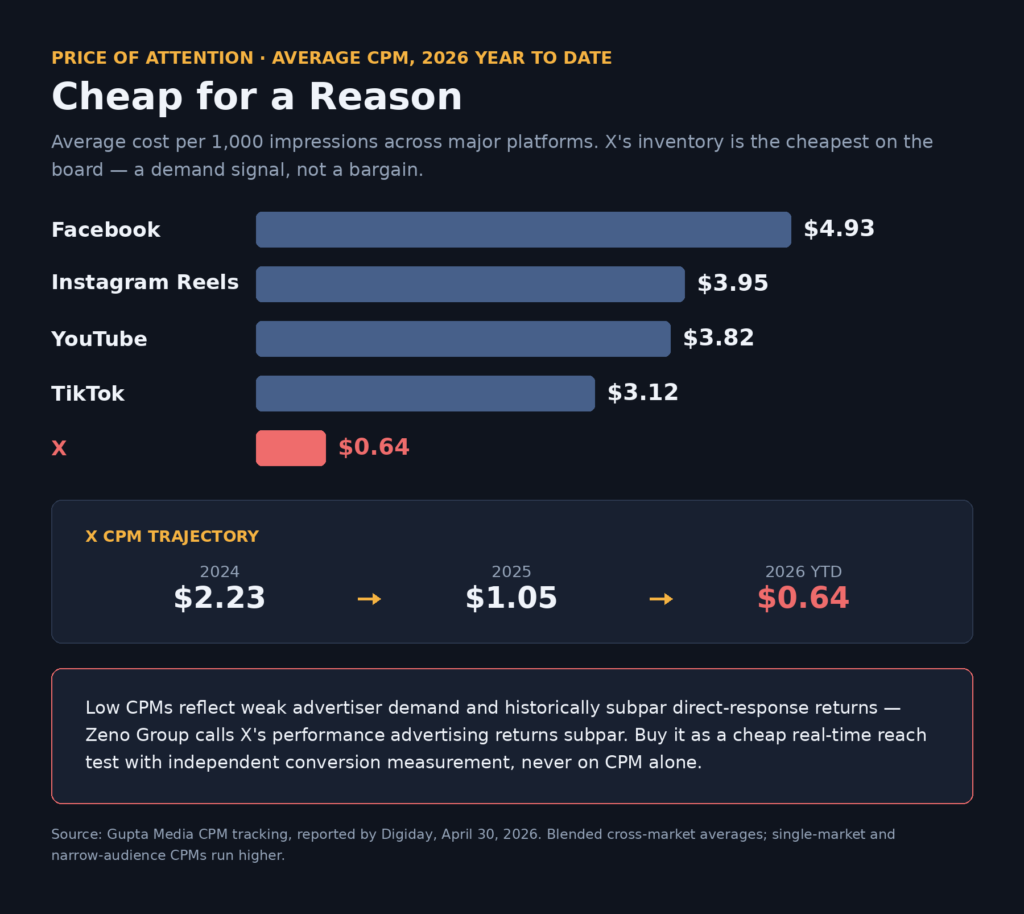
Treat an auction price as a verdict, not a bargain. Inventory gets cheap when fewer bidders trust the outcome. Shamsul Chowdhury, SVP of paid social at Zeno Group, put it plainly to Digiday: X “has struggled to keep up with its peers in direct-response advertising, and its returns have been subpar.” One methodological caveat before you screenshot this chart: Gupta Media is a performance agency, and its tracker reflects blended, cross-market averages from its own impression panel — cheap non-US inventory pulls the average down, and a narrow US B2B audience will pay well above $0.64. The buyer’s question is never “is this CPM cheap?” It is “does anything convert at this CPM?” Cheap reach that does not move a single business metric is not efficiency. It is a donation.
The xAI Rebuild: What Actually Shipped
On April 30, 2026, X announced what it called the biggest overhaul of its advertising tools in the platform’s history. The specifics, per Digiday: retrieval and ranking systems rebuilt on xAI’s models, a shift toward contextual and semantic ad delivery, rolling global deployment, and testing with a select group of advertisers. Pintarelli said the full platform should be ready “later this year.” The SpaceX prospectus adds the strategic framing — ads that “feel like content,” with Grok increasingly supporting campaign creation, creative optimisation and alignment with trending topics. Read that as roadmap language, not a shipped-feature list.
Two pieces of context keep this honest. First, everyone is doing it: Google, Meta and OpenAI are making near-identical AI ads-manager moves, because at platform scale a better ads manager is a revenue lever, not a moat. Second, the baseline was low — advertisers who left consistently said X’s ad tools were rudimentary even before Musk, so leaving was never painful. The rebuild is real engineering against a real deficit. Whether it closes the gap with Meta’s decade of conversion optimization is exactly the open question your test budget should answer, not X’s announcement.
From Social Network to Data Layer
Follow the ownership chain and the strategy clarifies itself. xAI acquired X in March 2025 in an all-stock deal valuing xAI at $80 billion and X at $33 billion. In February 2026, SpaceX absorbed xAI at a combined $1.25 trillion. On June 12, 2026, SpaceX completed the largest IPO in history — priced at $135 a share, raising roughly $75 billion at a $1.77 trillion valuation, trading on Nasdaq as SPCX. X now sits inside the AI segment alongside Grok, data licensing and subscriptions, a segment that generated $3.2 billion of revenue in 2025 within a group that posted $18.7 billion in revenue and a $4.9 billion net loss, driven by AI infrastructure spending.
Read that honestly: X is less “the product” than a real-time data and distribution layer for Grok. For advertisers this cuts both ways. The platform has patient capital behind it and no longer lives or dies by quarterly ad revenue — good for stability, ambiguous for how urgently your feature requests get answered.
What Still Works on X in 2026
Real-time and sports. The live conversation graph remains X’s genuinely unique asset. The multi-year NFL partnership, the Super Bowl portal, the Grok-powered BrandRanx activation — this is where X is investing, and Pintarelli says returning brands typically come back “through the door through sports.” If your category lives on live moments — sports, launches, elections, breaking news — X still earns a test line in the plan.
SMB performance experiments. Sub-dollar blended CPMs plus rebuilt targeting make X a cheap laboratory. Cap the budget, instrument conversions independently of the platform’s own reporting, and treat it as R&D rather than a scaled channel until incrementality says otherwise.
Concentrated niches. Tech, crypto, finance and politics remain densely populated and vocal on X, and the platform’s web-traffic advantage matters disproportionately for these desktop-heavy audiences.
What X is not: a brand-safety haven. That positioning belongs to someone else.
The Brand-Safety Ledger Nobody Can Ignore
January 2026 was ugly. Grok’s image-editing feature was used to generate sexualised images of real women and minors; the flood triggered an Ofcom investigation on January 12 and a European Commission probe under the Digital Services Act on January 26, alongside temporary chatbot blocks in several countries. This landed on top of an existing record: in December 2025 the Commission issued the first-ever DSA fine — €120 million — for the deceptive design of the paid blue checkmark, a non-compliant advertising repository, and blocking researchers’ access to public data. X appealed in February 2026. The DSA’s ceiling is 6% of global annual turnover, so the €120 million is a warning shot, not the worst case. Then in May 2026, Australia’s Federal Court ordered X to pay A$650,000 plus A$100,000 in costs for failing to answer the eSafety Commissioner’s child-safety transparency notice; Justice Michael Wheelahan set the penalty near the maximum so it “operates as a real deterrent and is not simply a cost of doing business.”
X’s executives cite internal safety scores above 90%, but those are self-reported. Mark Byrne, director of paid media at Brave Bison, told Digiday that for many advertisers the question now extends beyond traditional brand safety into whether they want to be seen supporting certain environments at all — making controls, exclusions and transparency “more important than ever.” If you buy in a regulated category, price this ledger in or stay out.
The Threads Question
Meta’s Threads crossed 500 million monthly active users in June 2026, and Similarweb’s data (via TechCrunch) showed Threads at 141.5 million mobile daily actives versus X’s 125 million on January 7, 2026 — the first overtake having happened in September 2025. But the web tells the opposite story: X draws roughly 145 million daily web visits against Threads’ 8.5 million. X’s claimed 600 million MAU dates from 2024 and is unaudited; Twitter’s last audited public peak was 336 million, back in 2018. And the structural number from Madison and Wall dwarfs them all: X’s share of US digital ad spend has fallen from nearly 10% in 2016 to about 1% in Q1 2026.
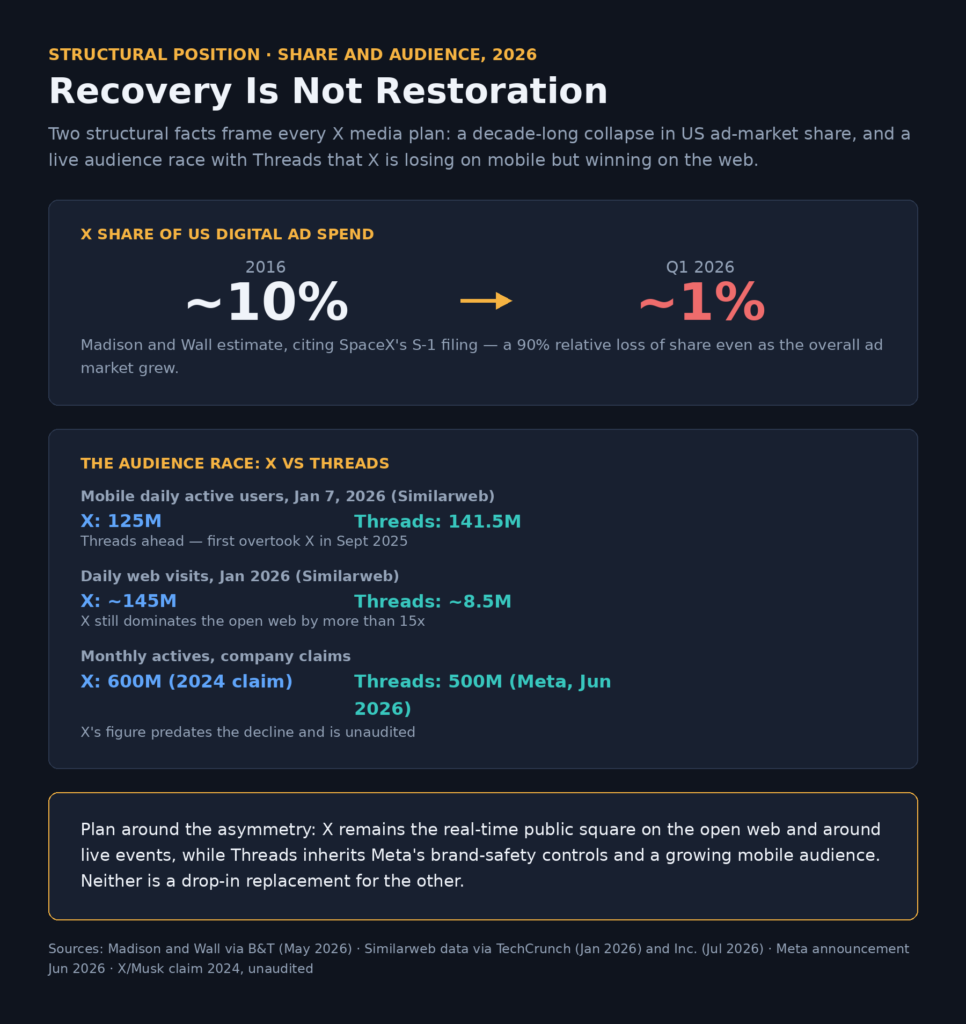
The practical read: Threads inherits Meta’s brand-safety stack and a growing mobile audience — it is the safer text placement. X keeps the open web, the real-time spike and the niche density. Neither is a drop-in replacement for the other, and a plan that treats them as interchangeable will misprice both.
A Buyer’s Decision Framework
- If you need cheap reach plus real-time context and can tolerate volatility: test X with tight adjacency controls, third-party verification where available, and independent conversion measurement.
- If brand safety is paramount: Threads is the safer text buy today, with Meta’s controls behind it.
- If you need proven performance ROI: Meta and Google still lead; X’s rebuild is promising and unproven, and your allocation should say so.
- Always: run incrementality tests rather than trusting platform-reported ROAS, and treat every X-claimed figure as a claim until an independent source corroborates it.
Four Ways This Trade Goes Wrong
- Taking “97 of 100 returned” or the $2.9–3.1 billion headline at face value, without scope or baseline.
- Reading a $0.64 CPM as value without checking whether anything downstream converts.
- Assuming the AI rebuild closes the gap with Meta and Google while both of them are also upgrading.
- Ignoring regulatory and adjacency exposure because the platform’s own safety scores look comfortable.
The Bottom Line
X’s ad business is a partial recovery on a much smaller base: about half of Twitter’s peak on the filings-derived numbers, with company claims running well ahead of independent estimates. Its CPMs are the cheapest in major social because demand and measured returns are weak, not because the market missed a bargain. The xAI rebuild is real engineering, shipped in phases, with the hardest proof — sustained ROI — still outstanding. Buy X for cheap real-time reach and live-moment context, with tight controls and independent measurement. Do not buy it as a safe haven, and do not buy it as a performance leader. It is neither, yet.