UGC Warfare: How Chinese Brands Turn Customers Into Content Armies
A woman in a small apartment asks one question. Strangers answer. She buys it, likes it, posts about it. That loop runs about 39 million times a day — and it is beating the ads.
She was renovating a kitchen the size of a wardrobe and wanted to know whether anyone made a dishwasher narrow enough for a countertop and still gentle enough for a baby bottle. So she asked Xiaohongshu — the app Western users call RedNote — the way you would ask the one friend who has already made the mistake.
Someone answered with a capsule machine called Lishang. She bought it. She liked it. She told her group chat, then posted about it herself, which is how the next woman in the next small kitchen found it.
The China Economic Times reports that a loop like that runs roughly 39 million times a day on Xiaohongshu. Not ads. Not campaigns. Ordinary purchases turning into evidence for somebody else’s decision.
That is the machine Western brand teams keep misreading as a tactic. It is not a tactic. It is a supply chain, and the raw material is your own customer list.
The vocabulary, because the words are the strategy
Three terms get used interchangeably in English decks, and the confusion costs money.
A KOL, or key opinion leader, is celebrity-tier reach. You rent an audience, you rent credibility, and both go home when the invoice clears.
A KOC, or key opinion consumer, is a real customer with a small following — hundreds to a few thousand people, usually someone who shares a city, a stage of life, or a problem. Payment is usually product, samples, or a modest fee.
UGC is the content itself: reviews, unboxings, before-and-afters, the two-minute video of somebody angrily fixing a broken hinge. Sometimes paid, often not.
The distinction matters because the cost curve and the trust curve run in opposite directions. Reach gets expensive fast; belief stays cheap.
The mechanics are also less organic than the label suggests. A nine-month ethnography of KOC production on Xiaohongshu, published in Proceedings of the ACM on Human-Computer Interaction in 2025, found that the KOC role is negotiated among creators, marketers, brands and the platform — and that the labor involved is deliberately obscured so the output reads as spontaneous, ordinary user posts. That is both the mechanism and the fault line, and we will come back to it.
The infrastructure nobody sees
The reason this looks effortless is that an entire industry is holding it up.
Xiaohongshu and Douyin each run an official matchmaking layer where brands post briefs and creators accept them — Pugongying on one side, Xingtu on the other. Above that sit the MCNs that aggregate creator supply and the seeding agencies that handle sampling, shipping, follow-up and reporting. Below it sits the handoff into private channels, where a customer who arrived through a stranger’s note gets pulled into a brand’s own messaging group and sold to again.
Strip that scaffolding away and the “army” is just a very large spreadsheet of strangers. The campaigns that work are the ones where somebody actually built the plumbing.
The ground shifted under paid media
Three numbers explain the strategic turn.
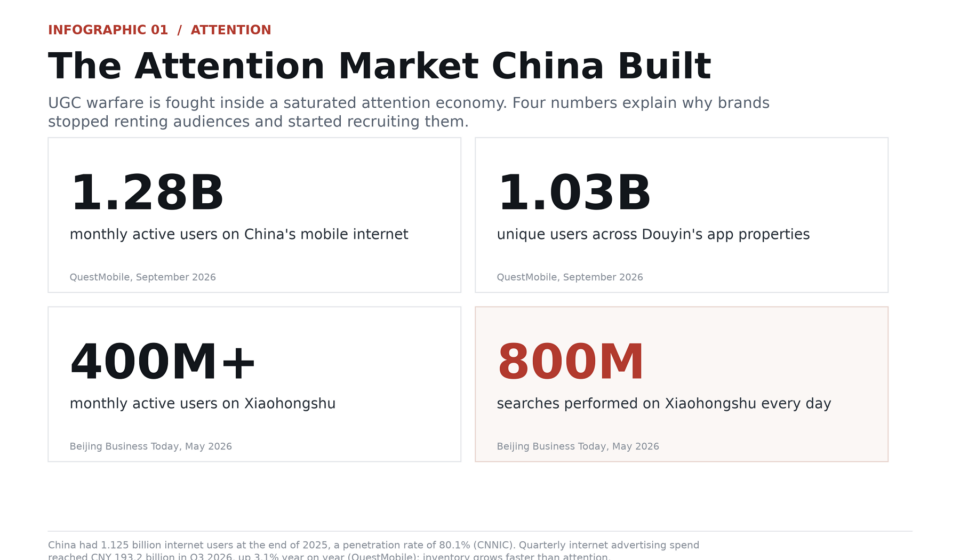
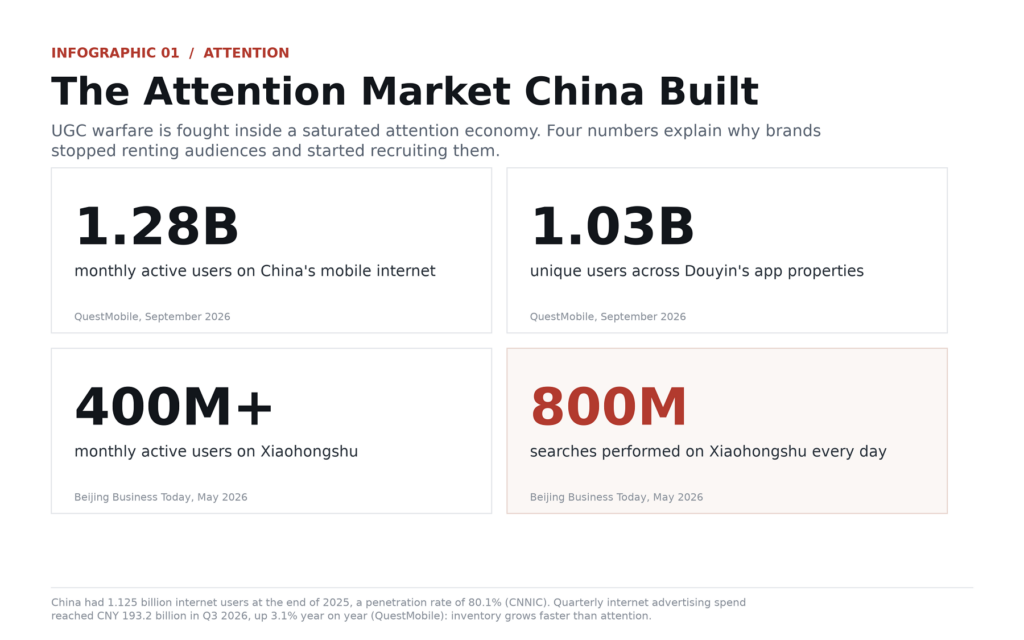
China closed 2025 with 1.125 billion internet users and a penetration rate of 80.1%, according to CNNIC. By September 2026, QuestMobile put mobile internet monthly active users at 1.281 billion — up just 0.9% year on year. There is no new audience left to buy.
Time deepened instead of expanding. Average monthly time per user passed 200 hours for the first time in August 2026, up 7.2% year on year, and held at 189.8 hours in September. Attention did not grow; it concentrated.
Meanwhile the money kept arriving. China’s internet advertising market took CNY 193.24 billion in the third quarter of 2026, up 3.1% year on year. Spend is rising faster than attention.
Run those three facts together and you get a predictable squeeze. When a channel saturates, the price of interruption climbs — and the value of a recommendation climbs faster. Brands that keep buying interruptions at rising prices are funding their competitors’ word of mouth.
Discovery moved inside the search bar
The second shift is behavioral, and it is the one global teams underestimate.
Xiaohongshu reported more than 400 million monthly active users in May 2026, alongside 800 million searches a day, according to Beijing Business Today. Sit with that ratio. This is not a feed you scroll; it is a search engine with a social layer, and its index is written by users.
Douyin runs the same logic with a different control. QuestMobile counted 1.03 billion unique users on Douyin in September 2026, and recorded its in-app mall growing 240% year on year in the third quarter — content handing shoppers straight to a shelf.
So the competitive unit is no longer the impression. It is the query and the note that answers it. A brand that cannot be found inside a search bar it does not own has outsourced its discovery to whoever can.
Two platforms, two different wars
The mistake is treating “China social” as one channel.
Xiaohongshu is a decision-stage instrument. Notes are text and image, they persist, they rank, and they get found by people already close to buying. Categories with high consideration and heavy comparison — skincare, home appliances, baby gear, travel — live and die in its search results.
Douyin is an interest-stage instrument. Video, algorithmic push, enormous velocity, a shorter half-life, and a transaction layer bolted on. It manufactures demand that did not exist thirty seconds earlier.
WeChat Channels is the third surface, and the one global teams forget: slower, more social, closer to a group chat than a feed, and unusually strong with older and lower-tier-city buyers.
Same customer, different moment, different machine. A brief written for one will fail on the others, which is why seeding programs that look identical on a spreadsheet produce wildly different results.
The trust hierarchy, measured
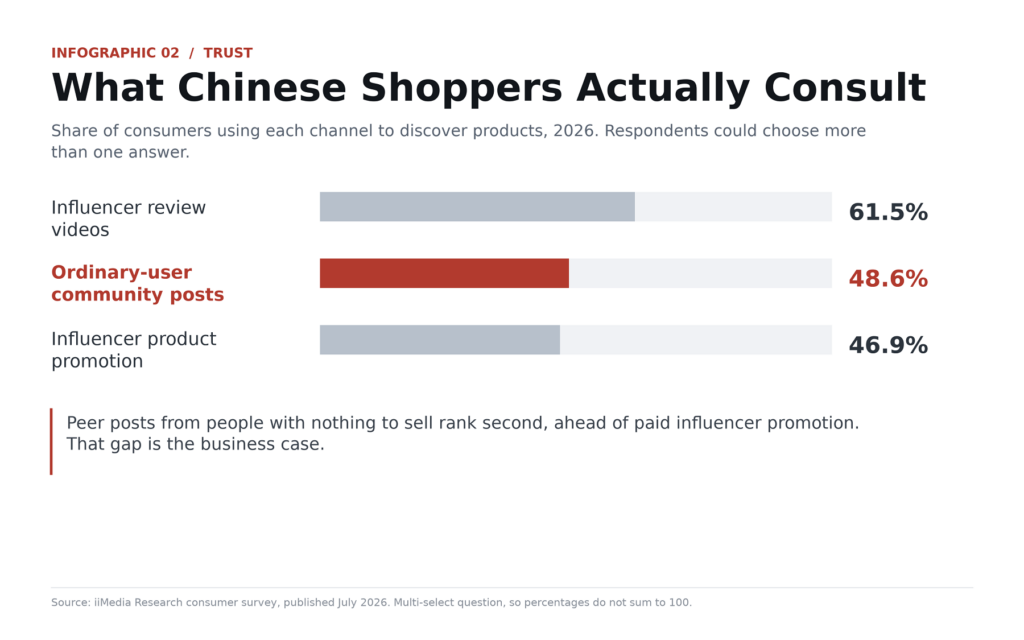
In July 2026, iiMedia Research published survey data on where Chinese consumers actually get product information. Among the listed channels, influencer review videos led at 61.49%. Ordinary-user community sharing came second at 48.62%. Influencer product promotion — the paid, scripted, obviously commercial version — trailed at 46.93%.
Respondents could select more than one channel, so the numbers do not sum to 100, and reported channel use is not the same as influence. But the ordering is the story: unpaid peers outrank paid promotion.
Why small accounts work — and exactly where the effect breaks
The academic literature is unusually clear here, and it complicates the folk version of the story.
A 2022 study in the Journal of Marketing tested what drives influencer campaign effectiveness and found three levers that raise it: the influencer’s originality, their follower size, and the salience of the sponsorship. It found that posts announcing a product launch reduce effectiveness. It also found inverted-U effects — too much posting activity, too perfect a follower–brand fit, or a relentlessly positive tone all begin subtracting value past a point.
That is the useful correction to the usual KOC sermon. Small accounts do not win because they are small. They win because they sit closer to the buyer’s situation and because their commercial motive is less visible. Push either advantage too far — over-script the post, over-incentivize the creator, over-polish the production — and the inverted U does the rest.
Anatomy of a content army
The playbook that produces thousands of posts is duller than the phrase suggests. It is operations.
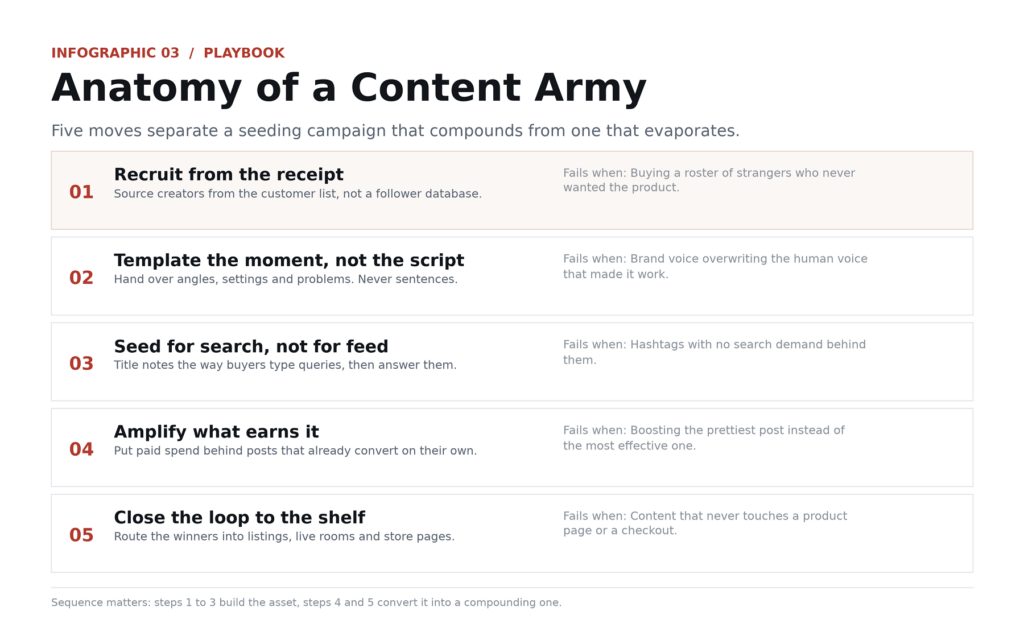
Step one: recruit from the receipt
Source creators from the customer list, not a follower database. People who already bought, already use, already have an opinion. The recruiting question is not “who has reach” but “who has a reason to speak.”
Step two: template the moment, not the script
Give angles, settings and problems. A steamy bathroom. A 6 a.m. commute. A toddler who refuses vegetables. Never give sentences. The moment a brief reads like ad copy, the asset stops working — which is the sponsorship-salience finding wearing work clothes.
Step three: seed for search
Write note titles the way buyers type queries, then answer the query in the first two lines. Hashtags with no search demand behind them are decoration. In a market where Xiaohongshu alone absorbs 800 million searches a day, a note is a search result before it is a post.
Step four: amplify what earns it
Wait for organic signal, then put paid spend behind the posts that already convert on their own. Most teams invert this: they boost the prettiest asset rather than the most effective one, and pay to distribute something nobody wanted.
Step five: close the loop to the shelf
Route winners into product listings, live rooms, store pages and retail displays. Content that never touches a checkout is a brand exercise. Content that does is a distribution channel.
The economics: cost per unit of belief
Here is the number that makes CFOs pay attention.
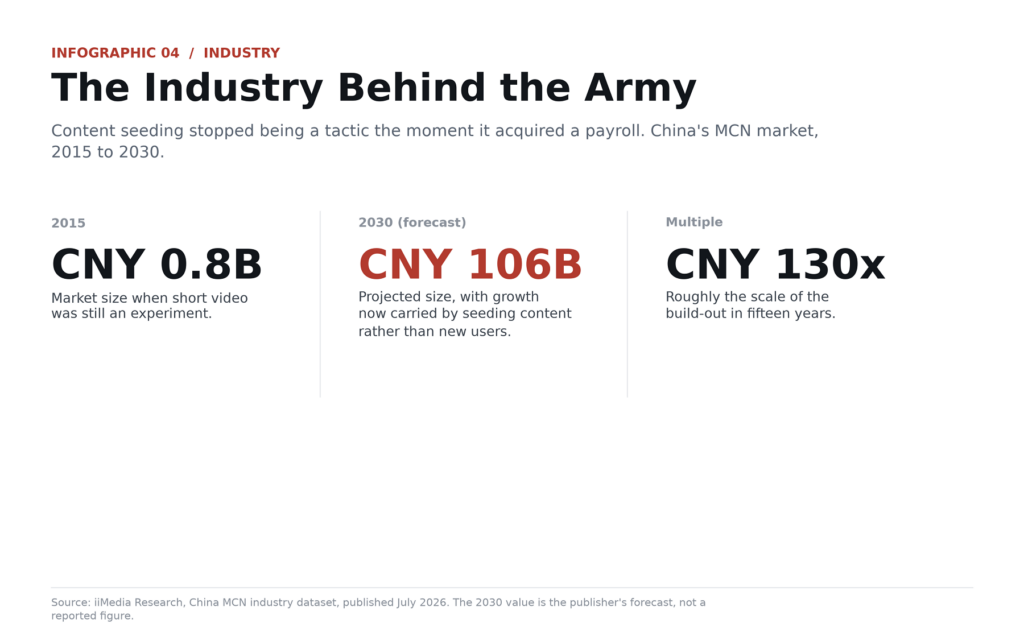
iiMedia Research tracks China’s MCN industry — the agencies, studios and creator networks that industrialize this work — at CNY 0.8 billion in 2015, forecast to reach CNY 106 billion by 2030. That is roughly a 130-fold build-out in fifteen years, and the growth driver has moved from new users to seeding content.
The unit economics are not “cheaper posts.” They are cheaper belief. A KOL campaign buys a burst of borrowed attention that ends when the contract ends. A seeding program buys thousands of small transfers of trust that keep ranking in platform search for months and keep converting in the background.
The budget has already moved. In its third-quarter 2026 review of soft advertising, QuestMobile found coffee and tea brands leaning on mid- and long-tail influencers as their main partners, precisely to feel closer to the customer rather than to maximize reach.
What global brands get wrong
Four structural reasons, and none of them are about budget.
Control culture
Global teams are built to approve one asset for one market. Chinese discovery needs a thousand assets for a thousand micro-contexts. The approval process, not the idea, is the bottleneck.
Compliance friction
Legal teams see incentivized customer content and think undisclosed endorsement. Sometimes they are right. But the answer is a disclosure system, not a ban; the ban simply hands the channel to competitors who built one.
The agency gap
Most international agency networks still sell KOL packages in China because they are legible, auditable and safe to present in a boardroom. KOC operations are messy, and messy does not pitch well.
Measurement mismatch
Seeding pays out in long-tail search ranking, lower return rates and repeat purchase. Global dashboards are built for clicks and immediate conversion. The value is real and invisible, which in most organizations means it is denied.
How to tell whether it is working
You do not need a new attribution model. You need four indicators, tracked weekly, in the order a buyer actually moves.
Branded search volume tells you whether the note layer is doing its job before the click. Note velocity — how many new customer notes mention the product each week without prompting — tells you whether the army is still recruiting itself. Save-to-view ratio separates content people merely watched from content people filed away for a purchase decision. And return rate tells you whether the content told the truth.
None of those show up in a programmatic dashboard. All of them move before revenue does.
The risk ledger
Disclosure is not optional
Chinese law requires advertising to be identifiable. The Internet Advertising Measures took effect on May 1, 2023 and pushed that principle into platform practice. The market regulator’s enforcement guide on ad identifiability followed in August 2024, aimed squarely at the gray zone where a paid post reads like a diary entry. Enforcement has kept tightening: Chengdu’s market regulator issued compliance guidance for AI-generated advertising in September 2026, and Hainan issued rules in June 2026 targeting missing labels on AI-generated ads.
Undisclosed paid seeding is not a gray area with good margins. It is a liability with a timestamp.
Authenticity is a depreciating asset
The finding cuts both ways. The obscuring of commercial labor is what makes KOC content persuasive — and it is exactly what regulators and audiences now hunt. One exposed campaign can turn an entire creator pool from asset to liability.
Variance and volume
A thousand posts means a thousand quality problems, a thousand shipping addresses, a thousand disclosure checks. Most brands find their operational ceiling somewhere around post four hundred, usually by discovering that half the content is unusable and the other half never got posted at all.
Where AI fits, and where it corrodes the asset
AI is genuinely useful in the unglamorous parts: clustering thousands of posts to find the language buyers actually use, drafting briefs, translating, flagging undisclosed commercial content before a regulator does.
It is corrosive in one place. If AI generates the “authentic” experience, the asset becomes indistinguishable from the advertising it was supposed to replace, and audiences detect that faster than brands expect. The platforms are already productizing the measurement layer: Xiaohongshu has spent 2026 rebuilding seeding as a measurable commercial product, with AI running through the workflow.
The tension will not resolve itself. AI makes volume cheap. Volume is precisely what destroys the signal.
A Monday-morning checklist
- Pull the last 90 days of buyers and count how many have posted anything, anywhere. That number is your army.
- Pick one search query your category loses, and commission ten customer notes that answer it properly.
- Rewrite the brief: angles and problems in, sentences out.
- Build a disclosure rule simple enough for a 400-follower creator to follow in one line.
- Move the KPI to branded search volume and return rate, away from impressions.
- Give one person ownership of the creator pipeline. It is a supply chain, so staff it like one.
The uncomfortable conclusion
The brands winning in China are not outspending anyone. They have reallocated the cheapest asset they already own: the opinions of people who bought.
That is uncomfortable for organizations built around creative control, because it requires surrendering the voice. But the arithmetic is not subtle. Attention is saturated, interruption is getting dearer, and the only media that still compounds for free is a customer with a reason to talk.
The question is not whether your customers will write about you. They already are. The question is whether you built anything to catch it.