Picture this. You’ve got ¥100,000 approved for your first China campaign. Someone on your team says Douyin is hot. Someone else swears by Xiaohongshu. Your agency contact mentions Baidu still converts for B2B. So you split the budget five ways, ¥20k each, and congratulate yourself on diversifying.
Ninety days later, every dashboard looks the same: erratic costs, thin data, no stable conversions. You didn’t diversify. You starved five machines at once.
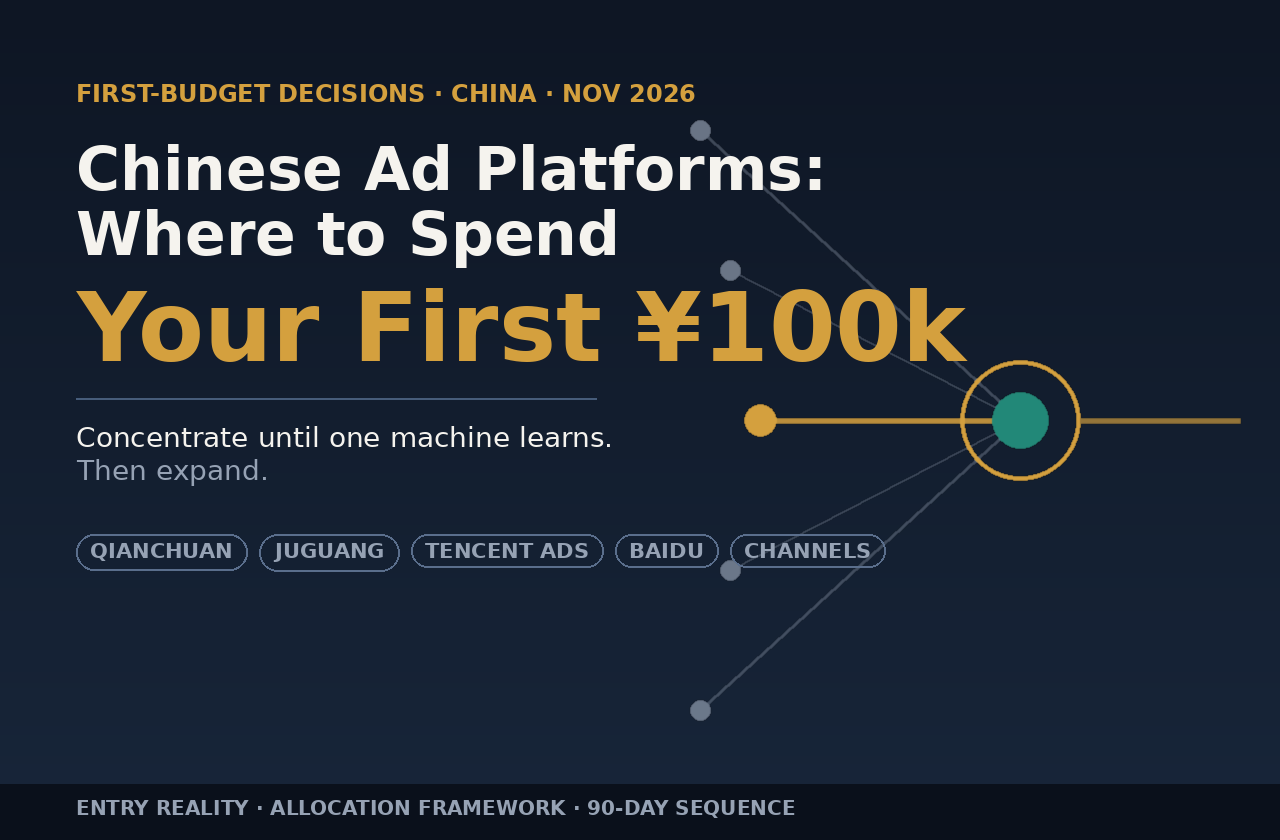
Here’s the thing nobody tells first-time advertisers: China’s ad platforms run on bidding models that need conversion data before they stabilize. Below a certain data threshold, the algorithm is guessing. Spread your budget too thin and every platform stays in guessing mode — permanently. This guide walks you through the entry reality of each major platform, a business-type allocation framework, and a 90-day spend sequence built around one principle: concentrate until one machine learns, then expand.
First, Understand the Machine You’re Feeding
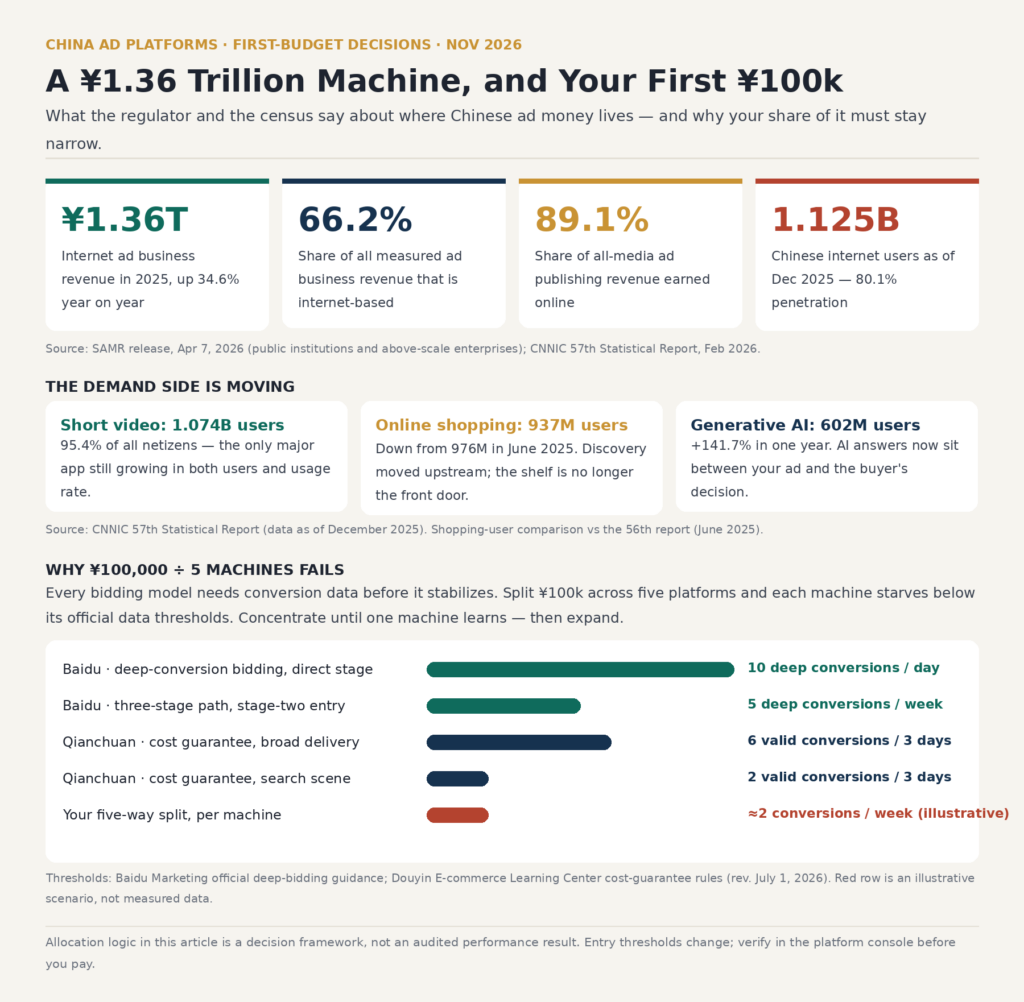
China’s State Administration for Market Regulation reported in April 2026 that the country’s advertising business revenue crossed ¥2 trillion for the first time in 2025, reaching ¥2,050.21 billion. Internet advertising accounted for ¥1,357.43 billion of that — up 34.6% year on year, and 66.2% of all measured ad revenue. Look at the publishing side and the tilt is even starker: 89.1% of all-media ad publishing revenue was earned online.
Meanwhile, CNNIC’s 57th statistical report (released February 2026, data as of December 2025) counted 1.125 billion Chinese internet users at 80.1% penetration. Short video reached 1.074 billion users — 95.4% of all netizens — and was the only major application still growing in both user count and usage rate. Online shopping users, notably, fell from 976 million in June 2025 to 937 million. And generative AI users hit 602 million, up 141.7% in a single year.
Read those numbers together and the strategic picture snaps into focus: discovery has moved upstream into feeds, video and AI answers, while the traditional shopping shelf no longer serves as the front door. Your ¥100k enters a mature, algorithm-mediated market. It rewards focused data, not scattered presence.
The Concentration Principle: 70/20/10
The counter-move to the five-way split is deliberately boring: put roughly 70% of your budget on one primary platform, 20% on a single test platform later, and hold 10% in reserve. To be clear, this is a decision framework, not a measured result — but the logic underneath it is grounded in each platform’s published mechanics.
The thresholds are real, and they’re published
Baidu’s official marketing guidance for deep-conversion bidding asks for around 10 deep conversions per day before the direct deep-goal stage stabilizes; its three-stage path opens stage two at roughly 5 deep conversions per week, with your deep bid set at no less than 80% of the system’s recommendation. Douyin’s Qianchuan cost-guarantee rules (revision effective July 2026) require at least 6 valid conversions in broad-delivery scenes — or 2 in search scenes — within a three-day window before the platform will compensate cost overruns.
Now do the beginner math. ¥20k on a platform where a conversion costs ¥80 buys you 250 conversions total. Filter that through creative testing, audience splits and a cold-start period, and any single campaign may see two or three conversions a week. You never reach the thresholds. The models never stabilize. Your CPA never converges. Concentration isn’t a stylistic preference — it’s arithmetic.
Platform Entry Reality Check
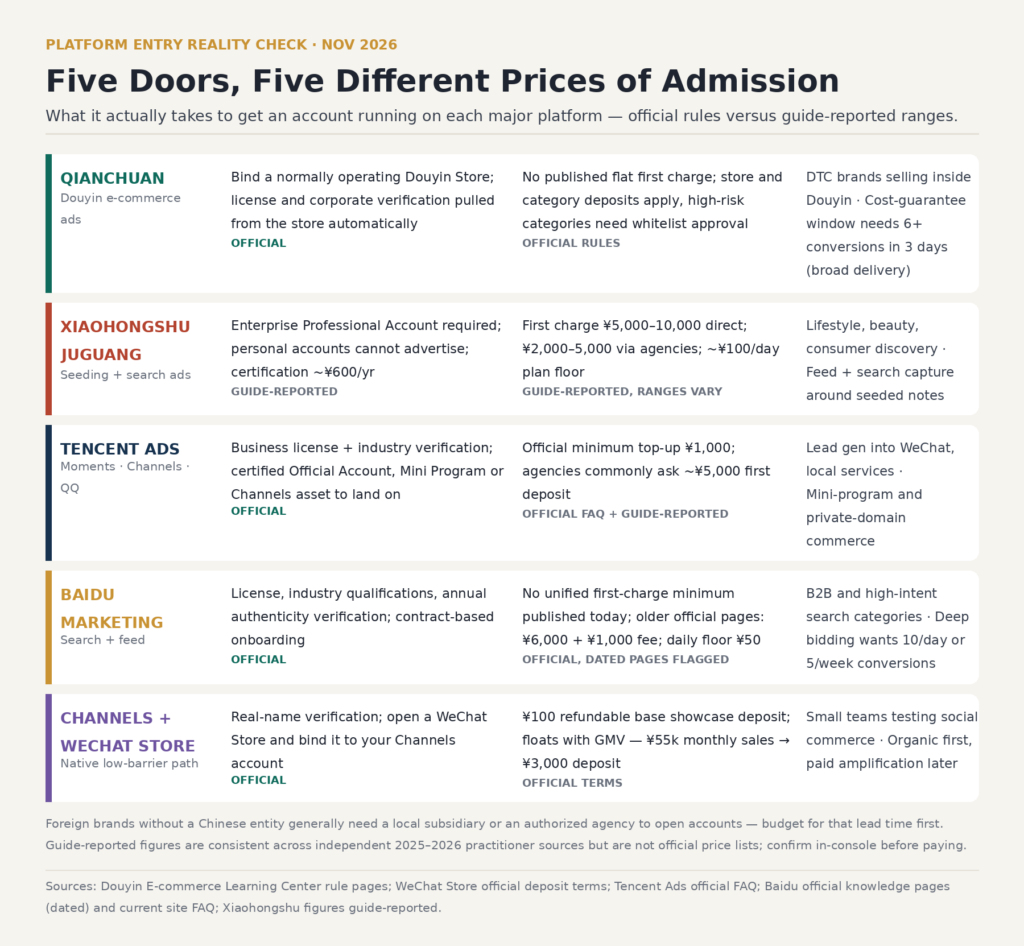
Before allocating anything, know what each door costs to open. A note on honesty: some figures below are official rule-center facts; others are consistent ranges reported across independent 2025–2026 practitioner guides but never published as official price lists. We label each, because your agency quote may differ and the console is always the final word.
Qianchuan: the store comes first
Qianchuan is Douyin’s e-commerce ad system, and for merchants the account is downstream of a shop. Official entry rules require a bound, normally operating Douyin Store; your business license and corporate verification are pulled from the store automatically, while category and product qualifications must be supplied per category rules. Creators have separate paths via product showcases or real-name verification, but if you’re a brand selling goods, budget for store setup before you budget for ads. High-risk categories — medical devices, health foods and similar — face separate whitelist reviews and category deposits before ad accounts unlock. There is no published flat first-charge minimum; deposits and qualification chains are the real gate.
Xiaohongshu Juguang: certification before conversation
Juguang is Xiaohongshu’s ad platform, and personal accounts simply cannot use it. You need an enterprise Professional Account, which independent guides consistently report costs about ¥600 per year to certify. Guide-reported first-charge minimums run ¥5,000–10,000 direct and ¥2,000–5,000 through agencies — with genuine conflict between sources about whether the agency floor rose in 2026 — and plan-level daily budgets start around ¥100. Treat these as planning ranges, not quotes.
Tencent Ads: the most official low floor
Here’s a pleasant surprise buried in Tencent’s own FAQ: the official minimum single top-up is ¥1,000. That’s an official figure, not agency folklore. In practice, agencies commonly ask for around ¥5,000 as a first deposit (guide-reported, with a ¥2,000–6,500 spread by channel and industry). What Tencent really demands is coherence: a business license, industry verification that can’t be changed after approval, and a certified asset — Official Account, Mini Program or Channels account — for your ads to land on. Ads pointing nowhere get rejected.
Baidu: the contract-based veteran
Baidu’s own knowledge pages, dated 2022–2023, describe first prepayment from ¥6,000 plus a service fee from ¥1,000 in direct-sales cities. Treat those as historical anchors. The current official position is contract-based: no unified first-charge minimum is published, and the official FAQ sets the daily budget floor at ¥50 for both search and feed campaigns. For B2B and high-intent categories, Baidu remains the backbone — people typing queries are telling you what they want.
Channels + WeChat Store: the ¥100 door
The lowest official barrier in China’s ad-adjacent ecosystem isn’t an ad account at all. WeChat’s official showcase deposit terms set a refundable base deposit of ¥100 for selling via Channels, floating with your GMV — the official example: ¥55,000 in monthly sales raises the deposit to ¥3,000. Open a WeChat Store and the separate base showcase deposit is waived. Guide-reported rules give store-bound accounts product-link permission at zero followers, while individual creators need around 1,000 valid followers for short-video links. For a small team, this is the cheapest way to test whether your product sells socially at all — before paying for traffic.
The foreign-brand asterisk
No Chinese entity? Most platforms will route you through a local subsidiary or an authorized agency. That’s not a footnote; it’s a lead-time item. Start qualification paperwork in week one, or your carefully planned launch date slips by weeks.
The Allocation Framework by Business Type
Now the core of this guide. Match your primary platform to where your buyers already make decisions — not to where the loudest case studies happened.
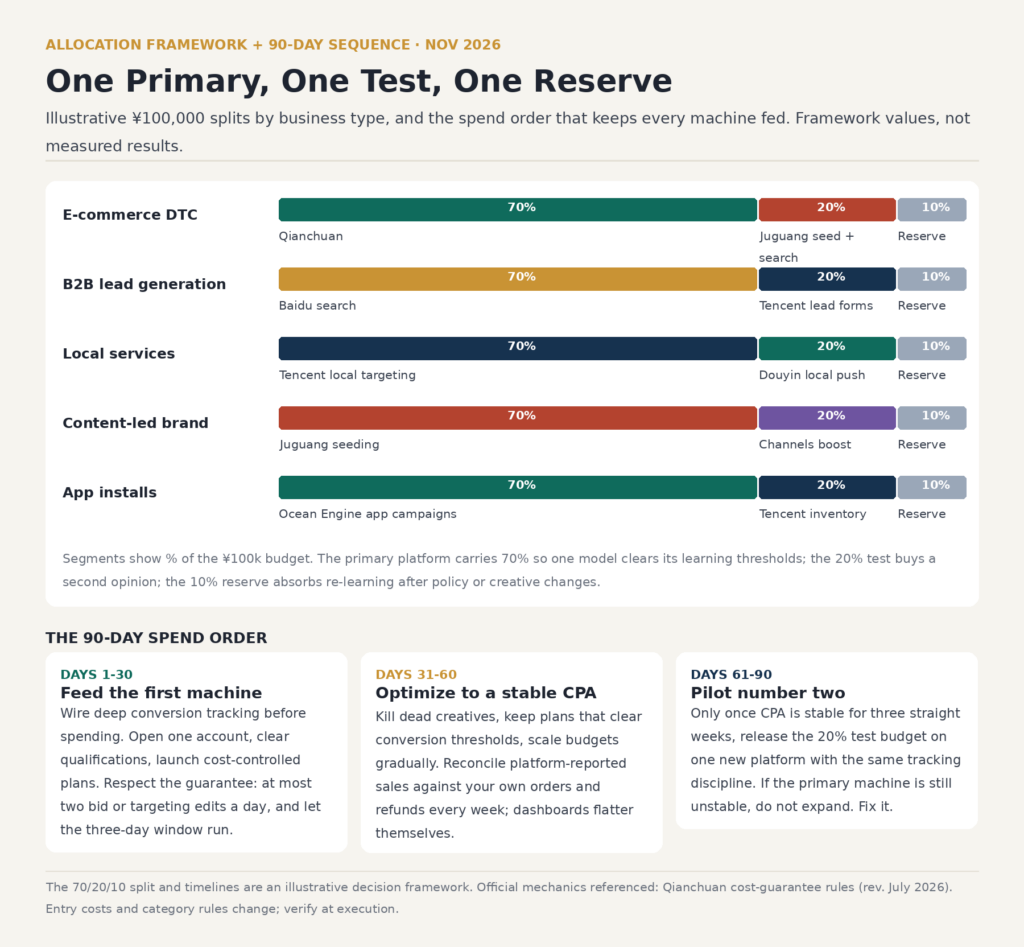
- E-commerce DTC: Qianchuan primary, because the transaction, the content and the ad live in one loop. Juguang as your test platform seeds demand you can harvest later. Expected learning window: two to four weeks if your creative pipeline holds up.
- B2B lead generation: Baidu search primary — procurement managers type before they scroll. Test Tencent lead forms landing in WeChat, where your sales team actually talks to people.
- Local services: Tencent’s geo-targeting primary, Douyin’s local push as test. Both reach people within driving distance of your door.
- Content-led consumer brand: Juguang seeding primary, because discovery is your funnel. Channels amplification as test, feeding the private-domain relationship.
- App installs: Ocean Engine’s app campaigns primary — conversion tracking is native and mature. Tencent inventory as your second source.
None of these is gospel. Category variance is enormous; a niche B2B service might find Douyin search surprisingly cheap. The framework’s job is to give you a defensible starting point, not to replace judgment.
The 90-Day Spend Sequence
Days 1–30: feed the first machine. Wire deep conversion tracking before spending a yuan — purchases, qualified leads, installs, whatever your real outcome is. Open one account, clear qualifications, launch cost-controlled plans. Then practice radical restraint: Qianchuan’s guarantee dies if you edit bids or targeting more than twice in a day, and the three-day cost-guarantee window only works if you let it run. Fiddling is the beginner’s tax.
Days 31–60: optimize to a stable CPA. Kill dead creatives. Keep the plans that clear conversion thresholds. Raise budgets gradually, not heroically. And every week, reconcile the platform’s reported sales against your own order system — refunds, cancellations and attribution flattery live in that gap.
Days 61–90: pilot number two. Only once your CPA has held stable for three straight weeks do you release the 20% test budget on one new platform, with the same tracking discipline. If the primary machine is still unstable, the answer is not more platforms. The answer is fixing the machine.
What NOT to Spend On First
Brand display at a tiny budget buys impressions nobody remembers. Mega-KOL deals at ¥100k total budget mean one post and no learning loop. Five-platform spreads starve every model, as we’ve established. And martech subscriptions before conversion tracking is like buying a gym membership before checking whether the gym exists.
One genuinely cheap complement deserves the opposite treatment: content built for search and AI answers. With 602 million Chinese users already asking generative AI questions, structured, factual content about your category compounds quietly while your ads run. It costs writing time, not media budget.
Measure From Day One, or Don’t Start
Pick one primary metric per business type — cost per qualified lead, cost per purchase, cost per install — and ignore everything else for the first month. Platform dashboards are marketing materials for the platform; your CRM and order system are marketing materials for reality. The weekly ritual that matters: exported platform conversions versus your own records, side by side, discrepancy explained. If you can’t explain a 30% gap, you don’t have a measurement system. You have a screensaver.
Budget for Compliance, Because Points Are Real
Qianchuan’s current service-points rule (V3.3, September 2026) runs an annual violation ledger: 4 points triggers a 7-day account suspension plus a 7-day block on new accounts; 8 points means 30 days; 12 points means 60 days. Points reset each January 1 — but the reset does not cancel penalties already in motion, and severe or repeated violations can escalate to permanent bans and blacklisting at the platform’s discretion, with no fixed point threshold. You have three working days to appeal a penalty notice.
Practical translation: build a claim library of approved wording before launch, keep qualification documents current, and treat your 10% reserve as partly a re-learning fund. One policy change or one suspended week can force a model to restart its education — on your dime.
Honest Boundaries
Let’s be straight about what this guide is. The 70/20/10 split and the timelines are a framework, not an audited result. Entry costs marked guide-reported vary by agency, region and industry, and some conflict between sources. Official rules change — the points regime was rewritten in 2026, and Baidu’s published entry prices date from 2022–2023. Every number here was checked against official rule centers, regulator releases or multiple independent practitioner sources as of November 2026, but your console, your contract and your category are the final authority. Verify before you pay. That’s not a disclaimer. That’s the job.