Here’s a riddle worth sitting with: which company quietly runs one of China’s biggest advertising businesses while almost nobody calls it an ad company? Not Baidu, whose search ads are shrinking. Not Tencent, whose ad business everyone already knows. The answer is JD.com — the retailer best known for selling laptops with same-day delivery and owning its own warehouses, trucks and couriers.
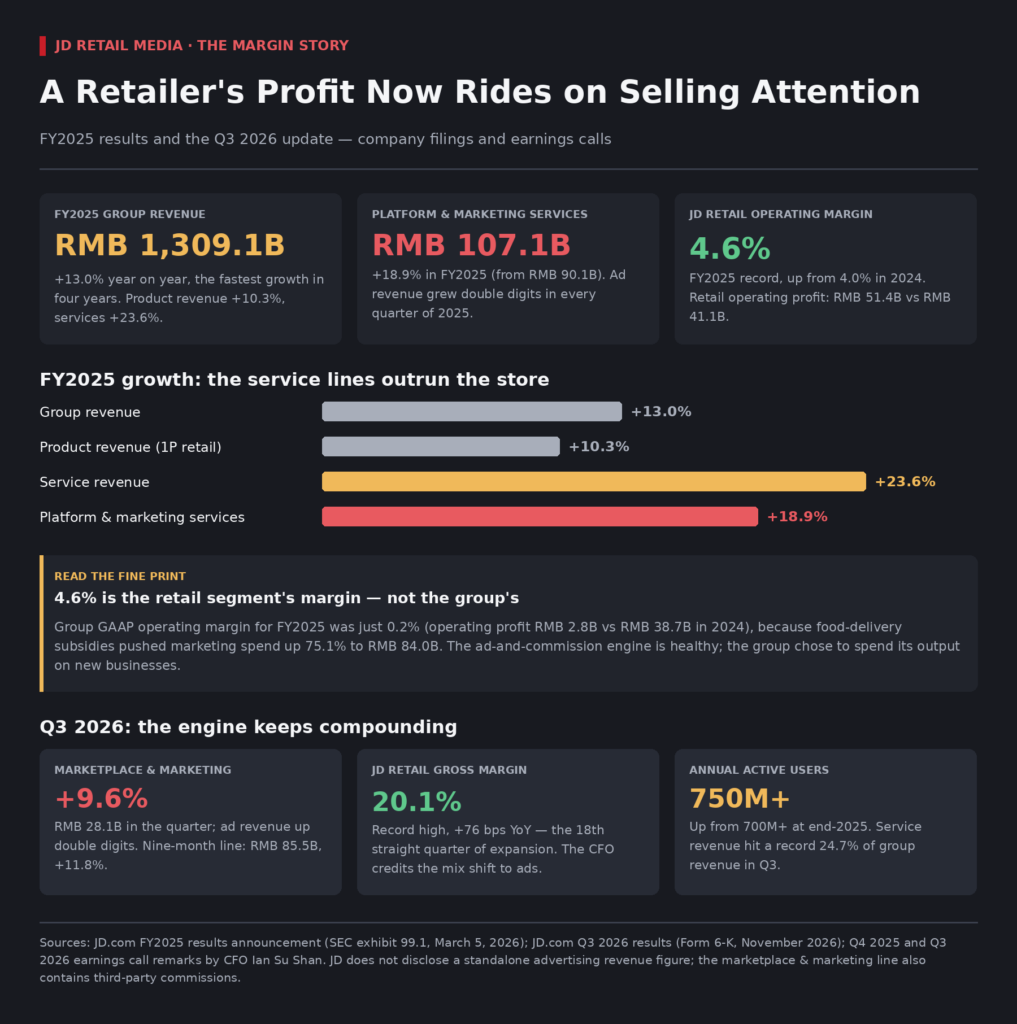
And the numbers back up the riddle. JD’s marketplace and marketing services — the revenue line that carries its advertising business — brought in RMB 107.1 billion in 2025, growing 18.9% while the company’s core product sales grew 10.3%. Ad revenue inside that line grew double digits in every single quarter of the year, according to the CFO’s remarks on the earnings call. For a company that still buys, stores and ships most of what it sells, that’s not a side hustle. That’s a second engine.
This piece unpacks how that engine works: the ad platform itself (Jingzhuntong, or JZT), the eight-product stack it sells through, the transaction-data moat underneath, and the AI agents now moving in on both sides of the counter. If you’re a brand marketer trying to figure out whether JD deserves a slice of your China budget — or a global marketer watching retail media eat the ad industry — this is the map.
The Retailer That Learned to Sell Attention
Start with the business model, because everything else follows from it. JD is built around first-party retail — it purchases inventory, prices it, and delivers it through its own logistics network. That’s a thin-margin business by design. Selling a refrigerator at a few points of margin is honest work, but it doesn’t compound like software does.
The escape hatch is the same one Amazon found years ago: let third-party merchants sell alongside your own inventory, then charge them commissions and sell them visibility. Commissions and ads carry fat margins. And unlike a pure marketplace, JD gets to price its ad inventory against something rare — a shopper base that arrived with a wallet already half open.
The FY2025 Numbers That Tell the Story
The 2025 annual results, filed with U.S. regulators in March 2026, lay it out cleanly. Group revenue hit RMB 1,309.1 billion, up 13.0% — the fastest growth in four years. Product revenue grew 10.3%. Service revenue grew 23.6%. And the marketplace and marketing line — commissions plus advertising — climbed from RMB 90.1 billion to RMB 107.1 billion, that 18.9% jump.
The retail segment’s operating margin reached a record 4.6%, up from 4.0% a year earlier, on operating profit of RMB 51.4 billion. Management has been explicit about why: as higher-margin businesses like advertising contribute a larger share of revenue, profit streams diversify and margins rise. By the third quarter of 2026, JD Retail’s gross margin crossed 20% for the first time — its eighteenth consecutive quarter of year-on-year expansion — and the CFO credited, among other things, the mix shift toward higher-margin advertising revenue.
The Fine Print: Two Different Margins
Now the caveat that most coverage skips, and you shouldn’t. That record 4.6% belongs to the retail segment, not the group. JD’s group-level GAAP operating margin in 2025 was 0.2% — operating profit of just RMB 2.8 billion against RMB 38.7 billion the year before. Why the collapse? Food delivery. JD launched a delivery business in 2025 and bought users with subsidies, pushing group marketing spend up 75.1% to RMB 84.0 billion.
So the honest reading is this: the ad-and-commission engine is healthy and getting healthier, and the group deliberately spent its output buying a new battlefield. By Q3 2026 the strategy was visibly shifting — marketing spend fell 26.2% year on year, food-delivery losses more than halved, and one of the three reasons the CFO gave for that improvement was rising commission and advertising revenue from delivery merchants. The attention-selling machine is now being installed in the new business too.
Inside Jingzhuntong: Eight Products, One Machine
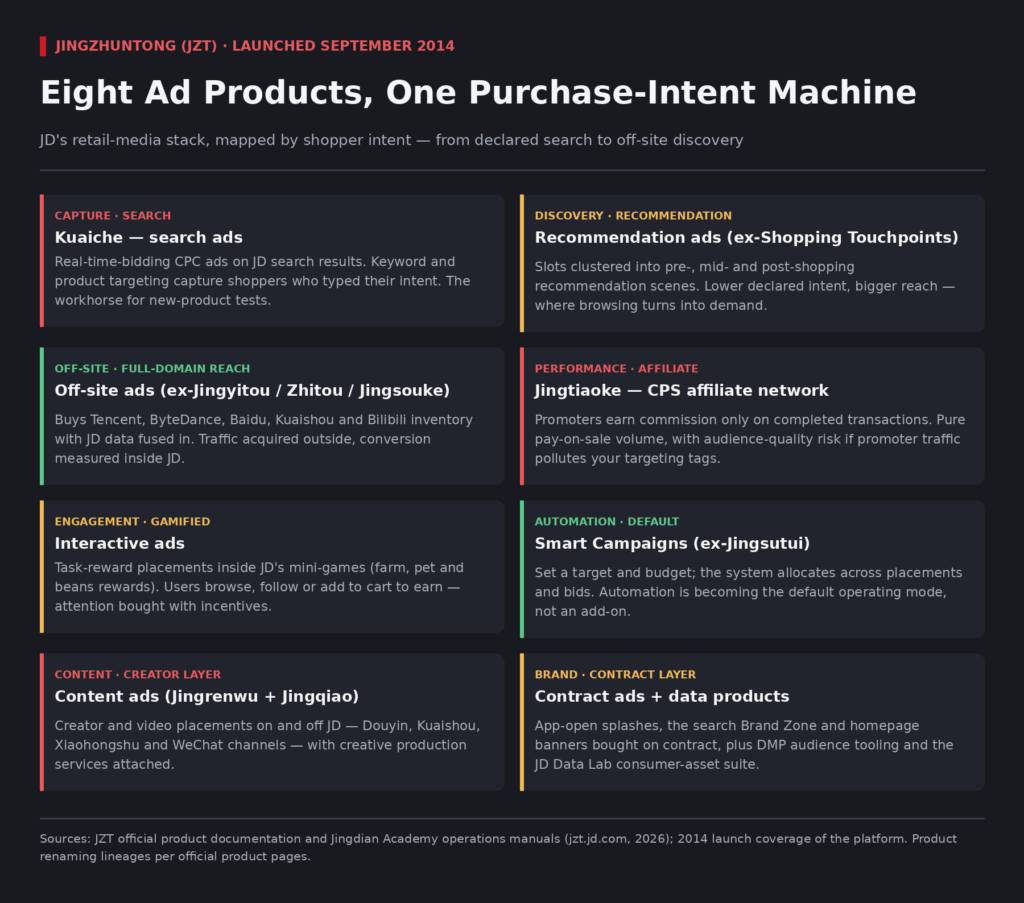
JD’s advertising platform launched in September 2014 as Jingzhuntong — roughly, “precision reach” — built on top of an earlier demand-side platform. Its search ad product, Kuaiche, predates it by two years. A decade of renaming and merging later, the stack has settled into eight product families. Think of them as eight ways to buy a shopper’s attention at different moments of intent.
Search: Kuaiche Captures Declared Intent
Kuaiche is the workhorse: real-time-bidding cost-per-click ads on JD’s search results, targeted by keyword or by product. When someone types “noise-cancelling headphones” into JD, they’ve declared their intent in plain text. Kuaiche lets you stand in front of that declaration. It’s the closest analogue to Amazon’s sponsored products, and it’s where most merchants test new listings and main images, because the feedback loop between spend and orders is short.
Recommendation Ads: Manufacturing Demand
Search harvests intent; recommendation creates it. JD’s recommendation ads — formerly called Shopping Touchpoints — cluster inventory into pre-shopping, mid-shopping and post-shopping scenes: homepage feeds, product-page suggestions, cart and checkout adjacencies. The shopper didn’t ask for you, which means lower conversion per click but far more scale. This is where browsing becomes demand, and where consumer brands with impulse-friendly price points earn their keep.
Off-Site Ads: Buying the Rest of the Internet
JD doesn’t confine you to its own app. The off-site product family — consolidated from three older tools — buys inventory across Tencent’s WeChat and QQ ecosystem, ByteDance’s Douyin and Toutiao, Baidu, Kuaishou and Bilibili, with JD’s audience data fused into the targeting. The pitch is a closed loop: acquire attention on the platforms where people actually spend their evenings, then measure the outcome in completed JD orders. In 2025, JD Health and JZT formalized this into a cross-platform brand growth program with Tencent Ads, Kuaishou, Weibo, ByteDance’s Ocean Engine, Bilibili, Zhihu and others — off-site seeding, on-site conversion, audiences recycled back into reusable brand assets.
Jingtiaoke: Pay Only When It Sells
Jingtiaoke is the affiliate network: promoters share links across the open web and earn commission only on completed transactions. Cost-per-sale means your downside is capped — no sale, no fee. The catch, which experienced operators will warn you about, is audience quality. Bargain-hunting promoter traffic can scramble the behavioral tags JD builds around your product, muddying the targeting for everything else you run. Cheap volume has a data cost.
The Gamified, Automated, Content and Brand Layers
Four more families complete the stack. Interactive ads sell task-reward placements inside JD’s mini-games — users browse your store, follow you or add to cart to earn beans and farm rewards; attention purchased with incentives. Smart Campaigns, the automation product, lets you set a target and budget while the system handles allocation and bidding — increasingly the default way small teams operate. Content ads connect creator and video placements on Douyin, Kuaishou, Xiaohongshu and WeChat channels, with creative production attached. And contract ads cover the brand layer: app-open splash screens, the search Brand Zone that defends your name from competitors bidding on it, and homepage banners — bought on contract, not auction, alongside DMP audience tooling.
The Moat: Transaction Data, Not Clicks
Every ad platform claims precision. What makes JD’s claim structurally different is the raw material. A social platform knows what you watched. A search engine knows what you wondered. A first-party retailer knows what you paid for — the actual transaction, the price you accepted, the repurchase cycle, the basket your purchase traveled in.
That distinction compounds. JD can build audiences from completed purchases and cross-category baskets — say, buyers of premium coffee machines who also repurchase specialty beans — and push those segments straight into campaign targeting. When the campaign ends, the results flow back as consumer assets you can reuse. The retailer’s ledger becomes the advertiser’s targeting engine.
The 4A Consumer-Asset Model
The organizing framework is JD Data Lab, which sorts a brand’s consumers along a 4A model: Aware, Appeal, Act, Advocate — from first exposure through purchase to loyal advocacy. Brands diagnose which stage leaks (plenty of awareness, weak conversion? strong purchase, no repeat?), build segments to fix it, and pipe them into JZT campaigns. JD Cloud’s broader user-operations stack extends this with a 5A lifecycle model and RFM layering for retention work. One honesty note: the case studies showing asset lifts and ROI gains come from JD’s own academy and agency partners — useful as illustrations of mechanics, not independent benchmarks.
The Practitioner Playbook
So how do you actually run this thing? The sequence experienced teams follow is boringly consistent.
Start with Kuaiche to capture declared intent and validate the product — if it can’t convert people who searched for exactly what you sell, no amount of upstream reach will save it. Layer recommendation ads to scale beyond the search ceiling. Use off-site and content products to seed demand on the platforms where your audience lives, then retarget the exposed audiences on JD. Add Jingtiaoke for pay-on-sale volume, but watch your audience tags. Let Smart Campaigns handle the grind once your targets are proven. And if competitors bid on your brand name, defend it with the Brand Zone.
Measure the way the platform measures: ad-cost-to-sales ratio and ROI on completed orders, with attribution windows you’ve actually read. JD reports conversions on order data, which makes the loop tighter than click-proxy platforms — but also means affiliate and promotion-order noise shows up in your numbers, so clean the attribution before you celebrate.
Risks and Honest Caveats
Three structural warnings. First, the referee plays the game: JD’s own first-party inventory competes with third-party merchants for the same traffic, and merchants have long grumbled about first-party priority. JD has no published guarantee of neutrality, so treat placement dynamics as something to test, not assume. Second, category skew: the audience tilts toward electronics, appliances and quality-assured general merchandise. Fashion and beauty discovery still leans toward Tmall, Douyin and Xiaohongshu, though Zara’s 2026 flagship launch on JD signals the gap narrowing. Third, data opacity: JD doesn’t disclose standalone ad revenue — the marketplace and marketing line bundles commissions with ads — and platform-wide cost-to-sales benchmarks are scarce. Most circulating “average ROI” numbers are vendor or agency marketing. Treat them accordingly.
The 2026 Frontier: Agents on Both Sides of the Counter
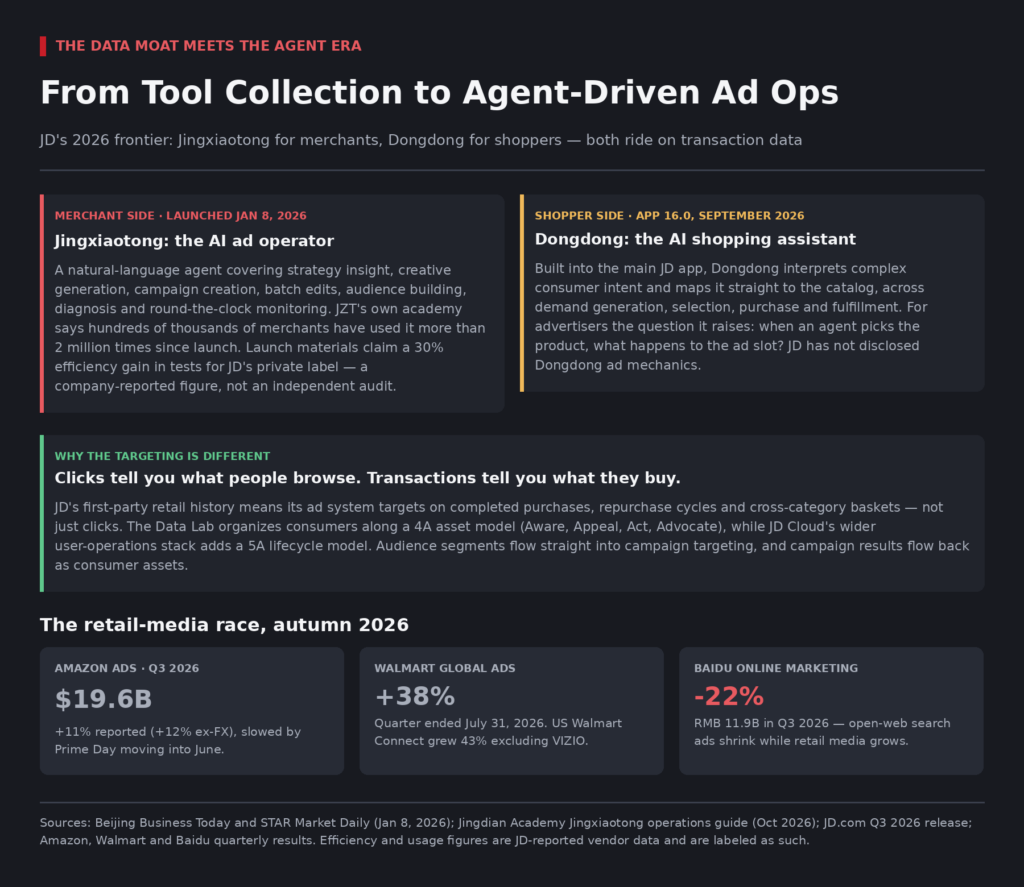
In January 2026, JD’s ad business shipped Jingxiaotong, an AI agent that replaces the tool-collection paradigm with conversation. Merchants describe goals in natural language; the agent generates strategy, creatives, campaigns and audience plans, diagnoses underperformance against industry benchmarks, and monitors budgets around the clock. JZT’s academy says hundreds of thousands of merchants have used it over two million times since launch, and launch materials claim a 30% efficiency gain in tests for JD’s private label. Both figures are company-reported — directionally interesting, independently unverified.
Then, in September 2026, JD shipped the other half: Dongdong, an AI shopping assistant built into version 16.0 of the main app, designed to interpret complex consumer intent and map it directly to the catalog. Annual active users, meanwhile, passed 750 million.
Here’s why that matters beyond the press release. When a shopper queries an agent instead of scrolling a results page, the ad slot as we know it — a ranked position bought at auction — has nowhere obvious to live. JD hasn’t disclosed how ads will work inside Dongdong. But the company that owns the transaction data is unusually well positioned to answer that question, because an agent recommending products needs exactly one thing to be trustworthy: knowing what people actually buy and keep.
What This Means for Global Marketers
Zoom out and JD is one more data point in the industry’s biggest migration. In the same autumn quarter, Amazon’s ad revenue grew 11% to $19.6 billion, Walmart’s global ad business grew 38%, and Baidu’s open-web search marketing fell 22%. Money is flowing from ads placed near content toward ads placed near checkout — retail media — because checkout is where intent is provable and measurement is honest.
JD’s twist is that it arrived there from the heaviest possible starting point: owned inventory, owned logistics, owned transactions. The lesson travels even if you never spend a yuan on JZT. Whoever owns the purchase record owns the most valuable targeting signal in advertising. Whoever sells attention priced by proven purchase intent can lift the margins of an entire business. And whoever lets an agent mediate the purchase will have to reinvent the ad unit — watch JD’s answer closely, because it’s coming.
The Takeaway
JD sells attention the way it sells everything else: with the receipt as proof. The eight-product JZT stack monetizes a shopper base of 750 million-plus at every stage of intent, the transaction ledger makes the targeting conversion-precise, and the shift toward ad and commission revenue is the quiet engine behind a record retail margin. The caveats are real — segment versus group margins, category skew, vendor-reported numbers, a referee who also plays. But the direction is unmistakable. The retailer that knows what you buy doesn’t just sell you things. It sells everyone else the right to try.