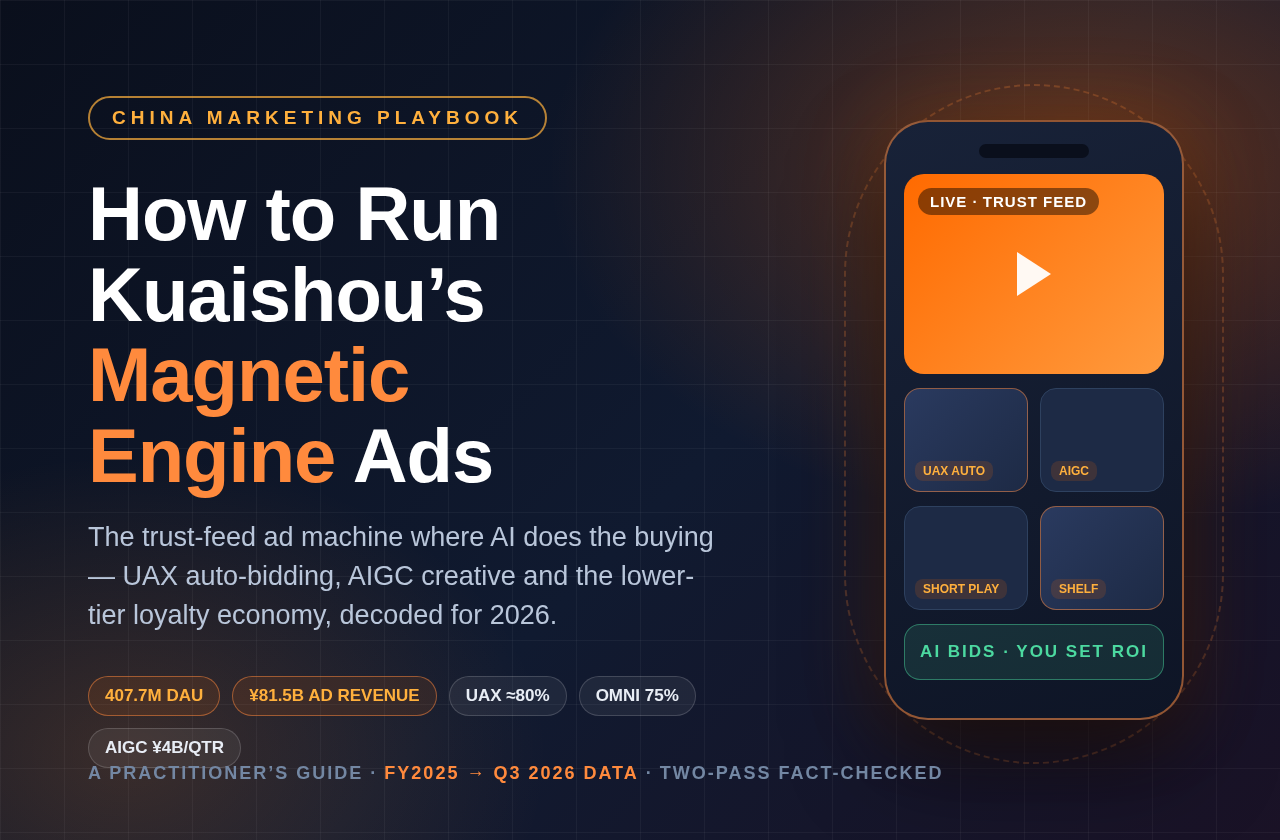
Everyone talks about Douyin. Meanwhile, a platform with more than 400 million daily users quietly rebuilt its entire advertising system around one idea: let the AI do the buying, and let creator trust do the selling. That platform is Kuaishou, and its ad machine — Magnetic Engine, known in China as Cili Yinqi — is probably the most misunderstood performance channel in Chinese digital marketing.
Here’s the thing. If you walk into Kuaishou ads expecting a manual bidding console like the one you mastered on Meta or Google, you’ll spend three months fighting the system. The advertisers who win here do something almost counterintuitive: they set a target, feed the machine creative, and get out of the way. This guide walks you through how that actually works — the two-loop architecture, the auto-bidding products, the AI models underneath, and the trust economy that makes the whole thing convert. And because we’re writing this in late 2026, we’ll also be honest about the quarter where the macro environment bit back.
Every number below comes from Kuaishou’s official earnings releases, its published technical research, or clearly labeled industry estimates. No folklore.
Why Kuaishou Is a Trust Feed, Not Just Another Feed
Kuaishou’s community runs on what users call laotie culture — roughly, buddy culture. Creators talk to their audiences like neighbors, not broadcasters. Fans follow people for years, message them, buy from them repeatedly. The platform leans into this: its official releases highlight rural content initiatives, mutual-follower messaging penetration, and repeat-purchase frequency as core operating metrics, not vanity stats.
Compare that with the algorithm-spike model most Western marketers assume all Chinese short-video platforms share. On a pure interest feed, tomorrow’s traffic belongs to whoever wins tomorrow’s auction. On a trust feed, a meaningful share of traffic belongs to relationships that already exist. That single difference explains Kuaishou’s e-commerce repeat-purchase strength, its historically lower ad monetization — and why its automation strategy looks the way it does.
The Numbers That Actually Matter
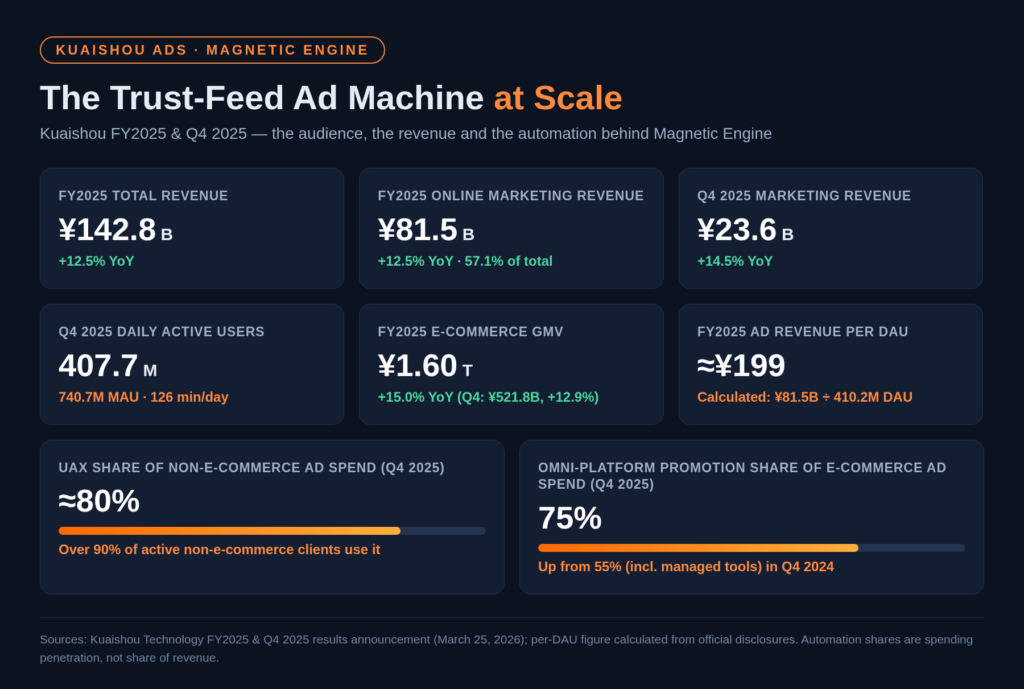
Let’s ground this. In fiscal 2025, Kuaishou posted total revenue of RMB 142.8 billion, up 12.5% year over year, with adjusted net profit of RMB 20.6 billion, up 16.5%. Online marketing services — the ad business Magnetic Engine runs — brought in RMB 81.5 billion, up 12.5%, contributing 57.1% of total revenue. In Q4 2025 alone, ad revenue hit RMB 23.6 billion, up 14.5%.
The audience behind those numbers: 407.7 million daily active users and 740.7 million monthly actives in Q4 2025, each spending an average of 126 minutes per day on the app. Full-year e-commerce GMV reached roughly RMB 1.6 trillion, up 15%. Do a quick division — RMB 81.5 billion in ads across 410 million average DAU — and you get about RMB 199 of annual ad revenue per daily user. Hold that number in your head; it explains both the opportunity and the ceiling.
Two Loops: The Distinction That Organizes Everything
Before touching any product, understand the split that governs Kuaishou’s entire ad system.
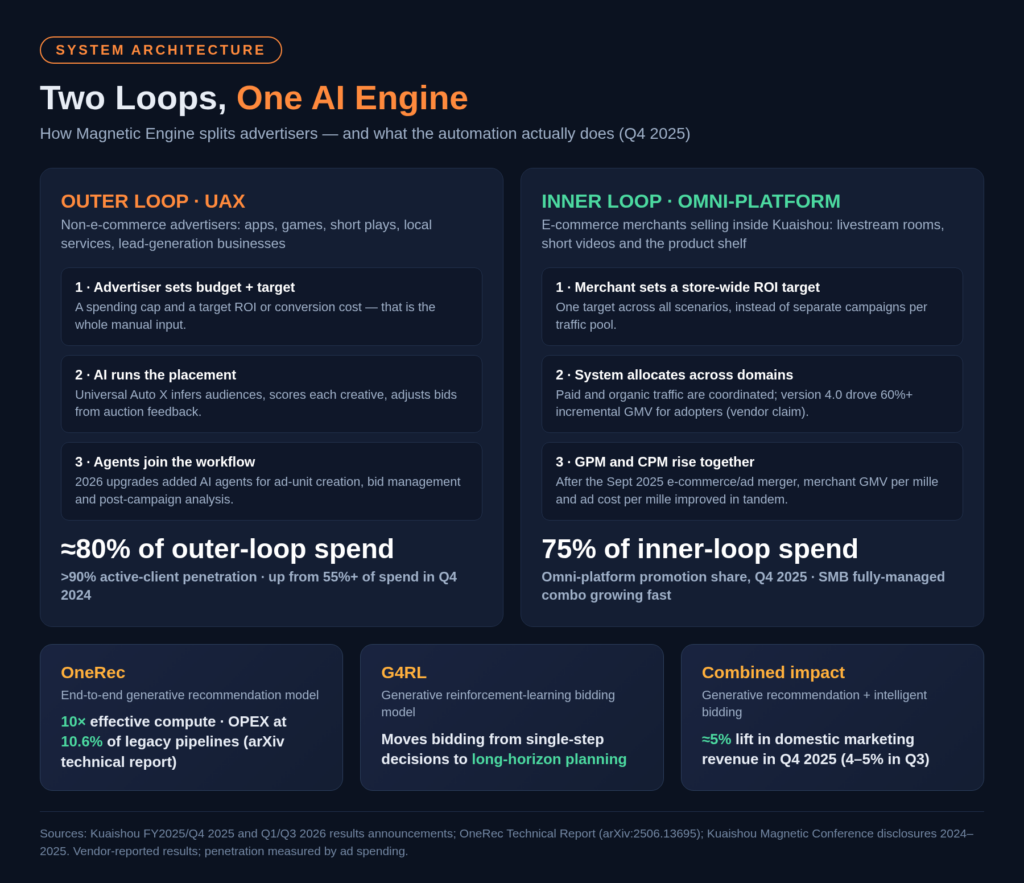
The inner loop is e-commerce merchants selling inside Kuaishou — livestream rooms, short-video storefronts, the product shelf. Their ads drive GMV that settles on the platform. The outer loop is everyone else: app developers, game studios, short-play producers, local service businesses, lead-generation advertisers. Their conversions happen off-platform or in a mini-program.
Same auction infrastructure, different products, different targets, different economics. Kuaishou even merged its e-commerce and related ad teams in September 2025 to fuse the two traffic pools. If you remember one structural fact from this article, make it this one: your loop determines your product, and your product is almost certainly automated.
UAX: The Outer Loop Where AI Does the Buying
Universal Auto X — UAX — launched in early 2024 and ate the outer loop in under two years. By Q4 2024 it already carried more than 55% of outer-loop ad spending. By Q4 2025, that figure approached 80%, with over 90% of active non-e-commerce clients using it. In content-consumption verticals like short plays and web novels, penetration reached 96% as early as 2024.
The mechanics are radically simple. You set a budget and a target — ROI or conversion cost. UAX infers the likely audience, scores every creative you upload for its ability to spend efficiently, and adjusts bids based on live auction feedback. Kuaishou reported a 25% improvement in cold-start success rates for adopters. In 2026, the company added AI-agent features that handle ad-unit creation and bid management, and by Q3 2026 UAX had been rebuilt as a multi-agent collaboration framework.
Read that trajectory again. Manual campaign management on Kuaishou’s outer loop isn’t dying; it’s already a minority behavior. Your leverage moved upstream — to targets and creative.
Omni-Platform Promotion: The Inner Loop’s Store-Wide Autopilot
E-commerce merchants get their own autopilot: omni-platform promotion, known in Chinese as quanzhan tuiguang. Instead of running separate campaigns for livestream traffic, short-video traffic and shelf traffic, the merchant sets one store-wide ROI target. The system allocates spend across every scenario — and, crucially, coordinates paid traffic with organic distribution. Kuaishou claimed at its 2025 Magnetic Conference that version 4.0 drove more than 60% incremental GMV for adopting merchants; treat that as a vendor-reported figure, but the adoption curve backs the direction. By Q4 2025, omni-platform promotion accounted for 75% of all e-commerce ad spending.
The subtle part is the alignment mechanism. After the September 2025 reorganization, Kuaishou reported that merchant GPM (GMV per thousand impressions) and ad CPM (cost per thousand impressions) rose in tandem. Translation: the platform tuned its allocation so that when merchants sell more per impression, the platform earns more per impression too. Your growth and its growth point the same way. For small merchants, a fully managed combo product removes even the target-setting complexity — and its adoption grew significantly through late 2025.
The Models Under the Hood: OneRec and G4RL
Why should you trust the black box? Because the box has published its homework.
OneRec, Kuaishou’s end-to-end generative recommendation model, replaced the traditional cascade of retrieval and ranking stages with a single generative architecture. Its technical report on arXiv documents a 10× increase in effective computation and operating expenses at just 10.6% of the legacy pipeline — the kind of cost collapse that lets a platform afford far deeper user modeling. G4RL, the generative reinforcement-learning bidding model, moved ad bidding from single-step decisions to long-horizon planning across a campaign’s life.
Together, Kuaishou disclosed, these models lifted domestic online marketing revenue by roughly 4–5% in Q3 2025 and about 5% in Q4 2025. That’s not a lab benchmark; that’s platform-scale revenue attribution. When your UAX campaign finds a converting audience you’d never have targeted manually, this is the machinery doing it.
AIGC Creative: When Making Ads Costs Almost Nothing
The third pillar is creative supply. Kuaishou’s AIGC toolchain — Magnetic Creator for video ad generation (powered by Kling AI), Nüwa digital-human livestream hosts, and digital employees handling around-the-clock customer replies — collapsed the cost of producing marketing materials. The company claimed a 62% reduction in customer-acquisition costs for advertisers using AIGC short-video materials back in 2024.
The spending data shows what happened next. Ad spending driven by AIGC marketing materials exceeded RMB 3 billion in Q3 2025 and reached roughly RMB 4 billion in Q4 2025. By March 2026, AIGC materials accounted for 10% of all short-video ad spending on the platform. Note the mechanism: AI creative didn’t just cut costs — it unlocked budgets from small advertisers who previously couldn’t afford to produce materials at all.
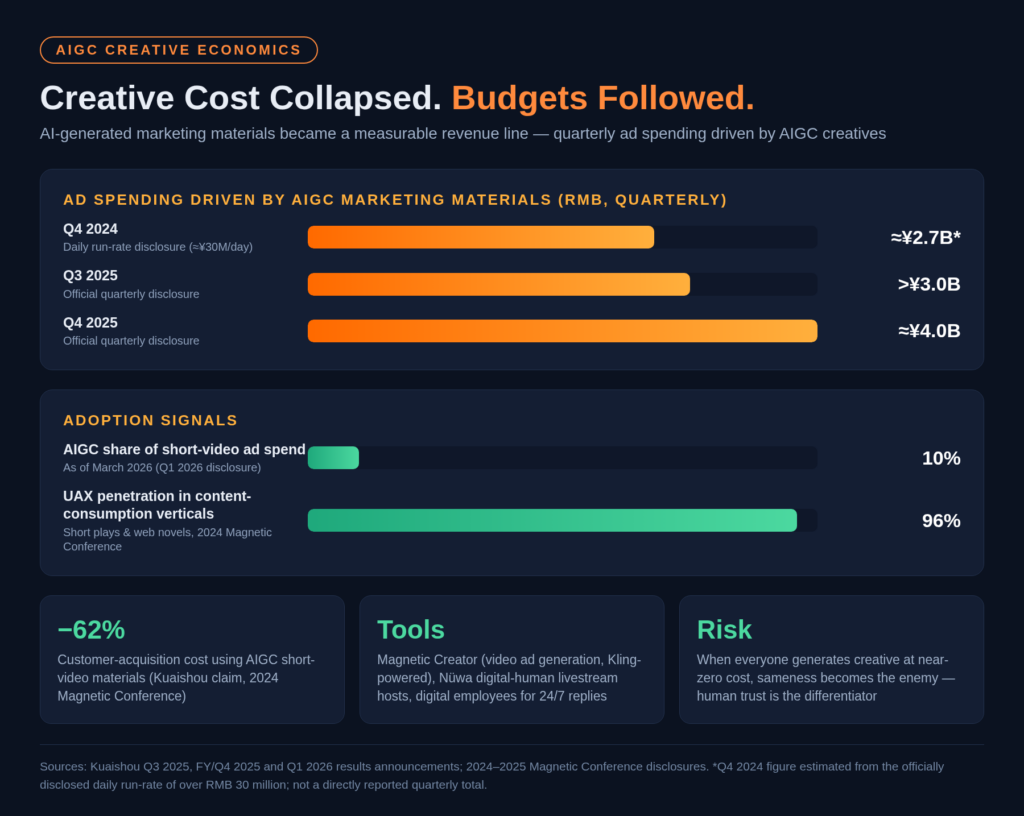
But here’s the trap. When every advertiser generates a thousand video variants for pocket change, the feed fills with sameness. The machine can optimize distribution; it cannot manufacture the one thing laotie culture rewards — a human being worth trusting. The winning pattern we see: AI creative for scale and testing, human creators for the trust layer.
The Lower-Tier Trust Advantage
Kuaishou’s audience skews toward lower-tier cities and rural China — a positioning the company itself reinforces through rural content programs and agricultural commerce initiatives. Precise city-tier splits versus Douyin aren’t officially disclosed, so we won’t quote the unverifiable percentages floating around. What is verifiable: repeat-purchase frequency of active e-commerce users kept rising through 2025, and the platform’s strongest categories remain value goods, agricultural products, local services and white-label merchandise.
For practitioners, the implication is strategic, not demographic. Relationship-based selling — a host who demonstrates the product, answers questions, and remembers return customers — converts here in ways that polished brand films don’t. If your product wins on demonstrated value and repeat trust, Kuaishou fits. If it wins on aspiration and premium signaling, budget elsewhere first.
The Playbook: Five Moves That Actually Work
One: pick your lane. E-commerce merchant? Omni-platform promotion is your default. Non-e-commerce advertiser? UAX. Don’t build a manual campaign structure out of habit — you’ll be optimizing against your own automation.
Two: set targets like an economist, not a gambler. Your ROI target is the steering wheel. Set it too aggressively and the system starves your delivery; too loose and you buy junk conversions. Start from your real unit economics, then adjust in measured steps and give the model days, not hours, to respond.
Three: feed the machine a creative portfolio. Upload volume and variety — AI-generated variants for coverage, creator-shot material for trust. UAX scores each asset’s spending ability, so your job is to keep the candidate pool fresh. Refresh before fatigue, not after.
Four: buy trust, not just clicks. Creator collaborations and livestream commerce are native here. A mid-tier host with a loyal laotie following often outperforms a bigger name with a colder audience. In Q1 2026, brand ad spending on the platform grew 42% year over year and active transacting advertisers grew 38% — the trust feed is no longer just for white-label sellers.
Five: measure what settles. Inner-loop merchants: watch GPM alongside ROI, and use the net-transaction ROI product, which optimizes for GMV after returns rather than raw orders — its penetration climbed from 28% in Q2 2026 to 34.7% in Q3. Outer-loop advertisers: measure deep conversion events, not installs. The automation optimizes for exactly what you tell it to value, so tell it the truth.
The Honest Caveats
No playbook is complete without the risks. First, the monetization gap: industry analyst estimates — not official figures — put Kuaishou’s e-commerce take rate at roughly half of Douyin’s. That’s upside for the platform someday, but today it reflects an ecosystem where top creators own their audiences and historically bought less traffic. Second, automation opacity: UAX is a black box, and when performance dips, your diagnostic levers are targets, creative and offer — not bid tables. Third, the value ceiling: lower average selling prices mean premium brands fight harder for margin here. Fourth, AIGC homogenization, covered above. And fifth, the newest one — macro pressure, which deserves its own section.
The 2026 Reality Check: The Quarter the Macro Bit Back
On November 19, 2026, Kuaishou reported Q3 results that sobered everyone up. Total revenue fell 11.1% year over year to RMB 31.6 billion. Online marketing revenue fell 11.1% to RMB 17.9 billion as e-commerce ad budgets softened. Adjusted net profit dropped 84.2% to RMB 0.79 billion, squeezed by an AI investment bill that includes roughly RMB 26 billion of guided 2026 capex — about RMB 11 billion more than 2025 — and R&D spending up 41.9% in the quarter. Management warned of continued pressure into Q4.
And yet. Daily active users hit an all-time record of 417 million, with MAU at 819 million. Content-consumption ad spending — short plays, comic-style plays, mini-games — more than doubled year over year, with daily active short plays up over 350% versus January 2026. The audience grew while the revenue dipped.
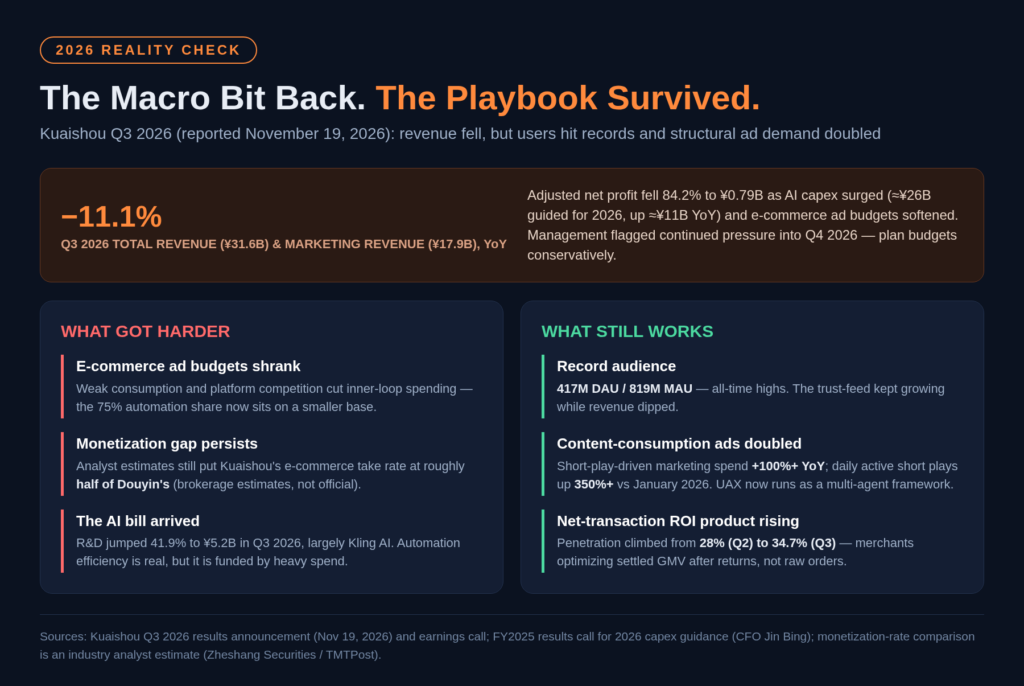
For advertisers, this changes tactics, not the thesis. E-commerce merchants should expect a more competitive, promotion-heavy inner loop and lean harder on net-transaction ROI. Outer-loop advertisers in content consumption are riding the platform’s strongest structural demand — and the platform is hungrier than ever for your budget, which is leverage if you negotiate agency terms and rebates accordingly.
What’s Next: Kling, Short Plays and the Shelf
Three forward signals worth watching. Kling AI, the video-generation model behind much of the creative toolchain, earned about RMB 1.04 billion in 2025, with monthly revenue exceeding USD 20 million in December and an annualized run rate above USD 300 million by January 2026; Kling 4.0 shipped in October 2026 and is already used in advertising and short-play production. Expect ad creative quality — and the sameness problem — to intensify together. Second, short plays have become the outer loop’s growth engine; if your product can be dramatized in ninety seconds, this is your moment. Third, the pan-shelf e-commerce push means Kuaishou is quietly becoming a search-and-browse marketplace, not just a livestream bazaar — shelf-scenario ad revenue grew rapidly through late 2025, and that’s where trust-built brands will compound.
The Takeaway
Magnetic Engine is AI-automated trust-feed advertising. The manual bidding era is over — roughly 80% of outer-loop spend and 75% of inner-loop spend already run on autopilot. What remains human is exactly what matters: the targets you set, the creative you feed, and the trust you borrow from creators. Kuaishou’s 2026 turbulence doesn’t break that logic; it sharpens it. Set the economics straight, let the models buy, and put your effort where the machine can’t reach — the relationship. That’s the playbook.