You have seen the ad, even if you have never watched a Chinese micro-drama. A woman is slapped at a family banquet; the camera whips to the husband everyone assumed was a delivery driver — and the clip freezes one second before his bodyguards arrive. Tap to unlock episode twelve. That frozen second is not storytelling. It is a conversion event, engineered, tested, and bought at auction.
Here is the thing most coverage misses: China’s short-drama industry looks like a content business, but it runs like a performance-marketing operation with a film crew attached. The drama is the raw material. The product is a tested matrix of ad creatives. And the profit-and-loss statement belongs to media buying, not to filmmaking. Once you see that, everything else — the seven-day shoots, the ten-thousand-variant creative libraries, the AI cost collapse — stops looking crazy and starts looking inevitable.
A Market That Swallowed the Box Office
Let’s size the thing before we open it up. China’s micro-drama market reached RMB 50.44 billion in 2024, surpassing the national film box office of RMB 42.5 billion for the first time, according to the China Netcasting Services Association’s industry white paper. By February 2026, the National Radio and Television Administration told a State Council briefing that the 2025 market had crossed RMB 100 billion — roughly double the prior year on a broader definition that includes animated micro-dramas. Keep that definitional wrinkle in mind: research firm iiMedia, counting live-action titles only, puts 2025 at RMB 67.8 billion. Same industry, different boundaries — always check which one a headline is quoting.
Attention has moved even faster than money. The China Network Audiovisual Development Research Report (2026), released in April with research support from CNNIC, found that micro-drama users averaged 129 minutes per day in December 2025 — more than long-form video. Nearly 700 million people in China now watch these vertical, one-to-two-minute episodes.
Overseas, the association’s white paper counted US$1.525 billion in revenue for January–August 2025, up 194.9% year over year, with 730 million app downloads. Chinese-backed apps made up 90% of the top twenty by revenue and contributed 91% of the money. This is not a niche export. It is a pipeline.
Seven Days Prep, Seven Days Shoot, Seven Days Buy
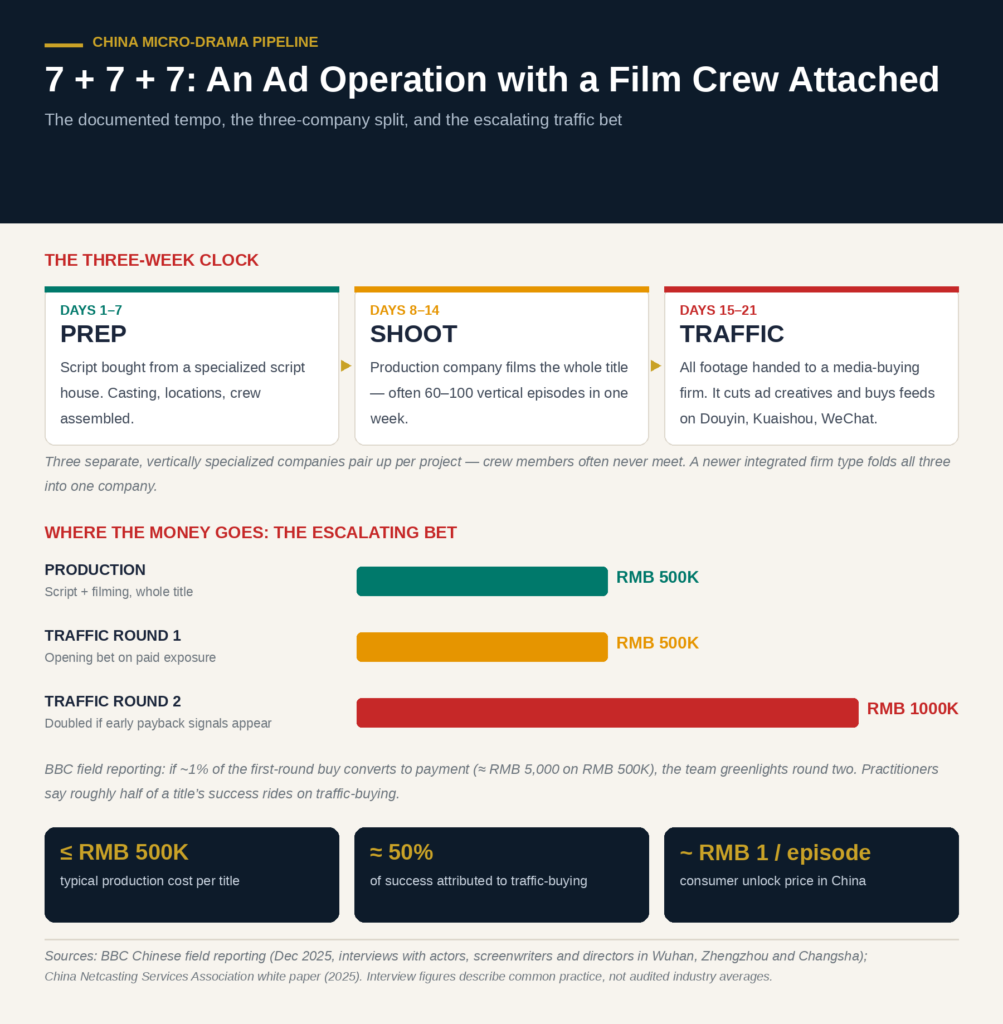
In December 2025, BBC Chinese published field reporting built on interviews with actors, screenwriters, directors, and crew across Wuhan, Zhengzhou, and Changsha. The tempo they documented has a name: “7+7+7.” Seven days of prep. Seven days of shooting. Seven days of traffic-buying — what the industry calls tou liu, the paid distribution phase.
Three Companies That Barely Know Each Other
Traditional film and TV fuse script, production, and distribution into one messy organism that argues for years. The short-drama pipeline does the opposite: it splits those functions into three vertically specialized company types — script houses, production companies, and traffic-buying firms — that pair up per project, more or less at random. BBC’s subjects described crews so siloed that people in adjacent stages of the same title often never meet. The screenwriter sells the script and walks away; the production team cannot rewrite it; the buying team receives all footage and decides what the market sees. A newer “integrated” firm type folds all three under one roof, but practitioners say it operates much like the loose alliances it replaced.
The RMB 500K Opening Bet
Now follow the money, because this is where the film-industry framing dies. Through script and production, a typical title costs no more than RMB 500,000, per BBC’s reporting. But for the traffic team, RMB 500,000 is merely the opening bet: buy half a million yuan of exposure, and if roughly 1% converts to payment — about RMB 5,000 back — that signal greenlights round two at RMB 1 million. Double the money, buy double the audience, bet that payers keep arriving. Nearly every practitioner BBC interviewed said the same thing: whether a drama sells is about half down to traffic-buying. One director’s summary was brutally clean — win the bet and you profit; lose it and you lose everything.
The Paywall Is the Conversion Event
Why would a studio hand its entire film to an ad-buying firm? Because the business model is not ticket sales. The first episodes are free; payment unlocks the rest — around RMB 1 per episode in China, with weekly subscriptions overseas commonly priced around US$9.9, per Securities Times’ November 2026 reporting. The viewer’s journey is a funnel: scroll, stop, watch, hit the cut-point, pay.
That means the ad creative has one job — deliver the viewer to the paywall at maximum emotional tension. Not to summarize the plot. Not to showcase the cinematography. To stop a thumb and drag a stranger to the exact second where not-knowing becomes unbearable. Everything about the creative line follows from that single conversion goal.
The Creative Unit Is Hook × Audience × Paywall Point
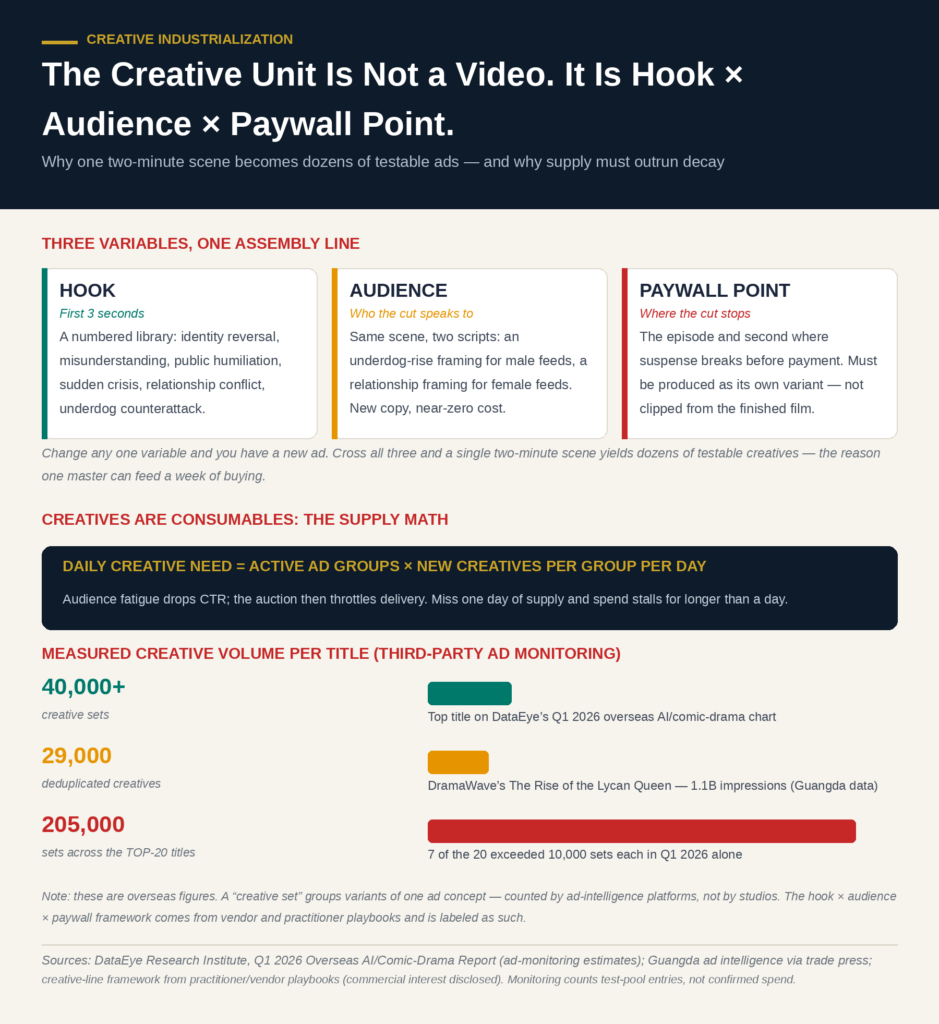
Here is the framework the buying teams actually use, as described in practitioner and vendor playbooks (these are commercial sources with a selling interest, so treat the framework as industry practice, not academic theory): a creative is not “a video.” It is a combination of three variables — the opening hook, the target audience, and the paywall cut-point. Change any one and you have a new asset to test.
Hooks Are a Numbered Library
The hooks are catalogued like spare parts: identity reversal, misunderstanding opening, public humiliation, sudden crisis, intimate-relationship conflict, underdog counterattack. Each hook spawns variants. The audience variable rewrites the same scene’s framing — an underdog-rise narrative for male-targeted feeds, a relationship narrative for female-targeted ones — at nearly zero marginal cost. And the cut-point must be produced as its own variant, not clipped from the finished master, because the episode and the second where suspense breaks are themselves testable variables. Cross all three and a single two-minute scene yields dozens of deployable ads. This is why one master can feed a week of buying.
Creatives Are Consumables, Not Works
Ad creatives decay. The same hook shown to the same audience loses click-through rate; the auction algorithm reads the decline and throttles delivery; the asset dies. Practitioner accounts describe effective windows measured in days, not weeks. So supply must outrun decay, and the planning formula is arithmetic, not inspiration: daily creative need equals active ad groups times new creatives per group per day. Miss a day of supply and spend stalls for longer than a day. Teams that treat creatives as a one-time batch delivery — fifty cuts before launch, done — are structurally guaranteed to stall.
What the Monitoring Data Actually Shows
Does the industrial scale hold up outside practitioner lore? Third-party ad intelligence says yes. In DataEye’s Q1 2026 overseas AI-drama and comic-drama chart, the top twenty titles together deployed 205,000 creative sets; seven exceeded 10,000 sets each, and the leader topped 40,000 — in one quarter. One Greek-mythology AI title, One Move God Mode, ran nearly 20,000 sets in Q1 alone. Guangda’s monitoring of DramaWave’s The Rise of the Lycan Queen counted 29,000 deduplicated creatives generating 1.1 billion impressions. A caveat worth stating plainly: “sets” group variants of one concept, and monitoring confirms an ad entered the test pool — not that it won spend. But the order of magnitude is unambiguous. This is a factory, not an editing suite.
AI Collapsed the Cost Floor — and Raised the Stakes
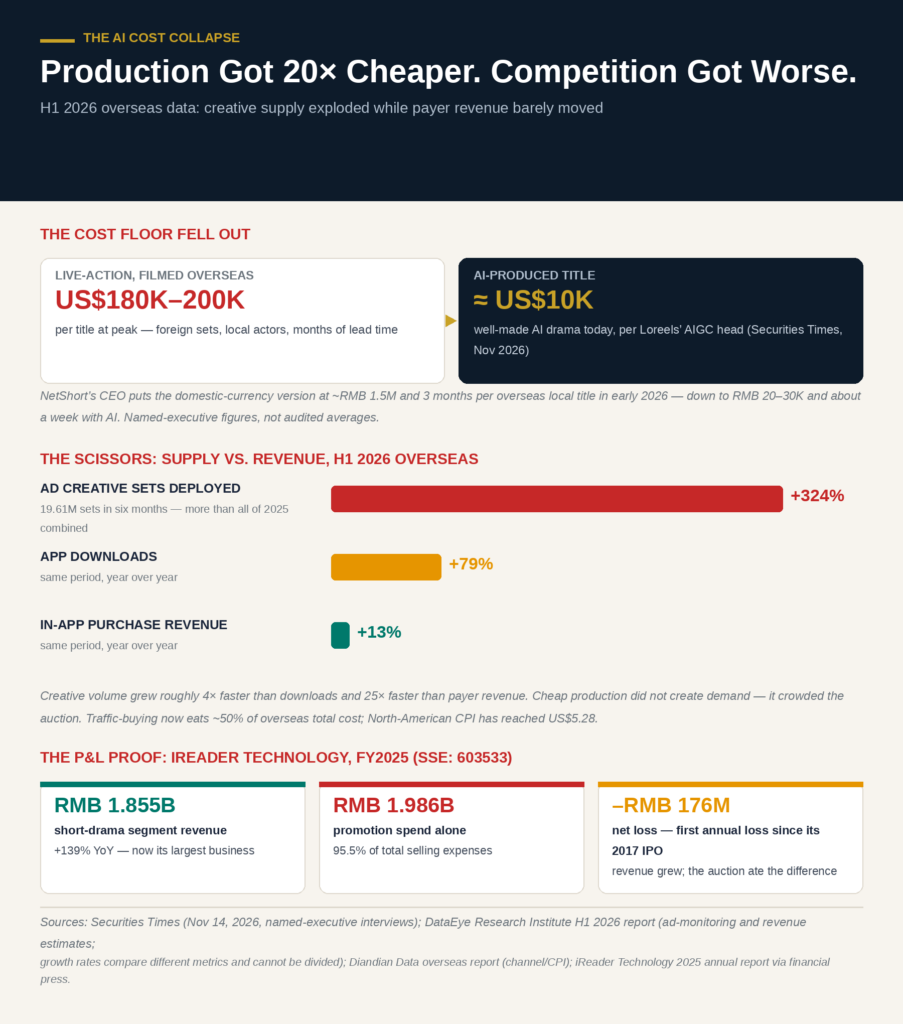
Then generative video arrived, and the ground moved. Securities Times’ November 2026 report, built on named-executive interviews, documents the collapse: Loreels’ AIGC head Li Mu says overseas live-action titles once cost US$180,000–200,000 each — foreign sets, local actors, scarce crews — while a well-made AI drama now runs about US$10,000. Roughly twenty times cheaper. NetShort CEO Wang Li gives the renminbi version: an overseas local title cost about RMB 1.5 million and three months in early 2026; with AI, some titles drop to RMB 20,000–30,000 and about a week.
The Scissors: +324% Against +13%
Cheap production did not make everyone rich. It made everyone faster. DataEye’s monitoring shows overseas creative volume hit 19.61 million sets in H1 2026, up 324% year over year — more than all of 2025 combined — while app downloads grew 79% and in-app purchase revenue grew just 13%. Three different metrics, so don’t divide them naively; but the direction is one story. Supply exploded; paying demand did not. Attention is the fixed resource, and when a thousand new entrants bid for the same feeds, the auction price rises. Media buying already consumes about half of total overseas cost, with Meta-family channels taking roughly 65% of spend, Google 20%, and TikTok 10%, per Diandian Data’s overseas report. North American cost-per-install has reached US$5.28. The savings from AI production flowed straight into the auction.
The P&L Proof
Want audited evidence instead of monitoring estimates? Read iReader Technology’s 2025 annual report. The Shanghai-listed company’s short-drama segment revenue grew 139% to RMB 1.855 billion, becoming its largest business. Promotion spend alone reached about RMB 1.986 billion — 95.5% of total selling expenses. The result: a net loss of RMB 176 million, its first annual loss since its 2017 IPO. Revenue up 139%, and the company lost money. That is a media-buying P&L, wearing a content company’s clothes.
What Everyone Gets Wrong
Three errors recur in outside coverage. First, the film-industry framing: analysts benchmark production budgets when the budget center is traffic. Second, the one-trailer assumption: teams plan a handful of promos per title when the operating reality is tens of thousands of variants, and the durable asset is the structure library — hooks, audience frames, cut-points — not any single video. Third, the AI-will-make-everyone-rich error: the +324%-against-+13% scissors shows cost collapse intensifies competition rather than resolving it. One producer told Securities Times that rivals spending RMB 10,000–30,000 per title ship hundreds of titles a month while his RMB 150,000–200,000 “premium” studio ships dozens — and loses the probability game. Cheap beats good at the auction, until good learns to be cheap.
The Counterargument, and Its Limits
Fair pushback exists. BBC’s interview subjects were largely pseudonymous, and no single quote can be independently audited — true. But the structural facts (the 7+7+7 tempo, the three-layer split, the escalating bet) are corroborated by named-executive accounts in the financial press and by ad-monitoring data. Second objection: this is a fad that regulation will normalize. Also true, and already happening — yet normalization changes content standards, not pipeline mechanics. Creative industrialization and the media-buying P&L survive any content crackdown; they are properties of the auction, not of the melodrama. Third: AI will remove humans entirely. The practitioners themselves disagree — tools take the standardizable steps, while humans keep the judgment calls: which story is worth a traffic bet, which hook deserves a variant budget. AIGC lowered the execution barrier, not the taste barrier.
The Regulator Joins the Pipeline
On September 1, 2026, China’s first ministerial-level rule dedicated to micro-dramas took effect: the NRTA’s Micro-Drama Development Administration Measures (Order No. 16, published July 30). It sorts titles into three tiers by investment and subject matter, with filing and distribution permits scaled accordingly, draws eleven content red lines, and requires AI-generated dramas to carry a visible label on every episode. The scale it governs is staggering: industry-association guidance cited by Legal Daily counted 367,000 titles launched in H1 2026 — over 1,500 new AI titles per day, more than 74% of supply. Read the rule as the state pricing the pipeline’s externalities, not killing it: the same document encourages exports, brand collaborations, and “micro-drama plus” integrations with tourism and commerce. The bet continues; the house now has rules.
What Brands Should Steal
You do not need to produce melodrama to use this machine. Four transfers work for any performance-marketing team.
Budget the creative line separately. Plan supply against decay, not against launch day. Ask any creative supplier for daily delivery capacity by asset type — and their delivery log from last week, by day. If they quote per-video prices before you have defined daily volume, you are shopping for lottery tickets.
Build a hook library, not a video library. Number your hooks. Tag audience frames and cut-points. Feed performance data back into the library so winning hooks earn variants. The library compounds; individual videos evaporate.
Treat the AI cost collapse as competitive intensification. When everyone’s production cost falls twenty-fold, volume alone stops differentiating. The scarce inputs move upstream to insight — which story deserves a bet — and downstream to iteration speed. Budget for judgment, not just generation.
Localize social relations, not subtitles. Chinese hooks fire on specific relationships: in-law hierarchy, clan face, workplace rank. Export the clip with translated subtitles and the hook dies, because the viewer does not feel the stakes. Rewrite the address system, rebuild the conflict motive, adapt intimacy, violence, and religious sensitivities per market. TikTok for Business’s own July 2026 conference data underscores the segmentation: live-action and AI dramas convert audiences that overlap by only about 10%, and AI content already accounts for roughly 40% of short-drama watch time on the platform. Different content forms reach different humans. So do different cultures.
The Takeaway
Strip away the melodrama and you are left with a clean machine: seven days to prep, seven to shoot, seven to buy; production capped near RMB 500K while the traffic bet starts at the same number and doubles on signal; creatives manufactured as hook × audience × paywall combinations by the tens of thousands; AI cutting production cost twenty-fold while creative-supply growth leaves payer-revenue growth in the dust. The drama was never the product. The tested creative matrix is the product, the auction is the marketplace, and the winners are the teams that treat inspiration as inventory. If your brand still plans one hero video per campaign, you are bringing a screenplay to a supply-chain war.