Here is the budget meeting nobody wants to have: the market grew, your budget didn’t, and the AI line item everyone demands has no precedent to size it against. China’s internet advertising and marketing market reached roughly 1.61 trillion yuan in 2025, up 12.62%. Meanwhile, CTR’s advertiser survey found 66% of advertisers watching their marketing cost-to-sales ratio stay flat or rise over three years, and Gartner puts global marketing budgets at a plateaued 7.8% of revenue. Growth in the market is not growth in your efficiency. Zero-based budgeting (ZBB) is the discipline that closes that gap: every spend re-applies for its job as a decision package, graded by evidence, with a kill criterion named before the money moves. This playbook gives you the full operating system — the evidence tiers, the decision-package template, a four-bucket method for sizing the AI line, and a 30-day sprint to land it — plus the portfolio rules and political moves that keep it honest quarter after quarter.
1. The squeeze is structural, not seasonal
Start with the numbers, because they explain why “last year plus ten percent” has quietly stopped working.
The market itself is healthy. The China Internet Marketing Development Report 2026 — a joint blue book from the Zhongguancun Interactive Marketing Lab, the Miaozhen Marketing Science Institute and Beijing Normal University’s journalism school, released in September 2026 — puts 2025 internet advertising at about 725.7 billion yuan (+11.50%) and internet marketing services at about 881.8 billion yuan (+13.56%), for a combined market of roughly 1,607.5 billion yuan, up 12.62%.
Your side of the table looks different. Miaozhen’s own 2026 China Digital Marketing Trends Report — built on a survey of 198 advertisers across 20-plus industries plus interviews with 17 marketing scientists — found advertisers expecting their 2026 marketing spend to grow 10%, up from 8% actual growth in 2025, with positive investment confidence recovering to 30%. Recovery, not abundance. And the same survey’s pain-point ranking reads like a confession: measurement difficulty (52%), ROI improvement difficulty (48%), media fragmentation (45%). “Not knowing how to apply AI” climbed from the 14th-ranked challenge in 2024 to 7th in 2026, cited by 25%.
The global picture rhymes. Gartner’s 2026 CMO Spend Survey — 401 marketing leaders across North America, the UK and Europe, mostly at companies above one billion dollars in revenue — shows budgets at 7.8% of company revenue, barely above 2025’s 7.7%, with 56% of CMOs saying the budget cannot deliver their strategy. AI now absorbs 15.3% of the average marketing budget, yet only 30% of organizations report mature AI readiness.
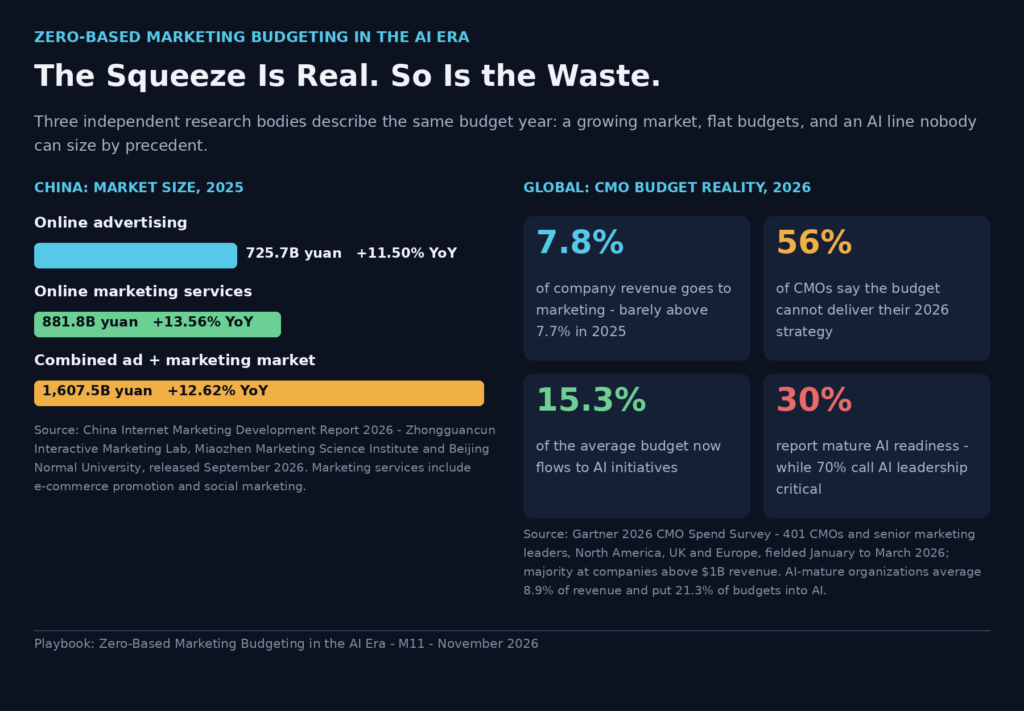
A growing market, a flat budget, and a new cost line with no history. That is not a bad quarter. That is a regime — and regimes need methods, not adjustments.
2. Zombie lines: how waste gets tenure
Incremental budgeting has one fatal defaults setting: last year survives unless someone proves it shouldn’t. The burden of proof sits on the cutter, not the keeper. Three zombie species thrive under that rule.
The retargeting pool that keeps “performing” on platform-reported ROAS — a number that counts conversions your ads merely intercepted, not caused. The brand line that gets zeroed in the spreadsheet because last-click attribution can’t see it working. And the mirror image: the AI experiment that never gets funded because no precedent exists to justify it. Notice the symmetry — inertia protects what should die and starves what should live.
CTR’s September 2026 trends release gave this state a name borrowed from evolutionary biology: the Red Queen race. Everyone runs faster; nobody moves ahead. Over the past three years, 66% of surveyed advertisers saw their marketing cost-to-sales ratio stay flat or climb. The market grew 7% in 2026 — its fastest pace in five years — while two-thirds of advertisers ran just to stay in place. When the tide rises and your efficiency doesn’t, the problem isn’t the tide. It’s the hull.
3. The zero-based inversion
Zero-based budgeting flips the default. Each cycle starts from zero, and every line must justify itself against a current objective — not against its own history.
The method is older than most martech stacks. Peter Pyhrr introduced it in Harvard Business Review in 1970, built around decision packages: each activity described with its cost, purpose, alternatives, performance measures, and the consequences of not doing it — then ranked and funded in priority order. McKinsey’s modern formulation, from its zero-based productivity work on marketing, states the inversion cleanly: the burden of proof shifts from finance justifying cuts to the business justifying spend by proving the return that spend will achieve.
The prize is documented. McKinsey’s zero-based marketing research finds savings worth 10 to 25 percent of spending in certain categories, with often more than half of those savings captured in the first 12 months — and businesses that methodically reinvest the unlocked funds into growth outperform the market. Read that as a budget strategy, not a cost strategy: ZBB is how a flat budget funds new things.
One caution before we build: the framework pieces in this playbook — the evidence tiers, the sprint calendar, the portfolio caps — are designed recommendations, labeled as such. The market data is measured; the operating system is engineered. Don’t confuse the two, and don’t let anyone sell you the second as the first.
4. Fund decisions, not departments
The unit of a zero-based budget is not the team, the channel, or the vendor. It is the decision.
A decision package answers one question — “should we fund X to achieve Y, given evidence Z?” — and carries everything needed to answer it. Departments blur accountability; decisions concentrate it. When a retargeting spend, a brand campaign and an AI pilot all arrive as comparable packages, ranked by the same standard, the budget meeting stops being a turf negotiation and becomes a portfolio review. McKinsey’s reinvestment research pushes the same granularity: a line reading “promotions, region X” becomes “15 campaigns at a known unit cost each,” so money can move to wherever the return is actually showing up.
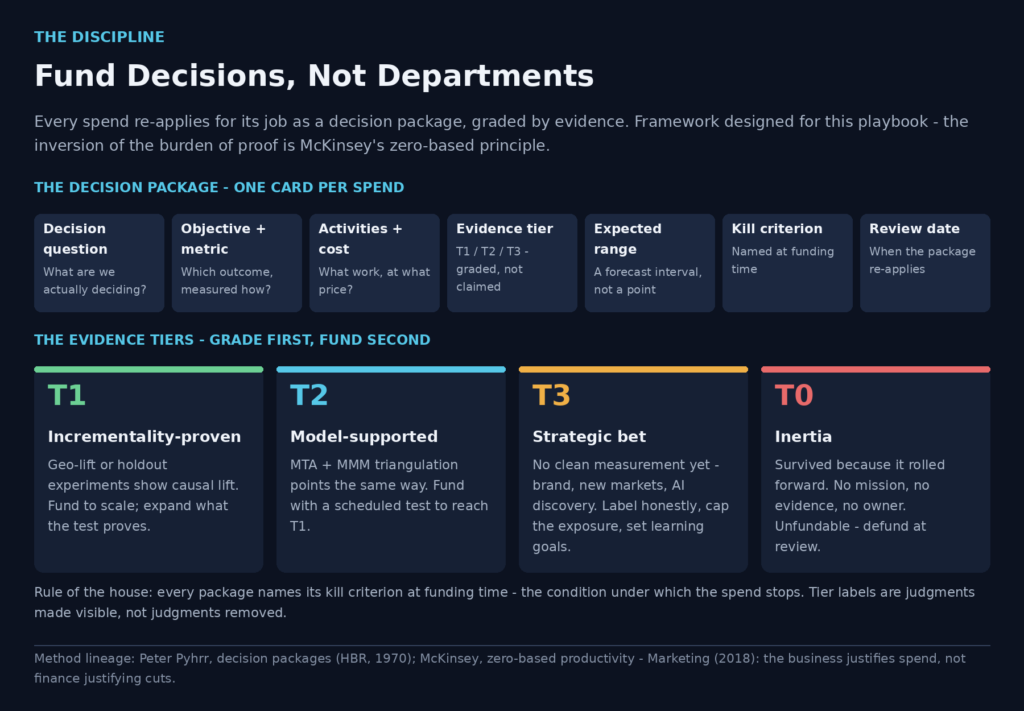
Here is the template. Seven fields, one page, no variance notes:
- Decision question — what are we actually deciding?
- Objective and target metric — which business outcome, measured how?
- Activities and cost — what work, at what price?
- Evidence tier — graded, not claimed (next section).
- Expected range — an interval, not a suspiciously precise point estimate.
- Kill criterion — the condition under which this spend stops, named at funding time.
- Review date — when the package re-applies for its job.
A worked example, illustrative only: “Q1 geo-lift test of always-on retargeting. Objective: incremental conversions at defensible CPA. Cost: one test budget plus holdout markets. Tier: T1-seeking. Expected range: stated from prior holdouts. Kill criterion: stop scaling if incremental CPA exceeds the agreed threshold. Review: end of Q1.” Notice what that package does — it funds a question, not a habit.
5. Evidence tiers: grade first, fund second
Not all evidence is equal, and pretending otherwise is how zombies get dressed up as strategy. Grade every package into one of four tiers.
T1 — incrementality-proven. A geo-lift test or holdout experiment shows causal lift. This is the gold standard: fund to scale, and expand exactly what the test proved, not what the dashboard flatters.
T2 — model-supported. Marketing mix modeling and multi-touch attribution triangulate in the same direction. Credible, but modeled. Fund it with a scheduled experiment attached — T2 packages should carry a plan to become T1.
T3 — strategic bet. No clean measurement yet: brand building, new markets, AI-answer visibility. These are legitimate. The IPA’s evidence base — Binet and Field’s analysis of roughly a thousand effectiveness cases — puts the long-run optimum around 60:40 brand to activation, which means brand spend isn’t an evidence failure; it’s an evidence category with a longer clock. Label T3 honestly, cap the exposure, and set learning goals instead of pretending to a CPA.
T0 — inertia. No mission, no evidence, no owner. It survived because it rolled forward. Unfundable. Defund at review unless someone rebuilds it into a real package.
The tiers do not eliminate judgment. They make judgment visible — which is the entire point. A budget where every spend wears its evidence level on its chest is a budget an honest CFO can sign.
6. Sizing the AI line: the 2026-specific problem
Now the line item with no precedent. Every framework that sizes spend by history fails here, because there is no history. Worse, the adoption data is a trap.
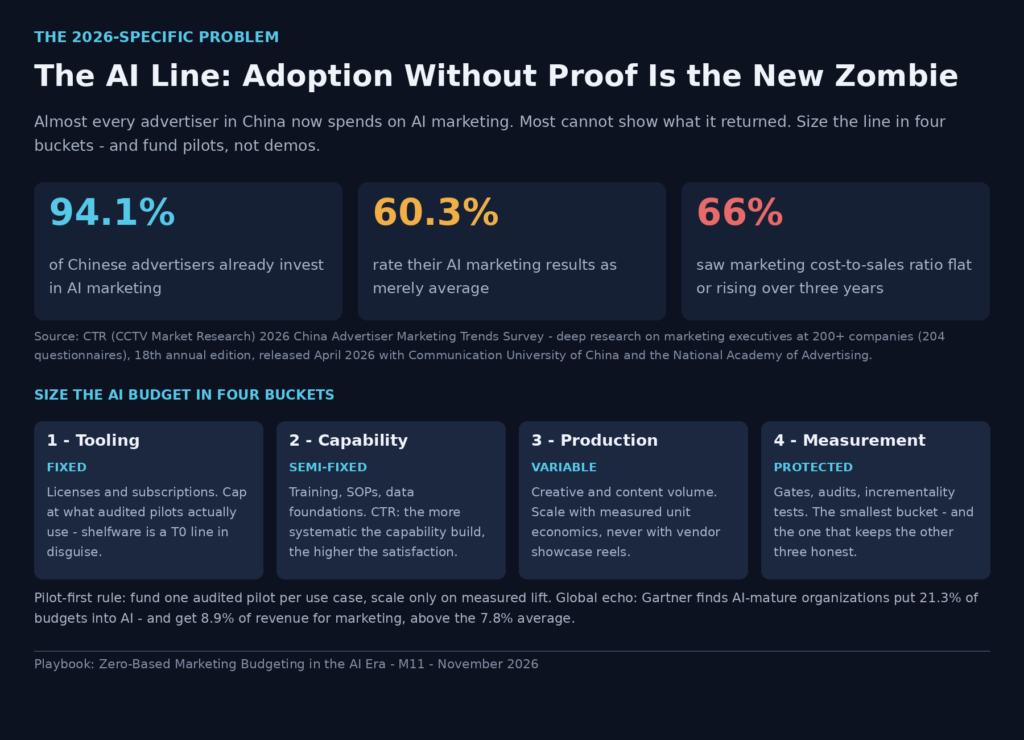
CTR’s 2026 China Advertiser Marketing Trends Survey — the 18th consecutive annual edition, co-released with the Communication University of China and the National Academy of Advertising, based on deep research covering marketing executives at more than 200 companies — found 94.1% of advertisers already investing in AI marketing. And 60.3% rate the results as merely average. Let that gap sit for a second: near-universal adoption, majority-mediocre outcomes. CTR’s own analysis points at the cause: the more systematic an advertiser’s AI capability build — data governance, knowledge bases, process redesign, not scattered tool purchases — the deeper the application runs into ROI loops, and the higher the satisfaction. Gartner’s global data echoes it from the other side: AI-mature organizations put 21.3% of budgets into AI and receive 8.9% of company revenue for marketing, above the 7.8% average. Discipline gets funded.
So size the AI line in four buckets, each with different economics:
- Tooling and licenses — fixed. Cap at what audited pilots actually use. Shelfware is a T0 line wearing an AI badge.
- Capability building — semi-fixed. Training, SOPs, data foundations. This is the bucket CTR’s satisfaction gradient vindicates, and the one incremental budgeting never funds because it has no last-click story.
- Production capacity — variable. Creative and content volume. Scale with measured unit economics, never with a vendor’s showcase reel.
- Measurement and gates — protected. Audits, holdouts, incrementality tests. The smallest bucket, and the one that keeps the other three honest.
The sizing rule is pilot-first: fund one audited pilot per use case, scale only on measured lift. A demo proves the tool works in the vendor’s environment. A pilot proves it works in yours. Only one of those deserves your production budget.
And notice the newest sub-line: 70.4% of advertisers in CTR’s survey have planned GEO budgets — generative engine optimization, the work of becoming visible inside AI answers — though only 14% treat it as a must-have and 47.9% plan pilots. That distribution is exactly what a healthy T3 tier looks like: broad, small, experimental. Fund it like one.
7. The 30-day sprint
Full ZBB rollouts can take months — McKinsey’s myth-busting work puts enterprise setup at four to eight months. You don’t need that to start. A single marketing function can run a defensible zero-based cycle in 30 days. Here is the calendar.
Days 1–7 — inventory. Convert every current spend into a draft package: media, retainers, subscriptions, sponsorships, headcount allocations, the AI tools nobody audited. The rule: nothing enters week two without an owner and a mission statement. Orphaned spend is T0 by definition.
Days 8–14 — grade. Pull the evidence: holdout results where they exist, MMM and MTA outputs, brand-tracking data, pilot readouts. Assign tiers. Where data is missing, say so in the package — an honest gap grades better than a confident guess. This week belongs to your analytics verifier, not to the channel owners.
Days 15–21 — rebuild from zero. Rank packages against objectives, apply the portfolio rules (next section), and draft the new allocation. The old grid stays shut. If a package’s numbers look suspiciously like last year’s, ask which evidence changed — if none did, you’re watching reverse-engineering, not zero-basing.
Days 22–30 — arbitrate and sign. One meeting, three roles: the marketing owner decides, the finance partner stress-tests, the analytics verifier certifies the evidence grades. Output: a signed allocation plus a kill-criteria registry — every package’s stop condition and review date in one live document. The registry is what makes this a system instead of an event.
8. Portfolio rules: caps, floors, and a reserve
Zero-based ranking has a known bias: it loves whatever is measurable this quarter. Counter it with rules set before the ranking, not after the damage. These are framework recommendations — designed guardrails, not measured constants.
Cap the bets. T3 strategic bets stay within roughly 10–15% of the total. Enough to matter, small enough to survive being wrong.
Protect the brand floor. Write a minimum brand investment into the exercise before grading begins, anchored to the long-run evidence (the IPA’s ~60:40 is a category-sensitive starting point). Otherwise the process will eat it — measurable spend always out-argues compounding spend in a single meeting.
Hold an experiment reserve. Keep 5–10% unallocated, deployable mid-cycle to whatever over-performs. Plan-time decisions shouldn’t starve month-five winners.
Re-arbitrate quarterly. Packages re-grade on new evidence every quarter; zombies auto-defund at their review date unless re-justified. The burden of proof never reverts to the cutter. Annual-only ZBB decays into annual-only theater.
9. The politics: land it without a civil war
Every channel owner hears “zero-based” as “your budget is on trial.” Correct — but that’s not the message.
The stakeholder map is predictable: performance leads defend attributable spend, brand leads fear the spreadsheet, finance wants cuts, and the AI champion wants a blank check. The antidote is not your authority; it’s the pre-agreed rules. Evidence tiers mean nobody’s judgment is being called inferior — everyone’s evidence is being called by its name. Kill criteria agreed at funding time mean a stopped program isn’t a defeat; it’s the system working as designed.
The script that lands: “We’re funding your decision, not cutting your team. Bring the package, and the best evidence wins — including evidence that says brand compounds slowly.” Then make it true in the first cycle. The fastest way to kill ZBB politically is to preach evidence and then fund the CEO’s favorite channel anyway. One exception poisons the registry.
10. Failure modes: four ways this dies
Zero-based in name only. Packages reverse-engineered from last year’s numbers. Symptom: every allocation lands within a few points of the old grid. Fix: the week-three interrogation — what evidence changed?
Gamed grading. Teams learn to dress activity as outcomes and modeled numbers as experiments. Fix: the analytics verifier owns the tier stamps, not the package authors, and T2 carries a mandatory path to T1.
Annual-only cadence. The January sprint becomes folklore by June. Fix: the quarterly re-arbitration and the live kill-criteria registry.
Killing the brand because it graded T3. The floor rule exists precisely for this. If your zero-based process defunds brand, you didn’t run ZBB — you ran last-click bias with extra paperwork. And remember the canonical corporate warning: Kraft Heinz’s zero-based austerity era ended in a $15.4 billion write-down in 2019 and, by February 2026, a new CEO publicly admitting the company had been “operating too lean,” with $600 million of reinvestment announced. Efficiency is a means. The moment it becomes the strategy, the assets it was supposed to fund start dying.
11. Honest boundaries
ZBB is expensive in attention. Justifying every line burns analyst-hours and meeting-hours, and small teams feel it most. The pragmatic pattern: full zero-based annually, lightweight re-grades quarterly, and — if you’re small — zero-base your three biggest categories rather than everything.
Evidence tiers don’t remove judgment; they relocate it. Someone still decides what counts as a strategic bet worth 12% of the budget. The discipline is that the decision is labeled, capped and dated instead of smuggled in as a forecasting assumption. And no tier system fixes broken measurement — if your analytics can’t run a holdout, your first T1 package is building the ability to run one.
Conclusion: the budget as a portfolio of current bets
The squeeze is real: a 1.61-trillion-yuan market growing 12.62% while two-thirds of advertisers run in place, global budgets stuck at 7.8% of revenue, and an AI line that 94.1% have funded and 60.3% can’t call a success. Incremental budgeting cannot answer that, because it lets the past own the future by default. Zero-based budgeting can — if you run it as an evidence discipline: decision packages instead of departmental envelopes, tiers instead of confidence, kill criteria instead of hope, and a quarterly ritual that makes the honesty repeatable. Start the 30-day sprint. The money you need for what’s next is already in your budget. It’s just working for last year.