Signal loss is permanent — but the obituary everyone wrote was wrong. Third-party cookies never died in Chrome: Google canceled the funeral in April 2025 and retired most of its Privacy Sandbox replacement APIs that October. What actually eroded your targeting precision was Safari, Apple’s ATT prompt, ad blockers, and two laws that made consent the price of admission. The teams winning from here aren’t chasing a cookie replacement. They’re building a consent-gated, server-side, first-party stack — and treating compliance as an asset, not a tax. This guide walks the whole stack: what died, what survives, the architecture, the consent design, the modeling, and the traps.
What Actually Died — and the Death That Never Happened
Let’s start with an honest inventory, because half the industry is still preparing for the wrong apocalypse.
What genuinely died or got gated:
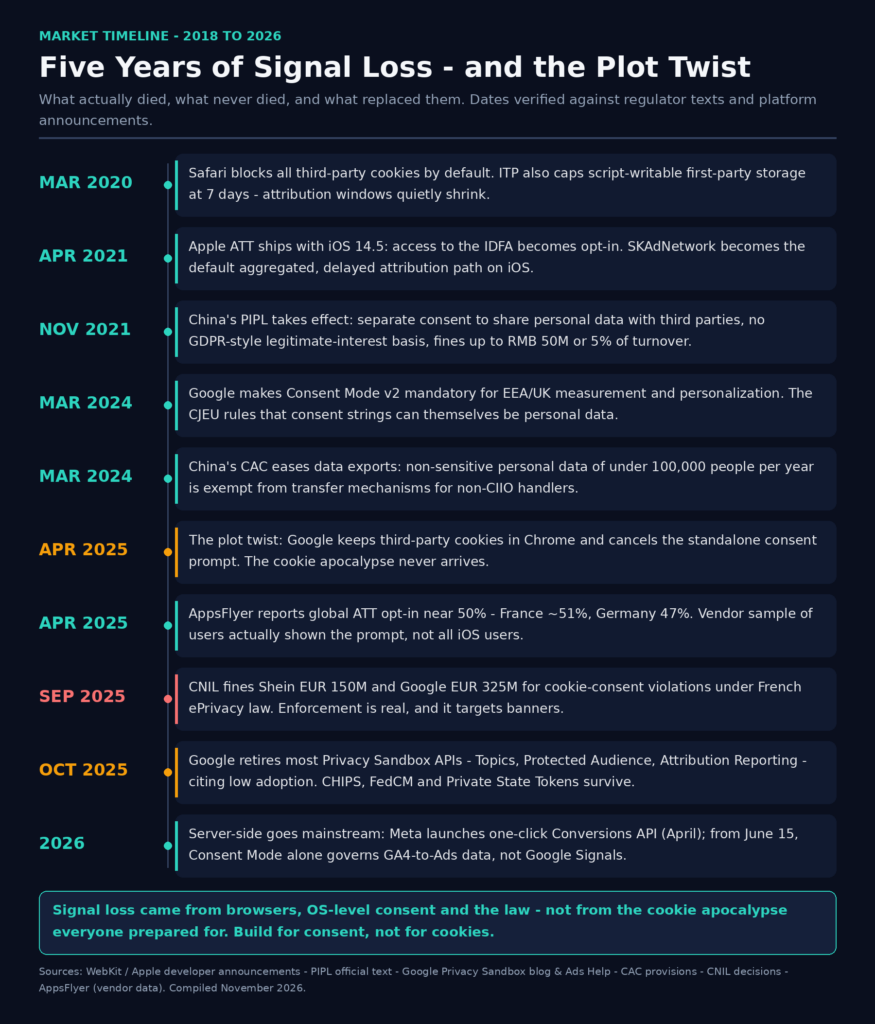
- Cross-site tracking in Safari and Firefox. Safari has blocked all third-party cookies by default since March 2020, and its Intelligent Tracking Prevention caps script-writable first-party cookies at seven days. Your 28-day attribution window became a seven-day window whether you noticed or not.
- Device-ID targeting on iOS. Since iOS 14.5 shipped ATT in April 2021, the IDFA is opt-in. AppsFlyer — a measurement vendor, so treat this as a vendor sample of users actually shown the prompt — reported global opt-in near 50% in April 2025, with France just under 51% and Germany at 47%. Half your iOS audience is a silhouette.
- Unconsented list uploads and cross-app fingerprinting. The former lacks any lawful basis under PIPL or GDPR; the latter violates Apple’s App Review rules outright. These weren’t “deprecated.” They were always going to be enforcement targets.
And the death that never happened: Google announced in July 2024 that Chrome would offer an “informed choice” instead of killing cookies — then on April 22, 2025, canceled even that prompt, keeping the existing cookie settings. On October 17, 2025, Google retired ten Privacy Sandbox technologies, including Topics, Protected Audience and the Attribution Reporting API, citing low adoption. Only CHIPS, FedCM and Private State Tokens survive. Days later, the UK’s CMA released Google from its four-year Privacy Sandbox commitments.
So the threat model was never “cookies disappear.” It’s “consent becomes mandatory everywhere.” Build for that, and Chrome’s reversals stop mattering to you.
What Survives: The Signal Inventory
Before the architecture, the good news. Four signal classes remain fully usable: consented first-party data (your accounts, orders, loyalty records — owned, durable, legal); platform-native engagement audiences (people who watched your video or messaged your page, built inside the walled garden without any export); contextual targeting (matching the page, not the person — no identity required at all); and aggregated or modeled conversions (statistical estimates that need no user-level trail). None of these depends on a third-party cookie. All of them scale with the quality of your consent design, which is why the rest of this guide obsesses over it.
Why Guessing Costs More
Here’s the mechanism your CFO should understand. When conversions go unobserved, the platform’s prediction models train on a partial picture. Smart Bidding undervalues your best audiences because it literally cannot see them converting. You end up paying higher bids for lower certainty — guessing costs more.
And the missing data isn’t random. Google’s own analysis in its consent-mode documentation says consented users typically convert two to five times more often than unconsented users. Read that twice: the people who click “accept” are systematically better customers. So your observed dataset isn’t just smaller — it’s biased toward your easiest wins, and the algorithm optimizes toward a distorted mirror of your market. Every missing signal compounds: weaker prediction, worse allocation, higher CPA, smaller budgets, even less data. Signal loss is a flywheel, and it spins the wrong way.
The Lawful-Basis Map: PIPL vs GDPR
Both laws want the same thing — informed, voluntary permission — but the machinery differs, and a GDPR-ready stack is a head start in China, not a passport.
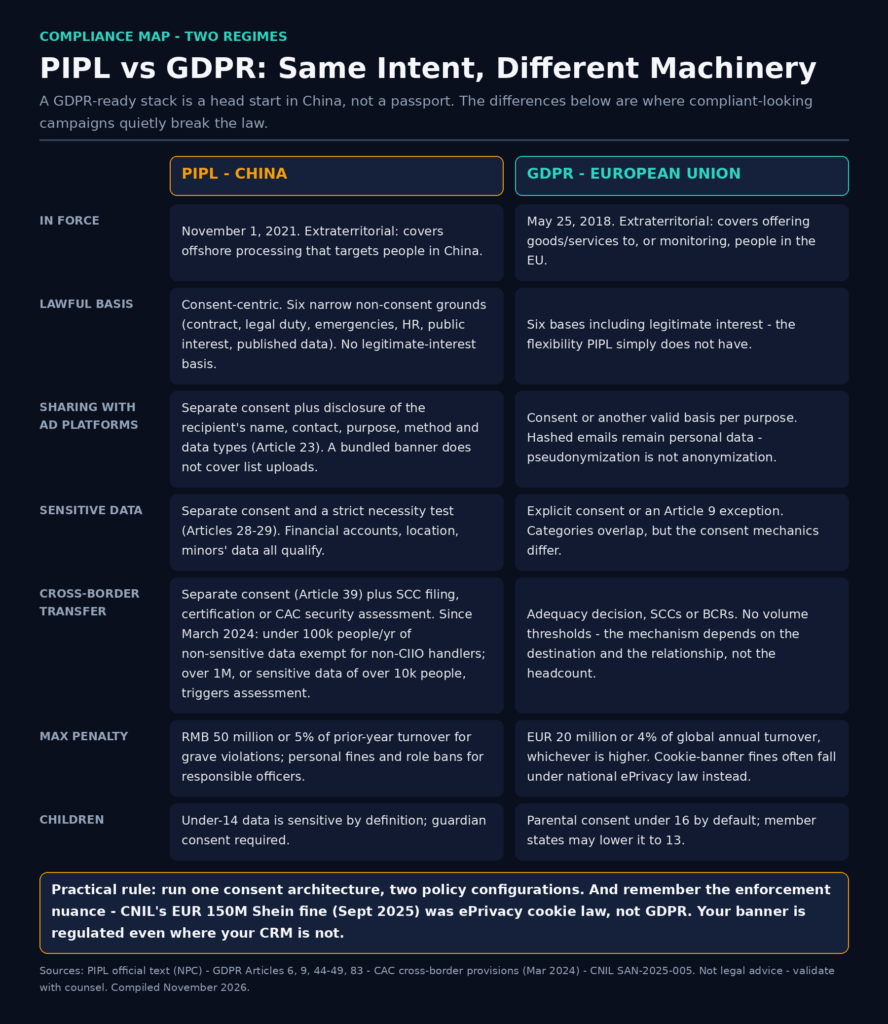
GDPR gives you six lawful bases, including legitimate interest. PIPL gives you consent plus six narrow non-consent grounds (contract, legal duties, emergencies, HR management, public-interest news, already-public data) — and no legitimate-interest escape hatch at all. In practice, China is consent-centric.
China’s Separate-Consent Trap
PIPL Article 23 is the clause that breaks most Western playbooks: providing personal information to another handler requires separate consent, plus disclosure of the recipient’s name, contact details, purpose, method and data categories. Uploading your CRM list to Meta, Google or Ocean Engine is exactly that kind of provision. A bundled cookie banner does not cover it. And hashing doesn’t launder the obligation — the CJEU ruled in March 2024 that even consent strings can be personal data when linkable to an identifier. Pseudonymized is not anonymized. Sensitive data (financial accounts, location, anyone under 14) needs separate consent plus a strict necessity test on top.
The Cross-Border Relief Valve — and the Enforcement Teeth
Since March 22, 2024, China’s CAC provisions have made exports survivable: for non-CIIO handlers, transferring non-sensitive personal data of fewer than 100,000 people per calendar year is exempt from transfer mechanisms entirely; 100,000 to one million requires standard contracts or certification; above one million — or sensitive data of more than 10,000 people — triggers a CAC security assessment. Separate consent under Article 39 generally still applies. Most mid-size advertisers exporting hashed audiences now fit in the exempt or SCC lane.
Don’t mistake relief for amnesty. In September 2025, France’s CNIL fined Shein’s Irish entity €150 million and Google €325 million — for cookies placed before consent, banners that hid purposes, and “reject all” buttons that didn’t actually reject. Note the legal basis: French ePrivacy law, not GDPR. Your banner is regulated even where your CRM isn’t. PIPL’s ceiling for grave violations is RMB 50 million or 5% of prior-year turnover, plus personal fines and role bans for responsible officers. Compliance is not a paperwork exercise; it’s a P&L line.
The Server-Side Stack: One Gate, Two Paths
The durable architecture looks like this: the conversion happens in your systems; a consent layer (CMP plus Google Consent Mode v2, mandatory for EEA/UK measurement since March 2024) decides what may flow; then the event travels two paths — the browser pixel and a server-side route — into the platform’s conversion API. Meta Conversions API, Google enhanced conversions, TikTok Events API, and Ocean Engine’s Event Management API upload all accept SHA-256-hashed first-party identifiers. A shared event_id deduplicates the two paths so one purchase counts once.
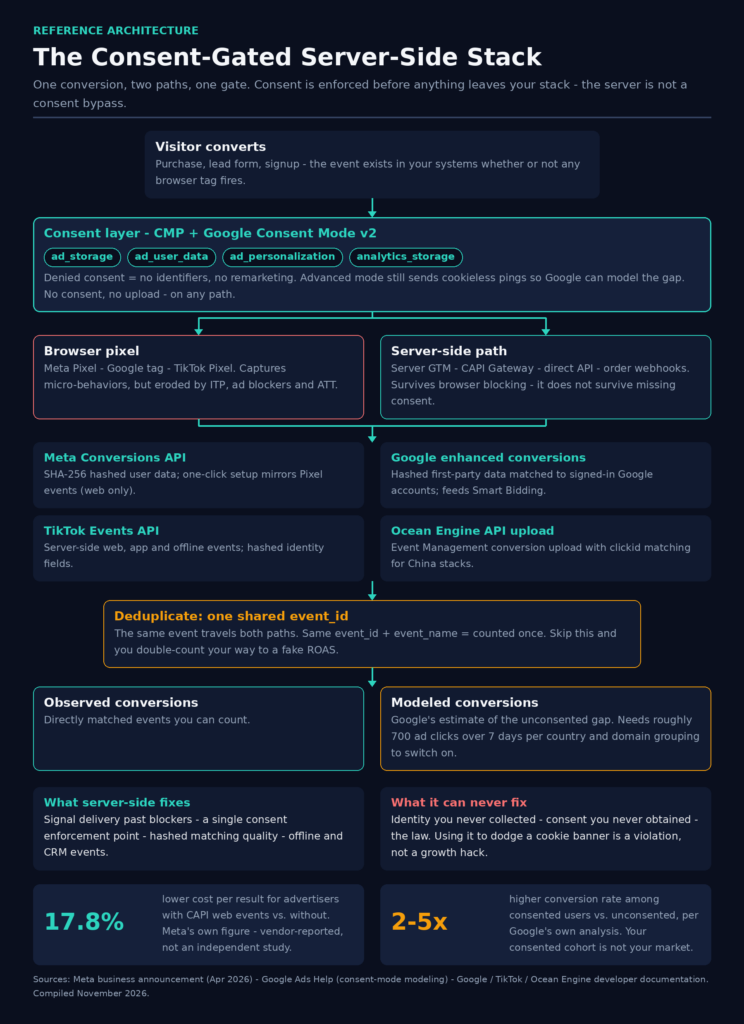
Two 2026 updates change the build math. First, Meta launched a free one-click Conversions API in April 2026 — but it mirrors your Pixel events, and a mirror can’t reflect what never fired: a session blocked by an ad blocker produces nothing on either path. Order-webhook-driven CAPI, which reads the purchase from your backend, still catches those. Second, from June 15, 2026, Consent Mode alone governs GA4-to-Ads data flows; the Google Signals toggle no longer gates advertising data. If your privacy posture relied on Signals as a backstop, that backstop is gone — your banner is now the whole ballgame.
What Server-Side Fixes — and What It Never Will
Server-side fixes signal delivery past blockers, gives you a single consent enforcement point, improves hashed match quality, and carries offline CRM events. Meta’s own figure — vendor-reported, not an independent study — puts advertisers with CAPI web events at an average 17.8% lower cost per result than those without. But server-side can never fix identity you never collected, consent you never obtained, or the law. Using a server tag to dodge a cookie banner is the exact behavior CNIL fined Shein for. It’s a durability upgrade, not a consent bypass.
Consent Design That Doesn’t Kill Conversion
Treat consent rate as a tracked KPI, not a legal footnote. The levers that move it are boring and effective: explain the value exchange before the system prompt (Apple explicitly allows a pre-ATT explainer screen), ask at a moment of delivered value rather than cold app-open, give “reject” equal visual weight, and make withdrawal actually work. AppsFlyer’s data shows opt-in rates climbing as prompts get better — transparency converts hesitation into an active choice. Dark patterns do the opposite: they inflate today’s consent rate and manufacture tomorrow’s fine. And remember the two-to-five-times conversion gap: your opted-in cohort over-represents your best customers, so never extrapolate their behavior to the whole market without correction.
First-Party Data Activation: The Asset Side
Collection points are everywhere you already deliver value: accounts, loyalty programs, warranty registrations, gated content worth gating. Activation means consented hashed uploads to platform audiences, CRM-to-ads pipelines, and — in China — the private-domain handoff into WeChat where the relationship lives on your turf. One underrated dividend: verified first-party data is also source defense in the AI era. The same clean, consented customer facts that feed your targeting feed the structured, authoritative content AI assistants quote. Data integrity compounds into brand trust, not just match rates.
Modeling the Gap — Without Fooling Yourself
Advanced Consent Mode sends cookieless pings when consent is denied, letting Google model the unobserved conversions. But modeling has a floor: Google’s documentation requires roughly 700 ad clicks over a seven-day period, per country and domain grouping, before conversion modeling switches on. Small advertisers in small markets get no backfill at all — they feel consent loss at full force. And modeled conversions are estimates, not counts. Google’s new data-strength-uplift metric (displayed from +1% to over 50%, rolling 14 days) explicitly blends observed and modeled conversions and measures measurement recovery — not incremental sales. Sanity-check platform numbers against your own holdouts and geo-tests before letting them steer budgets.
MMM: The Layer That Needs No User-Level Tracking
Marketing mix modeling works on aggregates — spend, sales, seasonality by region — so it needs no cookies, no device IDs, no consent strings. That’s its superpower in a low-signal world. Google open-sourced Meridian in early 2025 (Bayesian, geo-level, experiment-calibrated; the September 2026 v2.0 added native geo-experiments), and Meta’s Robyn remains the frequentist alternative. The honest caveat: a platform-built MMM grades that platform’s homework. Calibrate it with your own incrementality experiments, and it becomes the strategic layer that survives every future signal shock.
Clean Rooms: The Enterprise Tier (and the SMB Skip)
Clean rooms let two parties match hashed data and query only aggregate outputs — overlap, incremental reach, path-to-conversion — without exchanging raw rows. Google’s Ads Data Hub and Amazon Marketing Cloud lead; AMC became free and self-service for all Sponsored Ads advertisers in September 2025, which quietly erased the enterprise-only moat. But rooms don’t talk to each other, they demand SQL literacy, and a clean-room number is still correlation unless you build a holdout inside it. If you’re an SMB: skip the room. MMM plus lift tests buys you most of the answer for a fraction of the overhead.
The Trust Dividend
Here’s the reframe that pays for all of this. Consented audiences convert better — Google’s own two-to-five-times figure — and carry zero regulatory tail risk. Gartner’s 2023 survey of nearly 400 marketing leaders found almost a third had dropped an agency or channel partner over trust or privacy concerns in a single year. Buyers are auditing data supply chains now. A consent-first stack isn’t a cost center; it’s the difference between being the vendor customers keep and the vendor they quietly replace.
Failure Modes and Hard Boundaries
The ways teams wreck this: server-side used as a consent bypass; hashed uploads without separate consent in China; modeled conversions treated as ground truth; dark patterns that spike consent rates until the regulator arrives; pixel-plus-CAPI without deduplication, double-counting your way to a fake ROAS. And the boundary no vendor will sell you past: no stack restores 2015-era precision. The goal is durable, lawful measurement — not perfect identity. Anyone promising the latter is selling you the next fine.
Summary
The cookie apocalypse was canceled, but signal loss wasn’t — it moved from browsers to consent laws, and it’s permanent. The survival stack: an honest inventory of what died, a PIPL/GDPR lawful-basis map with separate consent where required, a consent-gated server-side architecture with deduplication, consent design treated as a growth KPI, modeled conversions sanity-checked against experiments, MMM as the aggregate backbone, and clean rooms only when the question justifies them. Compliance done right isn’t the brake on performance. It’s the flywheel that spins the right way.