Ask ten Western marketers to name China’s payment tools and you’ll get the same two answers: Alipay and WeChat Pay. Fair enough — those two wallets alone carry 89% of China’s e-commerce transaction value. But naming the wallets is like touring a concert hall and only noticing the front doors. The interesting part happens inside, in the layers stacked on top of the payment itself: coupons that fire the second money changes hands, membership cards that recruit customers mid-checkout, credit lines that quietly rewrite what a price feels like.
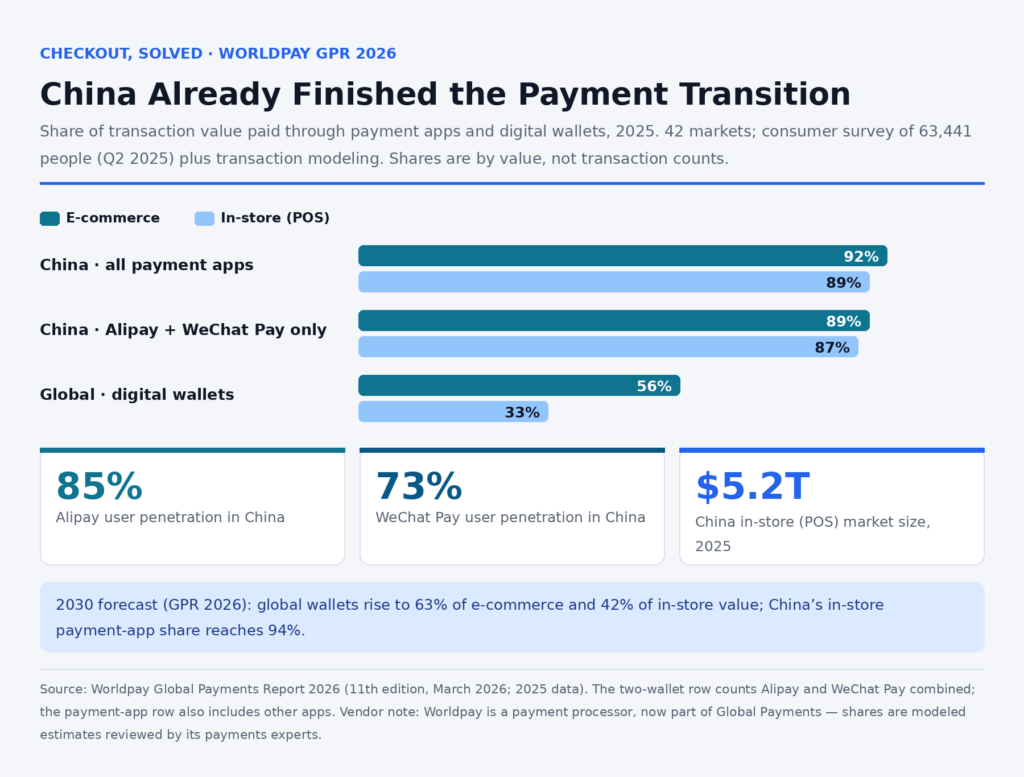
Here’s the number that should change how you think about this market. According to Worldpay’s Global Payments Report 2026, payment apps accounted for 92% of China’s e-commerce transaction value and 89% of in-store point-of-sale value in 2025 — the highest shares among the 42 markets the report covers. Checkout in China isn’t a funnel problem anymore. It’s solved infrastructure. Which means the real marketing question is no longer “how do we get people to pay?” It’s “what do we do with the moment right after they pay?”
That moment — the payment-success screen, the coupon in the wallet, the installment plan at checkout — is some of the cheapest attention in the economy. This piece maps the full stack, tool by tool, surface by surface: what each layer does, who pays for the marketing on it, what the compliance boundaries are, and where the hype (looking at you, e-CNY think pieces) outruns reality.
The 92% Anchor: Why Checkout Stopped Being the Battle
Let’s set the baseline properly, because the data deserves precision. Worldpay’s eleventh Global Payments Report, published in March 2026 and now issued under Global Payments after its acquisition of Worldpay, found that digital wallets carried 56% of global e-commerce value and 33% of in-store value in 2025 — 38% of combined online and offline payment value, more than $13.8 trillion across the 42 markets studied. One caveat worth stating up front: Worldpay is a payment processor, so this is vendor research, built from a consumer survey of 63,441 people fielded in the second quarter of 2025 plus transaction modeling. Shares are measured by value, not transaction counts.
China sits at the extreme end of that distribution. Payment apps: 92% online, 89% in-store. Alipay and WeChat Pay together: 89% online, 87% in-store — a two-product concentration with no parallel in any other large economy. Survey penetration runs at 85% for Alipay and 73% for WeChat Pay. And the report expects China’s in-store payment-app share to reach 94% by 2030, in an in-store market worth roughly $5.2 trillion in 2025.
Compare that with India, where UPI turned payment rails into a growth channel, or Brazil, where Pix overtook credit cards online. Same underlying story: once a payment rail wins, the competition moves up the stack. China just got there first, and its wallets evolved into something richer than payment pipes — they became operating systems for commerce. That’s the opportunity. That’s also the trap, because most foreign teams never look past the two logos.
The Stack Map: Five Layers, Not Two Apps
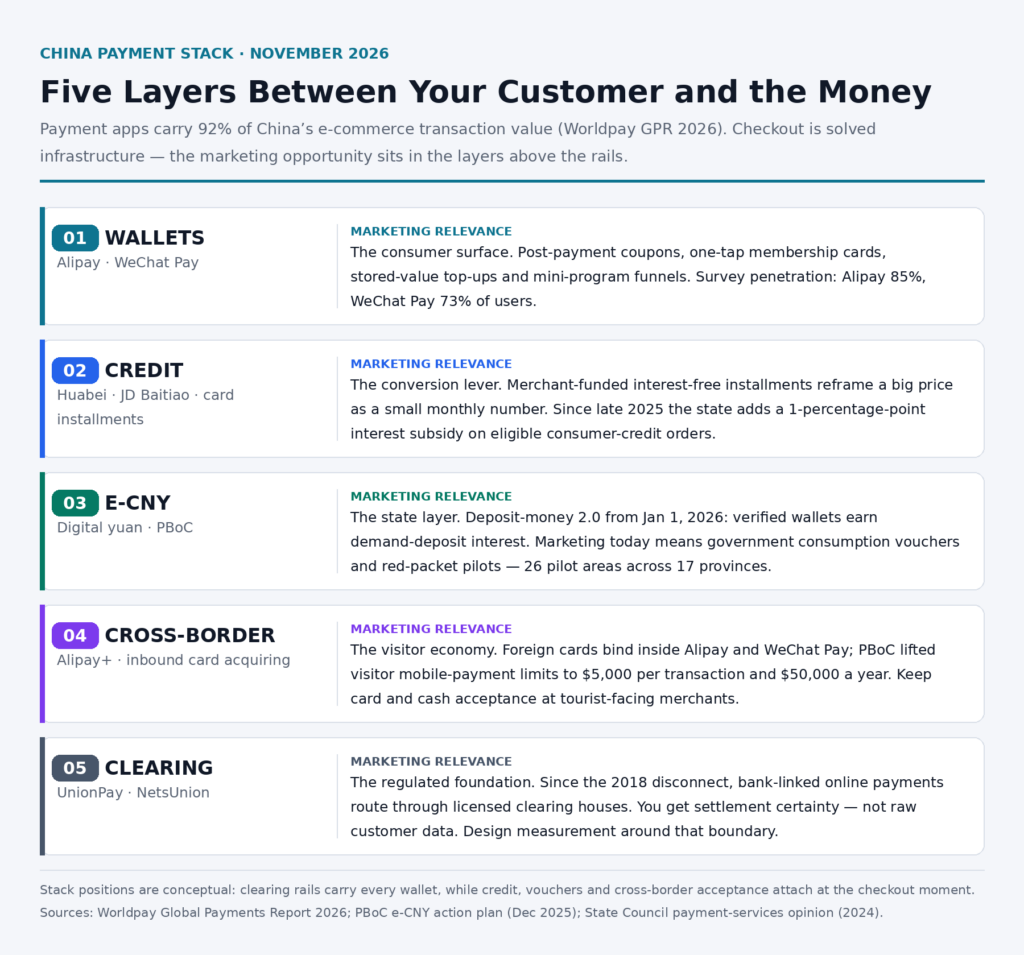
To work with Chinese payments as a marketer, you need a map with more resolution than “the duopoly.” Here’s the working version, top to bottom.
| Layer | Key tools | Marketing relevance |
|---|---|---|
| Wallets | Alipay, WeChat Pay | The consumer surface: coupons, membership, mini programs |
| Credit | Huabei, JD Baitiao, card installments | The conversion lever: merchant-funded interest-free installments |
| Digital yuan | e-CNY, PBoC-operated | Government vouchers, red-packet pilots; not yet a mainstream channel |
| Cross-border | Alipay+, inbound card acquiring | The inbound visitor economy |
| Clearing | UnionPay, NetsUnion | Regulated rails; settlement truth, not customer data |
Notice what the map does: it separates where customers experience marketing (wallets, credit) from where money actually moves (clearing). Marketers get to play on the top layers. The bottom layer is deliberately opaque to them — and that’s a feature of the system, not a bug you can engineer around.
Wallet Surfaces: The Post-Payment Real Estate
Both mega-wallets turned their payment-success pages into configurable marketing inventory, and the official documentation is refreshingly specific about the mechanics.
Alipay’s pay-gift program
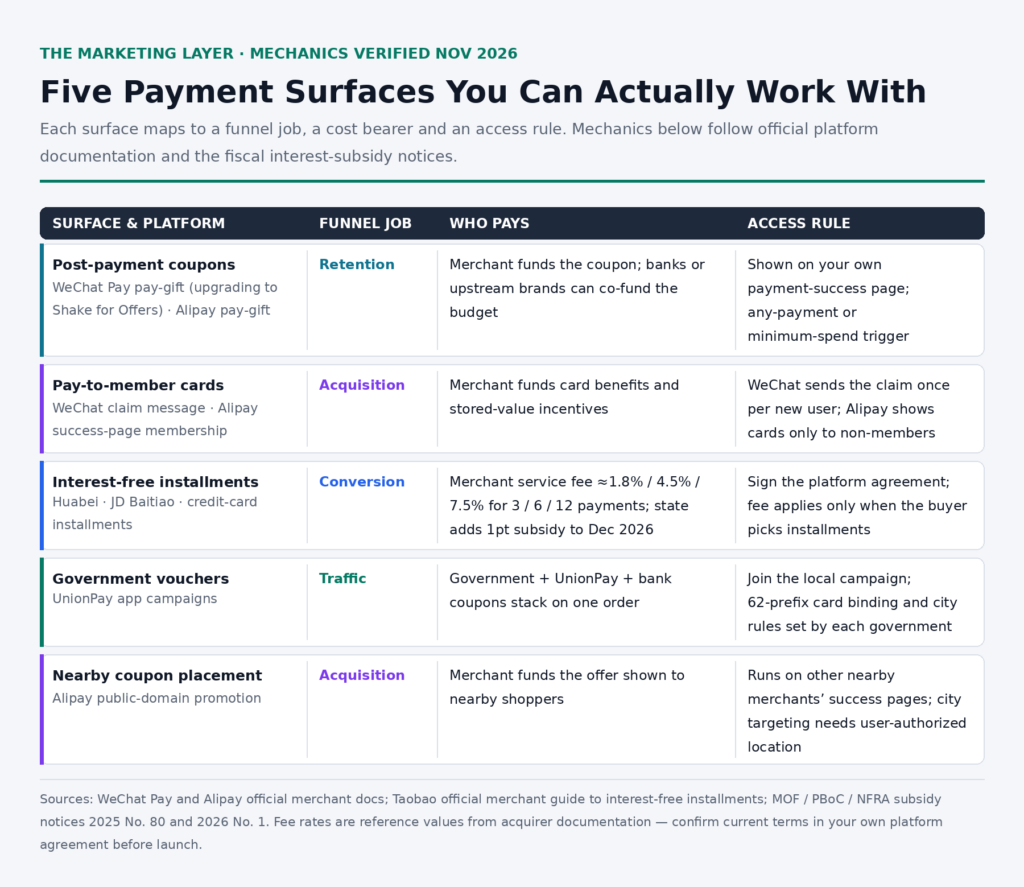
Alipay’s merchant docs describe a product literally built for the post-payment moment: merchants can place coupons, membership cards (including stored-value cards) or mini-program services on their own payment-success page. The targeting rules are the interesting part. Membership-card placements are shown only to non-members — the platform checks the relationship and spares your existing members the pitch. Triggers can be “any payment” or “spend above a threshold.” City-level targeting works only when the user has authorized location access. And via API, merchants can tag individual orders with custom markers to run segment-specific campaigns — RFM tiers, product preferences, payment-method cohorts, whatever your CRM dreams up. One placement per payment, with a priority order of card over coupon over service, ranked either by the platform’s smart model or manually.
WeChat Pay’s pay-gift, now wearing a new name
WeChat Pay’s equivalent delivers merchant coupons on the payment-success page, auto-applied on the customer’s next qualifying visit — a closed loop from payment to repurchase with no QR-code scavenger hunt in between. One freshness note that most competing articles miss: WeChat’s merchant documentation, updated in November 2025, announces that pay-gift is being upgraded into “Shake for Offers,” expanding exposure beyond the success page to a shake gesture entry, a fixed entry in the WeChat Pay official account, merchant business cards and search. Legacy campaign-creation entries began phasing out from December 1, 2025. If your agency’s playbook still says “configure pay-gift in the merchant portal,” it’s already stale — the capability survived, the front door moved.
Pay-to-member: recruiting while the receipt prints
Both ecosystems can convert a payment into a membership recruitment event. WeChat Pay can send a one-tap membership-card claim message after payment — once per new user, so it’s acquisition, not spam. Alipay’s version slots the card onto the success page for non-members only. For offline chains without strong in-store sales staff, this is the cheapest membership funnel available: the customer already trusted you with money; asking for a card click is a remarkably small next step.
And here’s the surface that surprises people: Alipay also sells public-domain promotion that places your coupon on other nearby merchants’ payment-success pages. Your competitor’s checkout can become your acquisition channel — within the platform’s rules, with the platform metering the traffic. Try doing that with a card terminal in Frankfurt.
Credit as Marketing: The Installment Lever
If post-payment surfaces are about retention, interest-free installments are about conversion — and in China this is a mature, merchant-controlled marketing tool, not a fintech curiosity.
The mechanics, per Taobao’s official merchant guide: a shopper buys an eligible product using Huabei installments (typically 3, 6 or 12 payments; some categories go to 24), pays zero interest and zero fees, and the merchant receives the full product price upfront when the order completes. The merchant pays a service fee for the privilege. Reference rates in acquirer documentation run around 1.8% of order value for 3 installments, 4.5% for 6, and 7.5% for 12 — confirm your own contracted rates before modeling, but the shape is what matters: you’re buying a conversion lift with a known, capped cost, and you only pay when a customer actually chooses installments. Taobao’s formula makes the budgeting clean: fee equals transaction value times the share of buyers choosing installments times the fee rate.
Why does it work so well on high-ticket items? Because ¥6,000 and “¥500 a month for 12 months, zero interest” are the same price wearing different psychological costumes. The installment frame doesn’t discount your product — it protects your price while shrinking the felt pain of paying. For electronics, furniture, education and medical services, that’s often worth more than a straight discount, because nobody’s anchoring your brand to a lower number.
The state joined the party
Here’s the 2025–2026 development that makes this section more than evergreen advice. In August 2025, China’s Ministry of Finance, the PBoC and the financial regulator launched a fiscal interest subsidy for personal consumer loans: one annual percentage point, capped at half the contract rate, funded 90% by the central government and 10% by provinces, running through 23 designated lenders — six big state banks, twelve joint-stock banks, and five others including WeBank and four licensed consumer-finance firms, one of which is Ant’s consumer-finance arm. A January 2026 notice extended the program to December 31, 2026, pulled credit-card bill installments into scope, scrapped the category restrictions and the small per-transaction caps, and kept the ¥3,000 annual subsidy ceiling per borrower per institution.
For marketers, that means the state is literally co-funding your conversion tool. Platform-disclosed figures give a sense of scale — treat them as vendor-reported, not audited: Ant says more than 2 million merchants co-funded interest-free offers during the 618 festival in 2026, with over 100 million interest-free products on Taobao and Tmall, up 26% year over year; Xinhua reported in November 2026 that more than 2.5 million merchants joined the subsidy-stacked offers during Double 11, and users of state-subsidized interest-free installments rose over 30% from a year earlier. JD’s Baitiao runs a parallel merchant-funded interest-free tool inside JD’s checkout. When fiscal policy and platform marketing point the same direction, swimming with the current is simply cheaper.
UnionPay’s Lane: Government Vouchers and Bank Co-Funding
The duopoly doesn’t own every surface. UnionPay’s app has become the distribution rail for local-government consumption vouchers — a channel that matters if you sell in categories governments like to stimulate: appliances, electronics, home renovation, cars, dining, tourism.
The machinery is consistent across cities: local governments load voucher budgets into campaigns on the UnionPay app, consumers typically bind a UnionPay card (the 62-prefix ones), claim vouchers in timed drops, and redemption happens automatically at payment. The stacking is the fun part — a government voucher, a UnionPay coupon and a bank-specific coupon can land on the same order, each funded by a different party. Your job as a merchant is usually enrollment, not engineering: get on the campaign’s merchant list, make sure your acquiring setup accepts the rail, and let three institutions subsidize your customer’s basket. UnionPay’s own disclosures from mid-2025 claim its trade-in voucher campaigns reached more than 56 million users and drove roughly ¥150 billion in consumption across dozens of regions — again, network-disclosed numbers, but the direction is unmistakable. Bank co-marketing budgets are real, and they’re looking for merchants to spend them on.
The e-CNY Reality Check
Now the section where honesty costs us some excitement. The digital yuan is real, large, and changing fast — and it is still not a mainstream marketing channel.
The official ledger: by the end of November 2025, cumulative e-CNY transactions reached 3.48 billion worth ¥16.7 trillion, with 230 million personal wallets opened through the app and pilots spanning 26 areas across 17 provinces. By year-end, cumulative value touched ¥19.5 trillion. Impressive — until you remember those are pilot-era cumulative totals dominated by transfers and government disbursements, not a rival to the wallets’ daily commerce gravity.
The genuinely new development arrived January 1, 2026, when the PBoC’s action plan moved e-CNY from “digital cash” to “deposit money 2.0.” Verified wallets held at commercial banks now earn interest at demand-deposit rates — the big state banks all published their interest rules on December 31, 2025. Balances count as commercial-bank liabilities and sit inside deposit insurance; anonymous wallets earn nothing; non-bank payment institutions must hold 100% margins against e-CNY. China became the first major economy to pay interest on a central-bank digital currency. The incentive logic is elegant: interest gives users a reason to hold, and bank liability status gives banks a reason to promote.
For marketers, the practical surface today is government consumption vouchers and red-packet pilots distributed through e-CNY wallets, plus smart-contract use cases like prepaid-fund supervision in pilot cities. Worth watching, worth testing if a local campaign invites you in — not worth rebuilding your stack around. And note the subtle shift: now that wallets pay interest, e-CNY’s differentiation against bank-linked wallet balances narrows even as its legitimacy grows. Watch the incentive design, not the headlines.
Cross-Border: Marketing to the Inbound Economy
China’s payment stack quietly opened a second front: visitors. A 2024 State Council opinion made payment convenience for inbound travelers and older consumers official policy — foreign-card acceptance at key merchants in tourism, dining, retail and transport, cash as a guaranteed floor, and two bridges into mobile payment: binding international cards directly inside Alipay and WeChat Pay, and letting overseas e-wallets work in China through partner networks. The PBoC, in parallel briefings, raised visitors’ mobile-payment limits from $1,000 to $5,000 per transaction and from $10,000 to $50,000 a year.
On the outbound side, the GPR’s China launch coverage put Alipay+ at 1.8 billion users and over 100 million merchants across 14 markets — the network that lets a Chinese tourist pay in Bangkok with the same app they use in Beijing. (Alipay’s broader corporate PR cites wider scopes; the figures here follow the report’s China launch.) If your business touches Chinese travelers abroad or international visitors in China, acceptance itself is marketing: the checkout logos at your door decide whether a wallet-first customer can buy from you at all. Enable the rails before you buy the ads.
Compliance: Payment Data Is Sensitive Data
Everything above operates inside a hard legal boundary, and it’s stricter than most growth teams assume. Under China’s Personal Information Protection Law, financial-account information is sensitive personal information. Processing it requires a specific purpose, sufficient necessity, strict protection measures, a prior protection-impact assessment — and separate consent, not a checkbox buried in your terms of service. The national security specification elaborates: bank accounts, payment accounts, transaction information all sit in the sensitive tier.
What does that mean operationally? You do not get to treat payment records as a free targeting dataset. What you legitimately get is what the platforms expose through consented, purpose-built marketing products — the non-member check, the authorized-location city filter, the order tags you attach to your own transactions. The platforms hold the sensitive data; you rent carefully scoped signals from them. Teams that try to scrape or enrich their way around this are building on a fault line.
The clearing layer reinforces the boundary by design. Since the 2018 “disconnect” mandated by the central bank, bank-account-linked online payments from payment institutions route through licensed clearing houses — NetsUnion for online payments, with UnionPay handling barcode cooperation. The reform ended the era when wallets kept direct pipes into every bank and sat on unregulated data lakes. You get settlement certainty. You don’t get the raw flow. Design accordingly.
One more boundary worth internalizing: the subsidy programs come with authenticity checks. Lenders must identify real consumption; fraudulent or misrouted transactions lose the subsidy and can trigger clawbacks. Promotions that manufacture fake orders to farm subsidies aren’t growth hacking — they’re documented violations with a paper trail.
Measurement: The Payment Event Is Your Conversion Truth
Here’s the quiet gift inside all this regulation: in China, the payment event is an exceptionally honest conversion signal. No pixels lost to browser privacy wars, no “add to cart” pretending to be revenue — money moved, and the platform can tell you which coupon, which installment plan and which surface accompanied it.
The working discipline looks like this. Reconcile campaign claims against settled payment events, not clicks — coupon redemption and installment adoption are observable at the order level. Budget installments with the official formula (value × adoption share × fee rate) and watch the adoption share weekly; it’s your real cost dial. Test interest-free offers for incrementality, not vanity: hold out comparable products or periods, and measure whether installments create orders that wouldn’t have happened, rather than subsidizing purchases that were already coming. And treat membership recruited at payment as a cohort with its own retention curve — a card claimed at checkout is worth exactly what its repurchase behavior proves, no more.
Failure Modes: Four Ways Teams Waste This Stack
The pattern of failure is remarkably consistent. First, treating payment data as freely usable — a compliance blowup waiting for an audit. Second, subsidizing without margin math: an interest-free offer on thin-margin SKUs can hand your entire profit to the fee schedule while the dashboard celebrates conversion. Third, e-CNY theater — building campaigns for a channel whose marketing surface is still mostly government pilots. Fourth, ignoring the clearing boundary and promising your CFO customer-level data the architecture was explicitly redesigned to withhold. Each failure comes from the same root: mistaking the payment stack for an ad platform, when it’s actually regulated financial infrastructure that rents you a few very good rooms.
The Bottom Line
China solved checkout so thoroughly that payment became the venue, not the obstacle. The marketers who win there don’t fight for cheaper clicks upstream — they work the moments the payment stack hands them: the success page that recruits members, the coupon that auto-applies on the next visit, the installment plan that makes a premium price feel light, the government voucher that brings three funders to one basket. Map the five layers, pick your surfaces by funnel job, price the subsidies honestly, respect the data boundary, and measure against settled payments. The checkout is the campaign. It has been for a while — most playbooks just haven’t noticed.