Here’s a coincidence that isn’t one. China’s consumers distrust polished brand claims and verify everything — and China’s regulators have spent a decade building rules that force brands to prove everything. Two forces, one demand. If you’re a global brand treating these as separate problems — a marketing problem and a legal problem — you’re paying twice to solve one.
Start with the trust side. In CSA Research’s 29-country survey (8,709 verified respondents, fieldwork by Kantar), 92% of Chinese consumers said they’d choose the product with information in their own language. But language is just the entry ticket. The deeper behavior is verification: Chinese platforms are architected around searchable experience posts, and since 2022, shoppers can look up a cosmetics product’s efficacy-evidence summary on the regulator’s own public portal. The claim-checking reflex isn’t a cultural quirk. It’s infrastructure.
Now the regulatory side. The Advertising Law bans absolute superlatives — best, No. 1, national-level — with fines from RMB 200,000 to a million. SAMR’s 2023 enforcement guidelines clarify what survives: factual, scoped claims the advertiser can actually substantiate. The Advertising Law separately requires that cited data be accurate and sourced. And the NMPA’s efficacy rules require human trials for whitening, sunscreen and anti-hair-loss claims, with the evidence summaries published for anyone to read.
Read those two paragraphs together and the mechanism appears: the regulator is not asking for less marketing. It’s asking for the exact asset the skeptical consumer already wants — a claim attached to checkable proof. Compliance and conversion run on the same currency.
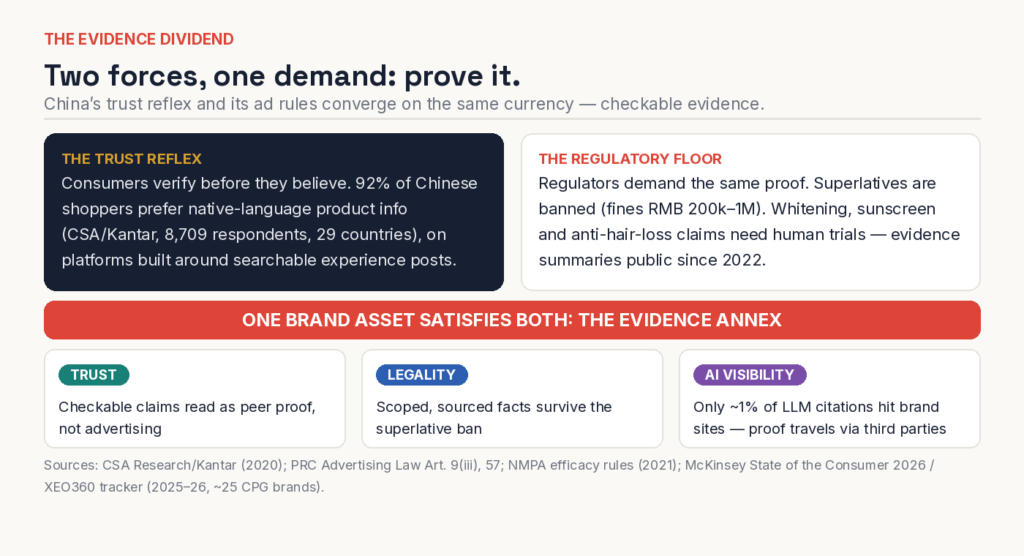
That’s the dividend. A brand that builds its evidence annex once — every claim mapped to a test report, a scoped sales fact, a filed summary — spends that asset three times. It converts the verification-reflex shopper, because checkable claims read as peer proof rather than advertising. It clears the legal gate, because substantiated, scoped claims are precisely what the guidelines exempt. And it survives the AI-search shift: McKinsey’s 2026 consumer report, drawing on XEO360’s citation tracking across roughly 25 consumer-goods brands, found only about 1% of the sources LLMs cite come from brand-owned websites. Your polished campaign page barely exists in the answer layer. Your evidence, embedded in reviews, test content and third-party databases, travels.
The inverse is the double tax. Brands that run persuasion-first copy through a legal cleanup pay once to write claims that can’t ship, then again to rewrite them under deadline — and the rewritten version, stripped of proof, underperforms with the very consumers who distrust polish. Two budgets, one inferior output.
The uncomfortable implication for global teams: your compliance officer and your growth lead are, structurally, on the same side. The brands winning China figured this out early — they staff evidence production like a content function, not a legal afterthought. Everyone else is still paying the tax.






