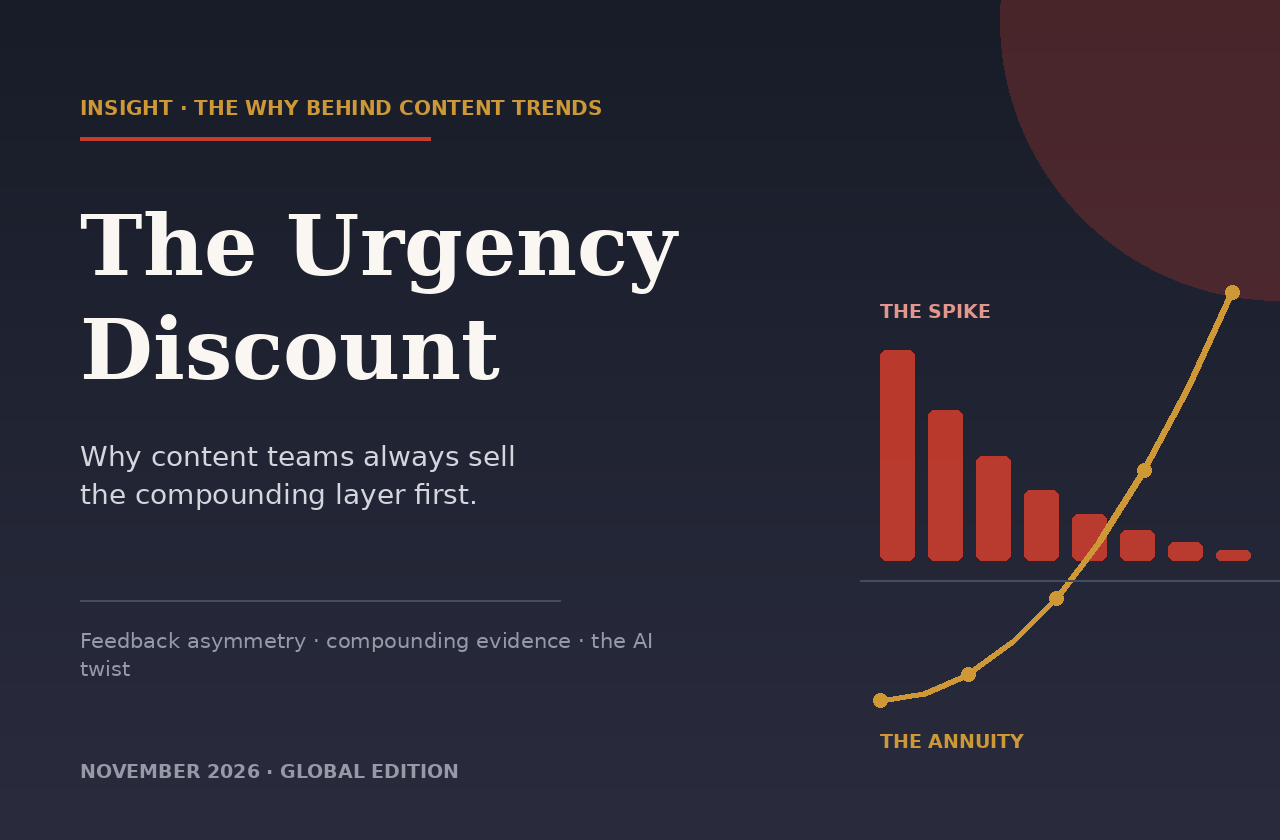
Every content team says it believes in compounding. Then the quarter gets tight, a trend breaks, a campaign slips — and the first line item quietly deleted is the weekly knowledge-asset slot. Not the festival posters. Not the trend rides. The one piece of work that would still be earning traffic in three years. Teams do not cut it because they disbelieve the math. They cut it because the math is invisible on the day the cutting happens.
Call it the urgency discount: work gets funded in proportion to how fast it reports back, not how much it eventually pays.
The Feedback Asymmetry
A trend ride reports within hours: views, shares, a screenshot in the leadership group chat. A festival campaign reports within weeks: GMV, conversion, a clean slide. A knowledge asset reports on a geological timescale — search entrances that trickle in for years, an AI citation nobody on the team ever sees. In any resource meeting, the loudest evidence wins. The asset layer walks in with a promise; the trend layer walks in with a receipt.
This is not a China quirk, though China’s always-on hot-search culture turns the volume up. It is a general incentive failure: feedback latency, not expected value, sets the internal price of work.
The Curves Cross Where Nobody Is Looking
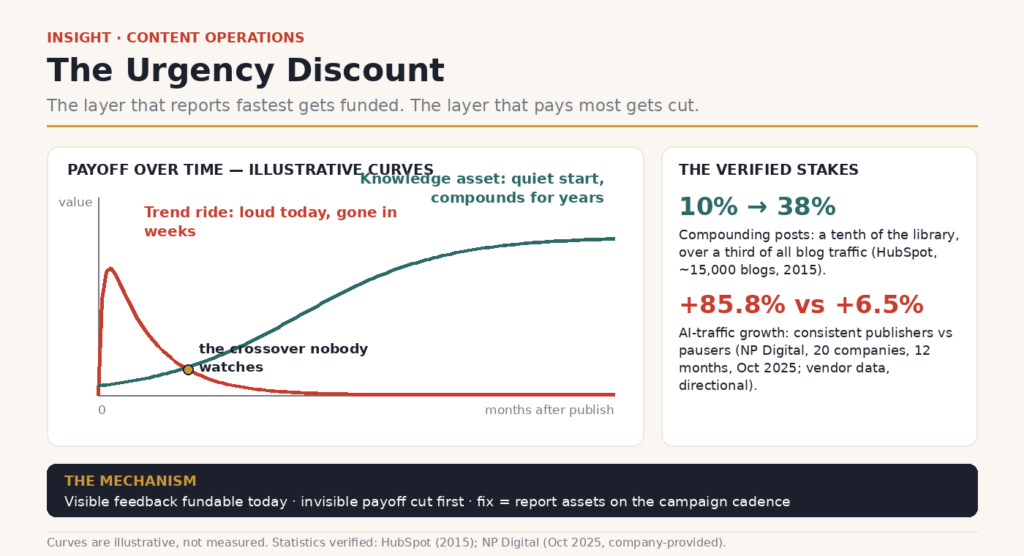
The payoff shapes are opposite. A trend ride spikes and decays — HubSpot’s analysis of roughly 15,000 business blogs found newsjacking-style posts among the fastest-decaying class, while compounding posts (about ten percent of the library) generated thirty-eight percent of total traffic and were pulling two and a half times their launch-month visits by month six. The asset curve starts near zero and climbs for years. At the moment of the budget decision — week one — the trend curve is strictly above the asset curve. Every rational-looking short-horizon comparison picks the loser. The crossover happens months later, in a quarter nobody is reviewing.
The AI Twist Makes the Discount Costlier
NP Digital’s twelve-month tracking of twenty companies found consistent publishers grew LLM-referred traffic 85.8% while pausers managed 6.5% — small, vendor-provided, directional, but mechanistically unsurprising: answer engines can only cite content that exists and stays fresh. The urgency discount used to cost you future search traffic. Now it costs you presence inside the answers themselves. The invisible layer became the distribution layer, and teams are still pricing it like a hobby.
The Fix Is a Reporting Trick, Not a Pep Talk
You cannot exhort a team out of an incentive gradient. Change what reports. Put asset metrics — search entrances, AI citations, internal reuse — on the same monthly slide as campaign GMV, so the slow curve produces a visible receipt every month. Give the slot a named owner whose performance is judged on it, so cutting it has a political cost. Floor it in hours, not percentages, so emergencies cannot silently repossess it. The layer that compounds does not need more belief. It needs a feedback loop fast enough to survive the meeting where budgets die.






