
In March 2025, Douyin did something unprecedented: it published how its recommendation system works. Neural networks predict each user’s behavior probabilities — finish, like, comment, save, re-watch — and content is ranked by total predicted value across more than a hundred modeled objectives. A genuinely radical disclosure. And yet, open any Douyin training course today and you’ll still read that completion rate is “40% of your score,” that 67% of viewers swipe away in three seconds, that videos graduate through traffic pools of exactly 200, then 3,000, then 30,000 views. None of those numbers appears anywhere in Douyin’s publications. So why does documented truth keep losing to invented precision?
The Vacuum Opacity Creates
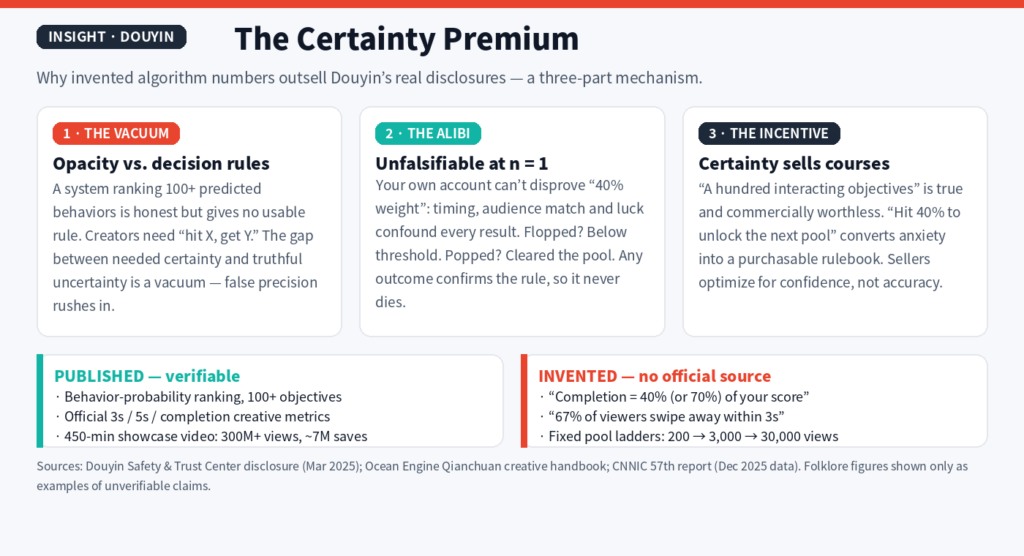
Here’s the mechanism. A probability-ranking system with 100+ objectives is honest but unusable as a decision rule. A creator staring at tomorrow’s shoot needs something actionable: hit this number, get that outcome. Douyin’s real disclosure offers no such rule — because no such rule exists. That gap between what operators need (certainty) and what the platform can truthfully provide (a distribution of predicted values) is a vacuum. And markets abhor vacuums. False precision rushes in: fixed thresholds, exact weights, tidy pool ladders. The golden three seconds is real — the platform’s own training materials say so — but the fake decimals wrapped around it are the market’s invention, not the platform’s.
Why Nobody Can Call the Bluff
The folklore survives because it’s unfalsifiable at the only sample size a creator possesses: their own account. Distribution is confounded — timing, audience match, plain luck — so any video’s performance can be narrated as confirming any rule. Your video flopped? Completion below the threshold. It popped? You cleared the pool. No personal dashboard can disprove “40% weight,” which means the claim enjoys eternal life. Meanwhile the actually-published metrics — Ocean Engine’s official 3-second, 5-second and overall completion rates for ad creatives — require the boring work of comparing against your own history.
The Seller’s Incentive
Follow the money and the picture completes. Certainty sells courses; nuance doesn’t. “Your outcome depends on a hundred interacting objectives” is the truth, and it is commercially worthless as a sales page. “Hit 40% completion to unlock the next pool” converts anxiety into a purchasable rulebook. Buyers pay a certainty premium — and the seller’s optimal strategy is to supply confidence, not accuracy. The honest disclosure even hurts: Douyin’s own showcase was a 450-minute video with 300 million views and 7 million saves, which quietly demolishes the short-and-punchy doctrine most courses sell.
What This Means for You
In a market of 1.074 billion short-video users — 95.4% of China’s netizens, per CNNIC — folklore scales exactly as fast as truth. Your edge is verification hygiene: treat every fixed threshold as an unpriced claim, demand the primary source, and build your rules from the metrics that actually exist. The three seconds are real. The decimals are somebody’s business model.