A brand launches a hashtag challenge with a cash prize pool. Forty thousand videos arrive. Most are seven-second template clips filmed by people who have never touched the product, submitted from ten accounts each, chasing payouts that average a few cents. The dashboard looks like a triumph. The content library is worthless, and the compliance team is one audit away from a very bad week.
This is not a hypothetical. A January 2025 investigation by Xinshi Research, published by TMTPost and 36Kr, documented exactly this economy inside Douyin’s official task marketplace: reward farmers flooding brand tasks with junk videos, and auto-clicker scripts colonizing livestream-watching tasks. The brands paid. The machine optimized against them.
Meanwhile, on the other side of the market, brands quietly buy “UGC” that is really scripted advertising in disguise — and watch Xiaohongshu throttle it, flag it, and sometimes ban the brand outright.
Both failures share one root cause: nobody designed the participation. They designed the prize, or the script, and hoped. This playbook is about the third option — engineering honest participation that platforms reward, regulators tolerate, and buyers actually believe.
The paradox: UGC is manufactured, and that’s fine
Let’s kill a romantic idea first. A nine-month ethnographic study of Xiaohongshu by University of Michigan researchers Huiran Yi and Lu Xian, published at CSCW 2025, shows that ordinary-user content on the platform is systematically produced — through recruitment pipelines, product sampling, brand briefs and platform mediation — with the commercial labor deliberately obscured so posts read as spontaneous life.
Read that as a scandal and you’ll conclude all UGC is fake. Read it as an engineer and you’ll conclude something more useful: participation is a designed system either way. The only question is whether you design it honestly — real usage, real incentives, disclosed — or dishonestly, and hand your brand to the enforcement queue.
What actually counts as UGC
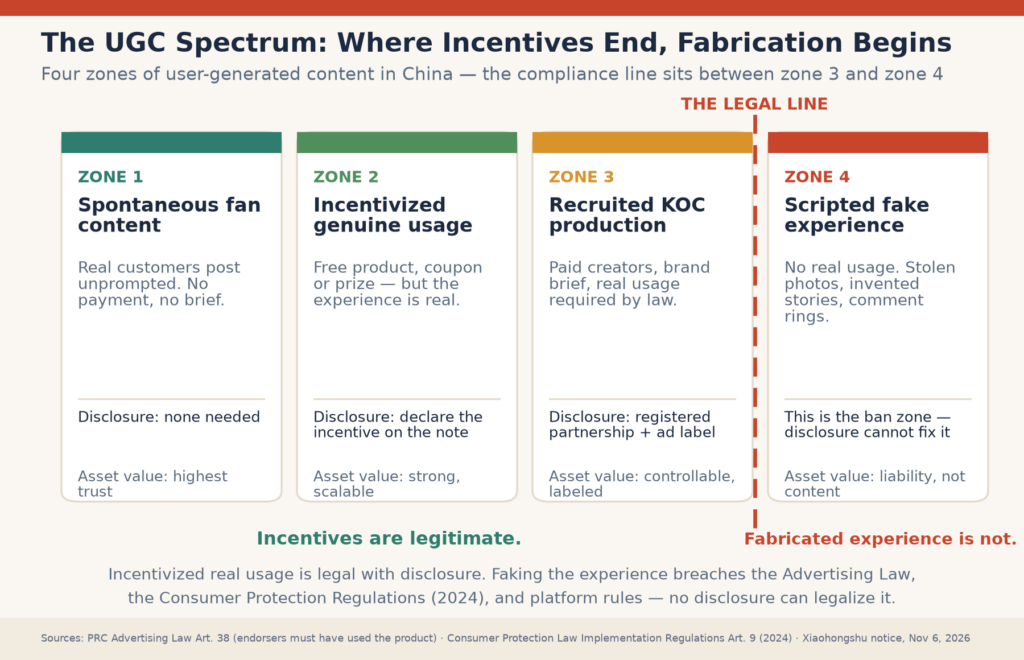
Think of a spectrum with four zones. Spontaneous fan content: customers posting unprompted, maximum trust, zero control. Incentivized genuine usage: a free product or a prize, but the experience is real. Recruited creator production: paid, briefed, registered through official channels, labeled as commercial. And scripted fake experience: no usage at all, stolen photos, invented stories, coordinated comments.
The legal line does not run between paid and unpaid. It runs between real experience and fabricated experience. China’s Advertising Law requires that an endorser actually used the product they recommend. The Consumer Rights Protection Law Implementation Regulations, effective July 2024, explicitly prohibit fabricated transactions, doctored user reviews and fake seeding — regulator interpretations name the practices directly, in plain operational terms: bulk likes, invented reviews, cash-for-praise, deleted complaints.
Incentives are legitimate. Disclosure makes them legal. Nothing makes fabrication legal.
Design the incentive ladder before the hashtag
Most campaigns pick a prize first and a behavior never. Invert that. Five reward types, five different risk profiles:
Product trials build real usage into the reward itself — the participant can’t fake the experience without faking the photo, and your review gates catch that. Coupons attract existing buyers, which is fine for retention campaigns and useless for reach. Cash pools buy volume fast and attract professional prize hunters faster. Status rewards — featuring the best content, jury recognition, creator spotlights — cost editorial time instead of money and select for craft. Charity-tied rewards borrow the Ant Forest lesson: Ant Group’s tree-planting game sustained 750 million cumulative users and 619 million real trees over nine years because the stakes were real and friends could watch your forest grow. Meaning plus social feedback outlasts cash.
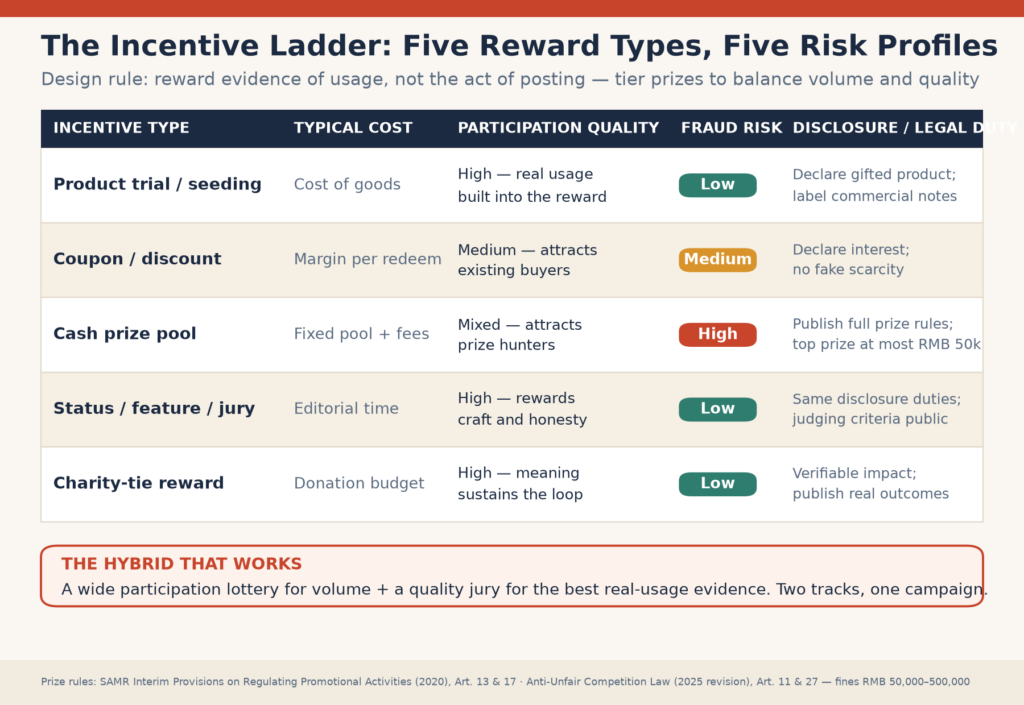
The hybrid is the workhorse. A participation lottery anyone can win keeps the funnel wide; a jury prize for the best documented usage keeps quality visible and aspirational. Bilibili’s official campaign pages show this structure natively — more on that below.
Three rules that keep incentives legal
Chinese prize law is specific, and it got tighter recently.
First, publish complete prize terms before launch. SAMR’s Interim Provisions on Regulating Promotional Activities require the prize types, entry conditions, draw method and timing, amounts, quantities or odds, redemption conditions and organizer contact — all published up front, and not changed afterward except in consumers’ favor.
Second, don’t move the goalposts mid-campaign. The revised Anti-Unfair Competition Law, effective October 15, 2025, added an explicit prohibition on changing prize terms after the activity starts without justification. Quietly shrinking the pool when participation overruns is now a named violation, not just bad manners.
Third, cap lottery-style top prizes at RMB 50,000 — and count non-cash prizes at market value. A car usage right, a luxury trip, game items, discounts: all priced as if sold. Violations carry fines from RMB 50,000 to RMB 500,000. One more wrinkle from the CSCW literature and platform rules alike: participation by minors needs guardrails, and gifting product to a creator is itself a disclosable commercial interest, not a loophole.
The platform mechanics menu
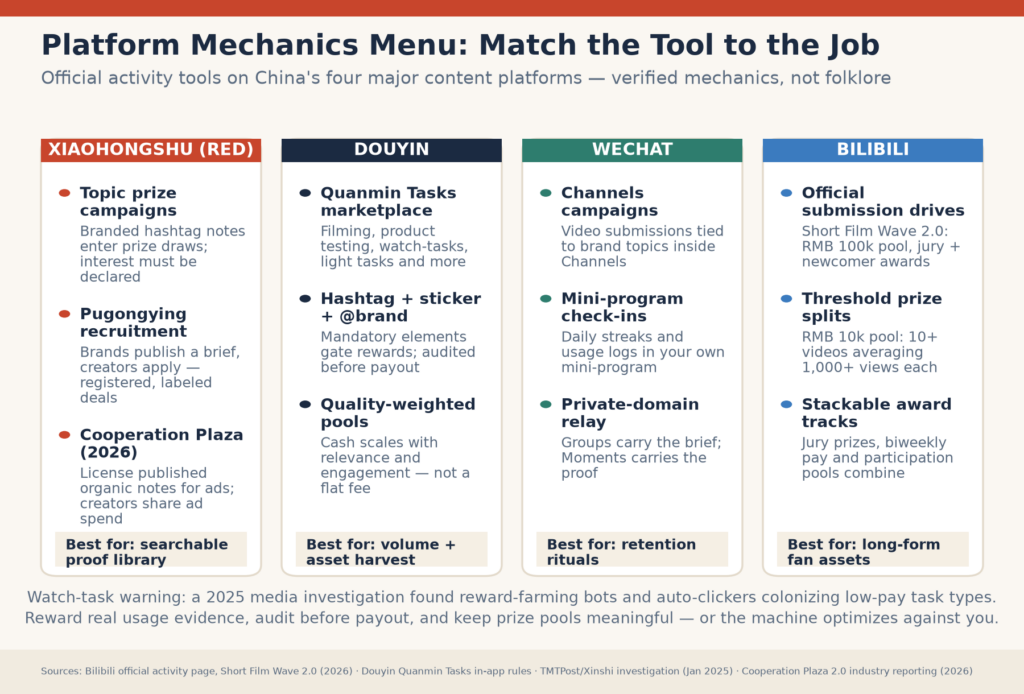
Every major Chinese platform now ships official UGC machinery. Use it — off-platform workarounds are precisely what enforcement targets.
Xiaohongshu: from topic campaigns to a licensing pipeline
The classic tools still work: branded topic pages where prize-linked notes must declare the commercial interest, and Pugongying open recruitment, where the brand publishes a brief and creators apply into registered, labeled partnerships.
But the structural news of 2026 is Cooperation Plaza. Launched in January and upgraded through the spring, it lets brands browse already-published organic notes from ordinary verified users, request the creator’s authorization, and boost those notes through the Juguang and Qianfan ad systems — with creators earning a share of the resulting ad spend, settled by the platform. Industry reporting through mid-2026 describes the 2.0 upgrade merging the platform’s separate UGC cooperation paths into one note pool, adding optional auto-authorization, and — via the Xiaohongmeng alliance in July — extending cross-platform conversion tracking, including JD.com purchases, to non-blogger notes.
Notice what flipped. The old model paid before content existed and prayed it performed. The new model lets real content prove itself in organic traffic first; you license the winners afterward. For a UGC campaign, that means your best participants now have a second payday — which is itself an incentive worth telling them about. Check current share rates and eligibility in the platform console before promising numbers; the published mechanics evolve faster than any article.
Douyin: the task economy, and its bot problem
Douyin’s commercial topics come in three tiers: basic brand topics for light aggregation, express challenge topics with custom pages and stickers for short bursts, and the full task-powered challenge with cash pools and platform-wide exposure for major launches.
The engine underneath is the Quanmin Tasks marketplace — literally “everyone tasks” — inside the Creator Center. Task types include filming, product testing, livestream watching and light interaction tasks. The mechanics are strict: designated hashtag, designated sticker or effect, an @ of the brand account, real person on camera, original content, no competitor products. Submissions are audited before rewards, and payouts scale with quality, relevance and engagement rather than a flat fee.
That design is sound. The failure mode is economic: when the pool is thin, per-video rewards collapse to cents, and the rational response for a reward farmer is volume over quality — the exact junk-video flood the Xinshi investigation documented. The lesson isn’t “tasks don’t work.” It’s that thin pools select for bots. Fund the pool meaningfully, gate rewards on usage evidence, and audit like you mean it.
WeChat and Bilibili: depth over spikes
WeChat runs participation inside owned territory: Channels video campaigns tied to brand topics, mini-program check-ins that turn daily usage into streaks, and community groups that carry the brief while Moments carries the proof. Lower reach, higher retention — the right trade for repeat-purchase categories.
Bilibili treats UGC as an investment. Its official Short Film Wave 2.0 campaign in 2026 stacked a RMB 100,000 pool across jury awards, a newcomer track for creators under 100,000 followers, biweekly incentives, and a participation pool split among creators with ten-plus videos averaging a thousand-plus views — all stackable. In January 2026 the platform launched an AI creation contest with a pool exceeding RMB 3 million and a RMB 1 million top prize, judged by a jury of top creators on story-first criteria. You don’t need that budget. You need that structure: reward craft, welcome newcomers, pay persistence.
Recruit for usage, brief for structure
Seed cohorts beat cold launches. Start with existing customers — people who already own the product and can photograph it in their own kitchen, on their own skin, in week three of use. Then extend to community creators whose feeds show genuine category usage. A campaign that launches to strangers dies at launch; a campaign that launches to users arrives pre-loaded with evidence.
The brief supplies structure, not sentences. Give each participant one outcome to document, the usage-evidence requirement, the disclosure duty, and the deadline. Do not give them copy. The moment forty notes share your marketing team’s phrasing, readers smell the template — and since November 2026, so does the platform’s detection stack, which explicitly names templated mass production as a violation. Own the sample logistics with a named person; a third of your wave will quietly publish nothing if the product arrives late or without instructions.
Quality control is a system, not a vibe
Run four gates on every submission before it earns a reward or an amplification budget. The claim gate: no absolute superlatives, no efficacy claims beyond what the product is registered for. The usage gate: does the photo or video show this person actually using this product? The disclosure gate: is the commercial interest declared, and is linked promotional content marked as advertising, as the Internet Advertising Measures require since May 2023? The AI gate: since September 1, 2025, China’s labeling measures and the mandatory GB 45438-2025 standard require explicit labels and metadata marks on AI-generated content — a participant’s AI-polished video carries obligations your campaign inherits.
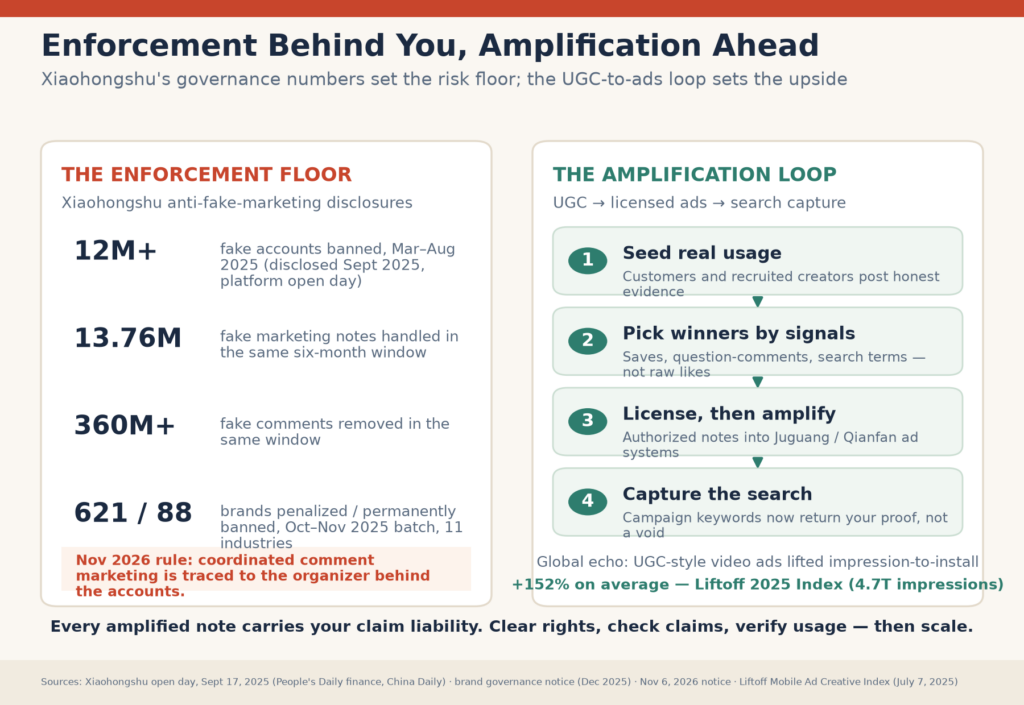
Then hunt fraud patterns: duplicate templates across accounts, receipts that don’t match orders, and the newest enforcement target — coordinated comment marketing. Xiaohongshu’s November 6, 2026 notice names multi-account question-and-answer relays that fake organic discussion, and promises to trace organized schemes back to the accounts’ operator, not just the accounts. If your agency sells you “comment section atmosphere,” you are buying a traced liability.
The enforcement floor you’re building on
These are not theoretical risks. At a September 2025 open day, Xiaohongshu’s anti-fake-marketing team disclosed its six-month scoreboard, covered by People’s Daily finance and China Daily: over 12 million fake accounts banned, 13.76 million fake marketing notes handled, more than 360 million fake comments removed, March through August 2025. In December 2025, the platform’s governance notice — consistently reported across industry media — penalized 621 brands across 11 industries for the October–November window, permanently banning 88. Banned brands get a violation flag in search results and lose commercial advertising access entirely. Promotion arranged outside official platform products is throttled by policy.
Amplify the winners — with rights cleared
Here’s the upside that justifies the whole system. Liftoff’s 2025 Mobile Ad Creative Index, drawing on 4.7 trillion impressions and 1.1 billion installs between January 2023 and May 2025, found that UGC-style video ads lifted impression-to-install conversion by an average of 152%, with UGC’s share of ad spend rising 11% among top-spending apps and nearly 30% in social and utility categories. Authentic-looking creative outperforms studio gloss at the moment of decision. That was mobile apps; the mechanism — content that doesn’t read as an ad in the first second — transfers.
So build the loop: seed real usage, pick winners by saves and question-comments rather than raw likes, license them properly, amplify through the official ad systems, and let the campaign’s keywords accumulate a search results page full of proof. Rights clearance belongs in the participation terms from day one: license duration, permitted placements, whether you can edit titles or covers, cross-channel reuse, and how any revenue share works. Screenshotting a customer’s note into an ad without authorization is copyright infringement wearing a growth-hack costume.
Measure the machine, not the moment
Judge participation quality, not participation count: what share of submissions passed the usage gate? Count reusable assets — notes you licensed and actually ran — and cost per usable asset against your KOC procurement benchmark. Track brand-word search lift and the questions appearing in comments; a comment asking about compatibility is a purchase forming, a comment saying “cute” is politeness. And set the attribution window before launch, measured in weeks, because discovery-led content converts late. Campaigns judged at week three get killed while they’re compounding.
Five failure modes to design out
Prize-only campaigns that attract professional farmers. No usage requirement, so the evidence layer is fiction. Rights left vague, so the best content can’t be amplified. Unverified claims amplified into paid reach, converting a participant’s exaggeration into your advertising violation. And no seed cohort, so the challenge page opens to an empty room and stays that way. Every one of these is a design decision made by default. Make it on purpose instead.
The one-page campaign brief
Objective with a number. One audience. The usage-evidence rule. The incentive ladder with complete prize terms. The platform mechanic and its mandatory elements. The claim register and disclosure duties. Rights terms. The four review gates. The amplification plan. The measurement window. One named approver. If it doesn’t fit on one page, you haven’t finished deciding.
The short version
Chinese UGC is a designed system — the research says so, the platforms institutionalize it, and the enforcement data punishes the dishonest versions at industrial scale. Reward evidence of real usage, publish prize terms that never move, use the official mechanics, gate quality before payout, clear rights before amplification, and measure assets and search lift rather than video counts. The brands winning this game aren’t the ones with the biggest prize pool. They’re the ones whose participants had actually used the product — and whose paperwork proves it.