Playbook · For Xiaohongshu content operators and brand content teams · November 2026 · Companion to the search-ads playbook — this is the organic note layer.
Your Note Is Not a Post. It Is a Search Asset.
Here is a scene every operator knows. You spend two days on a note — the shoot, the copy, the emoji spacing — and it dies in the feed within 48 hours. Meanwhile, a scrappy note you dashed off three months ago keeps pulling visitors every single day. Same account. Same product. What gives?
The difference is not luck. The lucky note answers a question people keep typing into the search bar. The dead note answers nothing; it just announces. On Xiaohongshu, users search the way they once searched Google: “how do I choose,” “which brand is better,” “mistakes to avoid.” A note built for those queries is not content that expires. It is a small landing page that keeps collecting traffic for months.
Most brands still write notes like ads. Ads interrupt. Search answers. This playbook takes the note apart into five components — cover, title, body, tags, comments — and shows you the ranking logic behind each one, in the order a reader (and an algorithm) actually encounters them.
The Numbers That Change How You Write
Let’s establish the stakes with verified figures, because “Xiaohongshu is big” is not a strategy.
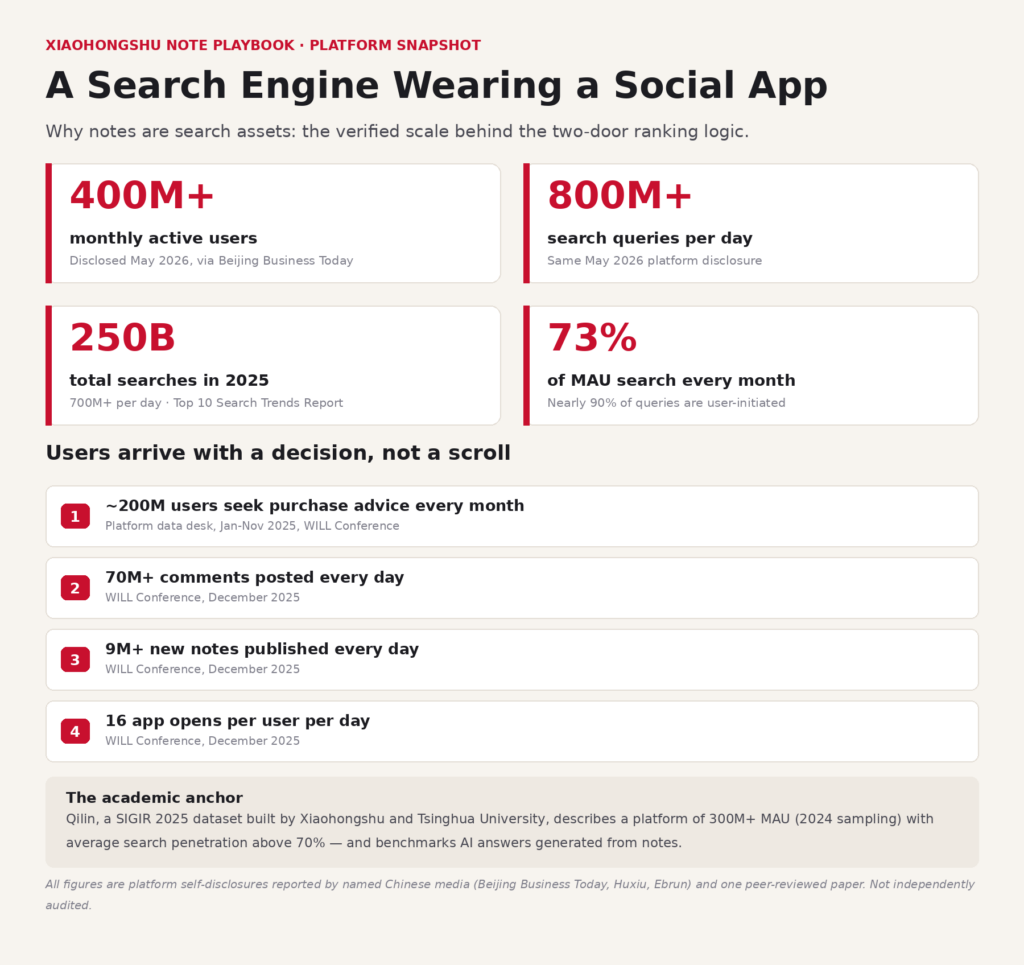
In May 2026, the platform disclosed more than 400 million monthly active users and over 800 million search queries per day, as reported by Beijing Business Today. Read that second number again. Eight hundred million searches, daily, inside what most Western decks still file under “social media.” For 2025 as a whole, the platform’s Top 10 Search Trends Report counted roughly 250 billion searches — over 700 million a day — with 73% of monthly users searching and nearly 90% of those queries initiated by the user rather than suggested by the app.
The buying intent is just as striking. At its December 2025 WILL business conference, the company said around 200 million users seek purchase advice on the platform every month, that users post over 70 million comments a day, and that more than 9 million new notes go live daily. An earlier disclosure in April 2025 put monthly purchase-advice seekers at 170 million and counted 80 million “link, please” comments — the growth between the two disclosures tells its own story.
And this is not just marketing-department arithmetic. Qilin, a research dataset released jointly by Xiaohongshu and Tsinghua University and presented at SIGIR 2025, describes a platform whose average search penetration exceeds 70% — and it benchmarks AI-generated answers built from user notes. Academics study this app as a search engine. You should write for it like one.
One honesty note: these are platform self-disclosures relayed by named media, not audited numbers. Treat them as directionally reliable, not gospel.
One Note, Two Doors
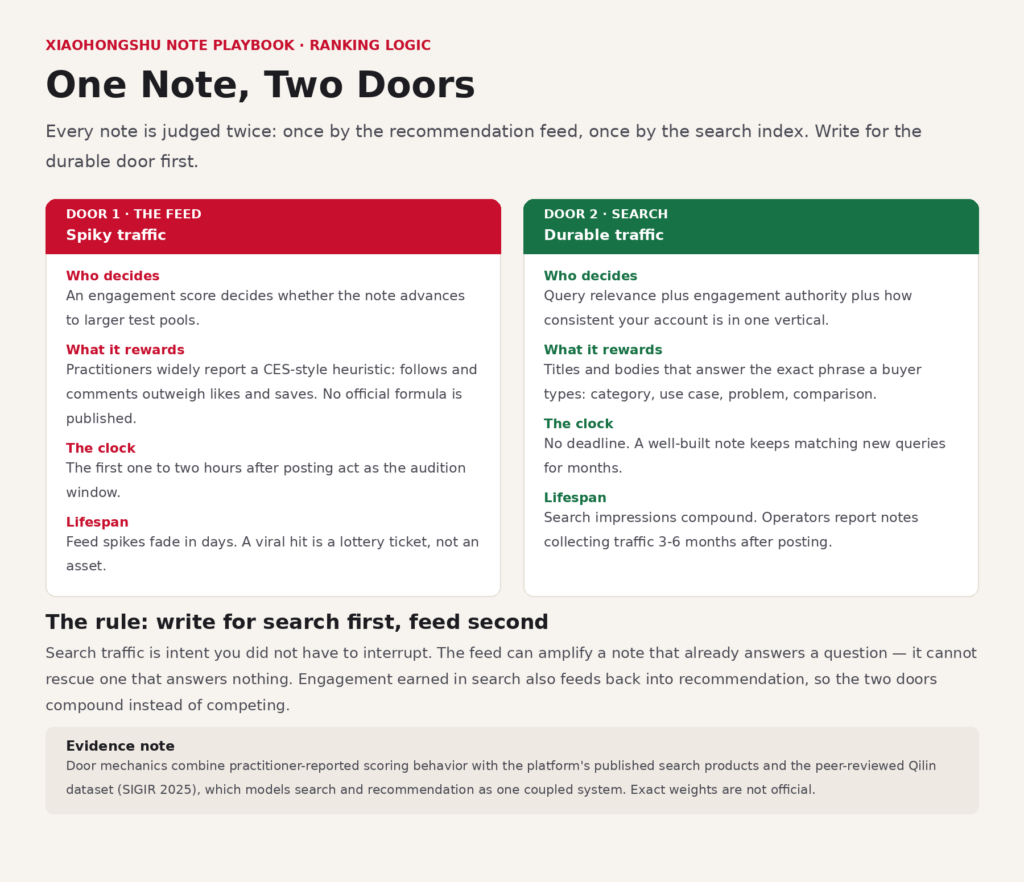
Every note you publish gets judged twice, by two different gatekeepers.
The feed door is the recommendation system. Practitioners widely report a CES-style engagement score — a heuristic in which follows and substantive comments count for far more than likes, with saves signaling utility. Xiaohongshu has never published an official formula, so treat the exact weights you see in course decks as folklore with a credible core: deeper actions outrank shallow ones. What operators consistently observe is an audition window — the first one to two hours after posting, when early engagement decides whether your note advances to larger test pools. Feed traffic is spiky. It arrives fast and leaves fast.
The search door works on a different clock. Here the note is matched against queries: does your title, body and tag vocabulary answer the phrase a buyer types? Relevance gets you considered; engagement history gets you ranked; and your account’s consistency in one vertical gets you trusted. There is no audition window, because the door never closes. Operators routinely report notes still harvesting search traffic three to six months after publication.
So here is the rule this whole playbook rests on: write for search first, feed second. Search traffic is intent you did not have to interrupt. The feed can amplify a note that already answers a question — it cannot rescue a note that answers nothing. And the doors compound: engagement earned through search feeds back into recommendation, which is why durable notes often get second and third feed lives.
Part 1 — The Cover Makes the Click Decision
In search results and the feed alike, your cover is a thumbnail competing against a wall of thumbnails. It has one job: earn the tap.
The platform’s native format is vertical, 3:4. Use it — a landscape image shrinks into irrelevance. Keep any text overlay short and high-contrast; operators converge on roughly ten characters or fewer, one visual promise per cover. Before-and-after splits and list-collage layouts work because they preview the payoff: the reader can see what they will get before spending a tap on it.
And please, retire the studio gloss. Xiaohongshu’s aesthetic reward function favors the native look — real rooms, real hands, real receipts. A cover that looks like a banner ad gets scrolled past like a banner ad.
The subtle rule: the cover promises, the title specifies. If the cover screams “save this checklist” and the title meanders into brand storytelling, the mismatch shows up as poor read-through, and the note stalls. Cover and title are one sentence split across two surfaces. Write them together.
Part 2 — The Title Carries the Keyword
You get 20 characters. That cap is real — media field-tests of the publishing flow confirmed it again when the long-form beta rolled out in July 2025. Twenty characters is not a constraint; it is a forcing function.
Front-load the search phrase. The words a buyer would actually type belong at the front, not buried after your brand name. Nobody who doesn’t know you searches your brand; they search their problem.
Four formulas that pay off
Operators keep returning to four patterns: audience + pain + solution (“oily skin, sunscreen that doesn’t pill”); the numbered list (“5 checks before buying a used lens”); the warning (“3 mistakes that ruin your first camping trip”); and the head-to-head (“A vs B after 30 days”). Each one mirrors a real query shape.
Where do you find the phrases? Three free mines: the search bar’s own suggestions (type your category root and harvest the completions), the keyword tools inside Juguang, the platform’s ad system, and the titles of competitor notes that keep resurfacing in results. Mine questions, not just nouns — “how to choose” and “is it worth it” are the queries with wallets attached.
One warning: never write a promise the body cannot cash. Clickbait borrows clicks at a brutal interest rate — readers bounce, completion collapses, and the note gets quietly buried.
Part 3 — The Body Earns the Save
The click is rented. The save is owned. A saved note is a reader telling the algorithm “this has future utility” — and telling themselves they will come back.
Structure the body like a good answer, not a press release. Open with one line that confirms the pain (“I also ruined two pans before learning this”). Then make it scannable: numbered steps or emoji bullets, one idea per block. Then bring evidence — real photos, actual prices, honest limits. Close with a soft invitation: save it for your next purchase, or answer one specific question in the comments.
On length, practitioners converge on a sweet spot of roughly 300 to 800 characters for standard image-text notes — long enough to be useful, short enough to finish. That is operator consensus, not a published rule; the long-form beta now allows thousand-plus character bodies for invited creators, but length is a servant of usefulness, never the goal.
Work your keyword in naturally — two to four placements across title, opening line and body is the working norm. Stuffing reads as spam to humans and, increasingly, to the semantic matching systems the platform has been deploying. Which brings us to the point most guides skip: honest limitations are a ranking asset. “Not for dry skin,” “the strap loosens after a month” — these lines make the rest believable, and believable notes get saved. The save button is a trust meter.
Part 4 — Tags and Location Are the Indexing Layer
Tags are not decoration; they are filing instructions. A small set of precise topic tags — mixing the category term, the use scenario, and one long-tail question tag — tells the system which shelves to stock you on. A wall of generic tags tells it nothing, or worse, whispers “spam.”
Local businesses should always attach the location tag: “city + service” is one of the highest-intent query shapes on the platform. And use brand tags only where your brand is properly registered — piggybacking on another brand’s tag is the kind of cleverness that gets notes throttled.
Part 5 — Comments Are the Second Content Field
Here is the most underpriced real estate on the platform: your own comment section. Remember those 70-plus million comments a day? Buyers read them as the unedited appendix to your note — sizing questions, ingredient checks, “does it work for…”.
Three moves make comments work for you. First, pin your own comment: a summary, a mini-FAQ, or the keyword phrased as a question-and-answer pair. Second, answer fast, especially in the first hours — quick author replies are both a velocity signal and a conversion lever. Third, mine the section: every recurring question is a validated topic for your next note. Operators who run this loop stop guessing what to write; their audience tells them, one comment at a time.
One boundary: seeding your own questions through fake accounts is exactly the coordinated behavior the platform’s anti-fraud systems hunt. Ask real friends real questions if you must prime the pump — never a comment farm.
The Account Behind the Note
Notes do not rank alone; they rank as representatives of an account. Vertical consistency — one domain, sustained — is the strongest account-level signal operators report, because it lets the system label your audience precisely. A steady cadence beats burst-and-vanish. Verified professional-account status unlocks the commercial tooling. And violation history is now a ledger, not a slap on the wrist: credit-score deductions suppress future distribution, which is why one clever shortcut can tax every note you publish afterward.
Running a matrix of accounts? Differentiate them genuinely — different personas, angles, audiences. Near-duplicate notes across accounts read as manufactured consensus, and the platform has spent two years building exactly the detectors that catch it.
The Compliance Gate: Three Rules Before You Publish
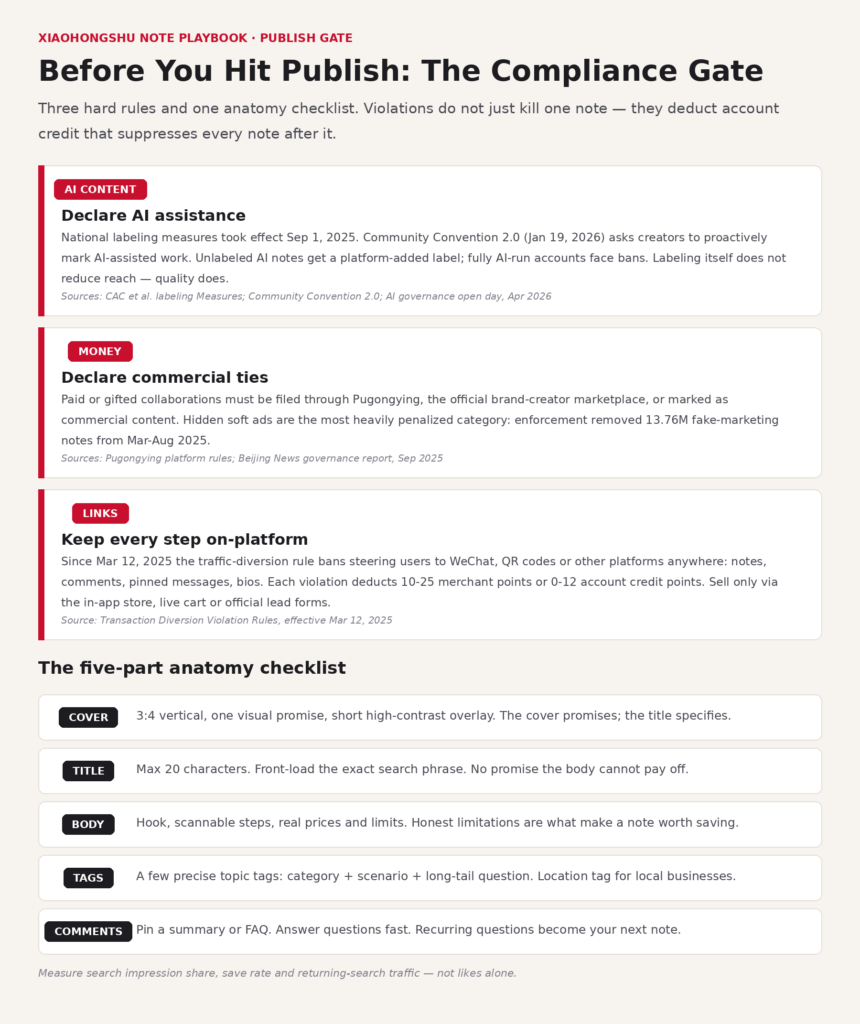
This is where organic ranking meets the law and the rulebook. Three gates, all verified against primary sources.
Gate one: declare AI assistance. China’s national AI-content labeling measures, issued by four ministries including the cyberspace regulator, took effect on September 1, 2025, and require users publishing generated or synthesized content to proactively declare it and use the platform’s labeling tools. Xiaohongshu’s Community Convention 2.0, released January 19, 2026, asks creators to mark AI-assisted work. At its first AI governance open day in April 2026, the platform said it will add labels to detected unlabeled AI content itself, and that the label does not reduce reach — quality decides distribution, and quality content gets priority. Fully AI-run accounts are a different story: over 800,000 were handled in 2026 alone. Use AI as an amplifier, declare it, keep a human voice.
Gate two: declare commercial ties. Paid or gifted collaborations belong in Pugongying, the official brand-creator marketplace, or marked as commercial content. Undeclared soft ads are the platform’s most-punished category — enforcement removed 13.76 million fake-marketing notes between March and August 2025. The label is not the penalty; hiding is.
Gate three: keep every step on-platform. Since March 12, 2025, the transaction-diversion rules ban steering users to WeChat, QR codes or other platforms anywhere — notes, comments, pinned messages, bios. Penalties run from warnings to permanent bans, with 10–25 merchant violation points or 0–12 account credit points deducted per offense. Sell through the in-app store, the live cart, or official lead forms. “DM me for the link” is not a growth hack; it is a deduction.
The Rewrite Workflow: Diagnose, Then Rebuild
Got a failing note? Do not delete-and-repost it — repetition dilutes account credibility. Diagnose which door failed. If feed impressions died within hours, suspect the cover-title pair or an early-engagement flop. If the note is invisible in search for its own target phrase, suspect vocabulary: you wrote what the brand says, not what the buyer types.
Then rebuild in anatomy order: re-shoot the cover around one visual promise, rewrite the title around the mined query, restructure the body into hook-steps-evidence-invitation, retag precisely, and plan the pinned comment before publishing. Ship it as a new angle, not a clone. And measure the right vitals: search impression share, save rate, returning-search visits — not likes. Likes are applause; saves are revenue intent.
Failure Modes That Kill Rankable Notes
The greatest hits, all avoidable: ad-voice bodies that announce instead of answer; keyword stuffing that trips semantic spam filters; cover-title mismatches that bleed completion; bought engagement that the fraud ledger eventually prices in; duplicate matrix notes; ignored comment sections; and the compliance trifecta — undeclared AI, undeclared commerce, off-platform steering. Every one of these converts a would-be asset into a liability.
The Pre-Publish Checklist
Before you hit publish, run the five-point gate: Does the cover make one promise in 3:4? Does the title front-load a real query within 20 characters? Does the body answer it with steps, evidence and honest limits? Do the tags file the note on the right shelves? Is the pinned comment drafted and are commercial/AI declarations in place? Five yeses, then publish. Anything less, rewrite.
The Bottom Line
Xiaohongshu is a search engine wearing a social app, and the numbers — 400 million users, 800 million daily queries — mean the costume is getting thin. Write for the save button, embed the buyer’s own words, declare what needs declaring, and let the comment section plan your editorial calendar. Feed fame is a lottery ticket. A rankable note is a bond: it pays quietly, for months. Compounding beats virality. Build the anatomy, in order, every time.