Your brand guidelines survived the flight to Shanghai. Your brand voice didn’t.
You know the artifact I’m talking about. The campaign deck lands in the local team’s inbox, beautifully translated, grammatically flawless — and it reads like an instruction manual written by a polite stranger. Nobody comments. Nobody shares. The comment section, when it exists at all, says the three words that should haunt every global brand manager: looks like an ad.
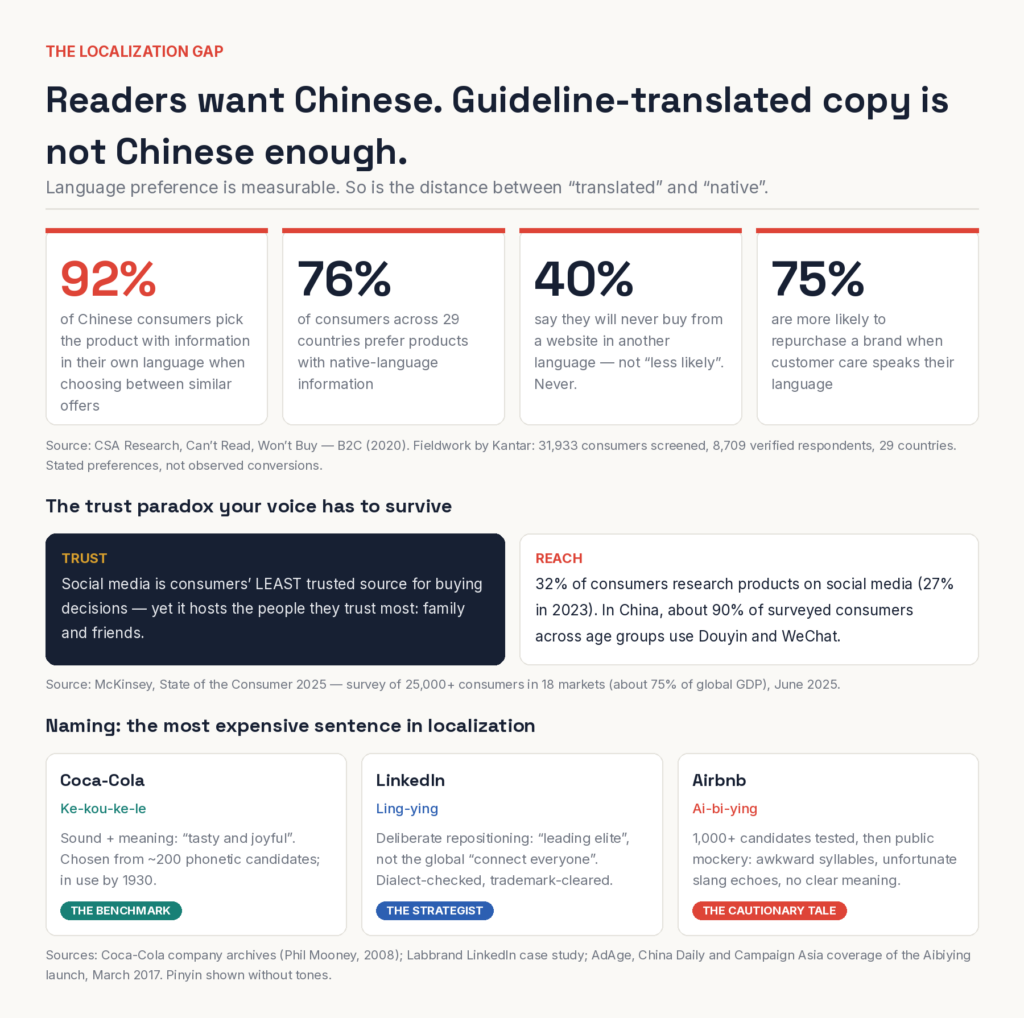
Here’s the uncomfortable diagnosis. Translation was never the hard part. In a market where 92% of Chinese consumers say they’d pick the product with information in their own language over a similar one without it — one of the strongest language preferences among the major economies in CSA Research’s 29-country survey — being in Chinese is table stakes, not an achievement. The hard part is being in Chinese the way a trusted local voice is in Chinese. That’s a different craft, and it has five layers, not one.
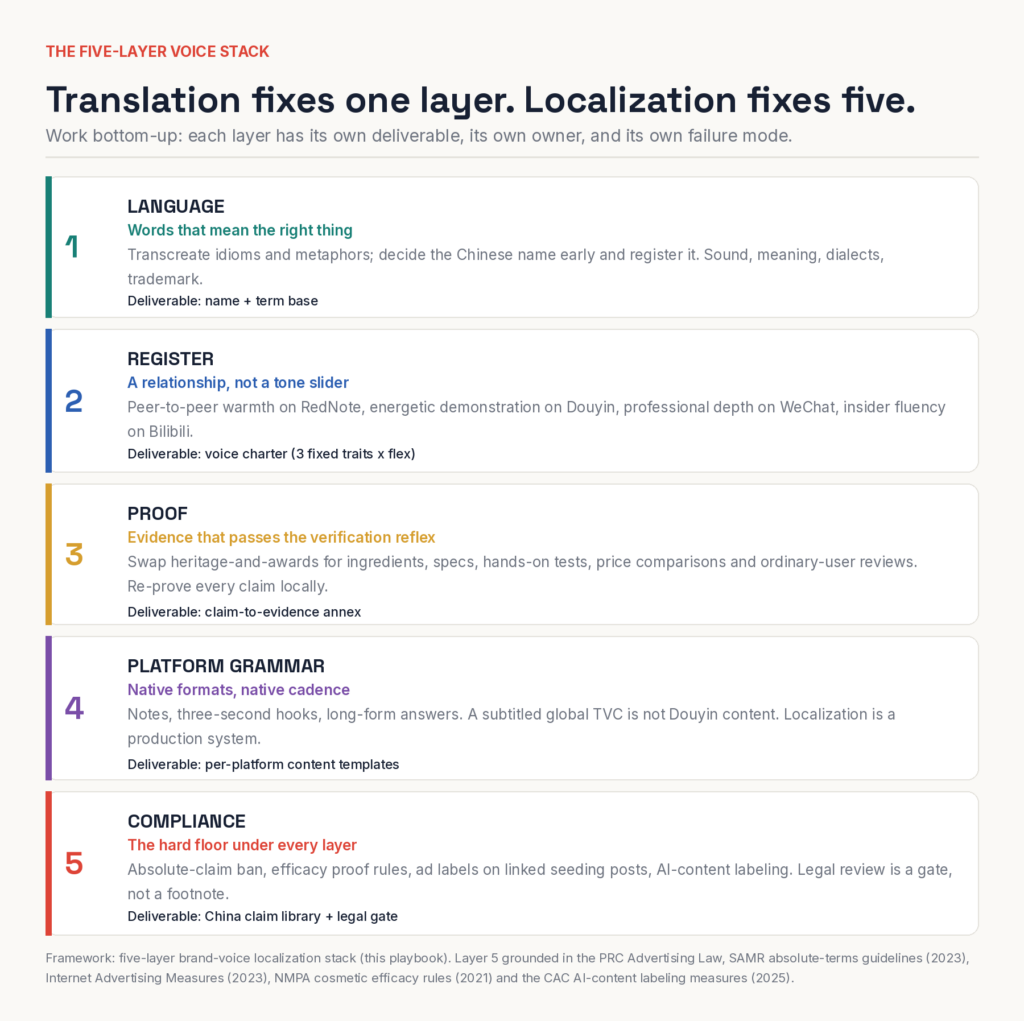
This playbook walks the full stack: language, register, proof, platform grammar, compliance. You’ll get a voice-charter template, a claim-library method, a workflow that keeps global strategy intact while letting execution go native, and an honest look at where AI helps and where it quietly ruins things.
Why Translated Copy Reads Like a Stranger
Start with the number that should reframe your budget. CSA Research — an independent research firm whose Can’t Read, Won’t Buy series is the most-cited language-preference study in the localization industry — worked with Kantar to screen 31,933 consumers and verify 8,709 respondents across 29 countries. The findings: 76% prefer products with information in their own language; 40% say they will never buy from a website in another language. Not less likely. Never. And 75% say they’re more likely to repurchase a brand when customer care speaks their language.
One caveat before you screenshot those numbers: this is stated-preference survey data from 2020 fieldwork, not observed conversion. And the same survey found 69% would still choose a strong global brand over local-language information — brand power buys you forgiveness. Just not forever, and not in the comment section.
Because here’s the paradox McKinsey’s State of the Consumer 2025 found across 25,000-plus consumers in 18 markets: social media is the least trusted source for buying decisions, yet it’s where consumers meet the sources they trust most — family and friends. Some 32% now research products on social platforms, up from 27% in 2023. In China, roughly 90% of surveyed consumers across age groups use Douyin and WeChat. Your voice doesn’t compete with other brands’ voices. It competes with a cousin’s recommendation. A translated corporate register loses that fight every time.
Layer 1 — Language: The Easy Layer That Eats Your Budget
Language is where localization projects go to feel productive. Transcreate the idioms, swap the metaphors, argue about whether to keep the English name. Necessary work — and roughly the smallest part of the problem.
The one genuinely high-stakes decision at this layer is the name. Get it right and you own a piece of the language. Coca-Cola’s Chinese name, Ke-kou-ke-le — roughly tasty and joyful — has been in use since at least 1930, and the company’s own archivist recounts staff winnowing some 200 phonetically plausible character combinations to find it. (The famous bite-the-wax-tadpole story, by the way, is half folklore: those grotesque renderings were shopkeepers’ improvisations, never the company’s official marketing name. The lesson survives the myth — unmanaged phonetic translation produces monsters.)
Get it wrong and the market writes your case study for you. When Airbnb announced Aibiying in March 2017 — a name its agency Labbrand had tested across more than a thousand candidates — Chinese social media responded with mockery: awkward syllables, unfortunate slang echoes, no meaning you could grasp without a briefing. AdAge and Campaign Asia documented the pile-on in detail. A name that people won’t say out loud is a word-of-mouth circuit breaker in a market that runs on word of mouth.
The interesting middle case is LinkedIn. Its Chinese name Lingying means something like leading elite — a deliberate departure from the global connect-everyone positioning, chosen after dialect checks and trademark screening because Chinese professionals wanted an authoritative international platform, not another grassroots network. That’s the real lesson of layer 1: sometimes localization means changing what you say about yourself, not just the alphabet you say it in.
Practical rules: decide the Chinese name before launch, screen it in Mandarin and major dialects, clear the trademark, and test whether people can say it in a sentence without wincing. Then move on. The next four layers are where the money is.
Layer 2 — Register: You’re Not Adjusting Tone, You’re Joining a Relationship
Western brand voice defaults tend to be individual aspiration, irony, understatement — a voice that stands apart and lets you admire it. Chinese platform-native voice defaults to something else: peer warmth, enthusiastic proof-sharing, collective belonging. The address forms alone tell the story — creators call their audiences sisters or family. A brand that shows up speaking like a press release is speaking into a group chat where everyone else is speaking like a friend.
But — and this is where naive localization goes wrong — there is no single Chinese register. The platform is the context:
- RedNote (Xiaohongshu): peer-to-peer sharing. The platform reported 350 million monthly active users in August 2025, and platform-stated figures say about 70% of monthly users search on the app — people arrive with purchase questions, not to be entertained. The native voice is a knowledgeable friend walking you through a real experience.
- Douyin: energetic demonstration. QuestMobile counted 907 million monthly active users in October 2025. The voice shows, fast, with personality — a hook in the first seconds or nothing.
- WeChat official accounts: professional depth. Longer arguments, earned authority, a reader who chose to subscribe. Irony can live here; hype dies here.
- Bilibili: community insider. The company’s Q4 2025 results put daily actives at 113 million and the average active user’s age at 26.5 — up from 21 at its 2018 IPO. This is a grown-up community with strong in-group literacy; borrowed slang used wrongly is worse than no slang.
One brand, four relationships. The tool that keeps this coherent is a voice charter: three fixed traits that never change on any platform (say, evidence-led, warm, never sneering), plus explicit flex dimensions — address form, energy level, humor style, proof density — tuned per platform. Fixed traits are the brand. Flex is the manners. Teams that write down both stop having the same argument every campaign.
Layer 3 — Proof: Rebuilding the Evidence Annex
Here’s the layer most global teams don’t know they’re failing. Western brand proof leans on heritage, awards, celebrity endorsement — trust by association and authority. Chinese digital-native proof leans on verification: ingredient lists, spec sheets, hands-on tests, price-per-unit comparisons, reviews from ordinary users. The consumer reflex is not do I admire this brand but can I check what it claims.
McKinsey’s trust data explains why. When your least-trusted channel is the one carrying your message, borrowed authority doesn’t transfer — checkable evidence does. And the regulatory environment has industrialized this reflex: since 2022, new cosmetic registrations in China must publish efficacy-evidence summaries on the regulator’s portal. Your customer can literally look up whether your serum’s claims have filed test data behind them. A heritage story doesn’t survive that lookup. A test report does.
The working method is a claim-to-evidence annex. Take every claim in your global message house and assign it a locally credible proof type:
- Global claim: award-winning formula → China proof: the specific test result the award was based on, ideally re-tested to Chinese standards.
- Global claim: loved by millions worldwide → China proof: scoped, sourced sales facts (period, platform, category — the ad law requires the source anyway) plus ordinary-user reviews.
- Global claim: celebrity favorite → China proof: keep it only as garnish; the main dish is demonstrable performance.
Heritage still works in luxury and premium categories, where provenance is part of the product. Everywhere else, treat it as a supporting actor. The annex does double duty: it’s your content brief and your compliance pre-screen in one document.
Layer 4 — Platform Grammar: Localization Is a Production System
A subtitled global TVC is not Douyin content. A translated blog post is not a RedNote note. This sounds obvious, yet the repurposed-global-asset approach remains the default because it’s cheap and the assets already exist. The grammar mismatch is structural: a note is a first-person experience with searchable keywords and photo evidence; a short video lives or dies in its opening seconds; a WeChat article is an argument a subscriber chose to read. Same claim, three different objects.
The implication is operational, and it’s the most expensive sentence in this playbook: localization is not a one-time translation project, it’s a production system. You need per-platform templates, a cadence, local creators or staff who speak the platform natively, and a feedback loop from comments back into the next batch. Budget it like a channel, not like a document. Teams that fund a translation sprint and then wonder why engagement flatlined bought a dictionary when they needed a newsroom.
The scale argument cuts both ways. With short-video users at 1.068 billion in China — 95.1% of all internet users, per CNNIC’s 56th statistical report — and 515 million people using generative-AI products by June 2025 per CNNIC’s separate AI application report, the audience for native-format content is enormous and the tools to serve it are cheap. The bottleneck isn’t tooling. It’s whether your operating model lets local hands actually make things.
Layer 5 — Compliance: The Hard Floor Under Every Layer
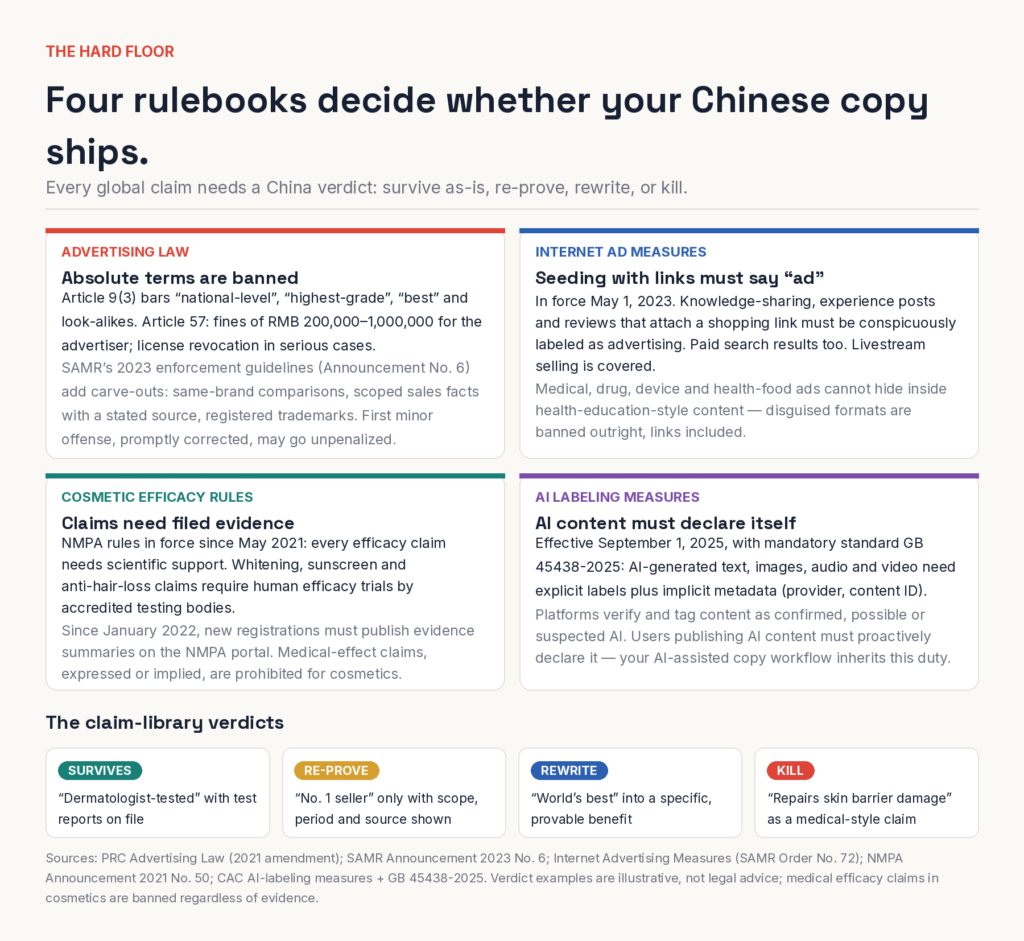
Compliance is not a layer you can negotiate with tone. Four rulebooks decide whether your Chinese copy ships, and each has teeth:
The absolute-terms ban. Article 9(3) of the Advertising Law prohibits national-level, highest-grade, best and similar absolutes. Article 57 sets fines of RMB 200,000 to 1,000,000 for the advertiser, with license revocation in serious cases. Your global superlatives — world’s best, No. 1, unmatched — mostly die here. But read the fine print before you panic: SAMR’s 2023 enforcement guidelines carve out same-brand comparisons, factual sales rankings with a stated period, scope and source, registered trademarks containing absolute words, and standardized product grades. A first, minor, promptly corrected violation may go unpenalized. Efficacy claims in medical and health categories generally don’t qualify as minor. The skill is not deleting every superlative; it’s knowing which claims can be re-proven into legality.
The seeding label rule. Since May 2023, the Internet Advertising Measures require that experience-sharing or review content with a shopping link attached be conspicuously labeled as advertising. Paid search results too. Livestream selling is covered. And medical, drug, device and health-food ads can’t hide inside health-education content at all — the disguised format itself is banned. Your KOC seeding program is an advertising operation; run it like one.
The efficacy-evidence regime. Under NMPA rules in force since May 2021, cosmetic efficacy claims need scientific support; whitening, sunscreen and anti-hair-loss claims require human efficacy trials by accredited bodies, and evidence summaries for new registrations are public. Medical-effect claims — expressed or implied — are prohibited for cosmetics. Barrier repair phrasing that sails through Western review can be an illegal medical implication in China.
The AI-labeling duty. Since September 2025, China’s AI-content labeling measures and the mandatory GB 45438-2025 standard require explicit labels plus implicit metadata on AI-generated content, platform verification that tags content confirmed, possible or suspected AI, and proactive declaration by users who publish it. If your localization workflow ships AI-assisted copy and imagery — and in 2026, whose doesn’t — this duty is yours, not just the tool vendor’s.
The deliverable for this layer is a China claim library: every global claim gets a verdict — survives, re-prove, rewrite, or kill — with the required evidence attached. Legal review becomes a gate in the workflow, not a footnote after launch.
The Voice Charter Template
One page. Two columns. Sign it once, revisit quarterly.
Fixed traits (never flex, owned by the global brand owner): pick three. Examples: evidence-led (every claim carries proof); warm without flattery; never punch down at competitors or customers. These are the brand’s spine — the things a customer should recognize on any platform in any language.
Flex dimensions (owned by the local team): address form (peer, expert, insider); energy (calm, lively, playful); humor (dry wit, memes, none); proof density (spec-heavy vs experience-heavy); cadence and format per platform. Write down the default and the allowed range for each.
Red lines (owned by legal): the claim library verdicts, category-specific bans, labeling duties. Red lines override both columns.
The governance rule that makes this work: strategy stays with the brand owner, execution goes local. Global teams that dictate wording lose the market; local teams that rewrite positioning lose the brand. The charter is the treaty between them.
The Workflow: From Global Assets to Native Output
Sequence matters. Run it in this order:
- Audit the global asset inventory and message house. Tag every claim.
- Gap-analyze against the five layers — most teams discover their gaps concentrate in proof and platform grammar, not language.
- Charter sign-off with global brand, local lead, and legal in the same room. Once.
- Pilot a small batch per platform — enough to read comment sentiment, not enough to bet the quarter.
- Dual review: native-speaker reviewer for voice fit, compliance reviewer for the claim library. Two different people, two different checklists. A native speaker who isn’t compliance-trained will happily approve an illegal superlative that sounds natural.
- Measure and iterate — voice-fit scoring against local benchmarks, not global averages.
Team design follows the charter: the global owner guards fixed traits, the local team owns flex, legal owns the gate. The failure mode to watch is drift in both directions — headquarters quietly re-centralizing wording, or the local team drifting so far native that the brand becomes unrecognizable. Quarterly charter reviews catch both.
AI-Assisted Localization: The 2026 Lever, With Gates
LLMs are genuinely good at the mechanical middle of this stack: drafting transcreation variants against a voice charter used as the system prompt, enforcing a claim library as a hard constraint, generating per-platform format skeletons at a cost that makes sustained native production affordable. Use them there.
But know the failure modes, because they’re specific. First, register drift: machine output trends toward a standardized, flattened style — translation studies has a name for the post-editing version of this, post-editese, and practitioners recognize it instantly. A Slator reader poll in 2024 (small and non-representative, but directionally telling) found 61% of respondents calling machine-translation post-editing tedious and mind-numbing; the complaint underneath is that fixing flat output is harder than writing fresh. Second, hallucinated claims: a model asked for persuasive copy will invent the evidence your claim library exists to prevent. Third, compliance blindness: the model does not know Article 9(3), and fluent output is exactly what makes an illegal superlative slip through review.
So the gates are non-negotiable: charter-constrained generation, claim-library filtering before human review, native + compliance dual sign-off, AI-content labeling where required. AI expands your production capacity. It does not expand your accountability.
Measuring Voice Fit: What to Actually Track
Global dashboards will tell you the localized content underperforms the global average and tempt you to blame localization. Wrong baseline. Track instead:
- Native-reviewer scoring: blind panel of target-platform users rating voice fit against native competitors, not against your global creative.
- Engagement vs local category benchmarks: saves and shares on RedNote, completion on Douyin, read-through on WeChat — each against the platform’s category norms.
- Comment sentiment: the ratio of this feels real to this looks like an ad is your truest voice metric, and it’s free.
- Conversion parity tests: localized-voice content against global-voice control, same offer, same platform. You’re testing voice, not price.
One 2026 addition worth watching: McKinsey’s State of the Consumer 2026 — a five-market survey of 4,863 consumers — found that only about 1% of the sources LLMs cite for consumer-goods answers come from brand-owned websites. Your localized voice increasingly lives or dies in third-party content: reviews, forums, creator posts. Which means the voice charter has to govern what you seed and earn, not just what you publish. The comment section is now also the training data.
Six Failure Modes to Post on the Wall
- Translation-only: funding layer 1 and declaring victory. The 90/10 trap — most of the budget on the smallest part of the problem.
- Register whiplash: sisterly warmth on RedNote, corporate legalese on WeChat, with no charter connecting them. Users read it as inauthenticity, not versatility.
- Proof-style mismatch: heritage-and-awards copy in a verification-reflex market. Admired, not believed.
- Compliance afterthought: legal review after the campaign ships. In China this is not a quality issue; it’s a fine with a statutory floor.
- Local over-ride: the team goes so native the brand’s fixed traits dissolve. You win the comment section and lose the brand.
- Ungated AI output: fluent, flat, occasionally illegal, shipped at machine speed. The most modern way to fail at all five layers simultaneously.
The Bottom Line
Localization is not making your brand readable in Chinese. It’s making your brand believable in Chinese — a relationship (register), backed by checkable evidence (proof), delivered in native objects (platform grammar), inside a legal floor you cannot decorate around (compliance), with the words themselves (language) being the easiest part of the job. Fund it as a production system, govern it with a one-page charter, gate it with two reviewers, and measure it against local reality. The market that punishes foreignness most severely also rewards nativeness most generously — 92% language preference cuts both ways. Speak like you belong, and belong.