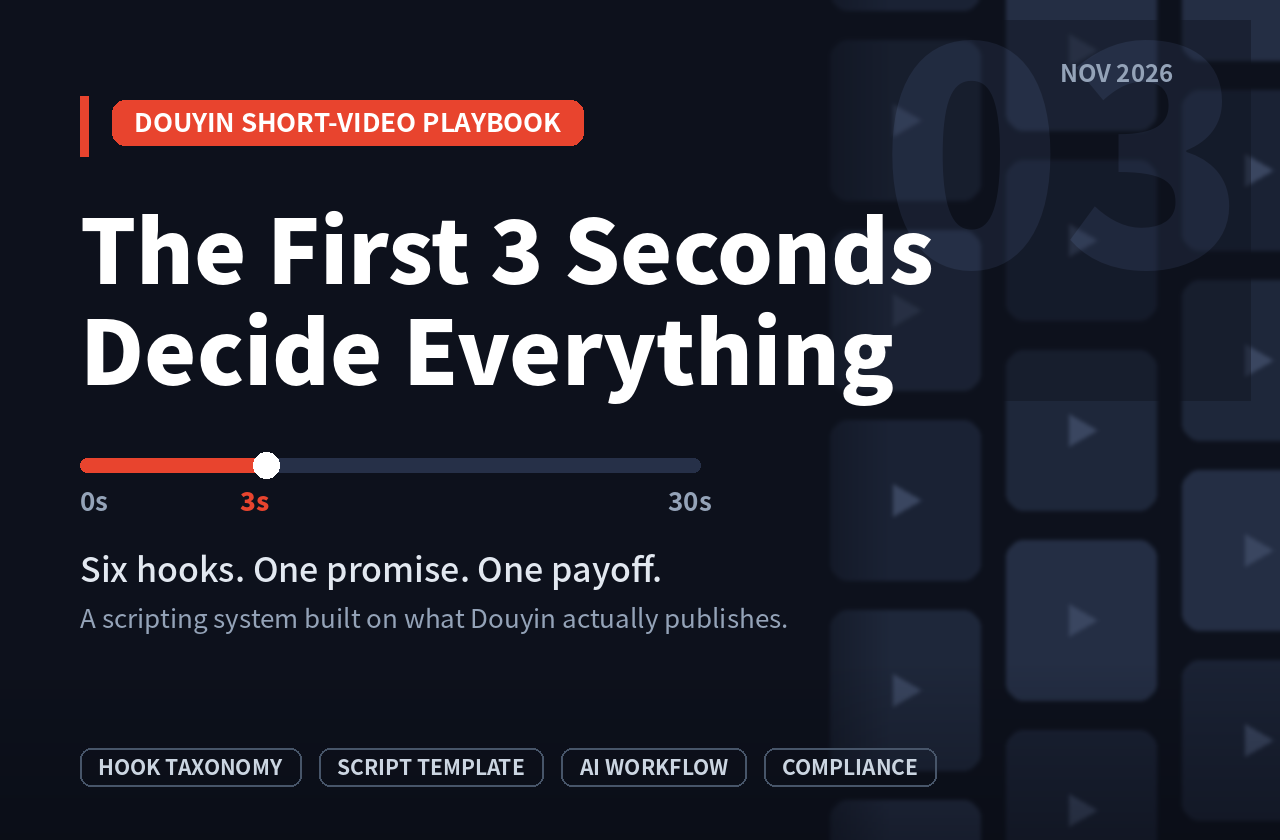
Hook taxonomy, hold structure, payoff design and the testing loop — verified against platform disclosures, national regulations and vendor pricing pages. November 2026.
Every Douyin course on the internet opens with the same slide: the golden three seconds. Most of them then bury the idea under invented statistics — 67% swipe-away rates, 40% completion-rate weights, tiered “traffic pools” with exact view counts. Here’s the uncomfortable part: almost none of those numbers appear in anything Douyin has actually published. And here’s the good part: you don’t need them. What the platform has officially disclosed about its recommender, what its ad system measures, and what Chinese law requires of your script are more than enough to build a scripting system that survives the swipe.
This playbook gives you that system: six opening patterns, a timecoded script skeleton, a testing loop, and the compliance gates that keep your account alive while you iterate.
Why Three Seconds? What the Algorithm Actually Does
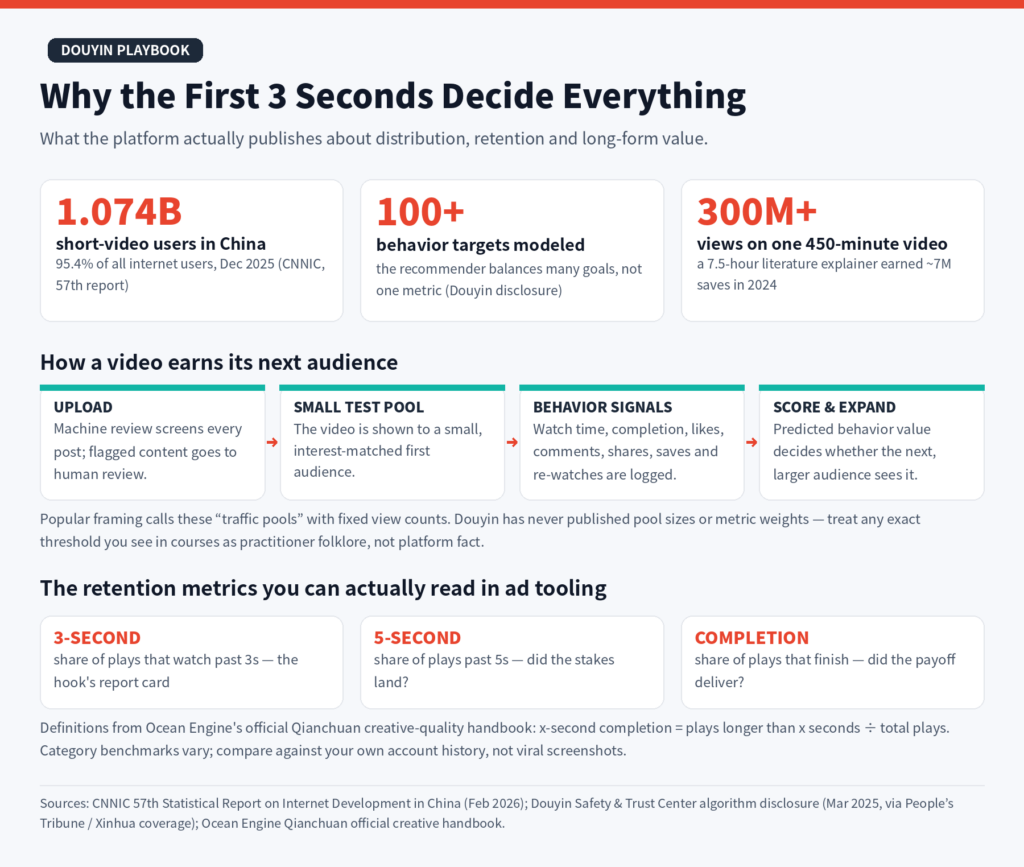
In March 2025, Douyin did something no short-video platform had done before: it published how its recommendation system works. Through its Safety and Trust Center website, the company explained that the recommender barely relies on content tags anymore. Instead, neural networks estimate the probability of each user’s behavior — will they finish this video, like it, comment, share, save it, come back for more from this creator? The system then ranks content by the total predicted value of those behaviors.
Two details from that disclosure matter enormously for scriptwriting.
First, completion is one objective among more than a hundred. Douyin’s engineers described balancing over 100 modeling targets — saves, re-watches, long-term creator consumption, diversity — because optimizing a single metric produces a feed of interchangeable content. So no, completion rate is not “70% of your score.” Anyone quoting a fixed weight is guessing.
Second, the platform deliberately trained models to predict saves and re-watches, and moved the save button to prime screen real estate. The proof case they cite: a 450-minute video essay on the classic novel Dream of the Red Chamber earned over 300 million views and roughly 7 million saves in 2024. Seven and a half hours. On the platform where attention supposedly goes to die. That single example torpedoes the idea that Douyin only rewards short, punchy clips — what it rewards is content people actually value, at any length.
The scale is worth pausing on. China’s internet authority CNNIC counted 1.074 billion short-video users as of December 2025 — 95.4% of all internet users in the country. This is not a growth channel anymore; it’s infrastructure. You’re not fighting for new eyeballs; you’re fighting for the next three seconds of a billion people’s existing habit.
The Metrics That Reward Your Opening
While organic distribution weights remain undisclosed, the paid side is refreshingly concrete. Ocean Engine — ByteDance’s ad platform — publishes an official creative-quality handbook for Qianchuan, its Douyin ad system. Among the playback metrics it names for evaluating video creatives: 3-second completion rate, 5-second completion rate, overall completion rate, and watch duration. The definition is plain arithmetic: x-second completion equals the share of plays that lasted longer than x seconds.
Think of it as a three-stage report card for your script. The 3-second number grades your hook. The 5-second number grades your stakes — did the viewer buy a reason to stay? Overall completion grades your payoff. When a video underperforms, these three numbers tell you which act failed, which is exactly what you need to fix it without reshooting everything.
One honest caveat: the “benchmarks” for these rates that circulate online (you’ll see 40% here, 15% there) come from agency blog posts and course slides, not from platform documentation, and they vary wildly by category and price point. Measure against your own account’s history, not against screenshots.
The Six-Hook Taxonomy
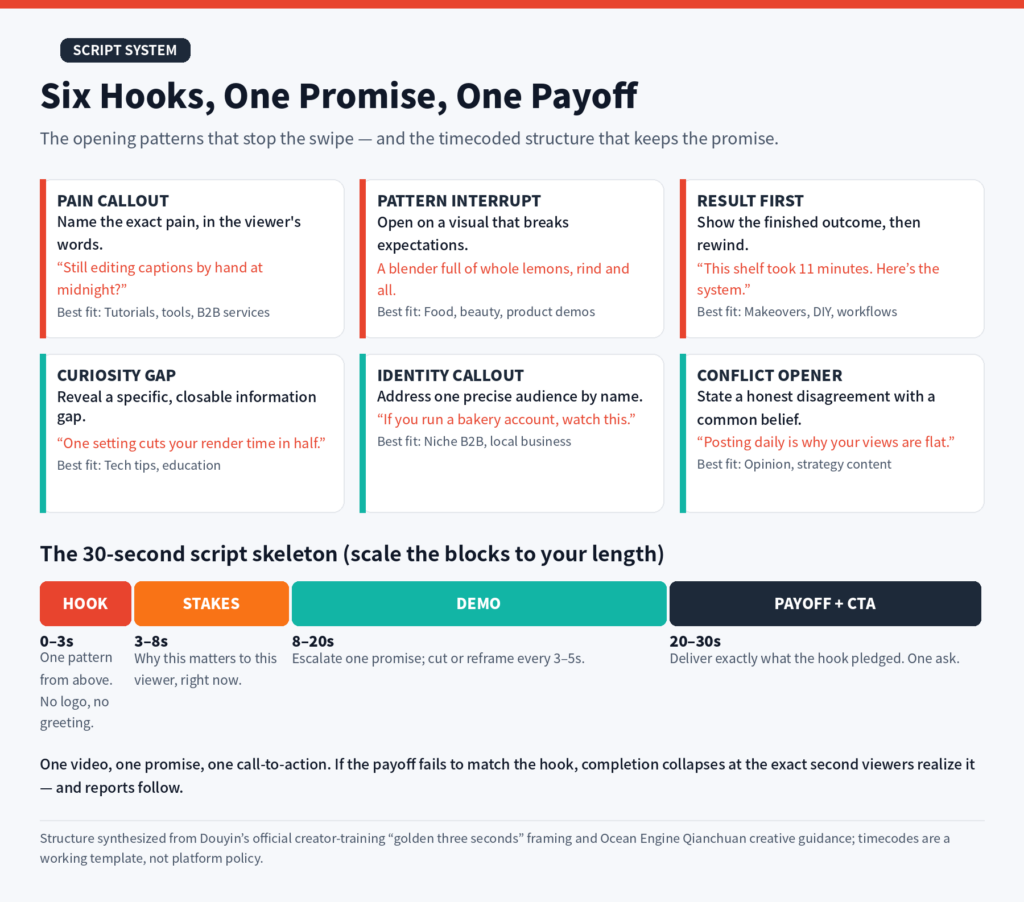
Douyin’s creator-training materials formalize the opening as the golden three seconds, and practitioner frameworks converge on a handful of repeatable patterns. Here are six that work, each with a first line you can adapt:
- Pain callout. Name the exact pain in the viewer’s own words. Not “tired of editing?” but “still hand-timing captions at midnight?” Specificity is the whole trick — a vague pain belongs to everyone and stops no one.
- Pattern interrupt. Open on a visual that breaks expectations: a blender full of whole lemons, rind and all. The brain allocates attention to prediction errors; give it one in frame one.
- Result first. Show the finished outcome, then rewind. “This shelf took eleven minutes. Here’s the system.” The result creates the question; the body answers it.
- Curiosity gap. Reveal a specific, closable information gap: “one setting cuts your render time in half.” The gap must be real and it must close — more on that below.
- Identity callout. Address one precise audience: “if you run a bakery account, watch this.” In a feed built for everyone, being called by name is the rarest feeling.
- Conflict opener. State an honest disagreement with a common belief: “posting daily is why your views are flat.” Honest is load-bearing — you must be able to defend it in the body.
What all six share: they make a promise in under three seconds, and the promise selects the audience. A hook that grabs everyone grabs no one the algorithm can build on, because the first test audience is interest-matched.
The Hold: Seconds 3 to 20
Stopping the swipe is half the job; the middle is where most videos quietly die. Three rules keep the hold.
One video, one promise. The moment your cooking demo detours into a brand story, viewers who came for the recipe leave. Every secondary topic is a tax on the primary promise.
Escalation beats listing. “Here are five tips” is a list — flat, skippable, and the viewer can guess the ending. “This mistake costs you money, and the fix is weirder than the mistake” is escalation. Structure the middle so each beat raises the stakes on the same question the hook opened.
Re-earn attention every 3–5 seconds. A cut, a zoom, a text pop, a change of angle — some visual event that resets the viewer’s prediction machinery. Watch your retention curve in the analytics: the drop-off points are where the frame went static. This is editorial craft, not superstition; the x-second metrics exist precisely because early abandonment is the platform’s clearest negative signal.
The working skeleton for a 30-second video: 0–3 hook, 3–8 stakes, 8–20 demonstration with escalation, 20–30 payoff plus one call-to-action. Scale the blocks proportionally for longer formats — but keep the ratios, not just the order.
The Payoff and the One-CTA Rule
The payoff must deliver exactly what the hook pledged. This is where the curiosity-gap hook goes wrong most often: open with “90% of people don’t know this,” then spend 25 seconds never actually revealing the thing, and you’ve trained both the viewer and the algorithm that your openings lie. Completion collapses at the precise second the audience realizes the payoff isn’t coming, and reports follow. Close every loop you open.
On calls-to-action: pick one per video. Follow, save, comment, or click — not a stacked “like, comment, share, follow and check my bio.” Each additional ask dilutes the others, and forced-engagement bait is explicitly a punishable violation under Douyin’s commerce rules. For product videos, align the product-card moment with the payoff: the card should appear when the viewer has just seen the result and wants the thing, not while you’re still building the case.
Scripting by Video Type
The skeleton flexes by format. A seeding review (product recommendation) opens best with result-first or pain-callout, demos in real use conditions, and pays off with an honest verdict — the save button is your friend here, since save-prediction is a modeled objective. A knowledge talking-head favors curiosity gap or conflict, and lives or dies on escalation; if your third point is weaker than your first, cut it. Narrative commerce skits open on conflict mid-scene — never on scene-setting — and the product must resolve the plot, not interrupt it. Livestream clips are their own validated traffic model: the hook already happened live, so your scripting job is finding the 20-second arc with a beginning and a payoff inside hours of footage, then labeling it honestly as a clip.
AI-Assisted Scripting: The 2026 Workflow
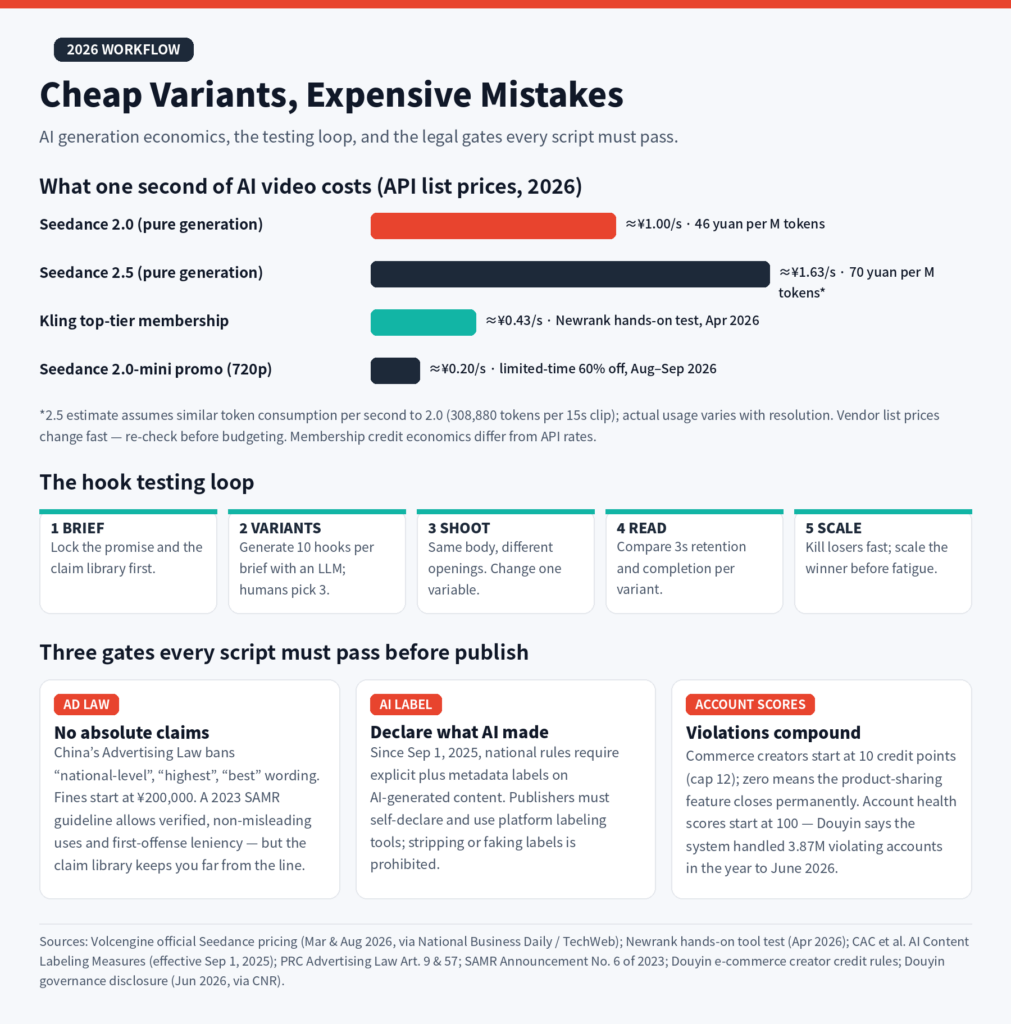
The economics genuinely changed this year. When ByteDance’s Volcengine published API pricing for its Seedance 2.0 video model in March 2026, pure text-to-video generation ran 46 yuan per million tokens — about 308,880 tokens for a 15-second clip, which works out to roughly one yuan per second. The 2.5 version, launched in August with 30-second single-shot output, lists at 70 yuan per million tokens for pure generation. On the membership side, Newrank — an independent Chinese new-media research firm — tested seven tools hands-on in April 2026 and found per-second costs ranging from about 0.18 yuan (a discounted Kling integration) to 1.38 yuan (Jimeng’s top-tier model), with Kuaishou’s Kling top membership landing around 0.43 yuan per second. Treat all of these as snapshots — vendors repriced repeatedly through 2026 — but the order of magnitude is the point: a 15-second variant costs single-digit yuan in compute.
So here’s the rational workflow inversion: use an LLM to generate ten hook variants per brief, have a human select three, shoot or generate the same body with different openings, and let the 3-second metric pick the winner. Variant volume is now cheap; direction is still scarce. What AI cannot do is decide the promise — what you’re claiming, to whom, and whether it’s true. That judgment is the brief, and the brief is yours.
One more gate: since September 1, 2025, China’s AI Content Labeling Measures — issued jointly by the cyberspace, industry, public security and broadcasting regulators — require explicit labels on AI-generated video plus metadata labels in the file, and require you as the publisher to self-declare AI content using the platform’s labeling tools. Stripping or faking labels is prohibited outright. Douyin has been actively enforcing this: its October 2026 governance bulletin detailed takedowns of AI digital-human accounts impersonating celebrities’ relatives to sell fake health remedies. Label your AI footage; the alternative is not a gray area.
The Testing Loop
Run hooks like experiments, not like art. Same body, different openings; change one variable at a time. Read 3-second retention and completion per variant — not total views, which conflate distribution luck with creative quality. Set kill-and-scale rules before you launch: if a variant’s 3-second retention trails the account median after its test pool, kill it; if one clears the median decisively, scale spend or produce siblings before creative fatigue sets in. In paid contexts this is the horse-race logic Qianchuan teams already use — and with generation costs at yuan-per-second, the constraint is no longer how many variants you can afford, but how many distinct promises you can honestly make.
Compliance Gates Before Publish
Three gates, checked before the camera rolls, not after the penalty notice.
Advertising law. Article 9 of China’s Advertising Law bans absolute claims — “national-level,” “highest,” “best” and equivalents — with fines from 200,000 to one million yuan under Article 57. The State Administration for Market Regulation’s 2023 enforcement guideline added nuance: verifiable, scoped factual claims (like time-limited sales rankings) fall outside the ban, and first minor offenses promptly corrected may go unpunished — at the regulator’s discretion, not as a right. The smart move is upstream: keep a claim library of pre-approved, evidenced phrasings, and write scripts from it.
AI declaration. Covered above: declare, label, never strip.
Account scoring. Commerce creators start with 10 credit points, capped at 12; hit zero and the product-sharing feature closes permanently. Separately, account health scores start at 100, and a fresh deduction resets your accumulated recovery progress — this is the mechanism Douyin says it used to handle 3.87 million violating accounts in the year to June 2026. Violations compound; one careless superlative can cost more than a hundred videos earn.
Five Failure Modes to Audit Your Script Against
Before you publish, scan for these: the brand-logo opening (three seconds of your logo is three seconds of nothing promised); the multi-promise video (two hooks fighting over one body); payoff mismatch (the loop that never closes); CTA stacking (five asks, zero actions); and format-copying without angle fit (the viral structure borrowed whole, with nothing specific to say inside it). Each one shows up in the retention curve before it shows up in your revenue — which means each one is fixable this week.
The Printable Script Sheet
Work every video through this grid before shooting:
| Block | Time | Write this before shooting |
|---|---|---|
| Hook | 0–3s | Pattern chosen + exact first line + first frame |
| Stakes | 3–8s | One sentence: why this viewer, why now |
| Demo | 8–20s | Three escalating beats + visual event every 3–5s |
| Payoff | 20–27s | The delivered promise, word-matched to the hook |
| CTA | 27–30s | ONE action; product card timing if commerce |
| Gates | — | Claim library check · AI label check · loop-closed check |
Summary
Douyin never published traffic-pool sizes or metric weights, and you don’t need them. What it did publish — a behavior-prediction recommender balancing 100+ objectives, official 3-second and 5-second creative metrics, save-and-rewatch modeling strong enough to push a 450-minute video to 300 million views — tells you everything a script needs: make one specific promise in three seconds, escalate it without detours, deliver it exactly, ask for one thing, and verify every claim before it costs you account points. AI made variants nearly free in 2026; the scarce inputs are now honest promises and disciplined testing. Write like the payoff matters, because the algorithm — and a billion viewers’ thumbs — can tell when it doesn’t.