Every team that gets burned by Xiaohongshu enforcement made the same arithmetic error, and it is worth naming precisely: they priced risk in the wrong unit.
The Unit Mismatch
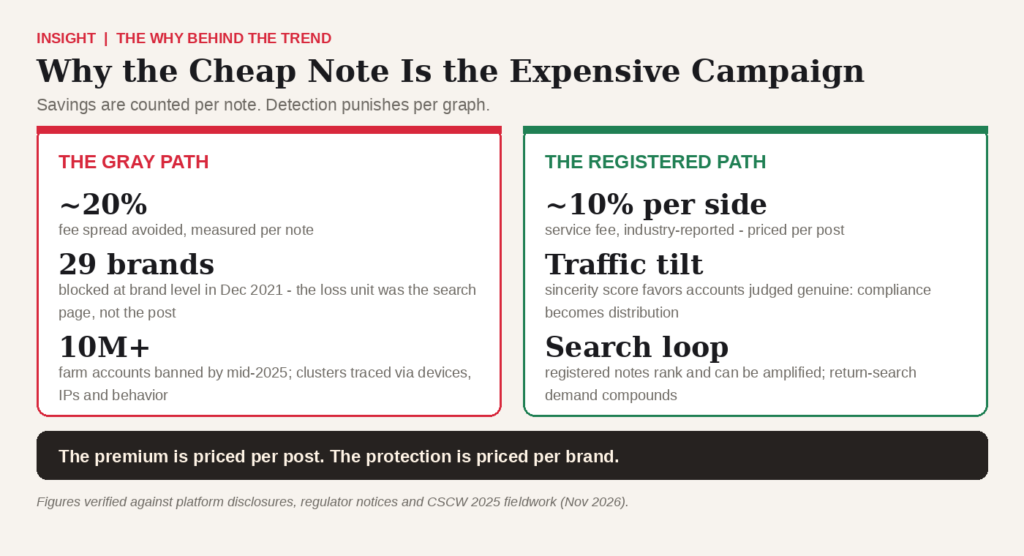
The saving from skipping registration is denominated per note — roughly a twenty percent fee spread, industry-reported, on a creator’s quote. It shows up cleanly in a campaign spreadsheet, line by line. The penalty is denominated in an entirely different unit: the account graph, and at the tail, the brand itself. In December 2021, twenty-nine brands did not lose twenty-nine posts. They lost their search pages — every note, past and future, replaced by a false-marketing notice. You cannot net a per-note saving against a per-brand loss. The units do not cancel. That mismatch, not greed or ignorance, is why rational teams keep choosing the option that eventually costs them everything.
Why Detection Made the Mismatch Worse
For years the mismatch was survivable because enforcement was noisy — a flagged note here, a muted account there. Then the platform industrialized graph-level detection. Device, IP and behavior correlation now tie notes to clusters and clusters to organizers: one month of 2026 sweeps traced 495,000 accounts through shared risk devices alone, and the farm-account campaign passed ten million bans by mid-2025. When punishment arrives at graph scale, the per-note saving is not a discount. It is a short position on your own network, sold at twenty percent of premium and settled at the worst possible moment.
The Hidden Second Ledger
There is a subtler reason the cheap note loses. The platform’s sincerity-score system tilts distribution toward accounts judged genuine, and registered notes remain eligible for search ranking and paid amplification. Compliance is not merely the absence of penalty; it is an input to reach. The gray note therefore pays twice: once in tail risk, once in suppressed distribution and zero return-search capture. CSCW 2025 fieldwork adds the human leg — KOC payments hidden inside KOL budget lines made the labor invisible to the very finance systems booking the savings. Invisibility on both sides of the ledger: the cost was never booked, and the labor was never seen.
What the Mismatch Predicts
Follow the units and the trends explain themselves. Crackdowns escalate from notes to accounts to brands to tool vendors — the Hangzhou courts fined an AI ghostwriting tool because fabrication threatens the ecosystem, the largest unit of all. Fees stay unpopular because they are visible per post while their benefit is invisible per brand. And the teams that win are the ones that re-denominate: they treat the fee as a per-brand insurance premium bought in per-post installments. The cheap note is only cheap until you count in the unit the platform counts in.