In January 2026, Douyin’s ad platform did something that looked like generosity. Orders placed through its new Chengfang system would carry a technical service fee of just 0.6%. AI creative generation became free. Coupons flowed. Seven months later, on August 1, the fee waiver quietly ended. Operators cried rug-pull. But watch the sequence again, slowly, and a different story appears: this was never a gift. It was a purchase. And the platform got exactly what it paid for.
What the platform was actually buying
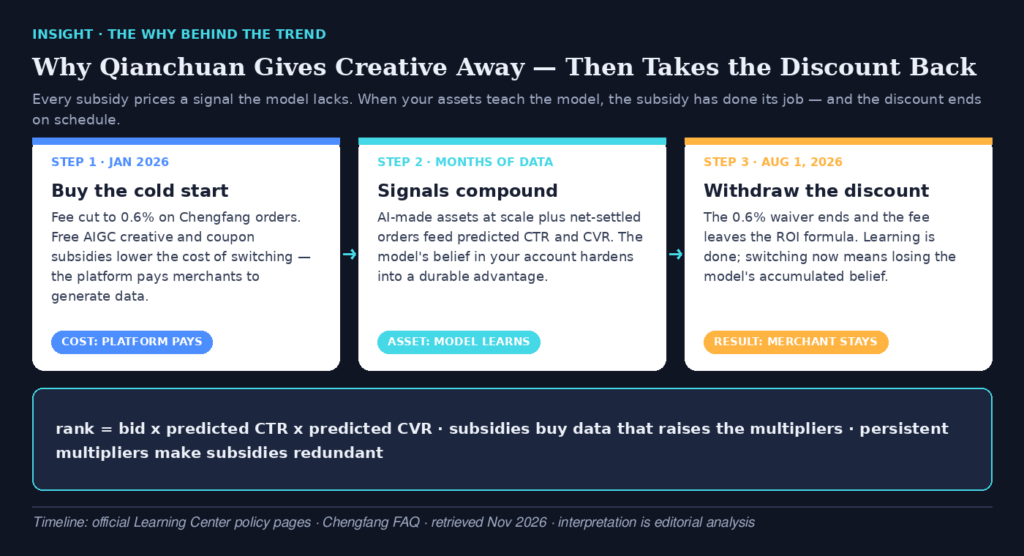
Remember the ranking equation from the deep dive: your ad’s rank is roughly your bid multiplied by predicted click-through and conversion rates. Those predictions are the model’s belief about your account — and belief requires evidence. A merchant who has never run Chengfang has no super-plan history, no AIGC asset performance, no net-settled conversion stream inside the new ledger. To the model, that merchant is a stranger.
Subsidies are how platforms buy introductions. The 0.6% fee slashed the cost of switching. Free AIGC removed the cost of producing the very assets the model needs to observe. Every generated video that ran, every net-settled order that landed, deposited evidence into the prediction layer. The platform wasn’t discounting your commissions; it was paying you to train its model on your business.
Why the withdrawal was on schedule, not a betrayal
Here is the uncomfortable economics: a subsidy is rational only while it buys something the platform lacks. Once your account has months of conversion history and a library of tested creative, the model’s multipliers persist without further payments. The information has been extracted. Continuing the discount would just be margin leakage.
And the lock-in runs deeper than habit. Under Chengfang, your accumulated performance lives inside the platform’s belief system — the official FAQ is explicit that upgraded plans inherit model data with no re-learning, which also means leaving forfeits it. Switch away, and you become a stranger again, at full price, in a colder auction. The August withdrawal didn’t create the lock-in. It merely revealed it.
This is the same clock that ran on creator funds, ride-hailing bonuses and food-delivery subsidies worldwide: pay for behavior change, harvest the data, retire the incentive once the behavior is self-sustaining. Qianchuan’s version is unusually clean because the asset being purchased — prediction confidence — is measurable, compounding, and non-portable.
What this means for your budget
Three practical reads. First, treat every platform subsidy as expiring capital: build the break-even math at full price, and let the subsidy be upside, never the business model. Second, the real asset you accumulated during the subsidy window isn’t the saved fees — it’s the conversion history and creative evidence. Keep feeding it, because that’s what you can’t take with you. Third, expect the clock to repeat: the next “generous” launch, in China or anywhere, is buying a signal somebody lacks. Ask which one, and you’ll know when the discount ends — roughly when the model stops needing you to teach it.
The platform gave away creative because creative was cheap and your data was not. Generosity, in an auction economy, is a procurement strategy.