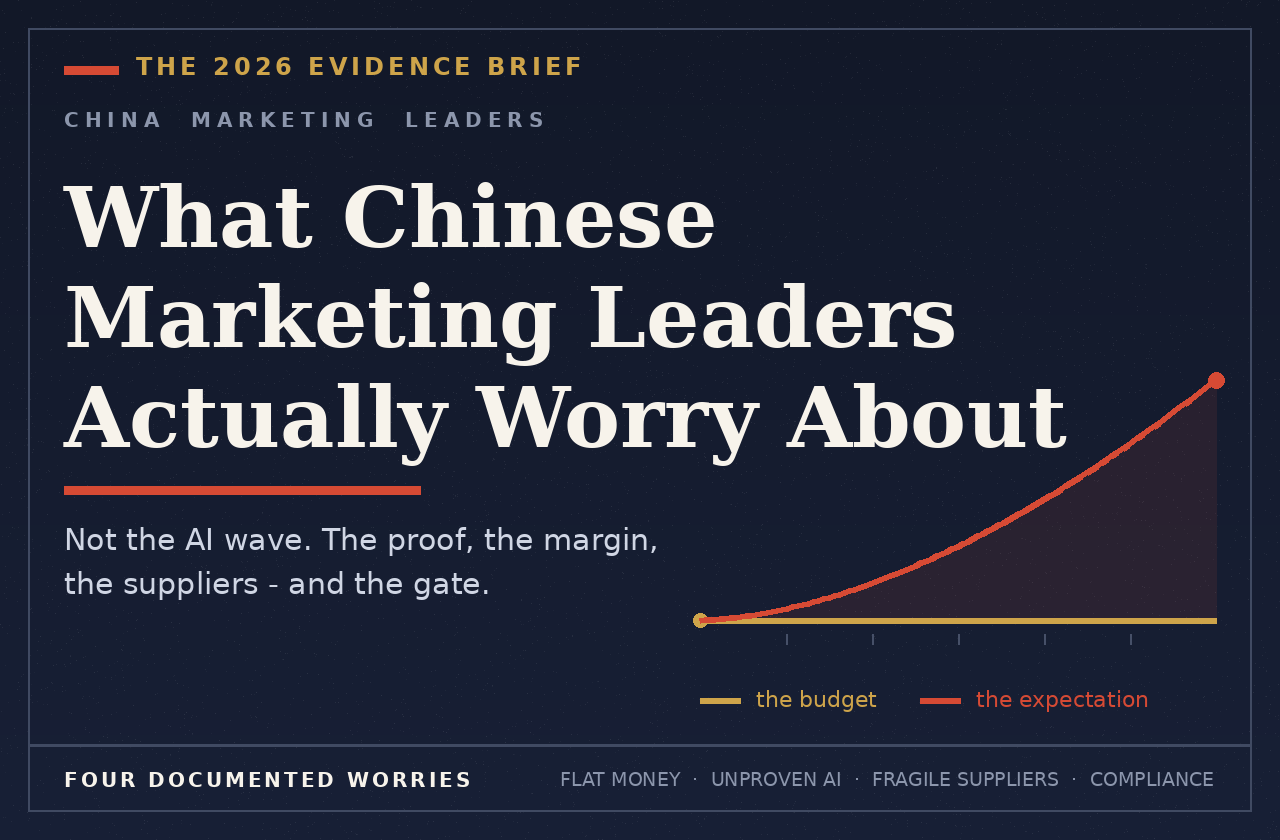
Ask a room of Chinese marketing leaders what keeps them up at night, and you will hear a rehearsed answer: AI transformation. Now look at what the surveys, the filings and the enforcement bulletins actually record, and a different list shows up. Margin. Proof. Suppliers going broke. A compliance gate that decides how much you are allowed to publish. The public narrative is about catching the AI wave. The documented anxiety is about surviving on a flat budget inside a tightening perimeter — while the agencies and creators you depend on quietly lose money.
We pulled four evidence streams — an annual CMO budget survey, a national advertiser survey, an industry whitepaper plus exchange filings, and a regulator’s campaign bulletin — and they converge on the same story. Here is what it says, and what you should do about it.
The Four Worries, in One Paragraph
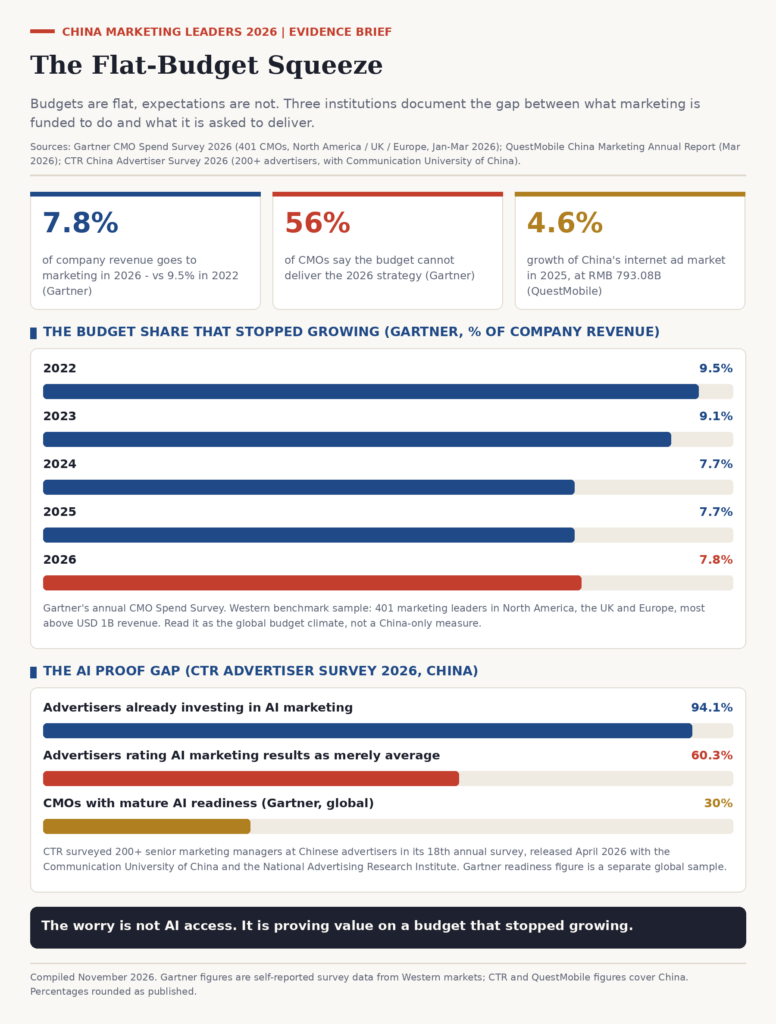
Budgets have flatlined at 7.8% of company revenue in Gartner’s 2026 CMO Spend Survey, and 56% of CMOs say that is not enough to deliver their strategy. In China, 94.1% of advertisers already invest in AI marketing, yet 60.3% rate the results as merely average, according to CTR’s 2026 advertiser survey. The agency ecosystem that executes campaigns grew just 2.5% in 2025 — a ten-year low — with nearly 80% of firms reporting flat or falling margins, per TopKlout’s whitepaper. And the Cyberspace Administration of China’s 2026 AI-content campaign cleared more than 5.61 million items and penalized over 49,000 accounts. Four numbers, four worries, one interlocking system.
Worry One: The Budget Is Flat. The Expectation Isn’t.
Gartner’s 2026 survey of 401 marketing leaders in North America, the UK and Europe puts the average marketing budget at 7.8% of company revenue — up a rounding error from 7.7% in 2025, and down from 9.5% in 2022. Some 56% of CMOs say the budget cannot deliver the 2026 strategy, and 54% report insufficient resources. One caveat matters: this is a Western sample, mostly companies above USD 1 billion in revenue. Read it as the global budget climate that multinational boards import into their China plans, not as a China measurement.
The China-side number comes from QuestMobile’s annual marketing report, released in March 2026: the country’s internet ad market reached RMB 793.08 billion in 2025, growing 4.6%. Still growing — but at single-digit speed, in an economy where every line item now defends itself. Flat money plus rising proof demands changes what a marketing leader is actually hired to do: not more activity, but demonstrable incrementality.
Worry Two: Everyone Bought AI. Almost Nobody Can Prove It Works.
CTR — the CCTV-affiliated market research firm, working with the Communication University of China and the National Advertising Research Institute — surveyed more than 200 senior marketing managers for its 18th annual advertiser report, published in April 2026. The headline pair: 94.1% of advertisers have already invested in AI marketing applications, but 60.3% rate the results as “average.” Not bad. Not good. Average — the most expensive word in a flat-budget year.
The same report offers the escape route: advertisers with systematic AI capability building — process redesign and ROI loops, not scattered pilots — report significantly higher satisfaction. Gartner’s global data rhymes with it: CMOs allocate an average 15.3% of budgets to AI, yet only 30% report mature AI readiness. The anxiety, in other words, is not access to AI. It is the verification gap between what was bought and what can be shown.
Worry Three: Your Suppliers Are Losing Money
This is the worry that never makes the conference keynote. TopKlout’s 2026 MCN industry whitepaper, based on 518 agency questionnaires, records net growth in registered MCN firms of just 2.5% in 2025 — the lowest in a decade — with nearly 80% of agencies reporting flat or declining profit margins. The industry has entered what the report calls the thin-margin era.
The filings make it concrete. Securities Times reported in July 2026, drawing on Beijing Equity Exchange documents and company disclosures: Yujia Digital, once YY’s largest livestream guild with over 30,000 signed hosts, lost RMB 69.9 million on RMB 371 million of 2025 revenue — and an early investor is now selling a 3.84% stake at a floor price of RMB 9.02 million. Xinpianchang lost RMB 17.7 million as revenue fell 18.7%; Weichuanbo’s loss deepened to RMB 36.3 million; Qingteng Technology lost RMB 11.5 million on revenue down 40.2%.
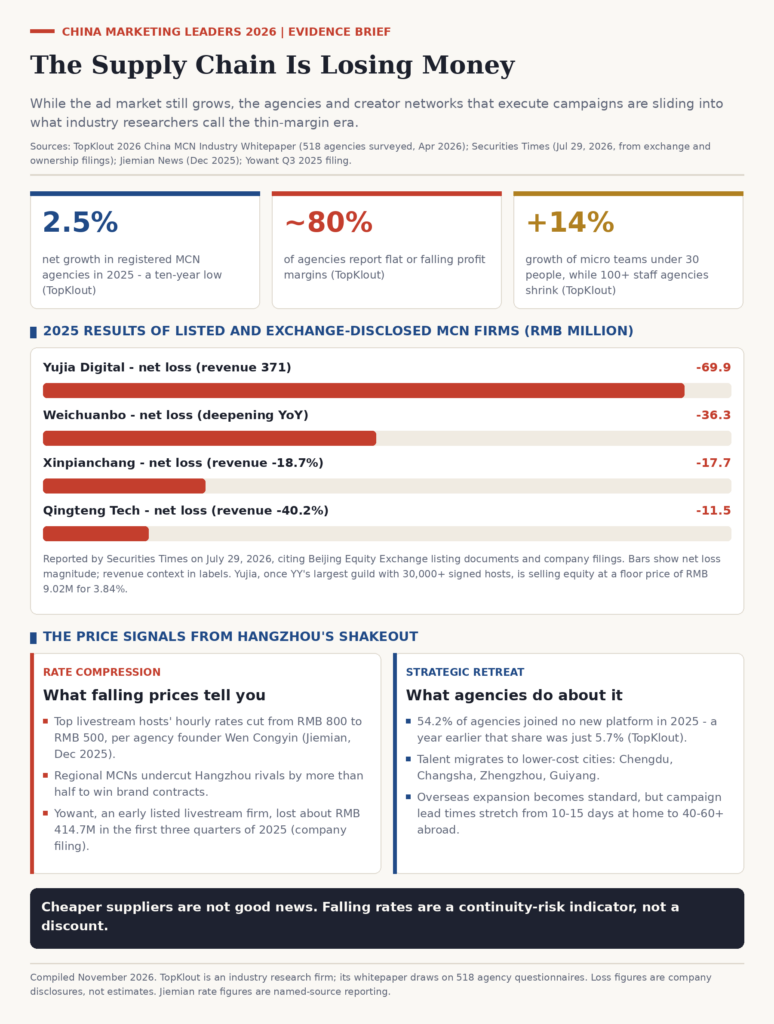
The price signals point the same way. Jiemian News reported in December 2025 that leading Hangzhou MCNs cut top livestream hosts’ hourly rates from RMB 800 to RMB 500, while regional agencies undercut Hangzhou quotes by more than half. Yowant, one of the earliest listed livestream commerce firms, lost about RMB 414.7 million in the first three quarters of 2025, per its quarterly filing. (Its English-language coverage rendered that figure as “4.1 billion yuan” — a tenfold translation error worth knowing about if you cite the English version.)
Notice what the survivors are doing, because it tells you what your future supplier pool looks like. The whitepaper describes agencies dismantling heavy middle-office structures into small, independently accountable studios, turning core staff into partners, and cutting asset-heavy business lines. Micro teams under 30 people grew 14% while agencies with 100-plus staff shrank. Overseas expansion has become standard — but the same Jiemian reporting notes that a campaign taking 10–15 days in China can take 40 days in Vietnam and 60 or more in Japan. The supply chain is not dying; it is repricing and reorganizing. Your vendor list should be rebuilt for that reality, not the 2021 one.
Worry Four: Compliance Became a Publishing Gate
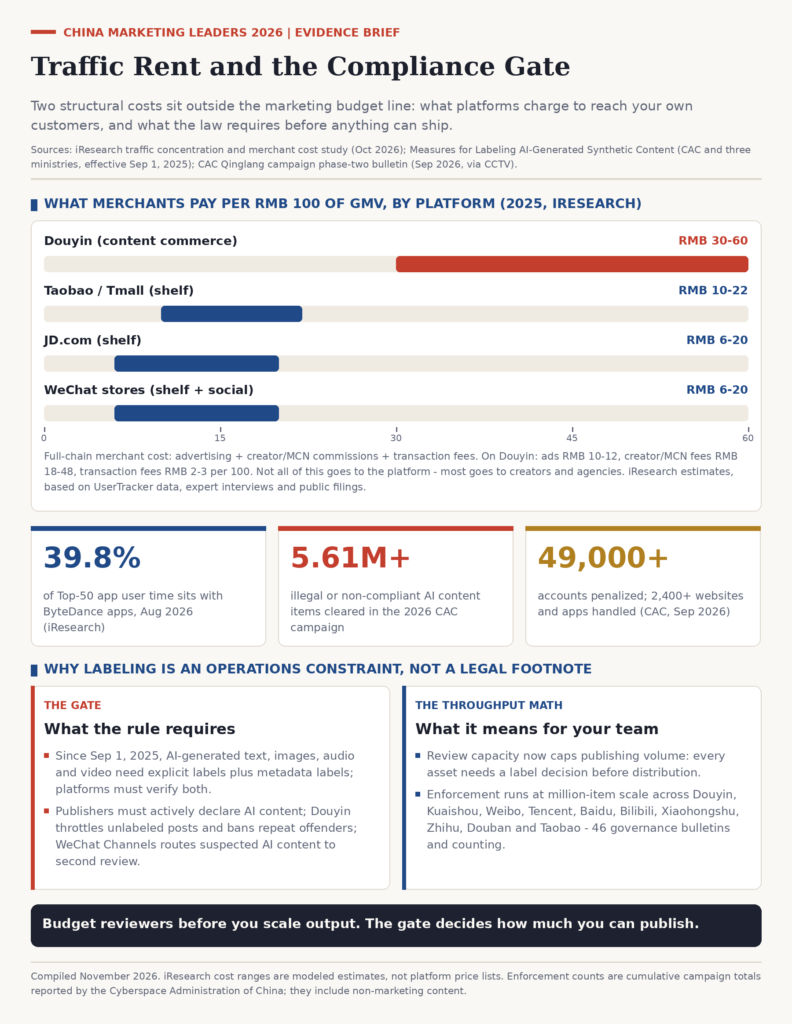
Since September 1, 2025, China’s Measures for Labeling AI-Generated Synthetic Content — issued by the CAC together with three other ministries, backed by a mandatory national standard — require explicit labels plus metadata labels on AI-generated text, images, audio and video. Platforms must verify them; publishers must actively declare AI content. Douyin throttles unlabeled posts and bans repeat offenders; WeChat Channels routes suspected AI content to a second review.
Enforcement is not theoretical. The CAC’s phase-two bulletin of its 2026 Qinglang campaign, reported by CCTV in September, records over 5.61 million illegal or non-compliant content items cleared, more than 49,000 accounts penalized, and 2,400-plus websites and apps handled. Ten major platforms — Douyin, Kuaishou, Weibo, Tencent, Baidu, Bilibili, Xiaohongshu, Zhihu, Douban and Taobao — published 46 governance bulletins between them. When every asset needs a label decision before it ships, review capacity stops being a legal footnote and becomes a ceiling on output.
The Hidden Fifth Pressure: Traffic Rent
There is a cost line that sits outside the marketing budget but behaves like one. iResearch’s October 2026 study of traffic concentration and merchant costs estimates that in 2025, merchants on Douyin paid RMB 30–60 in full-chain costs for every RMB 100 of GMV — advertising (RMB 10–12), creator and MCN commissions (RMB 18–48) and transaction fees (RMB 2–3). On shelf platforms the same RMB 100 cost far less: RMB 10–22 on Taobao/Tmall, RMB 6–20 on JD.com and WeChat stores. Note the caliber: much of that money goes to creators and agencies, not the platform itself — do not read it as a platform take rate.
Why does it matter to a CMO? Because ByteDance apps now hold 39.8% of user time across the top 50 apps (August 2026, iResearch), and attention concentration converts into pricing power. Traffic buy is drifting from optional spend to rent you pay to keep the store open. That is the merchant-side mirror of the leader-side squeeze.
Why the Four Worries Interlock
Read them as a system, not a list. Flat budgets demand proof; unprovable AI undermines proof; margin-collapsing suppliers threaten the quality of whatever you can still afford; and the labeling gate caps how fast you can publish the remainder. Each worry raises the cost of the next one. That is why “just adopt more AI” or “just negotiate cheaper agency rates” fails as advice — it treats symptoms of a single margin-and-verification problem.
Walk through a concrete quarter and you can feel the ratchet. Finance freezes the budget at last year’s level, so the CMO cuts two agency retainers and shifts the work to a cheaper regional MCN. The cheaper vendor, itself margin-squeezed, staffs the account with juniors and leans harder on AI-generated creative to hit volume. More AI-generated assets means more labeling decisions, more platform reviews and more throttled posts — so output slows exactly when the CMO needs a fast quarter to defend next year’s budget. And because the AI spend was bought as capability rather than verification, nobody can show which of those assets actually produced incremental sales. Every rational individual decision made the system worse. That is what an interlocking problem feels like from the inside.
How to Read This Evidence
A quick word on source quality, because the argument is only as strong as its weakest number. The budget climate comes from Gartner’s survey of 401 Western marketing leaders — self-reported, big-company skewed, and disclosed as such. The AI gap comes from CTR’s 200-plus advertiser sample, the longest-running survey of its kind in China. The supplier picture rests on 518 agency questionnaires plus hard exchange filings, which is about as close to audited as this industry gets. The compliance numbers are the regulator’s own cumulative campaign totals — they include non-marketing content, so treat them as the scale of the perimeter, not a count of marketing violations. The merchant cost ranges are iResearch modeled estimates from tracker data, expert interviews and public filings, not platform price lists. Where a number could not be traced to a primary or authoritative source, we left it out rather than dress it up.
What Everyone Gets Wrong
Three misreadings dominate. First, the AI-access myth: with 94.1% adoption, the scarce thing is not tools but evidence. Second, the cheap-supplier fallacy: falling agency rates are a continuity-risk indicator, not a procurement win — a vendor pricing below cost is a vendor who may not exist next quarter. Third, the compliance-is-legal’s-problem view: when enforcement runs at million-item scale and platforms throttle unlabeled content, compliance is an operations constraint that belongs in your capacity planning, not your legal appendix.
What Leaders Should Actually Do
Four moves follow from the evidence. Re-baseline the KPI set to margin and incrementality — flat budgets punish activity metrics. Buy verification, not capability: put written baselines, measurement formulas and independent monitoring into every AI and martech contract. Audit supplier financial health the way you would a credit counterparty — ask about staffing and review capacity, not just rate cards. And staff compliance as throughput: budget the reviewers before you scale the output, because the gate decides your real publishing ceiling.
Make it operational. On KPIs: pick one incrementality test per major channel per quarter — a holdout region, a paused-campaign window — and report the delta, not the dashboard total. On contracts: require every AI vendor to state the baseline metric, the measurement formula and the data source in writing, with an independent monitoring clause you can invoke without their permission. On suppliers: add a financial-health question set to your annual agency review — margin direction, staff turnover on your account, review capacity, client concentration — and treat a vendor quoting below cost as a risk flag, not a win. On compliance: count your label-decision throughput the way you count production throughput, and hire or tool the review step before you promise the board a content-volume target. None of this is glamorous. All of it is what the four worries, read honestly, actually demand.
The Counterargument, and Its Limit
Fair objections exist. Surveys and filings are not leader interviews — true; this piece synthesizes documented evidence, and any interview claims would need their own attribution. Some leaders are genuinely optimistic — also true; the same reports show pockets of strength in vertical specialists and overseas expansion, so the honest reading is polarization, not universal despair. And is this just a cyclical downturn? Partly. But the structural items — the flat budget share, the verification gap, the labeling gate — persist regardless of where the cycle turns.
The Takeaway
The documented 2026 anxiety of Chinese marketing leaders is not missing the AI wave. It is proving value on a flat budget inside a tightening compliance perimeter while the supply chain loses money. The leaders who sleep well are the ones who re-baselined to margin, contracted for verification, audited their suppliers’ finances and staffed review as capacity. The confident deck is easy. The four worries behind it are the job.