Why does a chat feature — reassigning contacts when staff leave — matter more than any campaign tool in WeCom’s arsenal? Because it fixes an accounting error that Chinese retail carried for a decade.
The Asset That Was Never on the Books
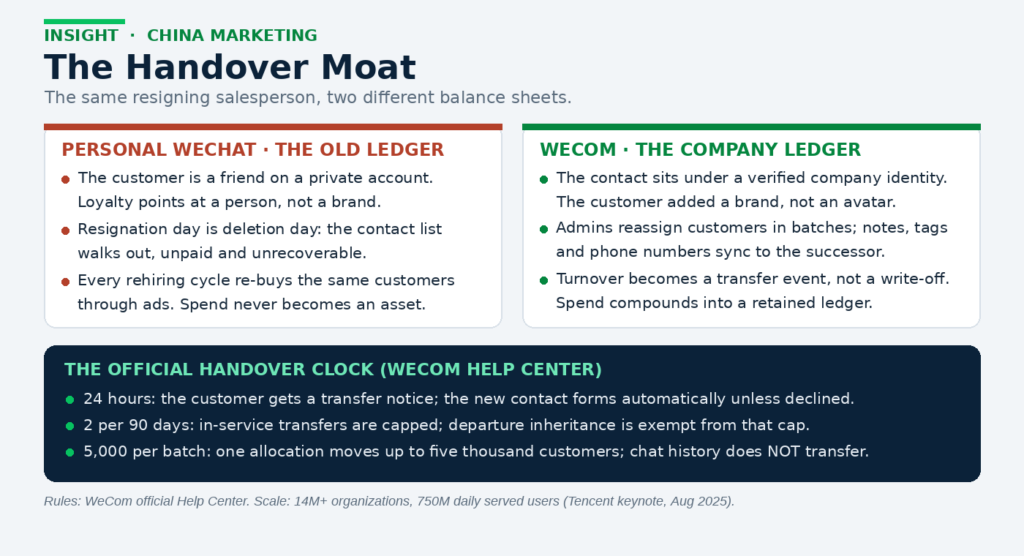
Before WeCom, the customer relationship lived on the guide’s personal WeChat. The company paid to acquire that customer — rent, ads, coupons, training — but the relationship itself sat in an account the company did not own. Every resignation was an unrecorded write-off: the contact list walked out the door, and the next hiring cycle re-bought the same customers through advertising. Acquisition spend behaved like an expense that could never compound. That is the old ledger, and it explains why private-domain traffic sounded revolutionary when it arrived: it promised to move the asset onto the company’s books.
The Transfer Event Changes the Math
WeCom’s inheritance mechanics are mundane on paper. Per the official Help Center, a reassigned customer receives a notice and automatically connects with the successor after 24 hours unless they decline; in-service transfers are capped at two per customer per 90 days, with departure inheritance exempt; one batch moves up to 5,000 customers; notes, company tags and phone numbers sync. Chat history does not transfer unless the firm runs the paid archive.
But look at what those rules do economically. Turnover stops being a write-off and becomes a transfer event. The customer acquired in 2024 still belongs to the ledger in 2027, across three different guides. Acquisition cost amortizes over a longer relationship life, so the same ad budget yields compounding returns. The moat is not the chat window — everyone has chat windows. The moat is that the denominator of customer lifetime value survives staff churn.
Why Competitors Can’t Copy the Clock
DingTalk and Feishu can clone groups, bots and Moments-style feeds. What they cannot clone is the other side of the bridge: the customer’s personal WeChat, where 750 million users are already served daily by businesses on WeCom, per Tencent’s August 2025 keynote. Inheritance only works if the consumer accepts the successor inside an app they already trust. That acceptance — a 24-hour silent handover in the customer’s own chat list — is an ecosystem property, not a feature. It is rented from Tencent’s scale, which is also the caveat: the moat sits inside someone else’s castle.
The Discovery
The private-domain boom was never really about traffic. It was about correcting who owns the relationship — and the least glamorous feature, the handover clock, is where the ownership actually happens.