Somewhere in a brand’s shared drive right now, there is a forty-slide deck titled “China KOL Guidelines.” It has approved sentence structures. It has a mandatory hashtag order. It has three rounds of legal review baked into the timeline. And it is, almost certainly, the reason that brand’s China creator content reads like a translated press release — polished, compliant, and completely ignored.
Here is the uncomfortable truth about influencer marketing in China: the brief decides the campaign. Not the budget. Not the creator’s follower count. The brief. Because Chinese creator marketing runs on a trust economy, and trust is exactly what an over-scripted brief destroys. You are not buying ad space when you book a Chinese KOL. You are borrowing a relationship the creator spent years building — and the brief is the document that determines whether you honor that relationship or strip-mine it.
This playbook walks through how to build a Chinese KOL brief that actually works: the seven components, the platform grammars, the search loop most Western teams miss entirely, and the compliance floor you cannot negotiate away.
The Market You Are Briefing Into
Let’s size the room before we rearrange the furniture. According to Ebiquity, a media-investment research firm, in findings reported by Campaign Asia in September 2025, China’s social KOL marketing market reached roughly RMB 93 billion — about US$13 billion — in 2025. That is 58 percent of global KOL investment and around 17 percent of all brand advertising spend in China. Growth is maturing: Ebiquity projects just 1 percent in 2026 before a rebound to 6 percent in 2027, when the market should cross RMB 100 billion.
Two structural numbers matter more for your brief than the headline size. First, the creator pool exploded: nearly 2.4 million commercial creators across Douyin, Weibo, Bilibili and Xiaohongshu in 2024, up from 880,000 in 2022. Second, the money moved down the pyramid — top-tier KOLs accounted for only 5.8 percent of order volume in 2025. Brands are betting on mid-tier and long-tail creators, where trust is denser and prices are saner. Your brief will most likely land on a creator with 30,000 followers and a comment section full of people who genuinely take her advice. Write for that person, not for a celebrity.
Why Western Briefs Fail in China
The script error
Western influencer operations grew up inside brand-safety machinery: approved copy, locked messaging, sign-off chains. Transplant that into China and you get content that audiences smell instantly. Chinese users have been burned by hidden ads for a decade; their radar is exquisite. When a creator whose voice you follow suddenly speaks in brochure, the audience does not think “nice product.” They think “she sold this slot.” The trust you paid for evaporates in the comments — sometimes literally, with users posting the brand’s rate card.
The global-message error
Your global campaign line was built for a feed-and-search culture. China runs on a seeding culture — zhongcao, literally “planting grass,” where content plants desire that users later verify through search. A slogan optimized for recall does nothing for a user whose next move is typing your brand plus “real review” into a search box. The message needs cultural translation, not linguistic translation: from claim to proof, from slogan to searchable answer.
The platform-blindness error
One brief, four platforms, zero native content. A Xiaohongshu note, a Douyin video, a Bilibili deep dive and a WeChat article are different art forms with different grammars. Briefing them identically is like commissioning a haiku, a screenplay and a legal memo with the same template. Something has to break, and it is usually performance.
The reframe is simple to say and hard to do: brief the outcome and the boundaries, never the script. The creator’s voice is not a risk to manage. It is the asset you are paying for.
The Brief Template: Seven Components
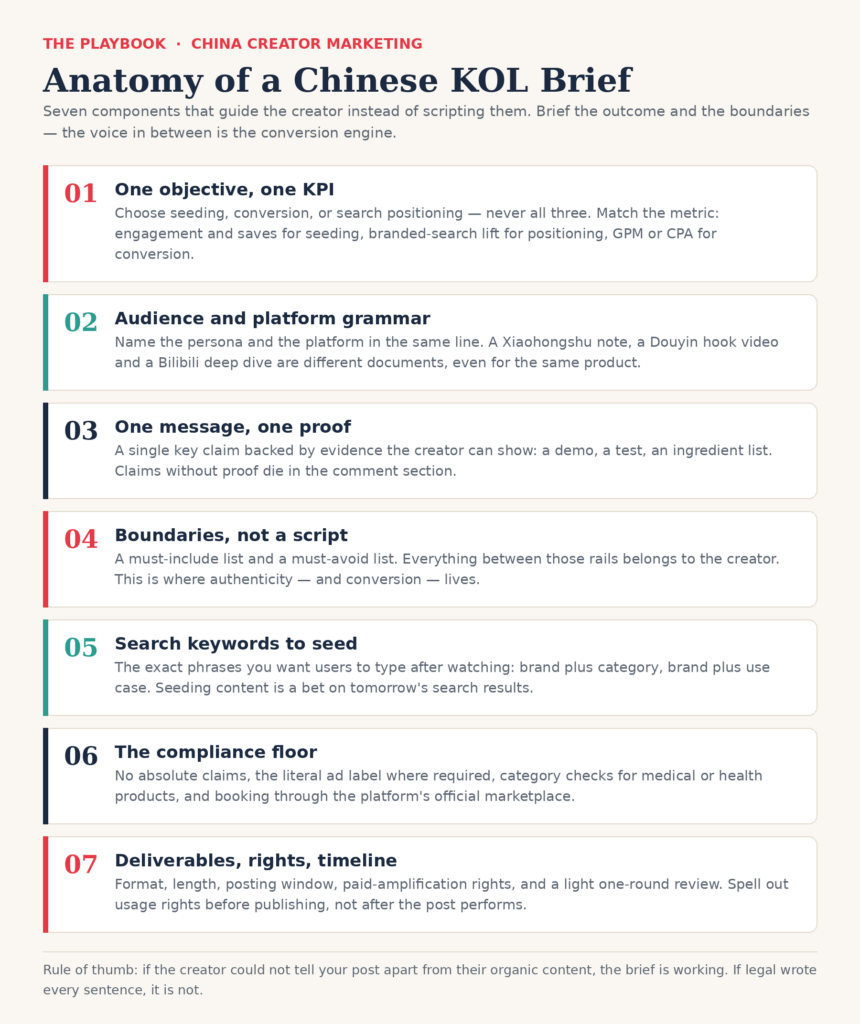
A working China KOL brief fits in two pages and contains seven things.
One objective, one KPI. Seeding, conversion, or search positioning — pick one. Seeding campaigns live and die on saves, comments and engagement quality. Search-positioning campaigns are judged on branded-search lift. Conversion campaigns get GPM or CPA. Briefs that ask for “awareness and sales and search” get none of the three, because the creator optimizes for nothing.
Audience and platform in the same line. “Mothers of toddlers on Xiaohongshu, note format” is a brief. “Women 25–40, all platforms” is a horoscope.
One message, one proof. A single claim the creator can demonstrate: a texture shot, a before-and-after with honest lighting, an ingredient breakdown. In a trust economy, an unproven claim is not persuasive — it is evidence of sponsorship.
Boundaries, not a script. Two lists: must-include (the key claim, a real product demo, the disclosure) and must-avoid (absolute claims, competitor attacks, off-platform contact details). Everything between the rails belongs to the creator. This single component separates briefs that convert from briefs that suffocate.
Search keywords to seed. The exact phrases you want users to type afterward — brand plus category, brand plus use case. More on why this is the most underrated line in the brief below.
The compliance floor. The legal rules, written into the brief in plain language, so creator, agency and legal read the same page. Also below.
Deliverables, rights, timeline. Format, length, posting window, one round of light review, and — crucially — paid-amplification rights agreed before publishing. Renegotiating usage rights after a post goes viral is how brands turn partners into adversaries.
One Message, Four Platform Grammars
Xiaohongshu: the searchable note
Xiaohongshu (RedNote) rewards the pain-point-plus-solution note: a real problem, a tested answer, evidence in the images. Cover and title carry the click; the comment section carries the trust. Brief the creator to answer questions in comments for the first 48 hours, and to write the note so it ranks for your seeded keywords weeks later. Good notes are annuities, not fireworks.
Douyin: the three-second contract
On Douyin, the viewer’s thumb is the judge. The first three seconds must earn the next thirty. Brief a hook, not an intro — no logo stings, no “hello everyone.” Native pacing beats production polish; a phone-shot demo in a real kitchen outperforms your TVC cut-down, and it is not close.
Bilibili: depth as proof
Bilibili’s commercial ecosystem skews toward established creators — roughly 60 percent top- and mid-tier, per Ebiquity’s ecosystem analysis — and its audience expects rigor. A ten-minute teardown that honestly weighs drawbacks builds more purchase intent than ten fifteen-second spots. Brief the argument you want made, then let the creator make it their way, caveats included. The caveats are why viewers believe the conclusion.
WeChat: the expert article
WeChat Official Accounts and Channels reward authority and completeness. Long-form, professional, sourced. Commercial bookings run through Tencent’s Huxuan marketplace. Brief this like an editor commissioning a specialist column, not like a media buyer ordering impressions.
Same message, four native forms. If your brief cannot flex across these grammars, it is a memo, not a brief.
Brief for the Re-Search, Not the Click
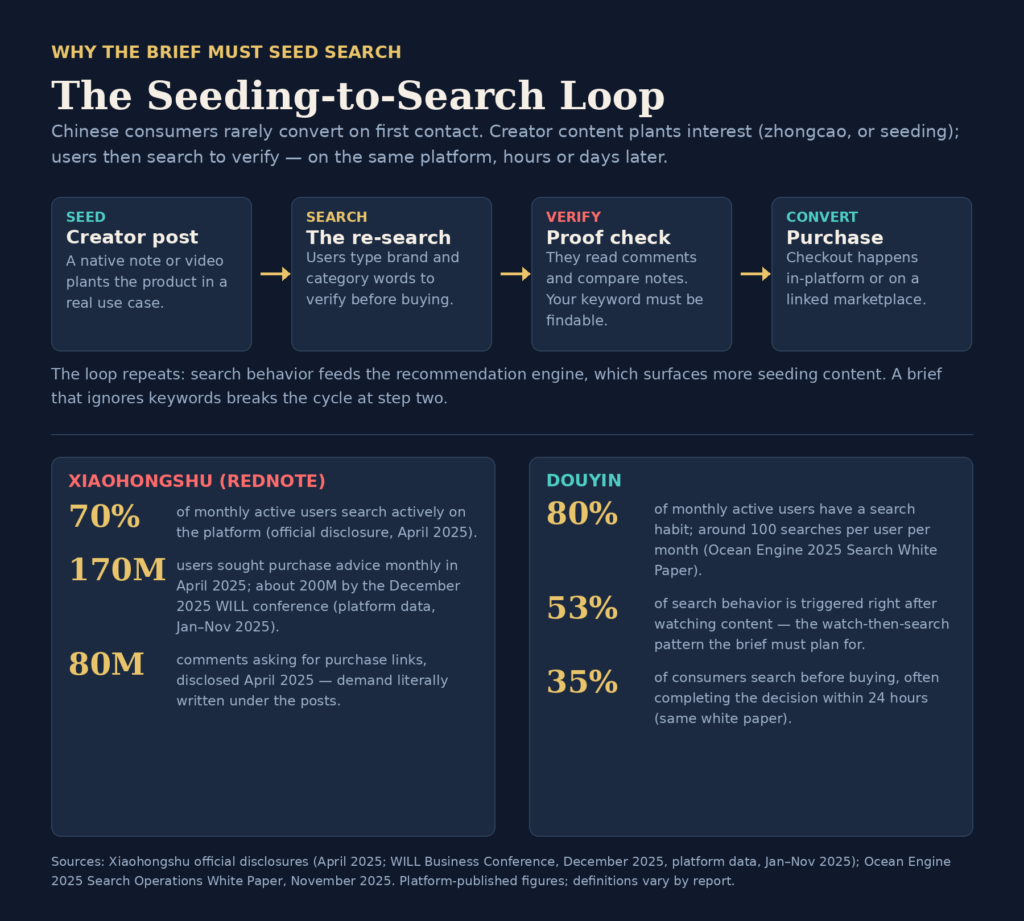
Here is the behavior that breaks Western funnel models: Chinese users see creator content, do not click, and then search. The seeding post plants the grass; the re-search harvests it. The platforms’ own disclosures show how industrialized this habit has become.
Xiaohongshu said in April 2025 that 70 percent of its monthly active users search actively, that 170 million users sought purchase advice on the platform each month, and that comments asking for purchase links hit 80 million. By its December 2025 WILL business conference, the company disclosed roughly 200 million monthly purchase-advice seekers (its data platform, January–November 2025), alongside 9 million-plus notes and 70 million-plus comments published daily. Read that last pairing again: demand is literally written underneath the content, in public.
On Douyin, Ocean Engine’s 2025 Search Operations White Paper — vendor research from the company that sells Douyin advertising, so treat the framing with appropriate salt — reports that 80 percent of monthly active users have a search habit, averaging around 100 searches a month, that 53 percent of search behavior is triggered immediately after watching content, and that roughly 35 percent of consumers search before buying, often deciding within 24 hours.
What does this mean for your brief? Three lines most teams never write. First, the exact keyword phrases the creator should say aloud and put in the title and caption — because that is what the viewer will type. Second, a searchable content structure: the note or video should answer the query it triggers, not just provoke it. Third, a KPI that measures the loop — branded-search lift over two to four weeks — instead of day-one clicks. A seeding campaign judged on immediate CTR is a farm judged by how fast the seeds sprout overnight.
The Compliance Floor
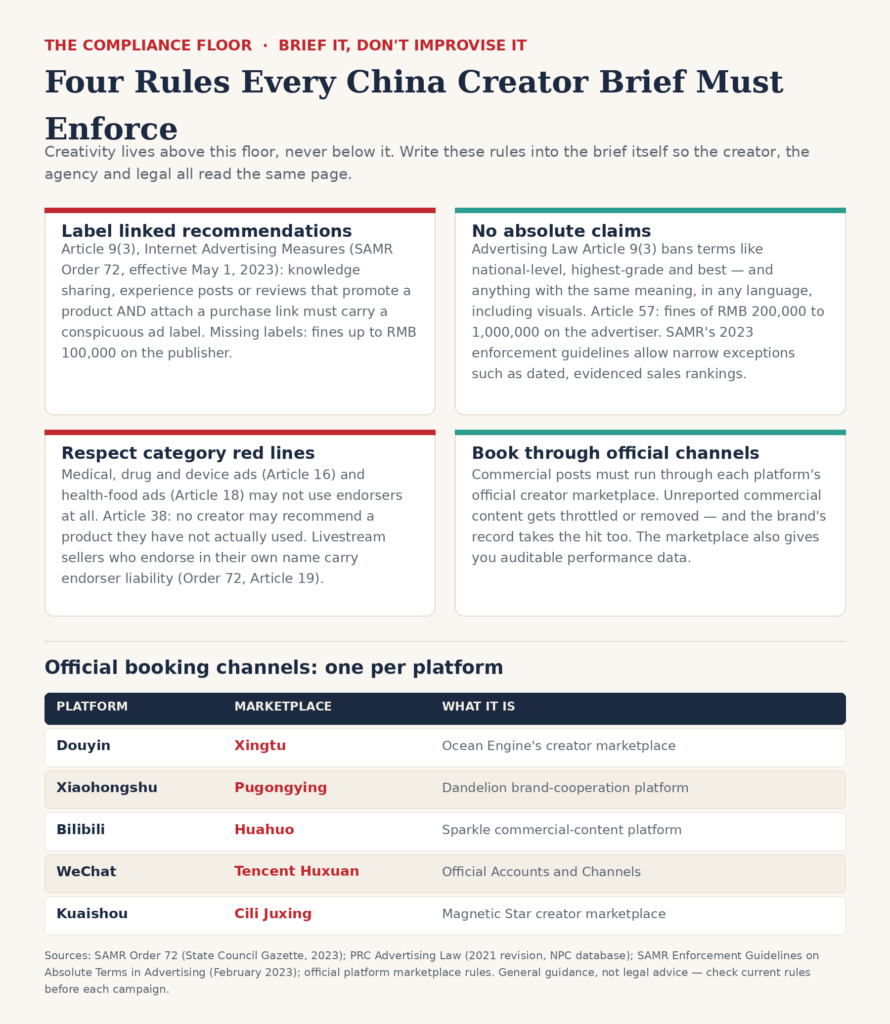
Compliance is not the enemy of creativity. It is the floor the creativity stands on. Four rules belong in every brief, in plain language.
The label rule
China’s Internet Advertising Measures — SAMR Order 72, effective May 1, 2023 — drew a bright line in Article 9, paragraph 3: content that promotes a product through knowledge sharing, experience posts or consumer reviews and attaches a purchase link must carry a conspicuous advertisement label, the literal Chinese word for “ad,” not a coy “sponsored” or “collab.” Miss the label and the publisher faces fines up to RMB 100,000. Platform booking systems apply the label automatically, which is one more reason to use them.
The absolute-claims rule
Article 9 of the Advertising Law bans “national-level,” “highest-grade,” “best” and terms of the same meaning — in any language, including badges and visuals that imply supremacy. The statutory fine route is brutal: RMB 200,000 to one million on the advertiser. SAMR’s February 2023 enforcement guidelines softened mechanical enforcement, allowing narrow cases like dated, evidenced sales rankings within a stated scope — but they explicitly treat efficacy claims in medical and health categories, investment-return promises, and education-results claims as generally not minor. The practical brief instruction: no superlatives, and any ranking claim must come with source, date and scope attached.
Category red lines and endorser liability
Some categories cannot use creators as endorsers at all: medical, drug and device advertising (Article 16) and health-food advertising (Article 18) prohibit endorser recommendations outright. Article 38 adds the rule every brief should state explicitly: no creator may recommend a product they have not actually used. Send samples early, and document it. And under Order 72’s Article 19, livestream sellers who recommend products in their own name or image — where that constitutes an endorsement — carry full endorser liability. Your creator is not a billboard. Legally, they are a witness.
Book through official channels
Every major platform runs an official commercial-content marketplace: Xingtu for Douyin, Pugongying for Xiaohongshu, Huahuo for Bilibili, Tencent Huxuan for WeChat, Cili Juxing for Kuaishou. Booking through them gets you the compliance label, platform dispute handling and auditable data. Booking around them — private deals, unreported posts — gets content throttled or removed, and the brand’s platform record takes the hit alongside the creator’s account. The service fee is not a tax. It is insurance.
The Trust-Not-Script Rule
Everything above collapses into one operating principle: brief outcomes and boundaries, then get out of the way.
That means light approval — one review round against the boundary lists, not a rewrite committee. It means selecting creators for vertical trust rather than reach: a comment section where followers ask follow-up questions is worth more than a follower count with silent fans. Check median engagement, not viral peaks; check whether comments look human. And it means treating creators as recurring partners. The second and third collaborations outperform the first because the creator now knows the product and the audience has seen the relationship survive. Briefs should evolve with that history, not reset to template every quarter.
Risks and Honest Caveats
No playbook survives contact with reality unmodified, so here are the honest edges. The compliance-creativity tension is real: boundary lists that grow too long become scripts by another name, so audit them each quarter and delete what fear added. Platform rules move — labeling enforcement and traffic policies on Xiaohongshu and Douyin have visibly tightened through 2025 and 2026 — so date-stamp your compliance section and re-verify before every major campaign. Measurement lags: seeding value shows up in search behavior weeks later, and if your CFO insists on day-one ROI, brief conversion campaigns instead of pretending seeding is one. And creator quality varies wildly at the long tail where the budgets now flow — fake engagement and astroturfed KOC networks exist, which is why selection diligence belongs in the brief process, not in a post-mortem.
One more caveat about the numbers in this article: the platform figures come from the platforms themselves, disclosed at commercial conferences where the incentive to impress is obvious. They are directionally trustworthy and definitionally fuzzy. Use them to design briefs, not to promise board-level forecasts.
Conclusion: Guide, Don’t Dictate
The Chinese KOL brief is a trust-preserving, platform-native, compliance-aware guide. Brief one objective with one KPI. Write boundaries, not sentences. Translate your message into four platform grammars. Seed the exact keywords the re-search will need. Enforce the legal floor in plain language. Book through official channels, approve lightly, and stay with creators long enough for trust to compound.
Western briefs fail in China because they treat the creator as a channel. The brands that win treat the creator as a partner whose voice is the conversion engine — and write briefs that protect that voice instead of replacing it. The brief is the campaign. Write it like you mean it.