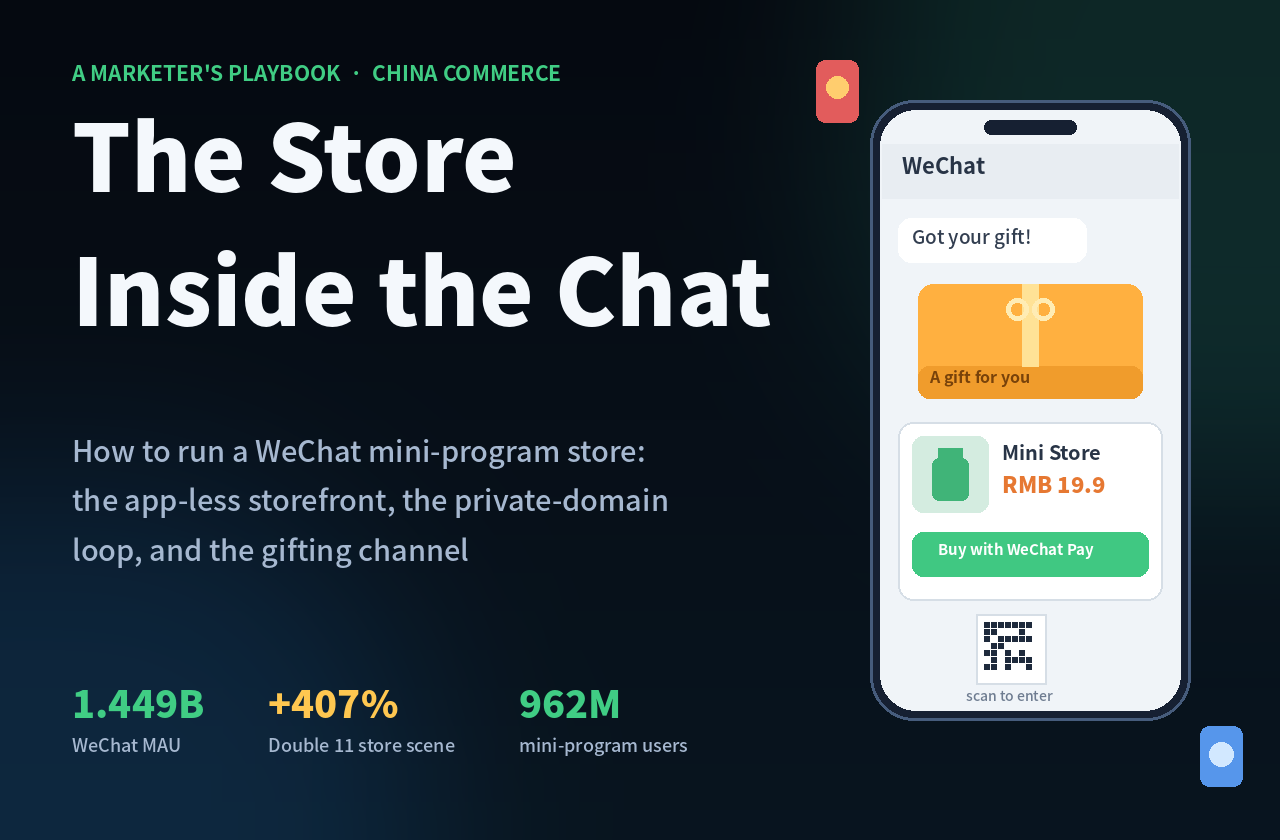
On December 30, 2024, Luckin’s packaged-coffee label ran a small New Year promotion inside WeChat. A coconut-latte gift set priced at 19.9 yuan — roughly three dollars — was gifted more than 10,000 times in a single day. Not ordered. Gifted. The buyer paid without ever typing a shipping address; the product landed in a friend’s chat window like a red envelope, and the friend filled in their own address to claim it. Coffee traveled through the social graph.
That is the WeChat mini-program store in one sentence: a shop that lives inside the chat. No app to download, no browser detour, no leaving the conversation. And if you run it the way Chinese operators do, every transaction doubles as a CRM enrollment. This guide walks through what changed in 2024–2026, the six components that make the machine work, what it costs, and the honest caveats the hype usually skips.
A Store That Lives Where People Already Are
Western e-commerce asks the customer to come to you: install the app, visit the site, search the marketplace. The mini-program reverses the trip. A mini-program is a lightweight application that runs inside WeChat itself — users enter by scanning a QR code, tapping a shared card, or searching, and pay with WeChat Pay without ever switching apps.
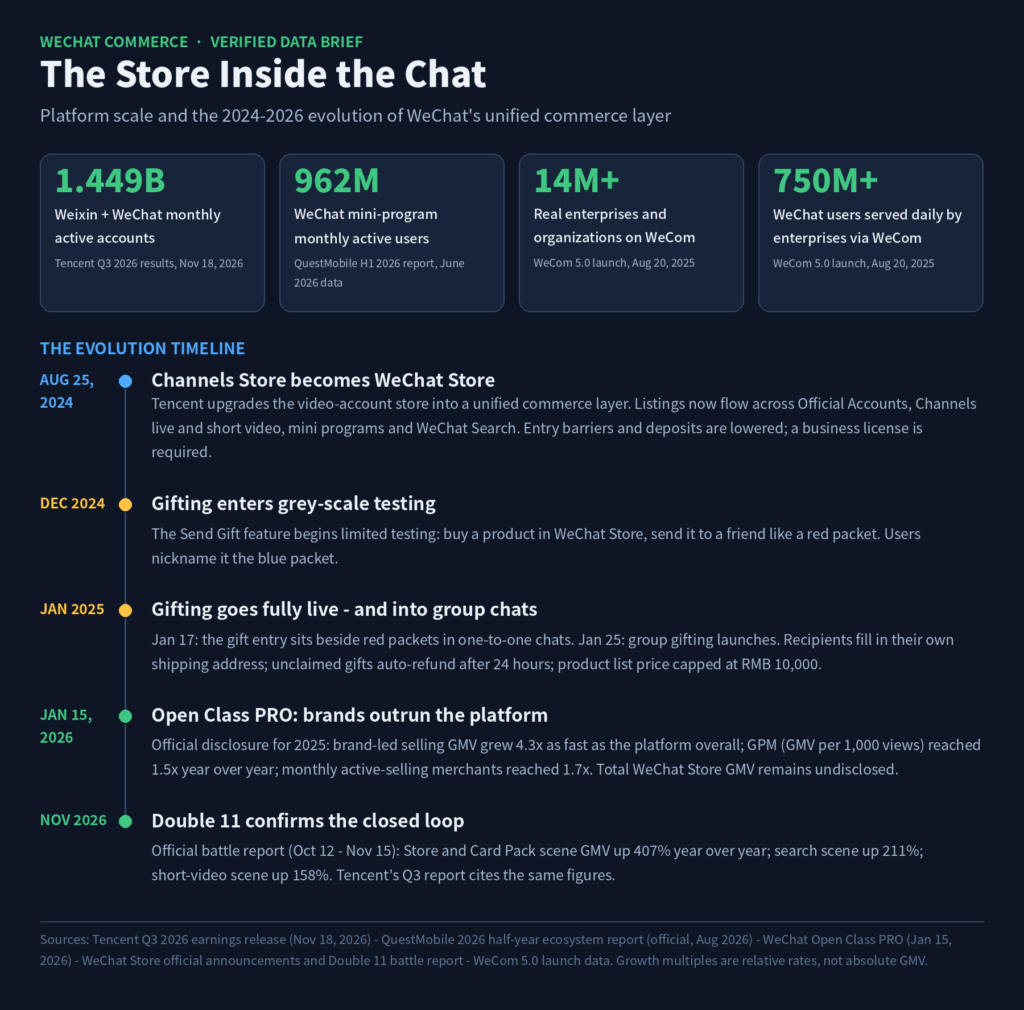
The audience underneath is not niche. Tencent’s third-quarter 2026 results, published November 18, put combined Weixin and WeChat monthly active accounts at 1.449 billion. QuestMobile, the independent Chinese mobile-data firm, counted 962 million monthly active users of WeChat mini-programs in its official half-year report using June 2026 data — within a mini-program ecosystem totaling 1.023 billion across all platforms. And the retention rails are already enterprise-grade: at the WeCom 5.0 launch in August 2025, Tencent disclosed that over 14 million real enterprises and organizations use WeCom (Enterprise WeChat), serving more than 750 million WeChat users daily.
You are not building a destination. You are attaching a store to a river that already flows past everyone.
From Channels Store to WeChat Store
The naming matters more than it sounds. On August 12, 2024, Tencent announced that the Channels Store — the shop tied to WeChat’s video feed — would upgrade into WeChat Store starting August 25. The official notice read like plumbing, but it was strategy: store and product listings could now circulate across Official Accounts, Channels livestreams and short videos, mini programs, and WeChat Search. Entry barriers and deposits were lowered. Onboarding still requires a business license; this is a lane for registered businesses, not anonymous sellers.
Tencent’s president Martin Lau had framed the shift on that quarter’s earnings call: the company was repositioning livestream commerce into a broader WeChat commerce ecosystem, connected to Official Accounts, mini programs, WeCom, and the social activity of groups and chats.
Why the Rename Mattered
A store bolted to a video feed lives and dies by the feed. A store wired into the whole app can be found in search, gifted in chat, embedded in an article, and reopened from a membership card. By the second quarter of 2026, management told investors that Mini Shops GMV was growing, with the centralized e-commerce gateway page inside WeChat growing significantly. The unified layer had become a destination of its own.
The Blue Packet: Checkout Inside the Social Graph
In December 2024, WeChat began grey-testing a Send Gift feature: buy a product in WeChat Store, send it to a friend the way you send a red envelope. Users nicknamed it the blue packet. On January 17, 2025, the gift entry went live beside red packets in one-to-one chats; on January 25, it extended to group chats, just before Chinese New Year. The recipient fills in their own shipping address. Unclaimed gifts auto-refund after 24 hours. Product list prices are capped at 10,000 yuan.
Notice what this removes: asking for someone’s address, guessing their size or flavor, the awkwardness of a gift invoice. Gifting becomes as light as sending cash — but it moves merchandise, and it introduces your product to a person who never visited your store.
The market went wild; management did not. At Tencent’s annual staff meeting, reported in January 2025, Pony Ma asked outsiders not to over-hype the feature. WeChat, he said, intends to spend five years or more building an e-commerce ecosystem connector. He relayed founder Zhang Xiaolong’s framing: products are information, and they should flow through the whole WeChat ecosystem rather than sit confined to a video feed. Treat gifting as one channel in a long game, not a lottery ticket.
The Six-Component Commerce Stack
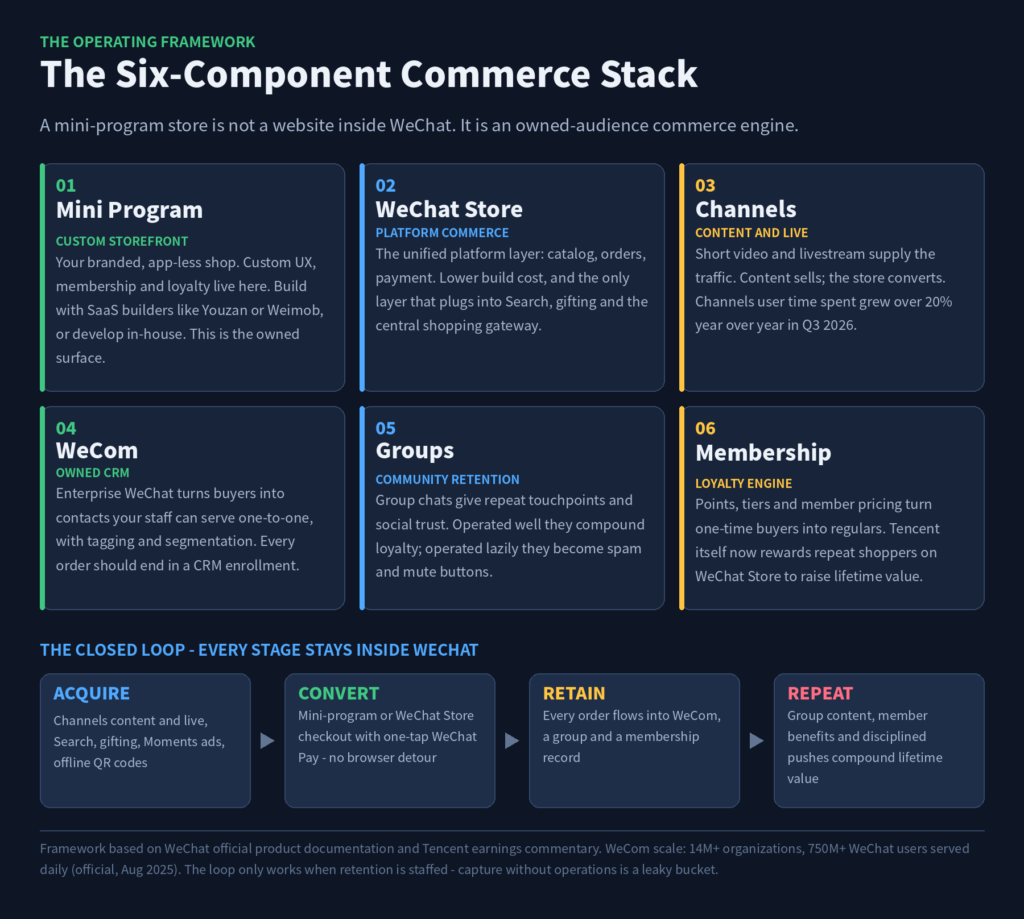
Here is the reframe that separates operators from tourists: a mini-program store is not a website inside WeChat. It is an owned-audience commerce engine assembled from six parts.
Mini program — the custom storefront. Your branded shop with full control over UX, membership and loyalty. Build it with SaaS providers like Youzan or Weimob, or develop in-house.
WeChat Store — the platform layer. Catalog, orders and payment with far lower build cost, and the only layer that plugs natively into Search, gifting and the central shopping gateway. Many brands run both: the Store for platform reach, the mini program for the owned experience.
Channels — the traffic engine. Short video and livestream supply discovery. Tencent reported Channels total user time spent up more than 20% year over year in Q3 2026. Content sells; the store converts.
WeCom — the owned CRM. Every buyer can become a contact your staff serve one-to-one, with tags and segmentation. This is where a transaction becomes a relationship.
Groups — the retention layer. Community chats create repeat touchpoints and social trust. Run well, they compound; run lazily, they collect mute buttons.
Membership — the loyalty engine. Points, tiers and member pricing turn one-time buyers into regulars. Tencent itself now rewards repeat shoppers on WeChat Store to lift customer lifetime value, per its Q2 2026 earnings commentary. That is the platform telling you where the game is.
The Closed Loop: Every Sale Is an Enrollment
The components matter less than the wiring. Acquisition comes from Channels content, search, gifting, Moments ads and offline QR codes. Conversion happens in the mini program or Store with one-tap WeChat Pay. Retention begins the moment the order completes: the buyer is invited into WeCom, a group, a membership. Repeat purchases then arrive through group content, member benefits and disciplined messaging — no re-acquisition cost, no auction for your own customer.
Compare that with the marketplace treadmill, where you rent the same customer twice. In the closed loop, the second sale is almost free. That is not a feature; it is the business model.
The Receipts: What Double 11 Just Showed
At WeChat Open Class PRO on January 15, 2026, the team disclosed 2025 results: brand-led selling GMV grew 4.3 times as fast as the platform overall — a relative growth rate, not an absolute multiple — while GPM (GMV per thousand views) reached 1.5 times the prior year and monthly active-selling merchants reached 1.7 times. Total WeChat Store GMV remains undisclosed, so read these as structural signals: brands are winning, conversion efficiency is rising, and the merchant base is widening.
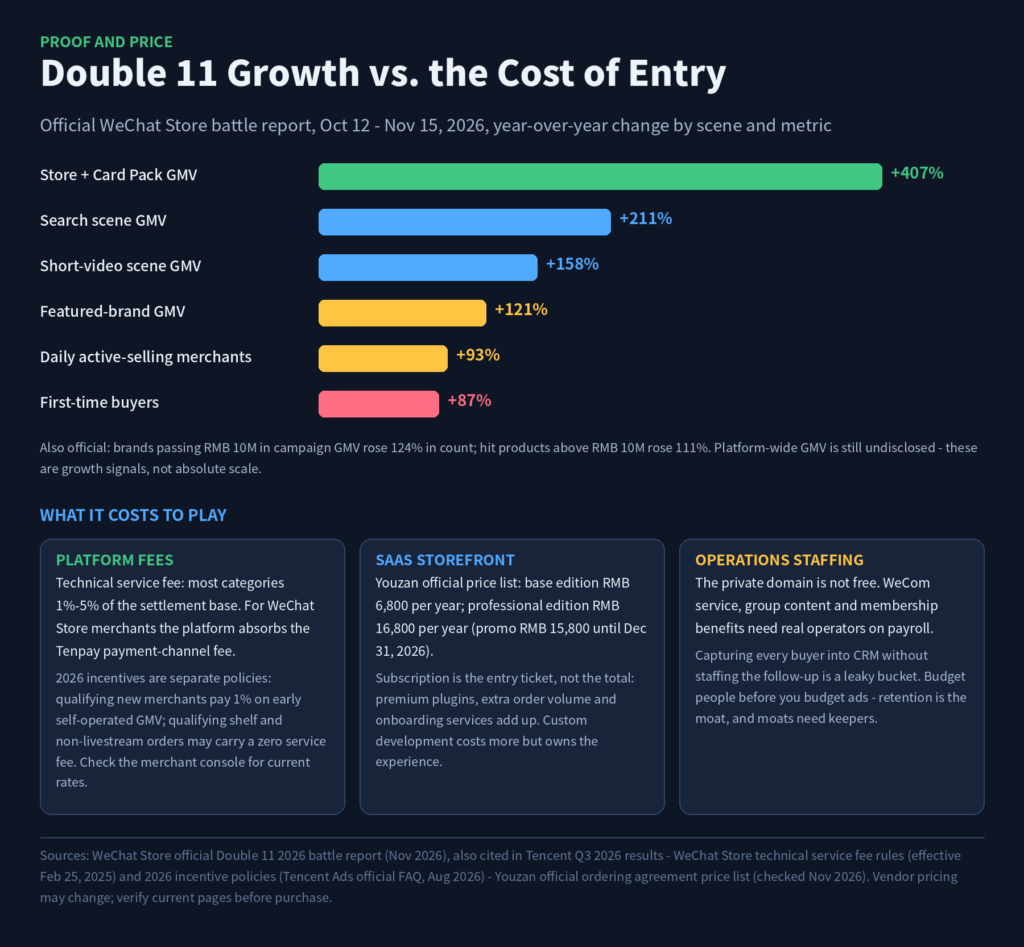
The Double 11 battle report published by WeChat Store in November 2026 (campaign window October 12 to November 15) added fresher proof: Store-and-Card-Pack scene GMV up 407% year over year, search scene up 211%, short-video scene up 158%. Daily active-selling merchants rose 93%, first-time buyers 87%, and the count of products passing ten million yuan in GMV rose 111%. Featured-brand GMV grew 121%, with the number of such brands passing ten million yuan up 124%. Tencent cited the same headline figures in its quarterly results — about as cross-validated as platform data gets.
The Practitioner Playbook
Step 1: Choose Your Build
Early stage, limited team? Start with WeChat Store: near-zero development, immediate access to search, gifting and the gateway. Need custom UX, deep loyalty mechanics or complex catalogs? Add a mini program via SaaS or custom development. The two are complements, not rivals — plenty of brands graduate from Store-only to both.
Step 2: Wire Content to Commerce
Publish short videos and run livestreams on Channels with products attached; embed store cards in Official Account articles. Do not treat content as brand decoration — it is the acquisition line of the P&L.
Step 3: Enroll Every Buyer
Design the post-purchase moment deliberately: a WeCom service invite, a group entry, a membership offer with a real first benefit. If your order-completion page is a dead end, you are running a one-sale store with extra steps.
Step 4: Operate Retention Without Becoming Spam
Groups need a content calendar and a human who answers questions. Members need benefits that recur. Pushes need restraint — the fastest way to burn an owned audience is to treat it like a free ad slot. Budget operators before you budget ads.
Step 5: Make Your Catalog Gift-Worthy
Gifting favors products that are presentable, moderately priced, size-agnostic and emotionally legible: coffee sets, snacks, beauty, small luxuries. Enable the gift option, design gift-ready packaging and bundles, and plan around the gifting calendar — New Year, Valentine’s Day, festivals. The Luckin set worked because it was cheap, cheerful and effortless to send.
Step 6: Measure LTV, Not Just GMV
Track first-sale GMV if you must, but run the business on private-domain metrics: enrollment rate per order, group and member activity, repeat-purchase rate, lifetime value by cohort. The whole architecture exists to make the second sale cheap. Measure the second sale.
What It Costs to Play
Three cost lines, honestly stated.
Platform fees. Under WeChat Store’s official technical service fee rules (effective February 25, 2025), most categories pay 1%–5% of a settlement base that includes platform-funded discounts. For WeChat Store merchants, the platform absorbs the Tenpay payment-channel fee — a detail many third-party guides get wrong. Merchants using custom transaction components inside their own mini programs still bear that channel fee themselves. Separate 2026 incentive policies sweeten entry: qualifying new merchants pay a 1% rate on early self-operated GMV within capped amounts and time windows, and qualifying shelf and non-livestream orders may carry zero technical service fee while channel fees still apply. Rates and windows change; check the merchant console, not blog posts.
Storefront build. WeChat Store itself is effectively free to open. A branded SaaS mini program is a subscription: Youzan’s official ordering agreement lists the base edition at 6,800 yuan per year and the professional edition at 16,800 yuan (promotional 15,800 yuan until December 31, 2026) — vendor list pricing, checked November 2026, subject to change. Plugins, extra order volume and onboarding add real cost. Custom development buys ownership at a higher price.
People. The private domain is not free land; it is farmland. WeCom service, group content and membership operations need staff. Capture without operations is a leaky bucket — the most common failure mode in this entire playbook.
Risks and Honest Caveats
You are a tenant. WeChat’s rules govern your store, your mini program, your messaging reach; policy shifts on fees, categories or traffic can reprice your business overnight. The GMV opacity cuts both ways: undisclosed totals mean the impressive growth multiples describe direction, not absolute scale — a small base can post big percentages. Vendor figures deserve their labels: QuestMobile is panel-based measurement, Youzan pricing is a seller’s own price list, and battle reports are the platform grading its own homework, however consistently cited. And the ops burden is real: this model trades media costs for labor costs. If you will not staff retention, a marketplace stall may honestly serve you better.
Where This Is Heading: Agents in the Loop
The next layer is already visible. WeChat’s AI assistant Xiaowei, powered by the Weixin-customized WeLM model, is expanding its grey test and connecting to mini programs and WeChat Store commerce scenes. On the Q2 2026 earnings call, management described the groundwork for an agent-to-agent transaction loop: tell the assistant what you need, and it discovers products, decides and orders, with user confirmations kept as guardrails. Meanwhile AI Marketing Plus already automates product selection, creative generation and smart bidding for Store advertisers. The strategic implication is quiet but sharp: when an agent does the browsing, the brands it can find, trust and transact with — clean catalogs, enrolled relationships, verified service records — win by default.
The Takeaway
The mini-program store is not a website in WeChat. It is an owned-audience engine: a custom storefront plus a platform store, fed by content, harvested into CRM, compounded by community and membership. The 2024–2026 upgrades — unified commerce, gifting, a central gateway — widened the surface, but the moat is still the loop you operate. Choose your build, wire content to checkout, enroll every buyer, staff the retention, gift-proof your catalog, and measure the second sale. The brands that do will win the repeat purchases the one-sale store never sees. Five years, slow craft, fine work — Pony Ma told you the tempo. Believe him.