Here is a product story that runs backwards from every playbook you know. WeCom — known in China as Enterprise WeChat — launched in 2016 as an internal office app, a Slack-style tool for attendance checks and expense approvals. Nobody bought it to sell anything. Yet by August 2025, Tencent disclosed at the WeCom 5.0 launch that more than 14 million real enterprises and organizations were connected to it, and that businesses were serving over 750 million WeChat users through it every single day. How does an attendance app become the customer-relationship infrastructure of the world’s largest consumer market? The answer is one structural move: WeCom became the official, verified bridge between a company’s staff and a consumer’s personal WeChat. The relationship lives in the app the customer already opens a hundred times a day — and it belongs to the company, not the employee. That last part is the moat. When a salesperson quits, the customer stays. This piece traces the evolution, unpacks the six-feature engine, examines the compliance layer that makes it usable in regulated industries, and hands you an operating playbook — with the honest caveats most vendor decks skip.
Act One: The Office App Nobody Marketed With
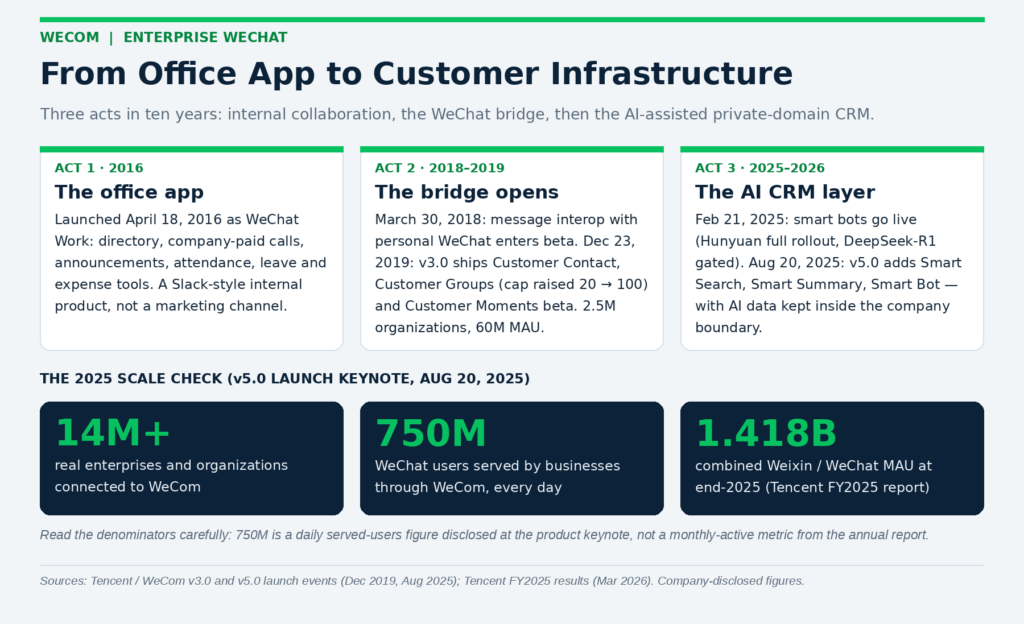
WeCom 1.0 shipped on April 18, 2016, across iOS, Android, Windows and Mac. Its feature list reads like an HR wishlist: company directory, company-paid calls, announcements, attendance, leave requests, expense flows, mail reminders. It was, in the language of the day, China’s answer to Slack — a B2B collaboration product sold to enterprises for internal efficiency.
Notice what it could not do: add anyone outside the company. A store guide could not connect with a shopper. A bank relationship manager could not message a client. The tool faced inward, and for its first two years, that was the whole point.
Act Two: The Bridge Opens
The pivot began on March 30, 2018, when message interoperability with personal WeChat entered beta. Suddenly an employee on WeCom could chat with a customer on WeChat — two different apps, one conversation. Tencent’s later keynote retrospectives date the fuller ecosystem connection (payments, mini programs) to late 2018, but the March beta is the first-hand milestone.
Then came December 23, 2019. At its annual event in Guangzhou, the team shipped WeCom 3.0 with three capabilities that changed its identity: Customer Contact, letting staff add a shopper’s personal WeChat under a verified company identity; Customer Groups, with the external group cap raised from 20 to 100 members; and Customer Moments, then in beta, letting staff publish professional content into customers’ WeChat feeds. The framing came straight from WeChat founder Allen Zhang’s philosophy of people as service. At that event, WeCom reported serving 2.5 million real enterprises with 60 million monthly active users.
Read that arc again: an internal B2B tool grew a B2B2C bridge, and the bridge turned it into a B2C relationship engine. The B2C tool that became B2B — and went back to B2C carrying enterprise-grade armor.
Act Three: Infrastructure Scale
Fast-forward to the 5.0 launch on August 20, 2025. Tencent vice president Huang Tieming, who runs WeCom, put two numbers on the screen: over 14 million real enterprises and organizations connected, and over 750 million WeChat users served by businesses through WeCom daily. One caution worth internalizing: these are product-keynote disclosures, not annual-report metrics. Tencent’s FY2025 results, released in March 2026, reported combined Weixin/WeChat monthly actives of 1.418 billion and full-year revenue of RMB 751.77 billion, up 14 percent. The 750 million figure counts daily served users — a different denominator from monthly actives. As of late 2026, the 14 million / 750 million framing remains the official scale wording.
The Six-Part Customer-Relationship Engine
So what does the machine actually contain? Six capabilities, each solving a failure mode of the old personal-WeChat gray market.
Contact, Groups, Moments: Reach With a Badge
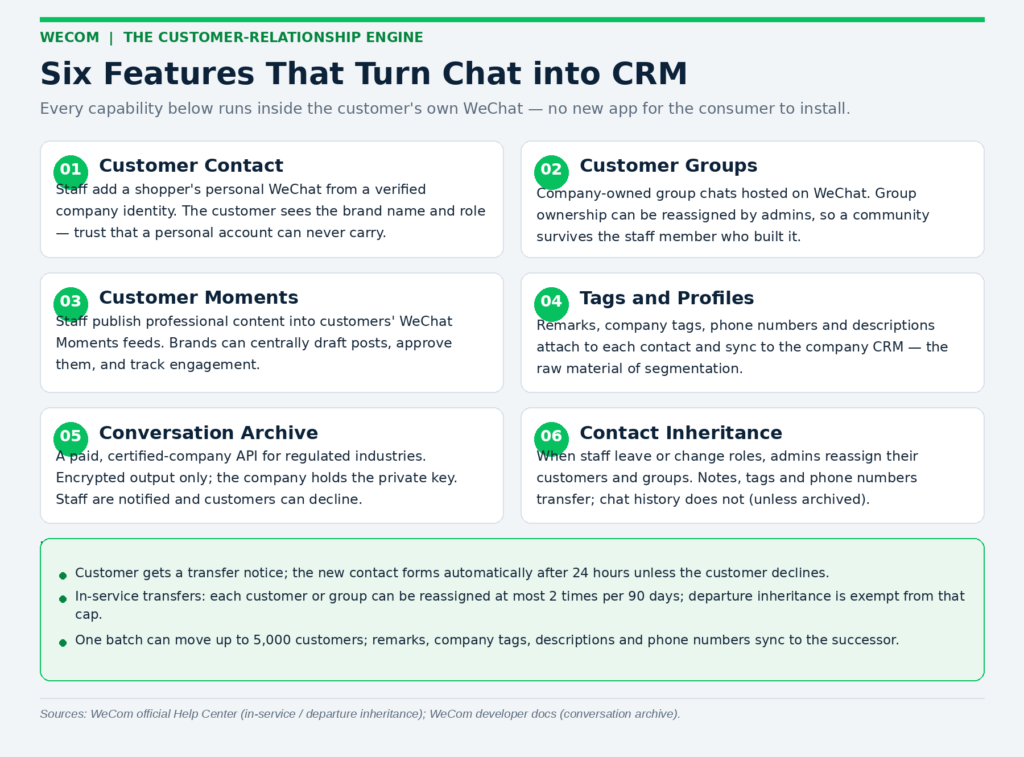
Customer Contact is the foundation. When a guide adds you, you see a verified company name and a real role — not a cartoon avatar selling skincare from a personal account. Customer Groups host communities on WeChat itself, and admins can reassign group ownership, so the community outlives its founder. Customer Moments puts staff content into the feed customers already scroll, with central drafting and approval on the brand side. It is the organic counterpart to paid Moments ads, minus the auction.
Tags, Archive, Inheritance: The CRM Underneath
Tags and profiles turn chats into structured data: remarks, company tags, phone numbers and descriptions attach to each contact and sync into the company’s CRM. Conversation Archive — a paid, certification-gated API — serves regulated industries; we will come back to it. And Contact Inheritance moves customers and groups between staff members when people leave or change roles. Three reach features, three asset features. The second trio is why CFOs, not just marketers, care about this product.
Why Inheritance Is the Structural Moat
Ask any Chinese retailer what happened when their best guide resigned in 2015. The answer: she took four thousand customers with her, because they were friends on her personal WeChat. The relationship was an employee asset wearing a company logo.
WeCom’s official Help Center spells out the fix. When an admin reassigns a departing employee’s customers, each customer receives a transfer notice; unless they actively decline, the successor automatically becomes their contact after 24 hours. Remarks, company tags, descriptions and phone numbers sync to the new owner. One batch can move up to 5,000 customers. For in-service transfers — role changes, territory swaps — each customer or group can be reassigned at most twice per 90 days, a friction designed to stop customers being bounced around; departure inheritance is exempt from that cap.
One honest limit: chat history does not transfer with the contact. The successor inherits the relationship and its metadata, not the transcript — unless the company runs Conversation Archive. Plan your handovers accordingly.
The strategic read? Every private-domain tactic — the QR codes at checkout, the group invites, the Moments posts — is renting reach. Inheritance is the one feature that converts rented reach into an owned asset. It is the difference between a customer list and a customer ledger.
The Compliance Layer: Boring, Expensive, Essential
Conversation Archive sounds like surveillance, and done badly it would be. Done officially, it is the reason banks and insurers can operate on WeCom at all.
The mechanics matter. It is a paid capability, enabled only for certified enterprises. Staff are notified that archiving is active; external customers see an archiving notice in the conversation and can decline — a notice-and-consent flow grounded in China’s Personal Information Protection Law. And here is the part most blog posts get wrong: the official product is an encrypted API stream, not a dashboard. Messages are encrypted with the company’s public key; the company holds the private key and decrypts on its own side. Tencent does not hand you a searchable chat viewer. If you want retrieval, auditing and retention, you build it or buy it from a service vendor — which is precisely why an SCRM industry exists around this product.
For regulated sellers, that plumbing is the product. A wealth manager’s promise recorded, encrypted and retrievable years later is not a marketing feature. It is a license to have the conversation in the first place.
Field Evidence: The Rainbow Numbers
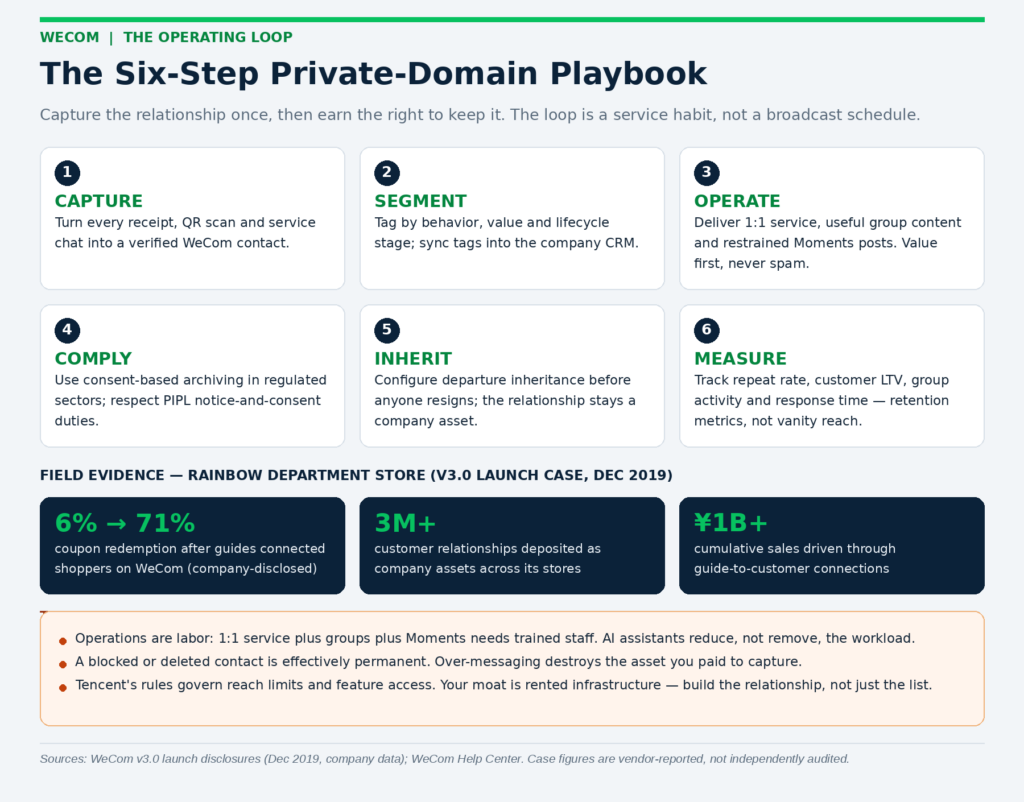
The canonical case is Rainbow, the Shenzhen-listed department store chain, disclosed at the 3.0 launch in December 2019. Guides connected shoppers on WeCom; coupon redemption jumped from 6 percent to 71 percent — roughly a ninefold lift; more than 3 million customer relationships were deposited as company assets; cumulative sales driven through those connections exceeded RMB 1 billion. Treat the figures for what they are: vendor-reported launch-case data, not an audited study. But the mechanism is reproducible, and it is not the coupon. It is that a tagged, verified, one-to-one channel made the coupon relevant. A 71 percent redemption rate is what happens when the right offer reaches a person who actually knows the sender.
The Practitioner Playbook
Six steps, in order. Skip one and the loop leaks.
- Capture. Turn every receipt, QR scan and service interaction into a verified WeCom contact. Enrollment at the moment of trust is ten times cheaper than retargeting a stranger later.
- Segment. Tag by behavior, value and lifecycle stage; push tags into the CRM. A list without segments is a spam cannon.
- Operate. Deliver one-to-one service, useful group programming and restrained Moments content. The discipline is value delivery, not volume.
- Comply. In regulated sectors, run consent-based archiving; everywhere, respect PIPL notice-and-consent duties.
- Inherit. Configure departure inheritance before anyone resigns, and rehearse handovers like fire drills.
- Measure. Track repeat rate, customer lifetime value, group activity and response time. Retention metrics, not reach vanity.
The Honest Caveats
Three, and they are not small.
First, this is labor. One-to-one service plus groups plus Moments is a staffing model, not a set-and-forget channel. AI helps — WeCom rolled out smart bots in February 2025 with Tencent’s Hunyuan model fully available and DeepSeek-R1 in gated release, and the 5.0 version added Smart Search, Smart Summary and Smart Bot with data confined to the enterprise boundary — but drafting assistance does not replace judgment about when to stay silent.
Second, the block is forever. A customer who deletes you is not an impression you can buy back. Over-messaging does not just underperform; it destroys the asset you paid to capture.
Third, you are building on rented land. Tencent’s rules govern external-contact limits, feature gating and platform policy. The moat is real, but it sits inside someone else’s castle. Own the relationship quality; never mistake platform tolerance for a permanent right.
Where This Is Heading
Two integrations to watch. WeChat Store account rules effective since August 2025 let verified WeCom company accounts share store products after admin binding — the service conversation and the transaction shelf are being stitched together. And WeCom’s customer-service capability has been wired into Channels and store product pages since late 2022, meaning a livestream viewer’s question can land in a company-owned service queue. Meanwhile the SCRM vendor layer — Weimob, Youzan and the specialist players — keeps industrializing tagging, archiving and handover workflows. The direction is unambiguous: chat, content, commerce and compliance converging into one company-owned loop.
Conclusion: Own the Relationship, Not the Broadcast
WeCom’s decade teaches one reusable lesson: the customer relationship should be a company asset, and the infrastructure should make that structurally true — verified identity at capture, consent at storage, inheritance at turnover. The scale is Tencent’s; the discipline is yours. Brands that treat WeCom as a broadcast channel will spam their way to permanent blocks. Brands that treat it as a relationship ledger — capture, segment, serve, comply, inherit, measure — will compound the one thing paid media can never sell you: a customer who knows your name and stays.