The legal perimeter around Nvidia tightened on Thursday. California Attorney General Rob Bonta served the chipmaker with an investigative subpoena, his office announced, making the state’s Department of Justice the newest authority demanding answers about whether Nvidia’s advanced AI chips — or its confidential information — ended up in China. The announcement lands twelve days before former CEO Jensen Huang sits for transcribed interviews with three House committees, and it converts what began as a governance scandal into a two-track legal proceeding: state securities law on one side, national-security oversight on the other.
Read the subpoena carefully, because its scope is narrower than the headlines suggest. Bonta’s office is asking two questions. Did Nvidia’s actions, or Huang’s, result in China obtaining advanced chips or confidential information? And did Nvidia mislead investors and the public about that risk, in violation of California’s corporate securities laws? “My office is investigating whether Nvidia or Jensen Huang’s actions resulted in China obtaining advanced chips or confidential information — and if Nvidia misled investors and the public about this risk, in violation of the law,” Bonta said. No court, regulator or company filing has established that either thing happened. An investigative subpoena is a demand for records, not a finding of wrongdoing — a distinction that matters for anyone pricing the stock or the supplier relationship.
The probe grows out of reporting on Huang’s relationship with Alice Huang, a former executive at Singapore-based data-center firm Megaspeed who is of no family relation to him. US officials have suspected her of ties to Chinese intelligence, and US and Singaporean authorities have been examining whether Megaspeed diverted restricted Nvidia chips into China. Megaspeed and the Chinese government deny wrongdoing; the espionage allegation remains unproven. Huang resigned as CEO, president and board member on November 12, and has publicly acknowledged serious personal mistakes while pledging cooperation with the board’s independent investigation. California’s attorney general, notably, does not need the spy story to be true to pursue the second question: what a company told its investors is a securities matter regardless of what the chips ultimately did.
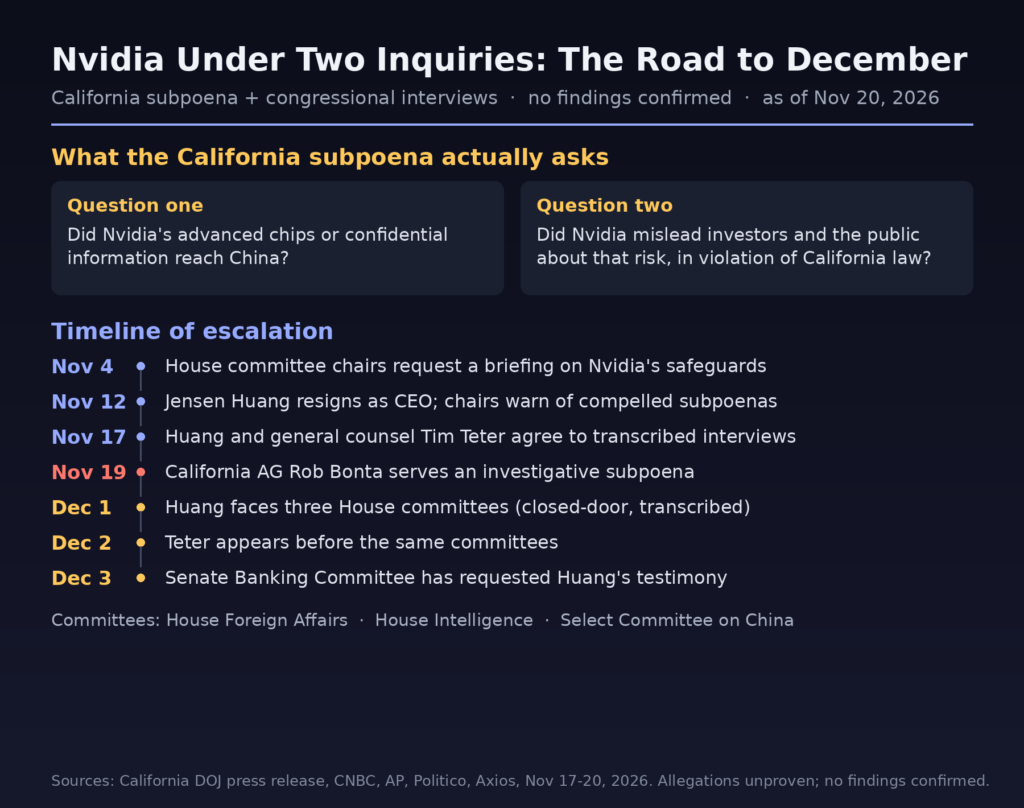
The congressional track has been moving in parallel, and its calendar is now fixed. The chairmen of the House Foreign Affairs, Intelligence and China select committees — Brian Mast, Rick Crawford and John Moolenaar — first requested a briefing on November 4 and warned on November 12 that non-cooperation would draw compelled subpoenas. On November 17 they announced that Huang had agreed to appear voluntarily on December 1 for closed-door transcribed interviews, with Nvidia general counsel Tim Teter following on December 2. Separately, Senate Banking Committee chairman Tim Scott has asked Huang to testify on December 3. The chairs have also tied the affair to their legislative agenda, pressing for four chip-security bills — the AI OVERWATCH Act, the Chip Security Act, the MATCH Act and the Remote Access Security Act — to ride the annual defense bill.
That legislative link is the part enterprises should watch. The scandal supplies political energy; the bills supply durable structure. Location-verification requirements for advanced chips, congressional oversight of export licenses, allied-equipment coordination, and restrictions on renting overseas compute to Chinese firms would each outlive this news cycle and reshape how AI infrastructure is bought, leased and audited worldwide. A remote-access rule, in particular, would reach far beyond hardware sales into the cloud-rental arrangements that many companies outside China have quietly relied on.
For Nvidia, the immediate question is containment. The company has already stood up a board-level national security and export-control committee, and Teter’s December 2 appearance signals an intent to answer institutionally rather than personally. For customers and partners, the practical guidance is less dramatic than the coverage: nothing in Thursday’s announcement changes export rules or supply commitments today. But disclosure risk is now a live variable in Nvidia’s own reporting, and December 1–3 will produce a transcript that regulators, plaintiffs’ lawyers and short sellers will all read closely. Two inquiries, zero findings — for now. The next two weeks decide whether that last phrase survives.