For two years, “agentic commerce” has been a conference phrase. On Thursday it got a line item. Walmart, reporting third-quarter results, said usage of its AI shopping assistant Sparky grew 129% year over year in the United States — and customers who use it build baskets 40% larger than those who don’t. That is the first time a retailer of Walmart’s scale has put a hard commerce metric on an AI assistant, and it changes the conversation from whether agents sell things to how fast.
The numbers sit inside a genuinely strong quarter. Revenue reached $188.8 billion, up 5.2%; global eCommerce grew 17% and now accounts for 24% of net sales, with US eCommerce up 23%. The advertising business — the margin engine marketers watch — grew 25% globally and 37% in the US. Full-year guidance went up. One accounting caveat worth stating plainly: GAAP net income fell 19.5%, driven by swings in equity investments, while adjusted EPS rose 4.8% to $0.65. Both are true; they measure different things, and the operating story is the adjusted one.
CEO John Furner, who took the top job in February, used the earnings call to describe where this is heading. Sparky has expanded to Mexico, Canada and Sam’s Club, and keeps adding capabilities. But the more consequential announcement concerns agents Walmart doesn’t own. The company is building what it calls an Agent Gateway: approved third-party AI agents will be able to shop Walmart on a customer’s behalf, connected through dedicated agent profiles. Customers set spending limits, track agent purchases separately from their own, and can revoke access at any time.
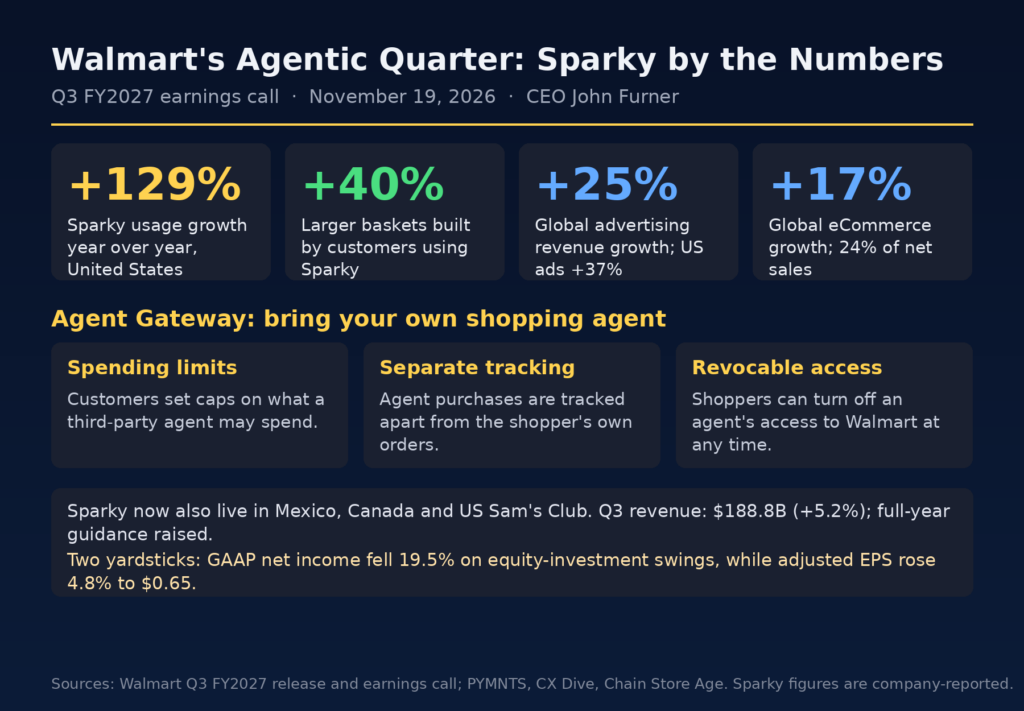
Read those controls again, because they are a product specification for an entire category. Limits, separate tracking, revocability — this is what accountable delegation looks like when your delegate is software with a payment method. Walmart is effectively publishing the trust framework that every shopping agent will be judged against, and doing it before the agents arrive at scale. “Whether customers shop directly with us or through an agent, they should be able to count on accurate pricing, reliable availability, and clear delivery options,” Furner said.
For brands and agencies, the strategic implication is uncomfortable and clear. If a growing share of baskets is assembled by an assistant — Walmart’s own or someone else’s — then visibility splits into two games. One is the familiar shelf: search rankings, sponsored placements, retail media. The other is the machine-readable layer: structured product data, availability feeds, pricing accuracy and the kind of clean attributes an agent can actually reason over. The 40% basket lift suggests the agent game is not cannibalizing the shelf; it’s expanding it. But the brands that win the agent layer will be the ones whose data an agent can trust, not just the ones whose ads a human can see.
There is a measurement caveat to keep honest: the basket figure is correlational, company-reported, and drawn from users who chose to adopt Sparky — enthusiastic shoppers may simply buy more. Walmart has not published a controlled comparison. Even discounted, though, the direction aligns with what the platform is betting its infrastructure on.
The next beats to watch: which third-party agents get approved through the Gateway first, whether Amazon answers with its own external-agent policy, and whether Sparky’s basket premium survives expansion beyond early adopters. Agentic commerce stopped being a demo this week. It became a P&L line — and a data-specification problem every marketer now owns.