When an AI company dies, what happens to everything its users told it? That question is now sitting on a bankruptcy judge’s desk in Delaware, and 39 states plus the District of Columbia have lined up to answer it. Character Technologies, the company behind the character-chat platform Character.AI, filed for Chapter 11 on October 12. Its assets go to auction on December 1 — and the most contested asset is not the code. It’s the conversations.
Two bids split the estate in a way that should interest every marketer who has ever exported a user list. Disney has offered $20 million for a non-exclusive perpetual license to the system code and nine patents, alongside a separate three-year compensation package worth about $180 million — $60 million a year plus a $30 million retention pool — to hire 66 employees, most of whom have already left the company. Disney, notably, is not bidding for the user data. The other bidder is: Smirks and Pangs Acquisition LLC, a entity registered in Delaware on November 13 that bid the next day, has offered $10 million in cash plus assumed liabilities for essentially everything else — roughly 163 million cumulative registered user accounts, their chat logs, advertising and analytics profiles, the model weights and the brand.
Do the arithmetic the states did: ten million dollars for 163 million accounts works out to about six cents per user. And these are not ordinary accounts. Character.AI’s logs include years of role-play conversations, emotional disclosures and, per the states’ filing, substantial usage by minors — against a current monthly active base of roughly 12 million. The cumulative figure counts everyone who ever signed up, which is precisely the population whose data would transfer.
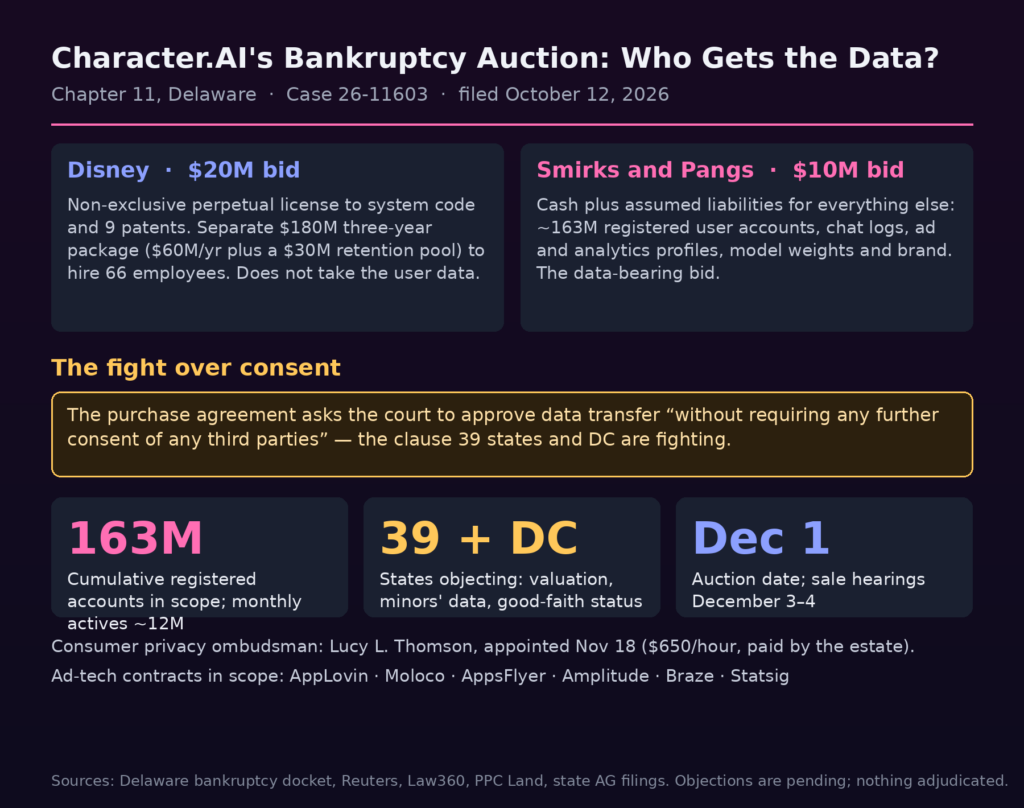
The legal mechanism is the part with industry-wide reach. The proposed purchase agreement asks the court to approve the data transfer “without requiring any further consent of any third parties” — meaning users would not be asked again. The November 18 joint objection from the 39 states and DC attacks this on multiple fronts: no valuation supports the price, the transfer of minors’ data may violate the law, and Disney’s structure raises good-faith-purchaser questions under bankruptcy code Section 363(m). The court has appointed a consumer privacy ombudsman, Lucy L. Thomson, at $650 an hour paid by the estate, to review what the sale means for users. The auction is set for December 1 at 10 a.m. Eastern, with sale hearings December 3 and 4.
Buried in the contract schedules is a detail that reads like an adtech autopsy. The agreements slated for transfer include AppLovin, Moloco, AppsFlyer, Amplitude, Braze and Statsig — a complete monetization-and-measurement stack. Character.AI wasn’t just a chatbot; it was a consumer data business with advertising profiles attached to some of the most intimate conversations on the internet. Anyone arguing that “conversational data is different” now has to explain why it was wired into a standard growth stack.
For marketing and data teams, the case is a due-diligence template arriving in real time. First: user data acquired through M&A or bankruptcy may carry consent defects that no purchase agreement can cure — ask where the data came from and what users agreed to, before you license it. Second: privacy policies promising data protection mean little if they lack transfer restrictions that survive insolvency; regulators are signaling that the promise follows the data. Third: if you build products on intimate conversational data, plan for the end-of-life scenario now, because a court-appointed stranger may end up deciding your users’ fate.
Nothing here is decided. The states’ objections are arguments, not findings, and the judge could approve a modified sale. But whichever way December 1 goes, it will set the price — legal and literal — of what users tell an AI. Six cents, so far, is the market’s answer. Thirty-nine states think that’s the wrong question.