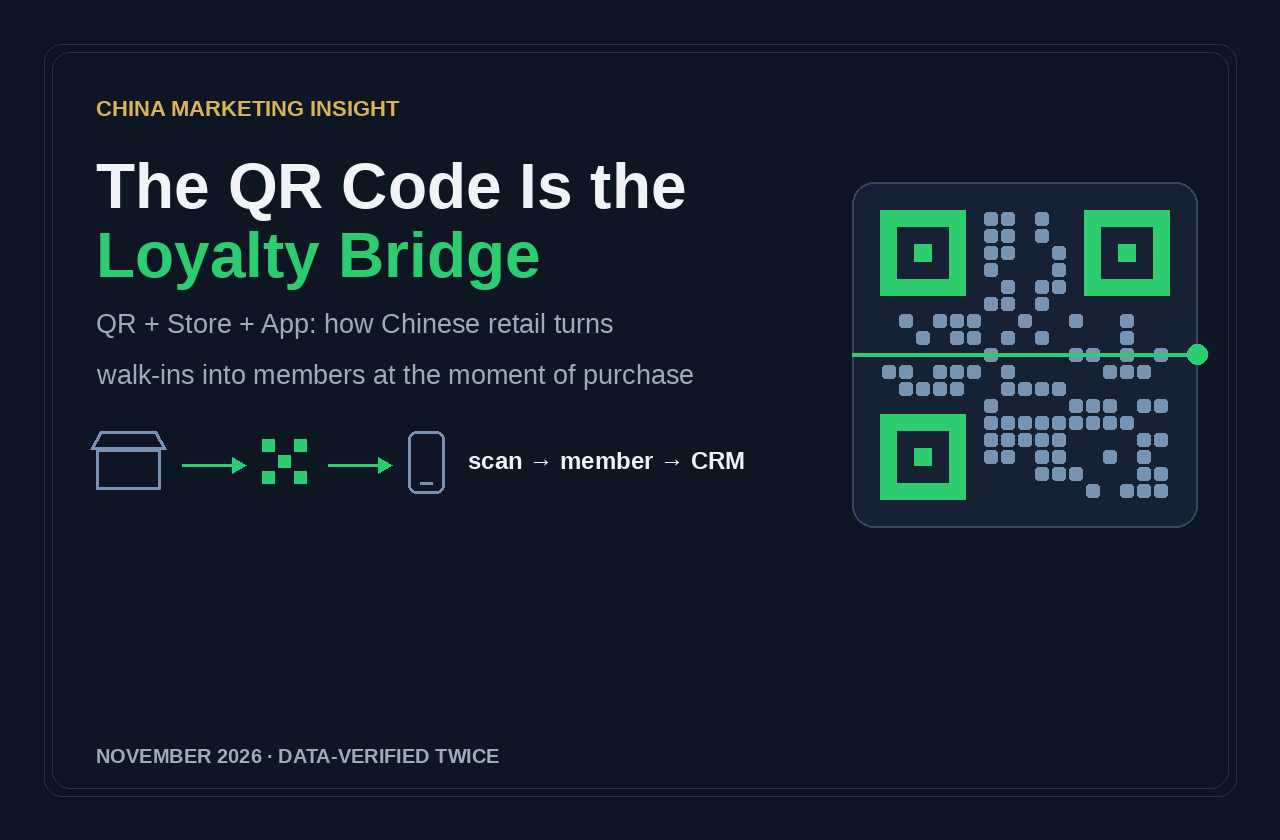
Picture the moment. You have just paid for a coffee, and the cashier asks the loyalty question: “Want to join our rewards program?” In most of the West, saying yes means opening an app store, finding the app, waiting for the download, creating an account, verifying an email. In China, saying yes means pointing your camera at a small square printed on the counter. One scan, and you are a member — often before your drink is even made.
Same question. Two completely different funnels. And the gap between them is one of the most underappreciated structural advantages in Chinese retail: the offline-online loyalty bridge, where the QR code is the bridge, the store is the acquisition channel, and the mini-program is the retention engine.
The Register That Isn’t There
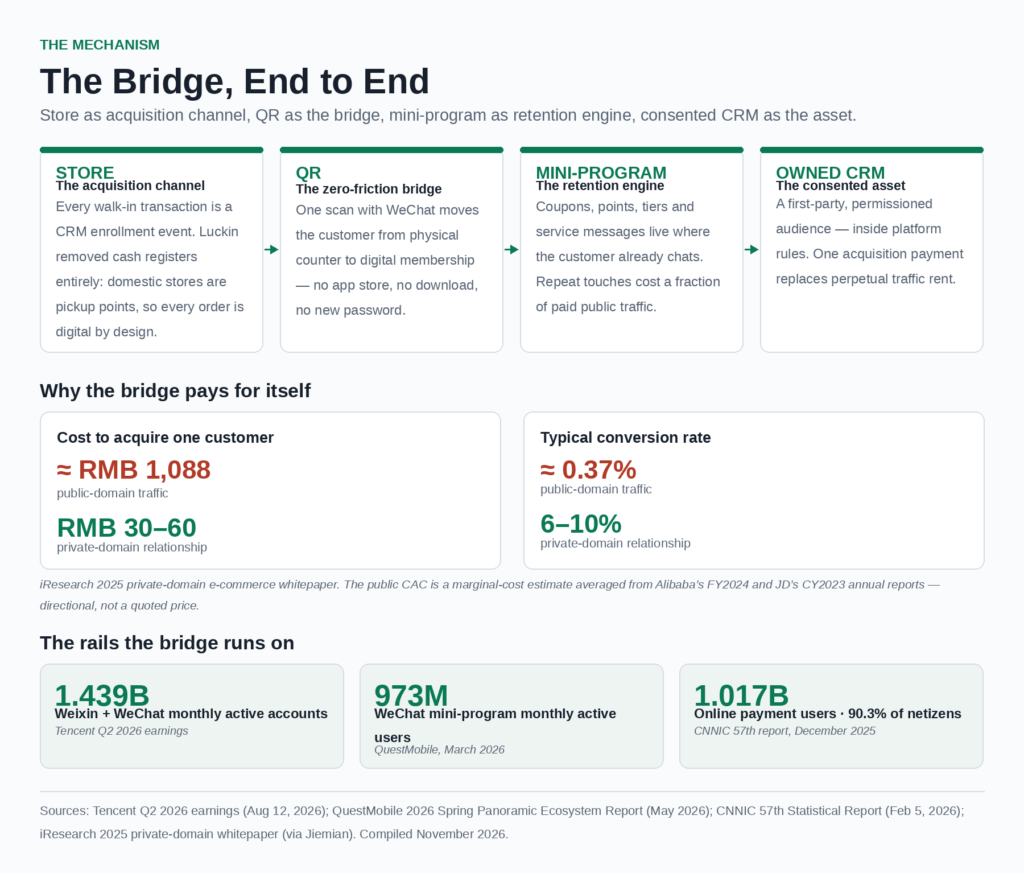
Walk into a Luckin Coffee store in China and look for the cash register. You won’t find one. Domestic Luckin stores are built as pickup points: you order through the app or a WeChat mini-program, pay digitally, and collect your cup when your number lights up. There is no anonymous cash transaction to lose.
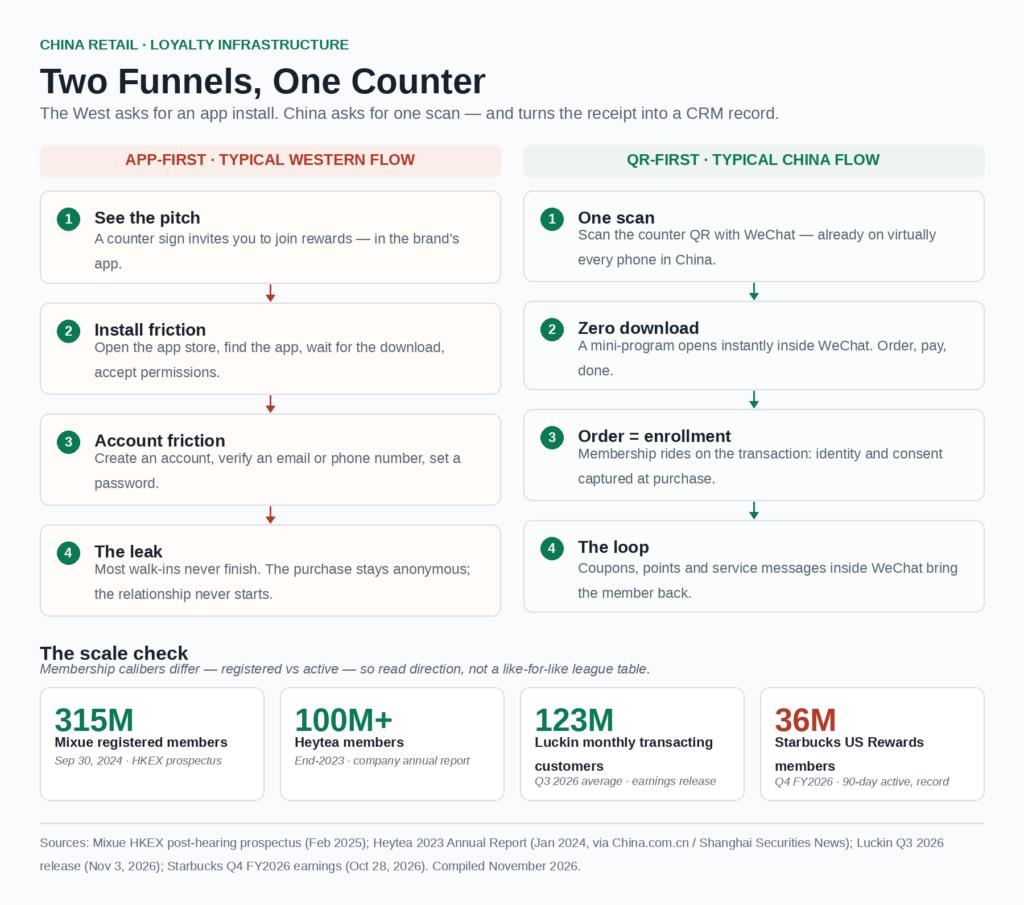
That design choice is the whole thesis in miniature. When every order must pass through a digital channel, every order is an enrollment event. The purchase captures identity, consent and a permissioned contact channel in one motion. The results compound: Luckin’s third-quarter 2026 earnings release, published in early November, reported a record 123 million average monthly transacting customers and more than 520 million cumulative customers since launch, across roughly 38,900 stores. You cannot build a customer file that size by asking people to download an app after they have already paid and left. You build it by making the transaction itself the signup.
Heytea’s Climb From Queue to Club
Heytea ran the experiment in slow motion, and the receipts are public. The brand launched its Heytea GO mini-program in 2018, when its stores were famous for hours-long queues. The scan solved a customer problem first — order ahead, skip the line — and membership rode along behind it.
The company’s own anniversary and annual reports trace the curve: more than 63 million members by the end of 2022, then over 100 million by the end of 2023 — roughly 37 million added in a single year, as reported by China.com.cn and Shanghai Securities News when the annual report landed in January 2024. Heytea became the first Chinese tea brand to cross a nine-figure private-domain user base. No app-download campaign did that. A queue-management tool did, because it turned every visit into a login and every login into a relationship.
Mixue: Hundreds of Millions of Members on Cheap Lemonade
If Heytea proves the bridge works for premium queues, Mixue proves it works at the very bottom of the price ladder. The budget lemonade-and-soft-serve chain’s Hong Kong listing prospectus disclosed about 315 million registered members as of September 2024 — roughly one member for every four or five people in the country — supported by more than 46,000 stores at the end of that year and nearly 60,000 a year later.
The mechanics are unglamorous: scan to order, scan for a coupon, scan to collect points. Each scan is trivially cheap for the customer, and each one lands in the same member ledger. When your product costs a few yuan, you cannot afford a paid acquisition funnel. The counter QR is the only funnel that pencils out — and at Mixue’s scale it became one of the largest consumer databases in Chinese retail.
Sam’s Club: The Bridge You Pay to Cross
Walmart’s Sam’s Club shows the bridge at the top of the market. Membership is not a post-purchase pitch; it is the entrance ticket. You show the member QR in the app to get in and again to check out, so the identity layer is welded to every transaction by design. Industry estimates put paid membership above 10 million households, and Chinese business media report renewal near 92 percent for the premium tier and around 80 percent for the standard card — media-cited figures rather than audited breakouts, but directionally confirmed by Walmart’s own earnings, which reported record Sam’s China membership and 20.7 percent China net sales growth in the quarter announced in August 2026.
Four brands, four price points, one architecture: the store acquires, the QR bridges, the app or mini-program retains.
Mechanism One: Friction Is a Tax, and the Scan Evades It
Every step in a funnel leaks people. The app-first loyalty funnel stacks four or five high-friction steps — store, download, permissions, account, verification — between the customer’s yes and the brand’s CRM. Each step is a tax, and most walk-ins simply refuse to pay it.
The QR-first flow collapses the tax to a single gesture. There is no download because the mini-program runs inside WeChat, an app already on virtually every phone in China. There is no new account because WeChat supplies the identity handshake. There is no password because payment authentication already happened. Behavioral economists would call this removing choice architecture that works against you; a store manager would call it shorter lines. Both are right.
Mechanism Two: The Transaction Is the Enrollment
The deeper trick is sequencing. Western loyalty asks for the relationship after the value exchange is over — the coffee is paid for, the customer is leaving, and joining is pure homework. The Chinese bridge asks during the exchange, when joining is the path of least resistance to getting the thing you already want.
Luckin’s register-free stores are the pure form: enrollment is not a step in the purchase, it is the purchase. Heytea’s order-ahead queue skipper is the friendly form. Mixue’s scan-for-coupon is the incentivized form. In all three, identity and consent are captured at the moment of maximum willingness — the customer is mid-transaction, wallet already open. Marketing teams spend fortunes manufacturing that moment online. The store manufactures it for free, dozens of times an hour.
Mechanism Three: Retention Lives Where the Customer Already Is
Enrollment is worthless without a cheap way to come back. This is where the bridge connects to the economics we covered in our traffic-tax piece. iResearch’s 2025 private-domain e-commerce whitepaper estimates public-domain customer acquisition at roughly RMB 1,088 per new customer versus RMB 30 to 60 inside private domain, with conversion rates of about 0.37 percent versus 6 to 10 percent. The public figure is a marginal-cost estimate averaged from Alibaba’s and JD’s annual reports — directional, not a quoted price — but the order of magnitude is the point.
Once a member lives in your mini-program or WeCom contact list, the next touch — a coupon, a points reminder, a new-product push — costs almost nothing. The rails are enormous: WeCom connects more than 14 million organizations and serves 750 million WeChat users daily, per Tencent’s disclosures. One acquisition payment at the counter replaces perpetual rent in the ad auction. The QR bridge is not a loyalty gimmick; it is the on-ramp to owned-audience economics.
The Rails Were Laid by Payments, Not by Marketers
None of this required teaching China to scan. Payments did that. CNNIC’s 57th statistical report, released in February 2026, counts 1.017 billion online payment users — 90.3 percent of the country’s 1.125 billion netizens. The QR habit is muscle memory from a decade of buying vegetables and splitting dinner bills.
And the muscle memory is now infrastructure policy. Under the People’s Bank of China’s guidance, a unified cross-border QR gateway went into trial in July 2025 so foreign wallets can scan Chinese merchant codes; WeChat disclosed at its January 2026 Open Class that mini-programs saw more than 5 billion cross-border and overseas uses in 2025 across 100 countries and regions. The loyalty bridge inherits a scanning culture, a payment identity layer and a super-app runtime — Tencent reported 1.439 billion combined Weixin and WeChat monthly active accounts in its second-quarter 2026 earnings, and QuestMobile counted 973 million monthly active users of WeChat mini-programs in March 2026. Marketers didn’t build this. They just moved in.
The Consent Architecture: The Bridge Has a Regulator
Here is the part most Western write-ups skip. China’s scan-to-member flow grew up under enforcement, and the rules are load-bearing.
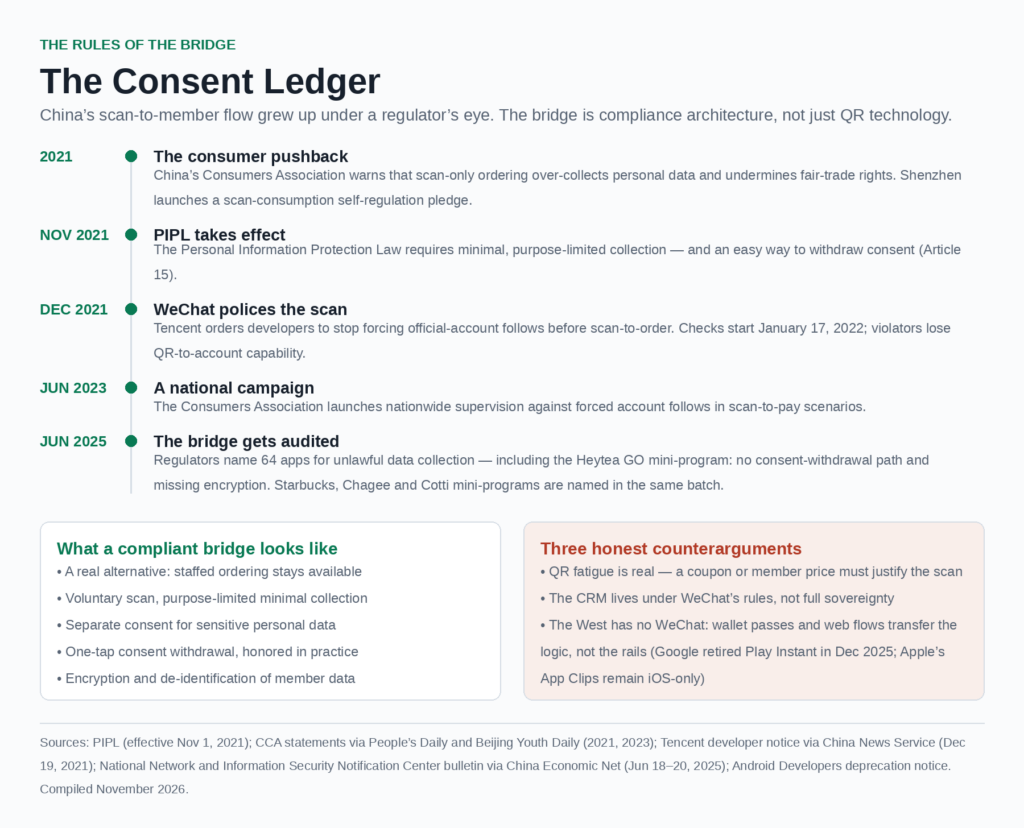
The timeline reads like a design spec. In 2021, the China Consumers Association warned that scan-only ordering over-collects personal data and undermines fair-trade rights. In November 2021, the Personal Information Protection Law took effect, requiring minimal, purpose-limited collection and — under Article 15 — an easy way to withdraw consent. In December 2021, Tencent ordered developers to stop forcing official-account follows before scan-to-order, with checks from January 2022 and QR restrictions for violators. In June 2023, the CCA launched nationwide supervision against forced follows.
Then came the audit. In June 2025, the national network and information security notification center named 64 apps for unlawful personal-data collection — and the list read like a loyalty-bridge all-star team: the Heytea GO mini-program was cited for providing no consent-withdrawal path and missing encryption, alongside mini-programs from Chagee, Cotti, Starbucks and others. The lesson is blunt: the bridge is compliance architecture, not just QR technology. The scan must be voluntary, the data minimal, the withdrawal real, and a staffed alternative must exist. Brands that treat consent as a checkbox are building their CRM on a fault line.
Three Things Everyone Gets Wrong
Myth one: the QR is just a link. No — the link is the surface; the function is enrollment, consent and a permissioned channel. A QR that opens a menu without capturing the relationship is a missed bridge.
Myth two: loyalty is app-first. The assumption smuggles in the download. China’s evidence says the lightweight runtime wins: Heytea crossed 100 million members without ever asking most of them to install anything.
Myth three: the store is just a place where sales happen. In this architecture the store is a media channel with negative acquisition cost — customers pay you while being enrolled. The sale is the campaign.
The Counterarguments, and Their Limits
Three objections deserve honest airtime. First, QR fatigue and privacy wariness are real; Chinese consumers grumble about forced scans, and regulators agree. The limit: fatigue attaches to coercion and valueless scans, not to value exchange. A member price or a queue skip justifies the gesture — which is exactly why the 2021–2025 rules pushed the flow toward voluntary, rewarded, minimal-data scans.
Second, the CRM lives on someone else’s land. WeChat writes the rules, as the forced-follow crackdown showed. True — owned here means consented first-party data inside platform governance, not sovereignty. The rent is lower, not zero, and platform risk must be managed.
Third, the West has no WeChat, so the bridge can’t travel. Half right. The rails don’t travel: Google retired Play Instant in December 2025, closing Android’s no-install path, and Apple’s App Clips remain an iOS-only slice. But the logic travels anywhere a scan can open a lightweight web flow, a wallet pass or an instant app — and the payoff math (acquire once at the counter, retain cheaply forever) is universal.
What the West Can Actually Copy
Start with humility: Starbucks Rewards is the counterexample that keeps everyone honest. Its app-first program reached a record 36 million 90-day active US members in the quarter reported in October 2026, and loyalty-linked transactions accounted for roughly 60 percent of US company-operated sales in fiscal 2025. App-first can win — with years of investment and heavy incentives.
But notice what Starbucks actually built: ordering, payment and rewards fused into one habitual flow. It reconstructed the transaction-as-enrollment logic inside its own app because it had no super-app to borrow. Western brands without Starbucks-scale gravity should copy the sequence, not the silo: put the QR where the transaction happens, open a lightweight flow (App Clips on iOS, web apps and wallet passes everywhere), offer immediate value, capture consent cleanly, and run retention in the cheapest channel you own — email, SMS, wallet, web push. The bridge is universal. The implementation is local.
The Playbook: Five Moves
One: put the bridge on the counter, the packaging and the receipt — every transaction surface is an enrollment surface. Two: make joining ride on the order, never a separate errand. Three: pay for the scan instantly with member pricing or a coupon; the value exchange is what defeats fatigue. Four: build consent as a product feature — minimal fields, one-tap withdrawal, a staffed fallback; the June 2025 bulletin is your QA checklist. Five: run retention where touches are nearly free, and measure the metric that matters — not signups, but the share of next month’s revenue that comes from members you enrolled at the counter.
The Takeaway
The West asks customers to install a relationship. China lets them scan one. Behind that one-gesture difference sits a full architecture: stores as acquisition channels, transactions as enrollment events, mini-programs as retention engines, and a consent regime that keeps the bridge honest. Luckin’s missing cash registers, Heytea’s hundred million members, Mixue’s prospectus disclosures and Sam’s renewal rates are the receipts. The QR code is not a link. It is the loyalty bridge — and the brands that turn walk-ins into members at the moment of purchase win the owned audience the app-download funnel quietly loses.