The most valuable company in the AI boom spent Friday watching its shares fall 14%. By the close, Nvidia was trading around $126, its market value had shrunk to roughly $3 trillion, and the stock had just posted its worst week since October 2008 — a sixth consecutive weekly decline, the longest losing streak since 2012.
The immediate trigger was a Reuters exclusive, published Thursday in New York, reporting that enforcement staff at the U.S. Securities and Exchange Commission are examining potential accounting issues at the chipmaker. Two people briefed on the matter described the inquiry to reporters Chris Prentice and Alexandra Alper. The Wall Street Journal had first reported the existence of an SEC investigation earlier in the week, but Reuters was the first to identify what the probe is actually about: the books themselves.
At the center of the scrutiny sits a quiet change in how Nvidia tells investors where its money comes from. Until last year, the company broke out geographic revenue based on the billing addresses of its customers. Under that method, the Financial Times reported, sales billed through Singapore accounted for roughly half of Nvidia’s global revenue — an extraordinary concentration for a company whose chips were officially restricted from sale to China. Nvidia then switched to reporting revenue by the location of each customer’s headquarters. Under the new method, Singapore vanished from the geographic breakdown entirely.
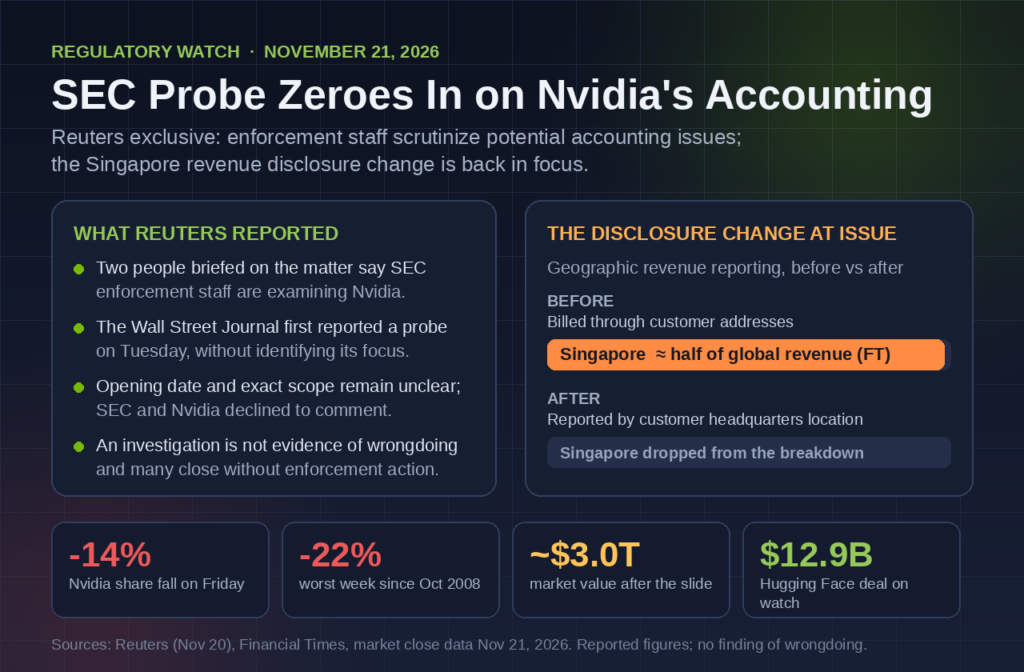
Neither the SEC nor Nvidia would comment on the record. It is worth being precise about what is known and what is not: the opening date and exact scope of the investigation remain unclear, and an investigation is not a finding of wrongdoing. Many SEC probes close without any enforcement action. But markets do not wait for conclusions. They price uncertainty, and this particular uncertainty lands on the one company whose revenue visibility has anchored the entire AI trade.
There is an awkward personnel detail, too. David Kress, the former chief financial officer who signed off on the disclosure change, is now Nvidia’s interim chief executive, following Jensen Huang’s departure. The executive who would oversee any response to the accounting questions is the same one who presided over the reporting shift now under review. Separately, Bloomberg has reported that the Justice Department is examining Nvidia’s $12.9 billion acquisition of Hugging Face for antitrust concerns — a second front that keeps the regulatory story alive even if the accounting questions fade.
For marketers and business operators who buy AI infrastructure or build on it, the practical read is narrower than the headlines suggest. Nvidia’s product roadmap remains intact, and its most recent quarterly results were staggering. What changed this week is the discount rate the market applies to those numbers. When a regulator asks whether revenue is recorded correctly, every forecast built on that revenue inherits the question. Expect procurement teams at cloud providers and enterprise AI buyers to start asking suppliers harder questions about financial durability — and expect “audited, transparent revenue” to become a selling point in the AI vendor pitch decks of 2027.
The next concrete signals: any voluntary supplemental disclosure from Nvidia, any public statement from the SEC, and whether the stock can hold its footing after a 22% weekly drawdown. Until then, the AI trade’s biggest name is trading like a company under audit — because, according to Reuters, it is.