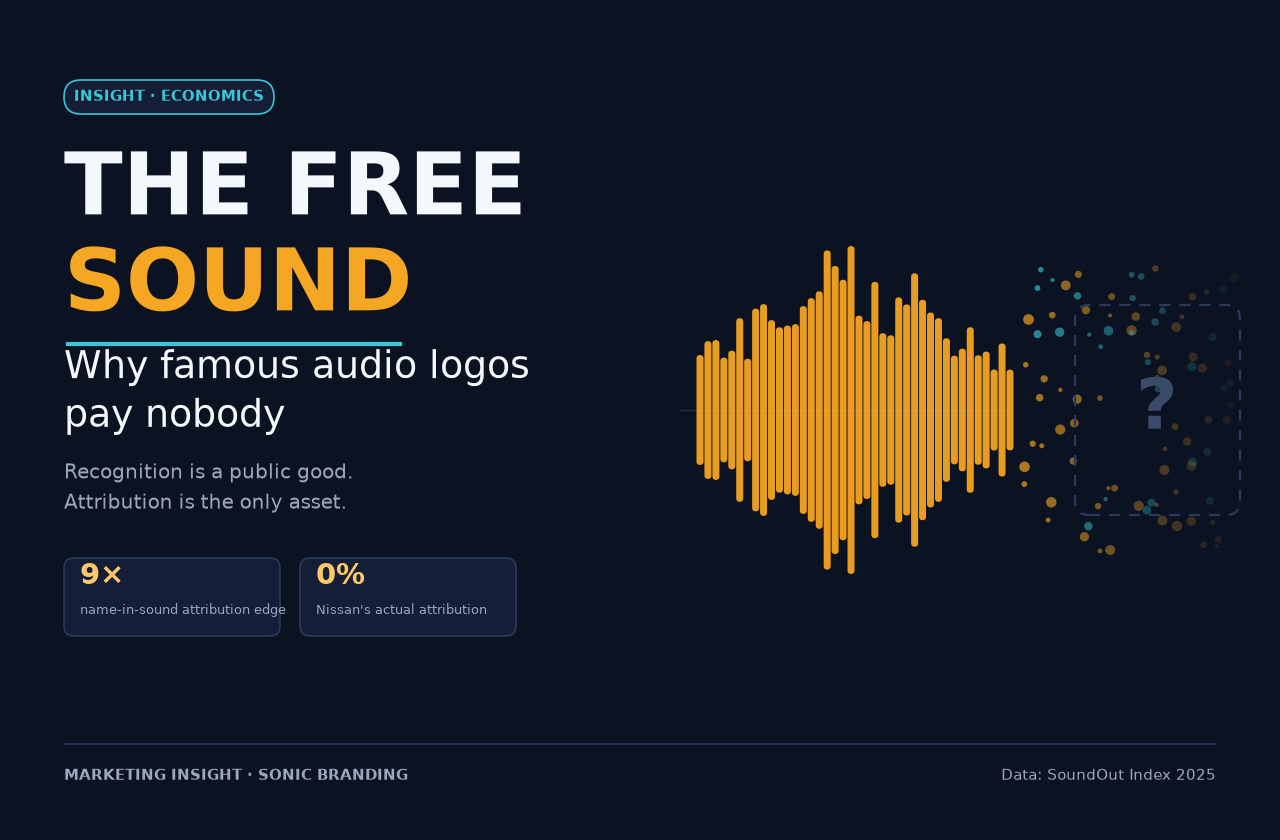
Everyone has heard that sound builds brands. The stranger question is why so many famous sounds build nobody’s brand. SoundOut’s Index 2025 — 174 sonic logos, 70,000-plus blind responses — found actual attribution trailing claimed recognition by more than 20 points on average, with Nissan at 30% claimed recognition and 0% actual attribution. This insight argues the failure is economic, not creative: an unattributed sound is a public good, and public goods get underinvested because their returns leak to everyone.
The Insight: Fame Is a Public Good, Attribution Is Property
Here is the mechanism most sonic-branding decks skip.
Recognition and attribution are not two grades of the same thing. They are different assets with different owners. A familiar sound — warm, nostalgic, vaguely “that car ad” — creates category-level goodwill that any brand with a similar sonic vibe can harvest. Nissan paid for a sound; the feeling it generates is available to the entire automotive category. That’s a textbook positive externality: the investor bears the full cost, the market shares the benefit.
Attribution is the property right. When a listener hears four notes and thinks a specific brand name, the memory structure is fenced. Every subsequent exposure pays the owner. SoundOut’s data prices the fence precisely: sonic logos containing the brand name are nine times more effective at actual attribution than purely musical cues, and 22 of the top 25 ranked logos include the name.
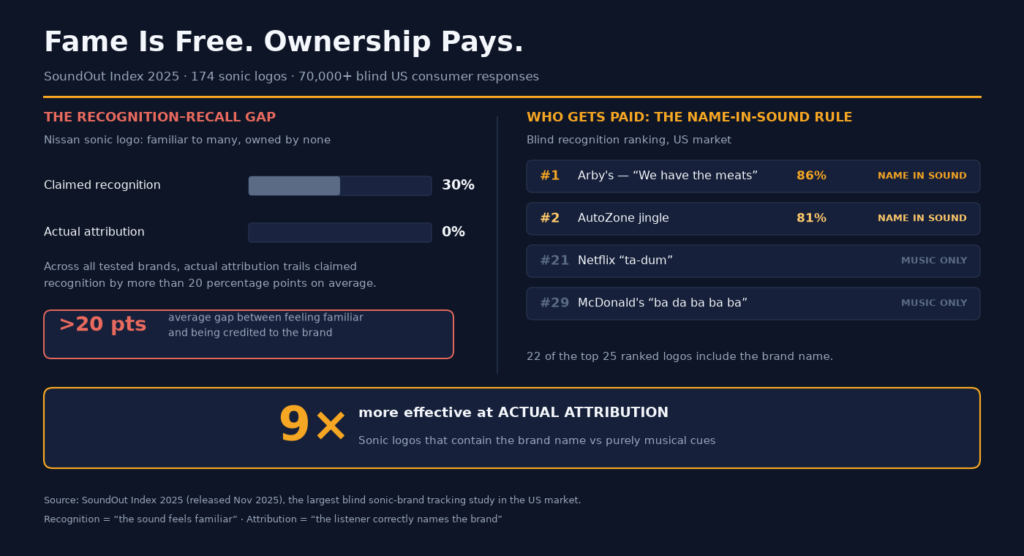
Now the incentive trap becomes legible. Teams are rewarded for what’s cheap to report: recognition scores, recall in friendly panels, executive approval. “People love it” is a deliverable; “people credit us” requires blind testing, iteration and the humility to put the brand name in the melody — which creative culture often codes as unsophisticated. So organizations optimize the public good and skip the property right. The Netflix fantasy is free to admire; the Arby’s lyric feels crass. One is a two-second asset compounding for a decade; the other is an awards reel.
The correction is a budgeting rule, not a taste debate. Treat unattributed recognition as leakage on the income statement. Fund the name-in-sound version until blind attribution clears a threshold, then — and only then — buy the right to abstraction the way Netflix and McDonald’s did: with decades of consistent exposure. Maybelline’s revival of a 25-year-old name-bearing jingle to #20 of 174 shows the cheapest attribution available is often the kind you already own.
The uncomfortable takeaway: your sonic budget isn’t buying familiarity. It’s buying enclosure. Sound without a fence is charity.