Every explainer about China’s moment-marketing machine focuses on the riders: the always-on brand teams, the minutes-scale shipping, the fines for bad judgment. Almost nobody looks at the landlord. That is where the strangest fact in this economy surfaced — not in a marketing case study, but in an earnings call.
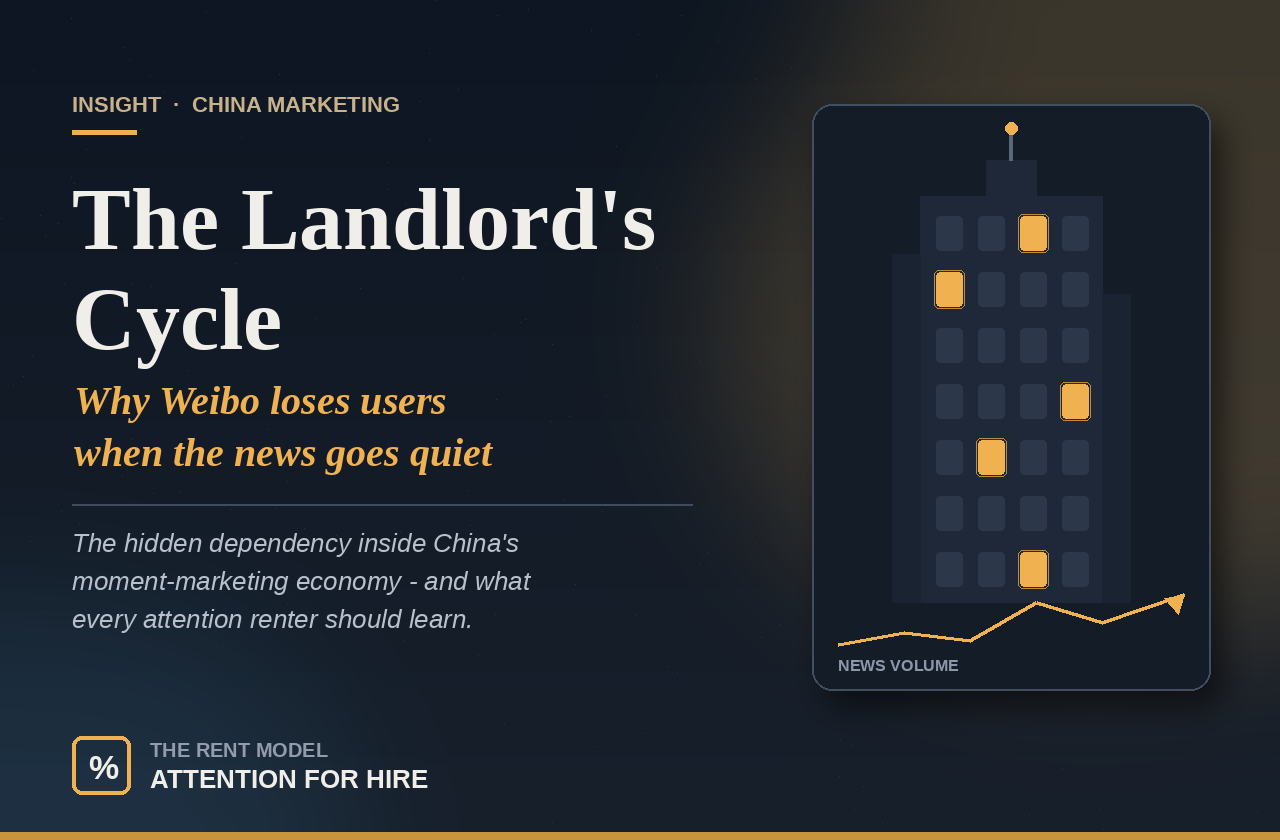
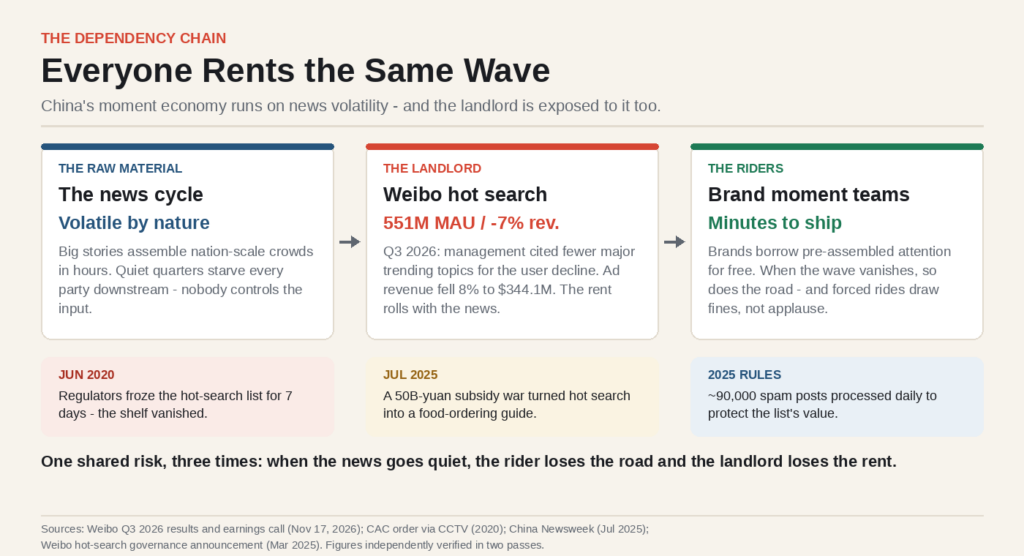
On November 17, 2026, Weibo told investors its September monthly active users stood at 551 million and daily actives at 254 million, both down year over year. Management offered an unusual explanation: the quarter had fewer major trending topics and big hit stories. Revenue fell 7% to $410.2 million; advertising slid 8% to $344.1 million. Read that causal chain slowly. The platform that sells the nation’s attention lost users because the nation had less to talk about.
The Dependency Nobody Diagrams
Moment marketing is usually described as brands borrowing attention from platforms. True, but incomplete. The full chain has three links: brands depend on trending moments; trending moments depend on Weibo’s hot-search machinery; and that machinery depends on something no one in the chain controls — the volatility of the news itself. Big stories assemble crowds in hours. Quiet quarters starve everyone downstream.
We have seen both extremes. In June 2020, regulators froze Weibo’s hot-search list for a full week; the shelf where borrowed momentum lives simply vanished. In July 2025, a 50-billion-yuan delivery subsidy war manufactured a maximum-volume news cycle, and the same list turned into a food-ordering guide. Same infrastructure, opposite conditions — and in neither case did the brands or the platform choose the weather.
Why This Reframes the Playbook
If attention were a stable commodity, the winning strategy would be efficiency: ship faster, ride more. But attention here is a crop, not a mine — it grows in seasons nobody schedules. That changes what the smart teams actually optimize. They are not maximizing rides per week; they are building the capacity to be brilliant on the few days a year when the crop is abundant, and to stay quiet, safely, through the droughts. Weibo’s own anti-spam sweeps — roughly 90,000 posts processed daily — exist because droughts tempt everyone into forcing rides that devalue the list further.
The incentive logic is uncomfortably elegant. The platform profits from volatility, so it invests in surfacing whatever burns hottest. Brands profit from volatility, so they staff for speed. And when volatility disappoints, both sides squeeze the same lemon harder — more manufactured moments, more forced relevance, more spam — until regulators or audiences step in. The system’s failure mode is not a bad ride. It is a quiet news cycle that everyone refuses to accept.
For global marketers, the transferable insight is not about China. Any strategy built on rented attention — trending ads, algorithmic feeds, AI answer placements — inherits its landlord’s exposure to the underlying content cycle. Ask the earnings-call question before you build the war room: what happens to my distribution when the feed has nothing to say? The teams that answer it stop renting weather and start owning voice.