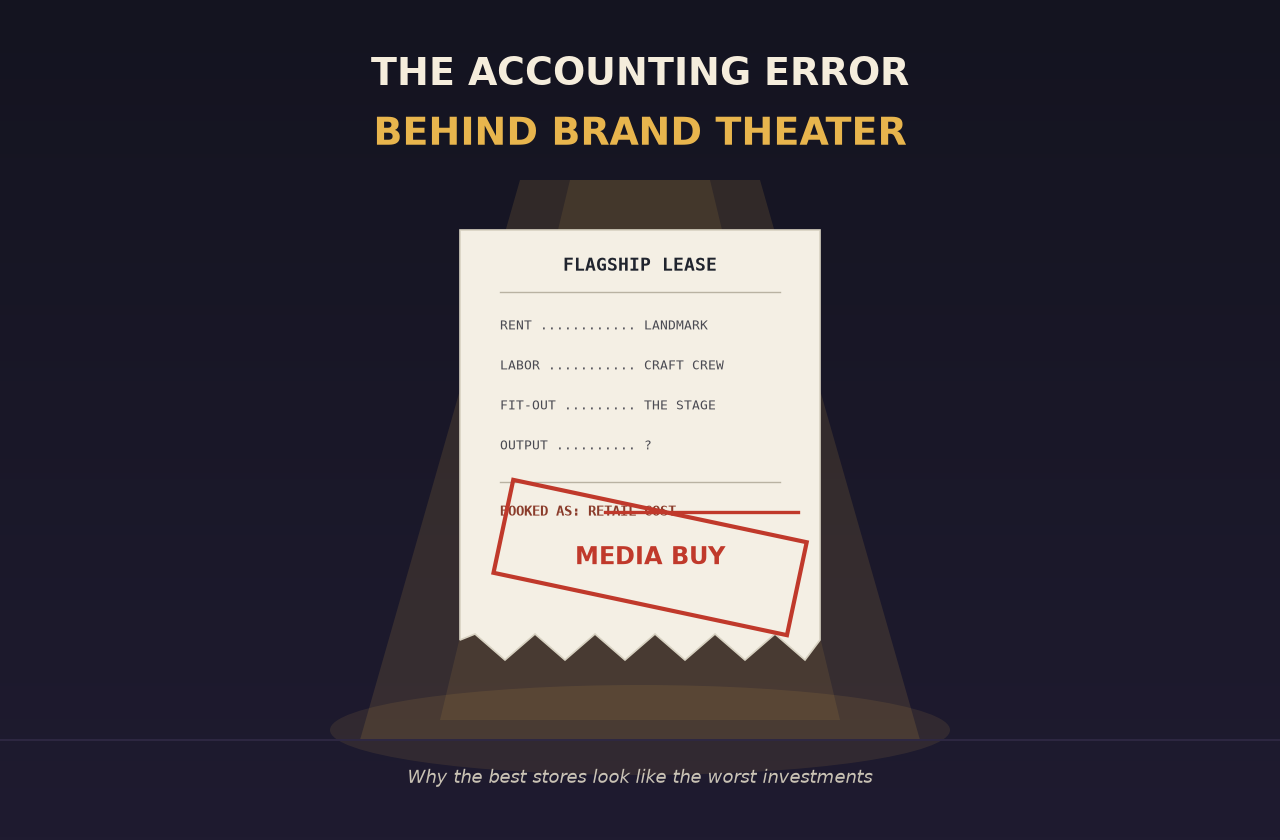
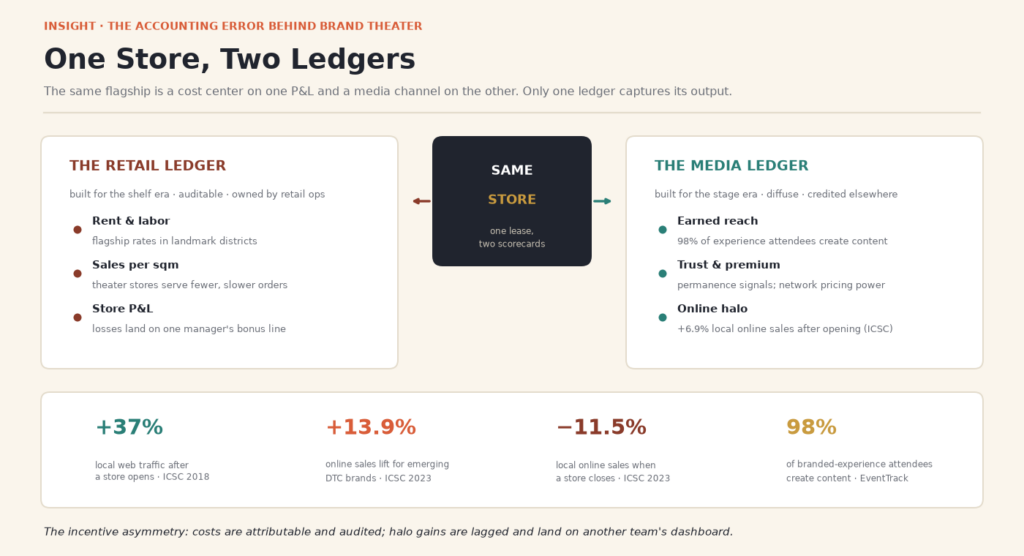
Here is a strange fact about experiential retail: the strategies with the strongest evidence behind them are the ones internal accounting systems punish hardest. Heytea’s Craft store in Guangzhou deliberately produces fewer cups per hour than a standard outlet. On the metric every retail operator is judged by — sales per square meter — it looks like a regression. Yet the halo research is unambiguous: ICSC found that store openings lift local web traffic 37% and local online sales 6.9%, with emerging brands gaining nearly 14%. So why does the theater store keep losing the internal budget fight?
The answer isn’t strategy. It’s bookkeeping.
Costs Are Attributable; Benefits Are Diffuse
A flagship’s costs arrive with a name on them. The lease is signed by someone. The fit-out sits in a cost center. The craft crew’s payroll lands on one manager’s P&L. Every yuan is auditable, immediate and personal.
The returns behave in the opposite way. When a visitor films the copper-pot ritual and posts it, the earned reach accrues to the brand, not the store. When the flagship’s presence lifts pricing power across five hundred standard outlets, no store-level ledger records it. When a Ginza lease convinces Japanese shoppers the brand is permanent, the payoff shows up quarters later in a market-level conversion rate. Costs are concentrated and dated; benefits are scattered and lagged. Any system that scores investments line by line will systematically undervalue the theater.
The Incentive Asymmetry
Follow the bonus. A retail operations director is compensated on store profitability, so a media-asset store is a career risk. The marketing director who benefits from the UGC — EventTrack found 98% of experience attendees create content, and all of them share it — pays none of the rent. The online team that harvests the halo owns none of the lease. Three teams, one asset, and only one of them carries the cost. Nobody is being irrational. Everybody is being rational inside a badly drawn org chart.
The Metric Was Built for the Shelf
Sales per square meter is a superb metric — for a shelf. It measures how efficiently floor space converts into transactions, which was the store’s entire job before e-commerce took that job away. Applying it to a stage is like measuring a billboard’s ROI by counting purchases made underneath it. The metric isn’t wrong; it’s obsolete for this asset class, and obsolete metrics survive because they’re easy to audit.
What the Winners Actually Changed
Look closely at the brands running the best theater and you’ll find they quietly reclassified the asset. Starbucks called its Shanghai Roastery a theater outright. Pop Mart reports its park inside the IP-experience business, not the store fleet. Miniso treats LAND locations as a different business model — IP retail — rather than big versions of small shops. The reclassification is the real innovation. Once the flagship is budgeted as media and scored on reach, trust and halo, the budget fight ends.
The lesson for everyone else: don’t argue harder for the theater store inside the retail ledger. Move it to the right ledger first — then the numbers finally tell the truth.





