Every brand that ships a physical product already owns a media network. It just files the asset under the wrong department.
The accounting is the insight. A package is paid for once — materials, printing, freight — and it reaches exactly one guaranteed viewer: the customer, at the most emotionally charged moment of the entire purchase journey. No ad platform on earth can promise that. A billboard rents attention by the second; a box arrives with attention pre-attached. The distribution cost of the first impression is zero, because it was already sunk into cost of goods sold. Chinese brands were simply the first to treat that sunk cost as a media buy that had already cleared.
That is the double-booking: procurement logs the box as cost; marketing can log the same box as earned media — if someone designs it to be filmed. Pop Mart’s 2025 results show what the second entry is worth. Plush — the Labubu blind-box charms whose reveal is the product — jumped from 21.7% to 50.4% of a RMB 37.12 billion business in one year. The unboxing videos were not coverage of the product launch. They were the product launch.
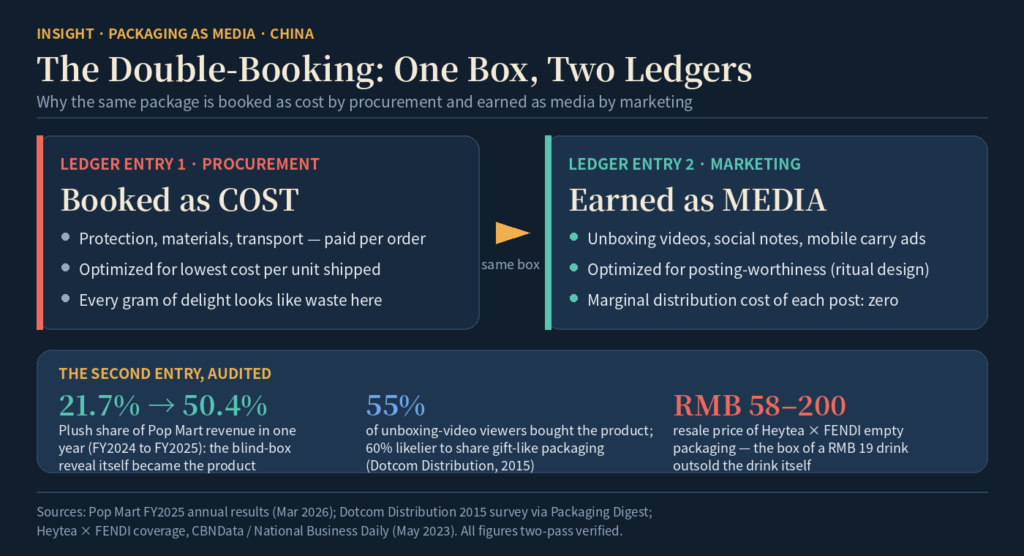
So why did almost everyone else miss it? Not ignorance — incentives. Procurement teams are measured on cost per unit; every gram of delight reads as waste on their scorecard. Marketing teams are measured on campaign ROI; the box sits in a budget they don’t own, so its impressions never enter their reports. The asset falls into the gap between two owners, each rational, neither rewarded for seeing the whole. Dotcom Distribution’s 2015 finding — 60% of shoppers are likelier to share gift-like packaging, and 55% of unboxing viewers went on to buy — sat in plain sight for a decade. The data was never the bottleneck. The org chart was.
The second reason the loop compounds is trust asymmetry. A paid ad is discounted on sight; a customer’s filmed gasp at a hidden Labubu variant is not. When Heytea’s FENDI-yellow bags resold empty for RMB 58–200 — multiples of the RMB 19 drink — the packaging had crossed from medium to merchandise. You cannot buy that credibility at any CPM. You can only design the conditions for it, then let the customer keep the credit.
The uncomfortable implication: this is not a design problem to hand to your packaging supplier. It is an ownership problem to solve at the exec table. Give one team both numbers — cost per unit and amplification per unit — and the box starts paying for itself twice. Leave the incentive gap in place, and you will keep buying impressions you already own.






