Anthropic’s first day as a public company gave investors two answers at once. The Claude developer’s stock finished Thursday at $97.17, up 17.07% from its $83 IPO price — a strong debut by any normal standard. Yet the same session ended with the S&P 500 down 2.02% for its sixth straight loss, the longest losing streak since April 2024, and the Dow shedding 1,101 points to close below 50,000. The biggest IPO in history turned out to be the moment the market chose to cash out of the AI trade, not recommit to it.
The numbers behind the whiplash are worth separating carefully. Anthropic sold 980 million shares at $83, above its marketed $70–$78 range, raising $81.3 billion in the largest base share sale in IPO history. A concurrent $26 billion private placement — with Nvidia and Google committing roughly $10 billion each, alongside Microsoft, AMD, Broadcom, Micron and TSMC — brought combined gross proceeds to about $107.3 billion. One caveat for the record books: SpaceX’s June IPO raised $75 billion at base but reached roughly $86.2 billion after its underwriters’ option was exercised. Anthropic’s own greenshoe, up to 147 million additional shares, would lift its IPO to $93.5 billion. Which deal is “biggest” depends on which yardstick you use.
Trading told the story in miniature. ANT opened at $111.50 around midday, a 34% premium that briefly pushed the fully diluted valuation past $2 trillion. The stock touched roughly $115, then bled lower all afternoon, hitting $92.72 before settling at $97.17 — about 13% below its own opening print. At the close, Anthropic was worth about $1.27 trillion on listed shares, or roughly $1.76 trillion fully diluted. Both figures are real; they count different things, and conflating them has already produced sloppy headlines.
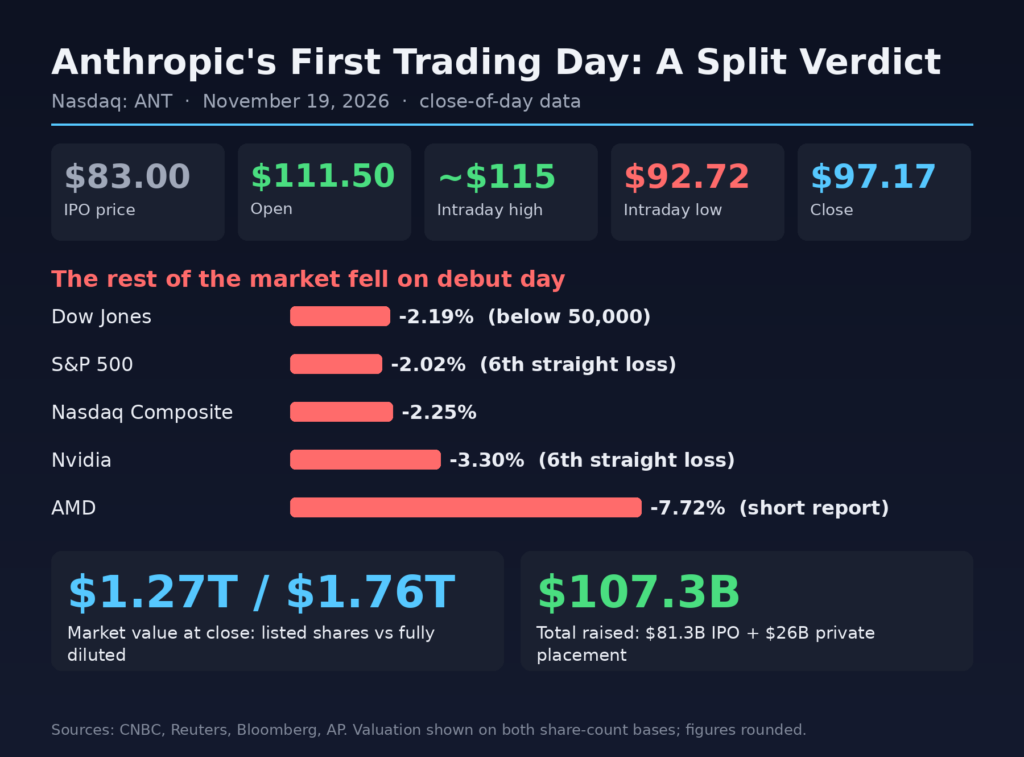
According to CNBC, the major indexes hit their session lows around the moment ANT began trading. Michael O’Rourke of JonesTrading explained the mechanics: money parked in Nasdaq-100 contracts waiting to buy Anthropic rotated into the stock once it opened, pulling the rest of the market down. Nvidia fell 3.3% for its sixth consecutive decline; AMD dropped 7.7% after a short-seller report. “Anthropic’s record-breaking IPO has failed to rekindle enthusiasm for tech stocks,” Capital Economics’ Joe Maher told Reuters.
The allocation deserves attention, too. Anthropic earmarked about 20% of the deal for retail investors, far above the usual 5–10%, and CNBC reported retail demand was the largest for any IPO on record. Regulatory filings show UK and European retail buyers took roughly $1.1 billion of stock. Meanwhile, Bloomberg reported that of some 1,200 institutions that placed orders, more than half received nothing, with allocations tilted toward US investors — a shareholder base curated for conviction, which helps explain both the hot open and the thin institutional support afterward.
The fundamentals underneath remain extraordinary — and unsettled. Revenue for the first nine months of 2026 reached $33.2 billion, against $2.5 billion a year earlier; third-quarter revenue alone was $17 billion. But Q3 swung to an operating loss of $567 million from a $974 million operating profit in Q2, which the company attributed to $5 billion of short-notice compute purchases at premium prices plus a $2 billion non-cash donation-matching charge. The prospectus also details roughly $900 billion in computing and infrastructure commitments stretching to 2045 — the number that will define every future earnings call.
The wealth effect is already a macro story. Bloomberg’s billionaires index put the seven co-founders’ combined fortune at about $166 billion at Thursday’s close, each holding roughly 1.3% of the fully diluted equity. Their pledge to give away 80% of their holdings is, per the prospectus, voluntary and revocable. CNBC reported more than 400 employees are now worth $100 million or more. Lockups run up to six months for staff and a year for founders, though about 3.6 billion of the roughly 15.5 billion fully diluted shares can be released early — a supply overhang traders are already pricing.
After hours, ANT fell 4.7% to about $92.60, and Friday’s premarket trade pointed to another decline of roughly 6%. MSCI is set to add the stock to its standard large-cap index on December 1, according to Chinese financial media citing the index provider — a move that should bring passive buying, eventually. Until then, the stock trades on sentiment alone.
At the Nasdaq, Dario Amodei framed the listing as fuel for restraint: “Today puts the company in a stronger financial position, and in doing so, only strengthens our resolve to do the right thing.” Outside, a dozen protesters chanted about the AI bubble. Inside, Altimeter’s Brad Gerstner called his planned $5 billion investment a multi-year cornerstone, not a trade. For enterprises buying AI, the split verdict is the useful part: demand for the technology is not in question this week — the price of financing it is.






