The short-seller campaign against AI’s financing machinery found its second target on Thursday. Hunterbrook Capital published a report accusing AMD of propping up chip demand by financing the very customers who buy its processors, and disclosed that it holds a short position in the stock and long positions in a basket of comparable names. AMD shares fell as much as 11.2% intraday to $470.56 before closing at $489.19, down 7.72%, with further losses after hours. AMD rejected the report, saying the claims “distorted” its business practices and partnerships.
The core allegation is familiar by now: circular financing. Chipmakers lend to, guarantee, or take equity in customers, who use that support to buy the chipmaker’s products — arrangements that can inflate apparent demand. Michael Burry, the investor famous for betting against subprime mortgages, has warned about the pattern across the sector. Hunterbrook’s twist is the claim that AMD, not Nvidia, is the more exposed party. The firm argues AMD’s commitments to customers and partners are far larger relative to its revenue than Nvidia’s, while its cash cushion is smaller. The report warned that if the smoke around Nvidia turned into a fire consuming AI infrastructure, AMD would be pulled in too.
The specifics are striking. According to the report and coverage by Chinese financial outlet Yicai, AMD granted OpenAI and Meta warrants to buy up to 320 million shares combined — 160 million each — at an exercise price of one cent, tied to their respective six-gigawatt compute deals. Hunterbrook tallied roughly $28 billion of credit support to partners, including lease guarantees and commitments to absorb unsold cloud capacity, against about $15.8 billion in cash and short-term investments. These are contingent obligations, not debts due today; they bite only if customers stumble. A separate analysis from research outlet The Bear Cave reached a similar conclusion with a blunter metaphor: if Nvidia is the central bank of AI, AMD looks more like its Silicon Valley Bank.
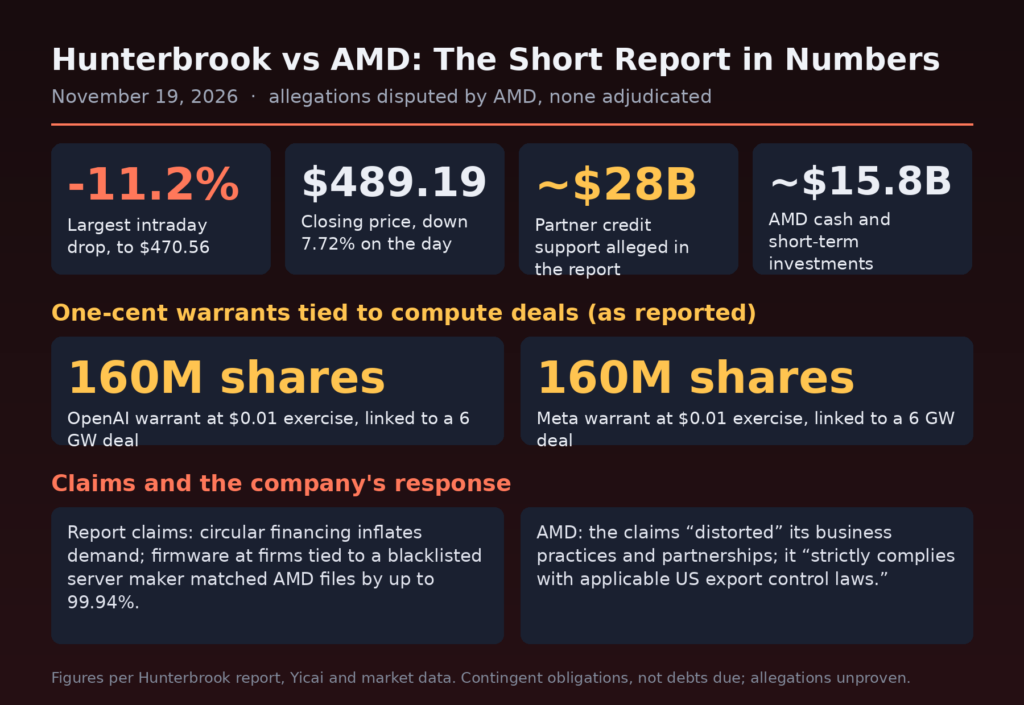
Hunterbrook’s media arm also raised export-control questions. Its investigation claimed that IEIT Systems, a Chinese server maker blacklisted by the US Commerce Department in March 2025, kept integrating at least six newer versions of AMD firmware after its designation, and that firmware files at three related companies — MagInfra in China, KAYTUS in Singapore and California-based Aivres — matched AMD’s by as much as 99.94%. The reporting does not establish that AMD supplied the technology directly or knew of any transfer. AMD’s response was categorical: it “strictly complies with applicable US export control laws” and maintains rigorous compliance processes worldwide.
Context matters on both sides. Hunterbrook, founded in 2023 by Sam Koppelman and Nathaniel Horwitz, runs an unusual model: its newsroom investigates, its fund trades before publication, and it profits from the moves. The approach has produced wins and a painful loss — its Ubiquiti short ended in a squeeze. And AMD’s operating momentum is real: third-quarter revenue of $13.4 billion grew 45%, fourth-quarter guidance sits around $17 billion at the midpoint, and the company has projected revenue growth above 80% for 2027. The stock had jumped more than 40% this month as investors sought an alternative to Nvidia amid its governance crisis; it had crossed a $1 trillion valuation in September. Thursday’s close left it near $802 billion — roughly $157 billion erased in a week.
None of the allegations has been adjudicated, and AMD disputes them outright. But for enterprises signing multi-year AI infrastructure contracts, the episode adds a practical due-diligence item: a supplier’s balance sheet is now part of the product. When the vendor is also the lender, the durability of the roadmap depends on the health of the customers it financed — and that is a risk no benchmark chart will show you.






