Two creators post on the same Chinese short-video app on the same Tuesday. One has two million followers, a studio light, and an editor. Her video lands with a few thousand views. The other opened her account last week, films a noodle shop on a cracked phone, and wakes up to a million.
On a follower-first platform, that reads like a glitch. On China’s interest-graph feeds, it’s just Tuesday.
Western social distribution still leans on the social graph: you see what the people you follow post, and creators bank an audience that persists. China’s dominant feeds — Douyin, Xiaohongshu’s discovery page, Kuaishou’s discovery tab — run on a different machine: an interest graph with aggressive recency weighting. Every piece of content enters a fresh auction against everything posted now. Follower counts buy little protection. Yesterday’s hit decays fast.
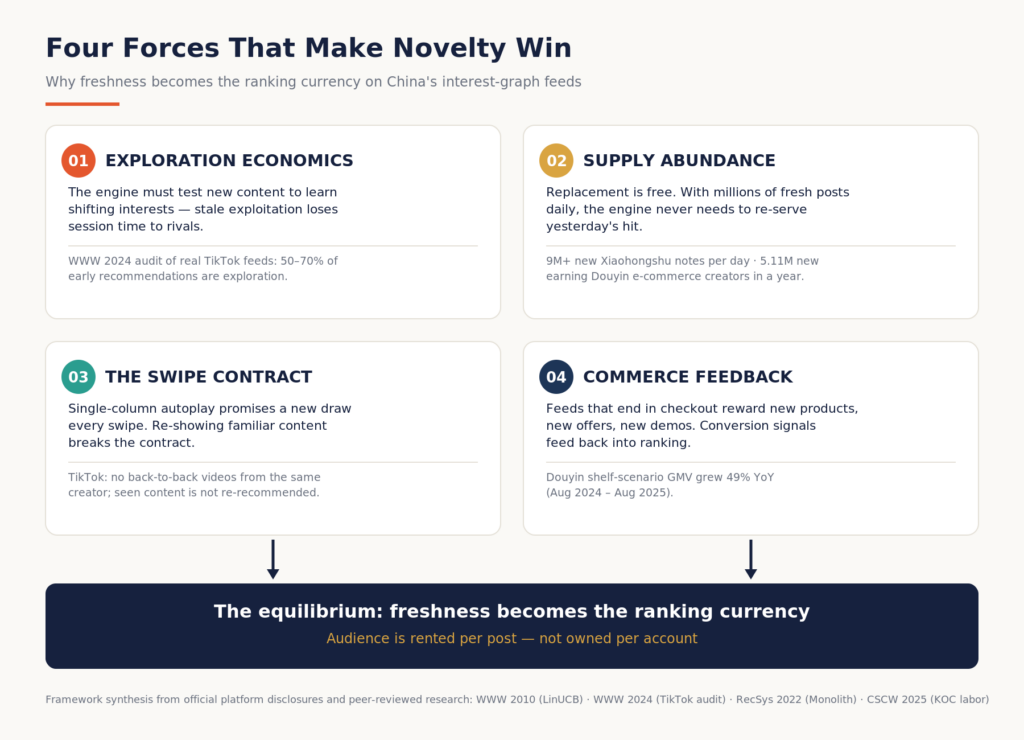
This isn’t a bug, and it isn’t a quirk. It’s the equilibrium of four forces — exploration economics, inventory abundance, swipe-session UX, and commerce integration. The consequence for marketers is brutal and liberating at once: audience is rented per post, not owned per account.
The Feed Has No Memory
Western feeds ask, “Who do you follow?” Chinese feeds ask, “What will hold you for the next fifteen seconds?” The second question has no memory — and therefore no loyalty.
You don’t have to take a marketer’s word for it. TikTok — the exported version of the same machinery — says so in its own explanation of the For You feed: “neither follower count nor whether the account has had previous high-performing videos are direct factors in the recommendation system.” A big account may get more views because its followers watch, but the number itself isn’t scored. Each video is judged on how viewers respond to it.
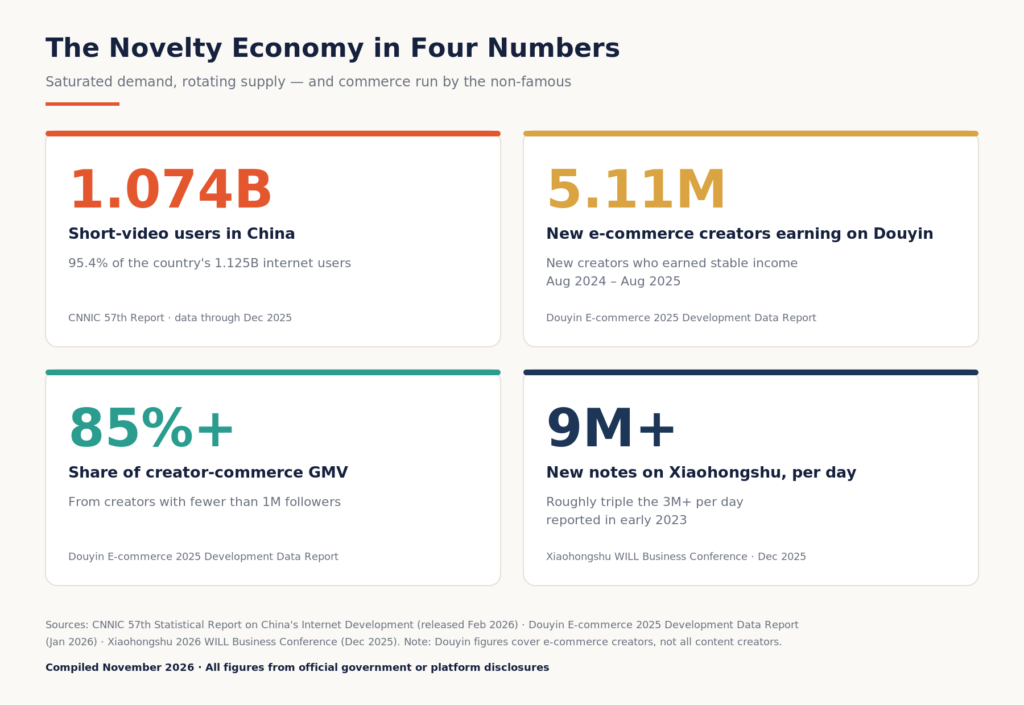
The scale behind this machine is almost hard to picture. CNNIC’s 57th Statistical Report on China’s Internet Development, released in February 2026 with data through December 2025, counts 1.125 billion internet users in China — and 1.074 billion of them watch short video. That’s 95.4% of all netizens. Demand is saturated. When almost everyone is already watching, the only way to grow session time is to make the next swipe better than the last one. Engines compete on supply freshness, because there is no new audience left to recruit.
Freshness Is the Ranking Currency
Every Post Re-enters the Auction
On these feeds, distribution is a per-post event, not an account privilege. Practitioners and industry media widely describe a tiered testing pattern: a new post enters a small initial exposure pool and earns wider distribution only if engagement signals justify it. Douyin has never officially published the full mechanics, and the specific thresholds circulating online contradict each other — treat those numbers as folklore. But the pattern itself shows up in the outcomes. Small accounts routinely outrun large ones, and a hit last month guarantees nothing this month.
The ecosystem is built for that. Xinbang’s 2022 New Media Content Ecosystem Data Report found that mid- and long-tail accounts made up 99.97% of all Xiaohongshu accounts. The head is a rounding error. The platform’s commercial life runs on the tail.
The Churn Is Structural
Here’s the number that should reset any Western influencer valuation model. In its 2025 Development Data Report, released in January 2026, Douyin E-commerce disclosed that between August 2024 and August 2025, more than 5.11 million new e-commerce creators earned stable income on the platform. And over 85% of creator-driven commerce GMV came from creators with fewer than one million followers. These are the platform’s own figures — promotional in intent, but specific in scope, and the scope is the story.
Read that again. The selling is mostly done by people who aren’t famous. This is a system that continuously recruits and rotates new supply — not one that entrenches incumbents.
The supply pipe keeps widening, too. At its 2026 WILL Business Conference in December 2025, Xiaohongshu reported over 9 million new notes published every day — roughly triple the 3 million-plus daily notes its COO cited in early 2023. When replacement content arrives at that rate, the engine never needs to re-serve yesterday’s hit.
Four Forces That Make Novelty Win
Force 1: The Engine Must Keep Learning
Every recommender faces the explore–exploit trade-off: serve what it knows you like, or test something new to learn what you might like next. The academic lineage runs back to LinUCB, the contextual-bandit approach to news recommendation presented at WWW 2010 — news, like short video, is a domain where yesterday’s knowledge goes stale fast.
On Chinese feeds, exploration isn’t a garnish. It’s structural. A peer-reviewed audit presented at WWW 2024 examined real TikTok feeds donated by 347 users — 9.2 million video views in total — and found that only 30–50% of the first thousand recommendations could be classified as exploitation of known interests. The rest was the system testing new ground. TikTok’s own explanation says the diversity is deliberate: mixing unfamiliar videos in helps the system “get a better sense of what’s popular among a wider range of audiences.”
And the learning never stops. ByteDance’s Monolith paper describes a recommendation system built for online training, updating continuously from live feedback rather than retraining in overnight batches. In a market where trends turn weekly, yesterday’s preferences are literally stale weights. Novelty weighting is the exploration budget made visible.
Force 2: Replacement Is Free
Exploration only works if there’s something new to test. China’s feeds have effectively infinite replacement inventory: 9 million-plus notes a day on Xiaohongshu, 5.11 million new earning creators a year on Douyin’s commerce side alone, industrialized content operations feeding the pipe. Western graphs with scarcer supply must conserve creator relationships — re-serving familiar faces is a feature. Chinese engines can burn inventory, because a fresh substitute always exists.
Force 3: The Swipe Contract
The interface makes a promise. Single-column, full-screen autoplay means every swipe is a new draw. TikTok’s explanation even says the feed generally won’t show two videos in a row from the same creator, and won’t re-recommend content you’ve already seen. Re-showing the familiar breaks the contract. The UX demands recency, and the objective function — session time — rewards it. Interface and algorithm reinforce each other until freshness feels like physics.
Force 4: Commerce Pays for Freshness
These feeds end in checkout. Commerce runs on launches — new products, new offers, new demos — and conversion signals flow back into ranking. In Douyin’s report period, shelf-scenario GMV grew 49% year-over-year; the buy button is now part of the content economy’s feedback loop. A feed that sells rewards whatever is new enough to buy. Freshness isn’t just engaging. It’s monetizable.
What Everyone Misunderstands
The Algorithm Isn’t Fickle — It’s Consistent
Creators experience decay as unfairness: “I posted the same quality video — why did this one die?” But the engine isn’t moody. It’s ruthlessly consistent about whose side it’s on. Its asset is the viewer’s session, not the creator’s audience. It optimizes the demand side; supply is replaceable by construction. What feels like fickleness from the supply side is loyalty from the demand side.
Followers Are Weak Insurance
Followers aren’t worthless — follows still deliver some reach, and fan relationships still convert. But on interest feeds, distribution is re-earned per post, which makes followers weak insurance rather than an asset you can bank. This is why KOC swarms beat star accounts: many fresh draws beat one banked audience.
The human side of this machine is documented. In a nine-month ethnography published at CSCW 2025, University of Michigan researchers Huiran Yi and Lu Xian traced how Xiaohongshu turns ordinary users into Key Opinion Consumers — de facto marketers whose promotional labor is deliberately obscured to look like spontaneous life sharing, and who are often under-recognized and unpaid. Visibility is precarious; the platform’s machinery decides who gets seen. The feed drafts people into the creator economy without a contract — and can drop them just as quietly.
Novelty Doesn’t Ban Depth: Two Clocks
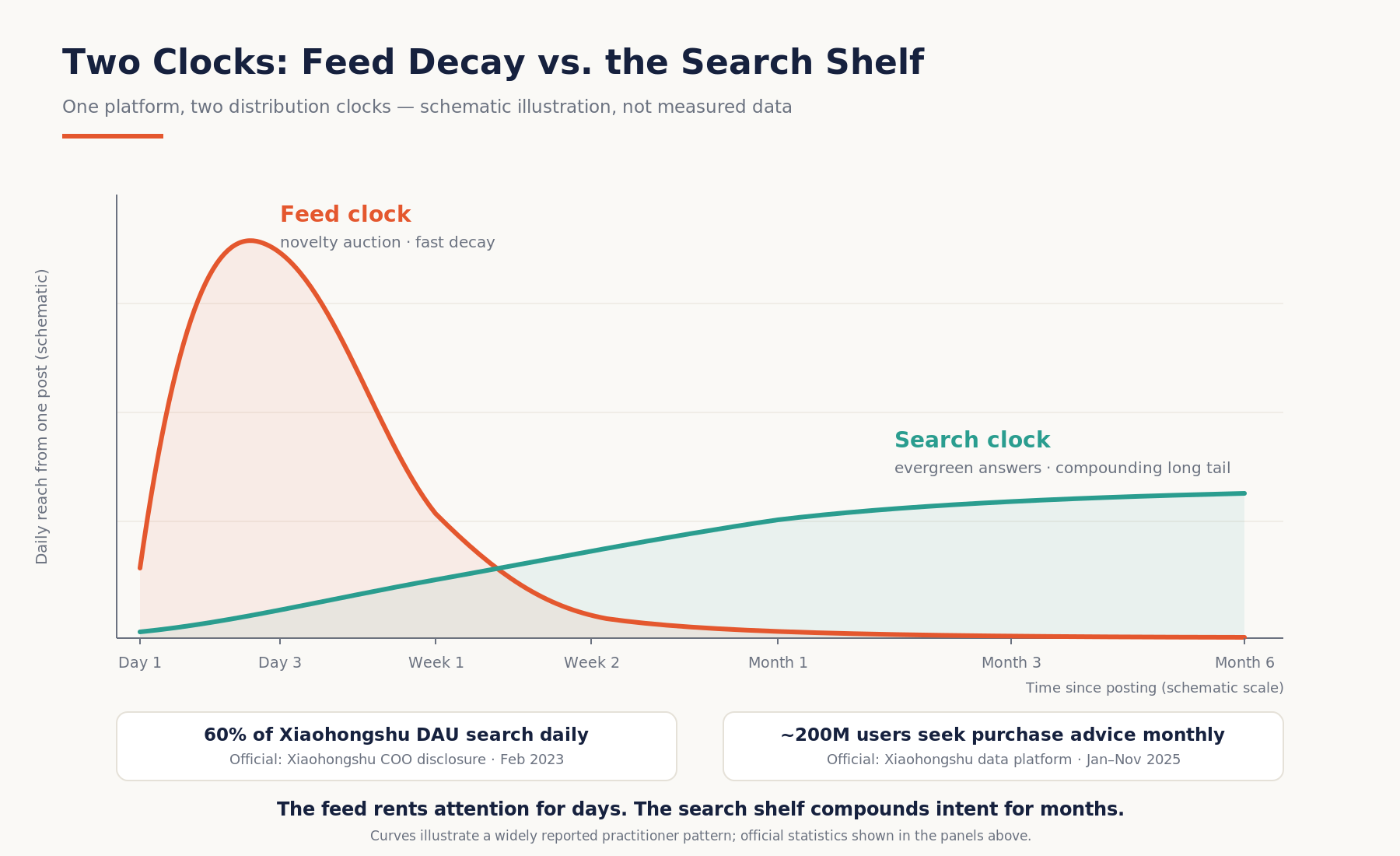
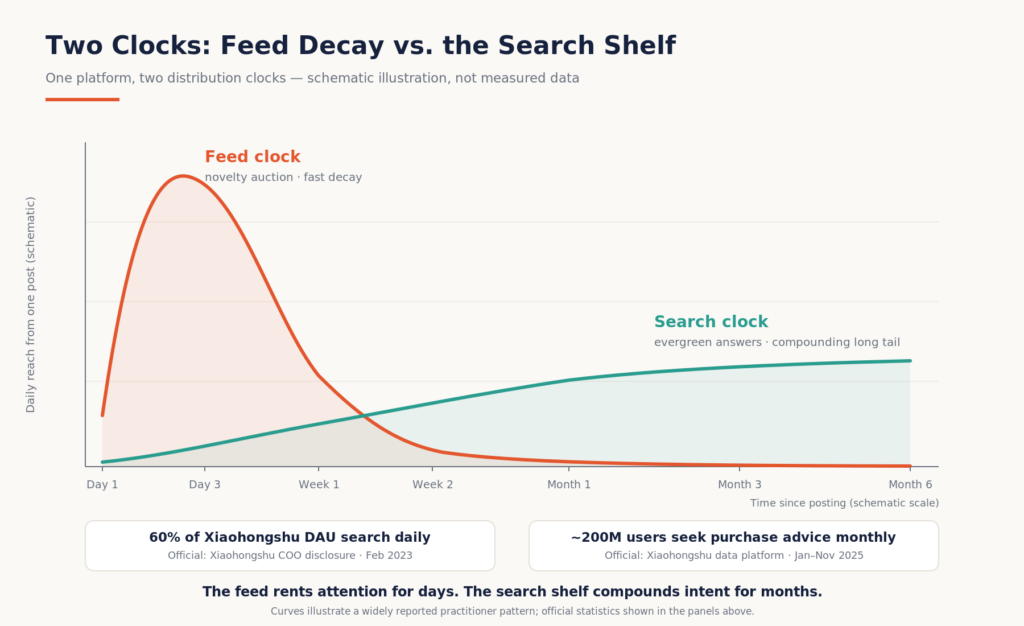
Here’s the twist that saves the strategy: freshness weighting governs the feed, not the whole platform. Xiaohongshu’s search shelf runs on a different clock. Its COO disclosed in 2023 that 60% of daily active users search actively, with daily queries approaching 300 million; by late 2025, the platform said roughly 200 million users seek purchase advice there every month. Practitioners widely report the same pattern: a note’s feed-driven reach burns out in days, but a note that answers a stable question keeps surfacing in search for months.
Two clocks, one platform. The feed is novel; retrieval is evergreen. The fast clock rents attention. The slow clock compounds it.
The West Isn’t Exempt
If this sounds like a Chinese peculiarity, look at what’s happening at home. TikTok exported the interest-graph model worldwide. Instagram head Adam Mosseri described the same drift at a September 2026 media roundtable: the system infers your interests from behavior and shows you videos “from an account you follow, or even an account you don’t follow.” His verdict on the industry’s direction was blunt: “Everyone’s gone that way because it drives engagement.” Reels and Shorts drifted the same way. China is simply the native, mature case of where all swipe feeds go. The follower-graph remnants are the exception, not the rule.
The Counterargument: Kuaishou’s Trust Economy
Fair objection: Chinese platforms do reward loyalty too. Kuaishou’s whole brand is the laotie relationship — trust e-commerce, follow tabs, fan groups. And it’s not just branding. On Kuaishou’s Q3 2025 earnings call, CEO Cheng Yixiao told investors that private-domain fan accumulation, with its high stickiness and high repurchase, is the moat of merchants’ long-term operations: acquire traffic in the public domain, then convert fans to customers and earn repeat purchases in the private one. The official numbers back the direction — e-commerce GMV of 385 billion yuan for the quarter, up 15.2%, with active buyers’ repurchase frequency rising year-over-year.
So loyalty is real. But notice where it lives: in retention surfaces, not discovery. Even on Kuaishou, the discovery tab runs interest-graph logic. Platforms segment the two jobs — novelty for growth, loyalty for retention — which is exactly the split this article recommends brands adopt. The thesis describes the dominant acquisition surface, not every corner of every app.
Two more honest limits. First, novelty bias can churn quality; engines continuously tune the explore–exploit ratio, and what looks like pure novelty is an equilibrium under abundant supply and swipe UX. Change the supply or the interface, and the weighting shifts. It’s economics, not ideology. Second, for high-consideration purchases, search still closes the research — which is precisely why the two-clock strategy exists. The feed introduces you; retrieval convinces.
The Playbook: Flow, Stock, and Bucket
Budget for Flow, Not Stock
On interest feeds, plan continuous content supply — swarms of creators, repeatable formats, constant refreshes — instead of banking on an account’s audience. Every post re-enters the auction. Budget like a supply chain, not like a campaign.
Play Both Clocks
Feed content for novelty: trend response, fresh demos, new angles. Search content for durability: evergreen notes that answer stable questions. The second clock compounds while the first churns. Teams that only play the fast clock rent forever; teams that play both build an asset.
Convert Spikes Into Ownership
The feed won’t remember you for the customer. Capture every novelty spike into owned surfaces — memberships, private-domain groups, subscriptions, store follows. The novelty engine is an acquisition firehose; retention is the bucket. Kuaishou’s own moat language confirms the logic: the platform itself tells merchants to bank what the feed delivers.
Read the Treadmill Honestly
Novelty preference raises content costs and creator burnout. Yi and Xian’s invisible-labor findings are the human price of the machine. Brands should build sustainable supply chains — fair pay, realistic cadences, reusable formats — not demand infinite hustle from partners. A treadmill that burns out its runners eventually runs out of supply.
Conclusion: Build Loyalty Where the Feed Can’t Reach
China’s recommendation engines prefer novelty because they were built to answer a different question: not “who do you know” but “what holds you next.” Abundant creator supply, exploration-hungry learning, swipe-session UX, and commerce feedback loops make freshness the ranking currency. Yesterday’s viral is today’s inventory.
For marketers, the strategic split follows. Play the feed’s fast clock with continuous fresh supply. Play search’s slow clock with evergreen evidence. And capture every novelty spike into owned relationships the algorithm can’t repossess.
The feed has no loyalty. So build yours somewhere it can’t reach.