Ask a media planner what Tmall sells on Super Brand Day and you’ll get a sensible answer: premium ad inventory. Homepage takeovers, search banners, livestream slots — a day of concentrated attention, priced against the brand’s marketing commitment. Sensible, and wrong. If attention were the product, Alibaba would sell more of it. Instead it rationed the thing it could scale, and the rationing is the business.
The Product Is the Refusal
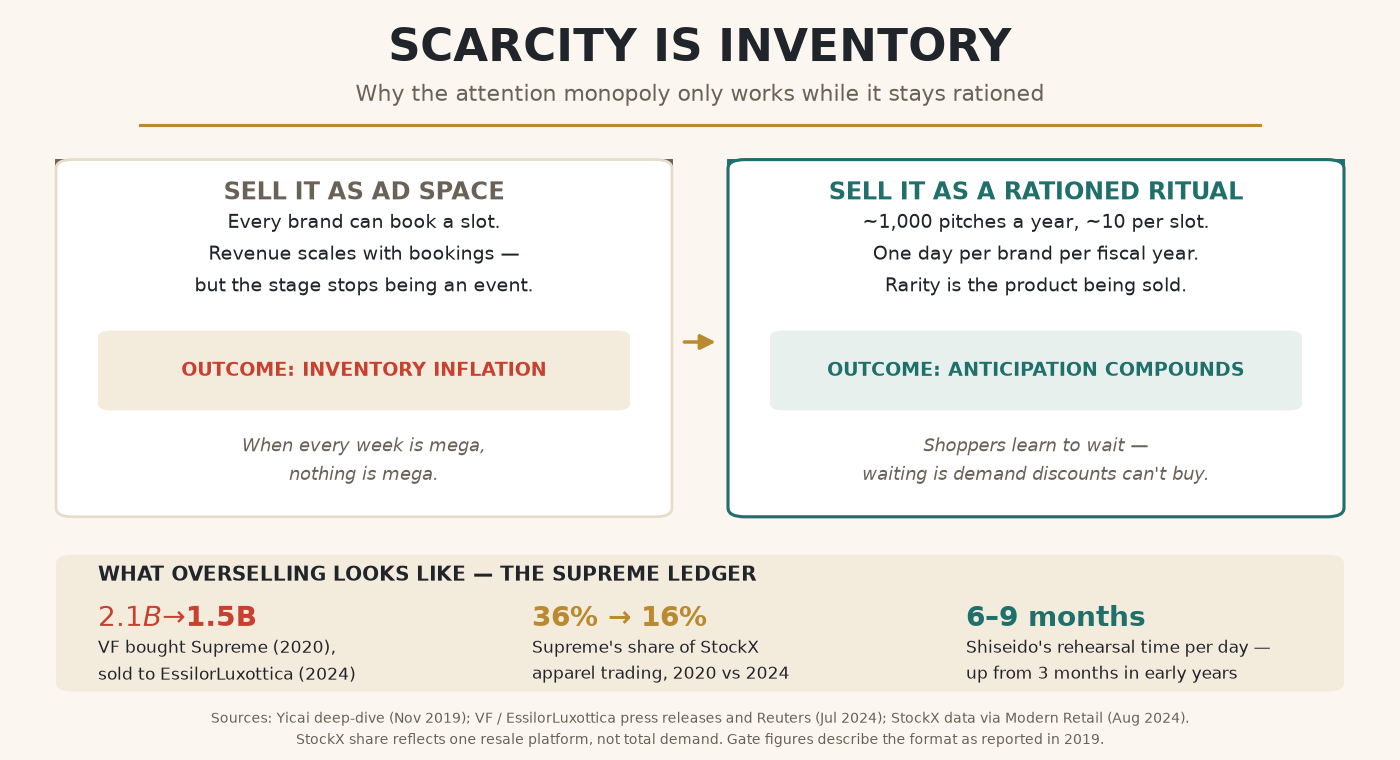
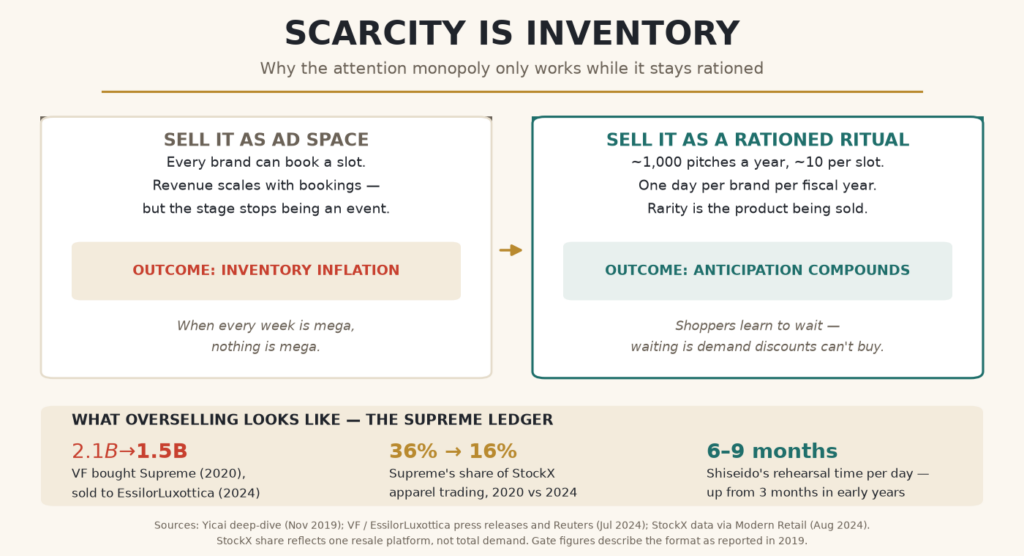
Here’s the counterintuitive core: what makes a Super Brand Day valuable is precisely what a normal ad business would eliminate — the scarcity of the slot itself. Yicai’s 2019 reporting captured the economics: roughly a thousand proposals a year, about one in ten accepted, and in principle one day per brand per Alibaba fiscal year. The same reporting noted the team carried no GMV target and had no plans to commercialize the format. Read that again. The most potent sales-driving IP on the platform was deliberately kept off the rate card.
Why refuse revenue? Because the moment every brand can book a takeover, the takeover stops meaning anything. The shopper’s learned response — this brand has a day, something new will happen, I should wait for it — depends on days being rare events in the calendar, not wallpaper in the feed. Sell the slot like ad space and you inflate your own inventory until the currency is worthless. The gate isn’t a friction to optimize away. The gate is the product.
Scarcity Has a Balance Sheet — Supreme Kept It
The West ran this experiment with real money. VF Corporation paid $2.1 billion for Supreme in 2020, betting the drop machine could scale inside a growth-hungry portfolio. By July 2024 it sold the brand to EssilorLuxottica for $1.5 billion. Along the way, Supreme’s share of apparel trading on StockX slid from 36% in 2020 to 16% in 2024, per StockX figures reported by Modern Retail. An industry analyst summed up the tension in that coverage: scarcity and growth are oppositional forces. Every unit of scale you add to a scarcity business subtracts from the asset you bought.
Tmall’s structure internalizes that lesson. The platform doesn’t own the brands, so it can’t be tempted to overproduce them — it can only overbook the stage, and the 10:1 gate plus the once-a-year rule is the commitment device that stops it. Shiseido’s preparation stretching from three months to six-to-nine isn’t bureaucratic drag; it’s the rehearsal cost that keeps each day event-grade. High friction, deliberately maintained, is what protects the anticipation the platform is actually selling.
What This Means If You Build Your Own
The transferable insight isn’t “run a brand day.” It’s that scheduled scarcity is an asset you can destroy with your own success. A drop calendar that adds weekly events to hit quarterly targets is VF-era Supreme in miniature: more bookings, less meaning. The discipline is to treat your calendar slots like Tmall treats its stage — fixed count, real gaps, genuine rehearsal — and to measure the asset by anticipation (waitlists, return visits on announcement, member enrollment) rather than by how many events you managed to ship. Revenue scales with volume. Rituals scale with restraint. Pick which business you’re in before the growth targets pick for you.