Every November, China’s e-commerce machine throws one giant party. But the smartest brands stopped waiting for it a decade ago. They learned to throw their own.
Tmall’s Super Brand Day, launched in 2015 — looks like a promotion from the outside. Spend a day, cut some prices, watch the GMV chart spike. Look closer and you’ll find something stranger and more interesting: a ritual machine. The platform hands one brand exclusive use of its highest-attention real estate for roughly 24 hours, wraps it in limited editions and member-first access, and lets the calendar do the selling.
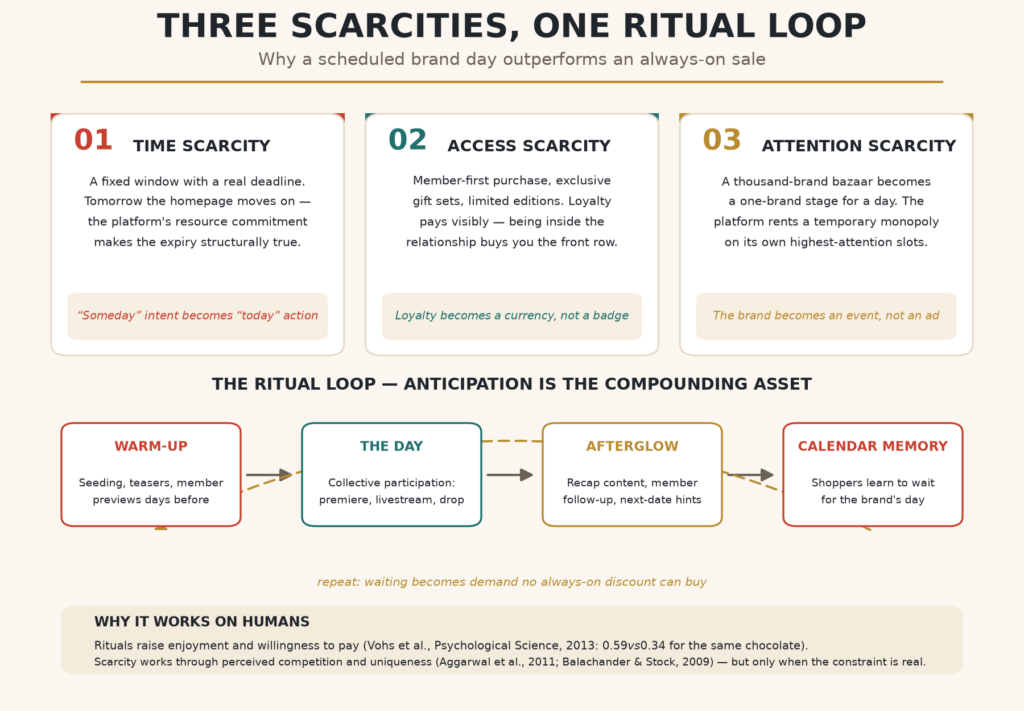
Here’s the thesis of this piece: the Brand Day works because it manufactures three kinds of scarcity at once — scarcity of time, of access, and of attention — and then repeats the formula until shoppers learn to wait for it. Waiting, it turns out, is demand that no always-on discount can buy. Let’s take the machine apart.
The Phenomenon: A Private Festival on Public Infrastructure
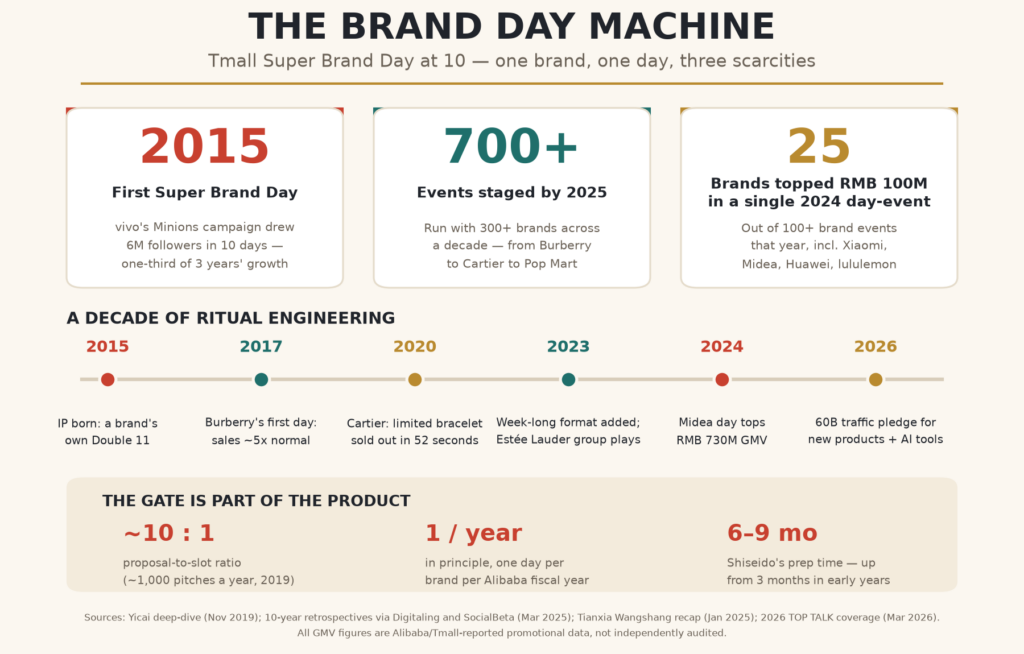
The format is simple to describe and brutal to execute. One brand, one day. Homepage focus, search banners, livestream slots — resources normally scattered across thousands of storefronts get concentrated on a single stage. Alibaba’s own marketing arm calls it “the brand’s own Double 11,” and a 2019 deep-dive by Yicai, China’s leading business magazine, documented how the sausage gets made: roughly a thousand brand proposals arrive each year, and about one in ten gets a slot.
By its tenth anniversary in 2025, the IP had staged more than 700 events with over 300 brands, according to retrospectives published by the marketing trade outlets Digitaling and SocialBeta. The 2024 season alone ran 100-plus brand events, with 25 brands — Xiaomi, Midea, Huawei, lululemon, down-jacket maker Yaya, fashion label MO&Co. among them — crossing RMB 100 million in sales during their day. Those numbers come from Tmall’s own year-end recap carried by Tianxia Wangshang, Alibaba’s affiliated merchant media: treat them as platform-reported promotional data, not audited results.
The scale of a single day can be startling. Midea’s 2024 event reportedly cleared RMB 730 million across its product ecosystem. UR staged a fashion show in a valley below the Jinshanling Great Wall, drew a reported 2 billion-plus impressions, and became the first apparel brand to break RMB 100 million on a Super Brand Day. And the promise that keeps brands pitching: the day is designed to be your second-highest single-day sales peak of the year, right after Double 11.
Three Scarcities, One Ritual Loop
Why does concentrating a day work better than spreading discounts across a month? Because the format stacks three distinct scarcities, and each one does a different psychological job.
Scarcity One: Time — The Deadline Is Structurally True
Every marketer knows fake countdown timers. You’ve seen the “offer ends in 02:14:33” widget that resets when you refresh the page. Shoppers have learned to ignore them.
A Super Brand Day deadline is different in kind, not degree. The platform has committed its homepage, its banners, its traffic plan to your brand for this window — and tomorrow those resources move to someone else. The expiry isn’t a marketing claim; it’s an operational fact. That converts “someday” intent into “today” action, because someday genuinely won’t have the same stage, the same bundles, or the same premiere products.
Scarcity Two: Access — Membership Becomes Currency
The second lever is gating. Member-first purchase windows, exclusive gift sets, limited editions that never reach the open shelf. When Cartier ran its 2020 Super Brand Day — the first hard-luxury maison to open a Tmall flagship — a limited bracelet sold out in 52 seconds, per the platform’s anniversary retrospective.
Notice what that does to loyalty. Being a member stops being a badge and starts being a head start. The relationship pays, visibly, on the day it matters. We’ll come back to the harvest this produces, because it’s the most underrated part of the machine.
Scarcity Three: Attention — The Stage Itself Is the Product
Here’s the lever most Western analysts miss. In feeds engineered for infinite variety, a full-day single-brand takeover is artificially scarce attention. The platform is renting the brand a temporary monopoly on its own real estate.
Think about what a shopper experiences. Normally the app is a bazaar — a thousand brands hawking at once, comparison shopping as the default behavior. On a Brand Day, there’s no comparison set. It’s one brand’s world. The scarcity isn’t of stock; it’s of context. And in an attention economy, context is the scarcest commodity of all.
The Ritual Loop: Anticipation, Participation, Memory
Stack the three scarcities inside a repeating structure and you get a ritual: warm-up seeding days before, collective participation on the day, recap content and member follow-up after. Consumer researchers have described this loop for decades — Dennis Rook’s 1985 work in the Journal of Consumer Research defined rituals as fixed, episodic, symbolic sequences, and commerce has been borrowing the structure ever since.
The loop’s output is calendar memory. Shoppers learn to wait for the brand’s day. Oreo’s China team told Yicai they treat the Super Brand Day as the most important of their three annual “exams” — bigger than 618, bigger than Double 11 in strategic weight — because it starts a gear that turns fan accumulation and sales for months afterward. That’s not a promotion. That’s demand scheduling.
The Science Under the Spectacle
Does the ritual wrapper actually change behavior, or is it just theater around a discount? The lab evidence says the wrapper matters.
Rituals Raise Willingness to Pay
In a 2013 Psychological Science paper, Kathleen Vohs and colleagues ran four experiments on ritual and consumption. Participants who performed a small ritual before eating chocolate — break it in half without unwrapping, unwrap one half, eat, then the other — rated the same chocolate as more flavorful, savored it longer, and were willing to pay $0.59 for it versus $0.34 in the no-ritual group. A delay between ritual and consumption heightened enjoyment further, and performing the ritual yourself beat watching someone else do it. The mechanism was involvement: rituals make you pay attention, and attention makes consumption richer.
One caveat, in the interest of honest sourcing: co-author Francesca Gino later faced data-integrity allegations concerning other papers. This 2013 study carries no retraction or expression of concern as of our checks, and its findings were replicated across products — but read it as suggestive lab evidence on small student samples, not an iron law.
Scarcity Works Through Competition and Uniqueness
The scarcity side has its own literature. Aggarwal, Jun and Huh showed in the Journal of Advertising in 2011 that scarcity messages work by stoking perceived competition — limited quantity says “others are buying,” limited time says “the clock is running,” and they trigger different consumer mindsets. Balachander and Stock’s 2009 Marketing Science model went further: limited editions can raise profits even when the edition itself sells poorly, because scarcity changes what the mainstream product signals.
Put the two literatures together and the Brand Day’s design logic reads like a checklist: real deadline (time scarcity), gated access (competition plus belonging), exclusive stage (uniqueness), rehearsed sequence (ritual involvement). Whether or not Tmall’s product team read the journals, they built the experiment at industrial scale.
The Loyalty Harvest: What the Day Leaves Behind
Now the part that separates a ritual from a fireworks show. The spike fades; the member roster doesn’t.
LA MER’s Membership Machine
The luxury skincare brand LA MER has been integrating its Tmall flagship with its offline counters since 2017 — that July’s Super Brand Day fused the online and offline membership systems entirely, so a flagship-store purchase earned the same points and spa privileges as a counter visit in any city. The day’s sales ran 2.5 times that year’s 618 festival, and a limited 500ml cream priced at RMB 17,200 sold out, per contemporaneous reporting by Jiemian.
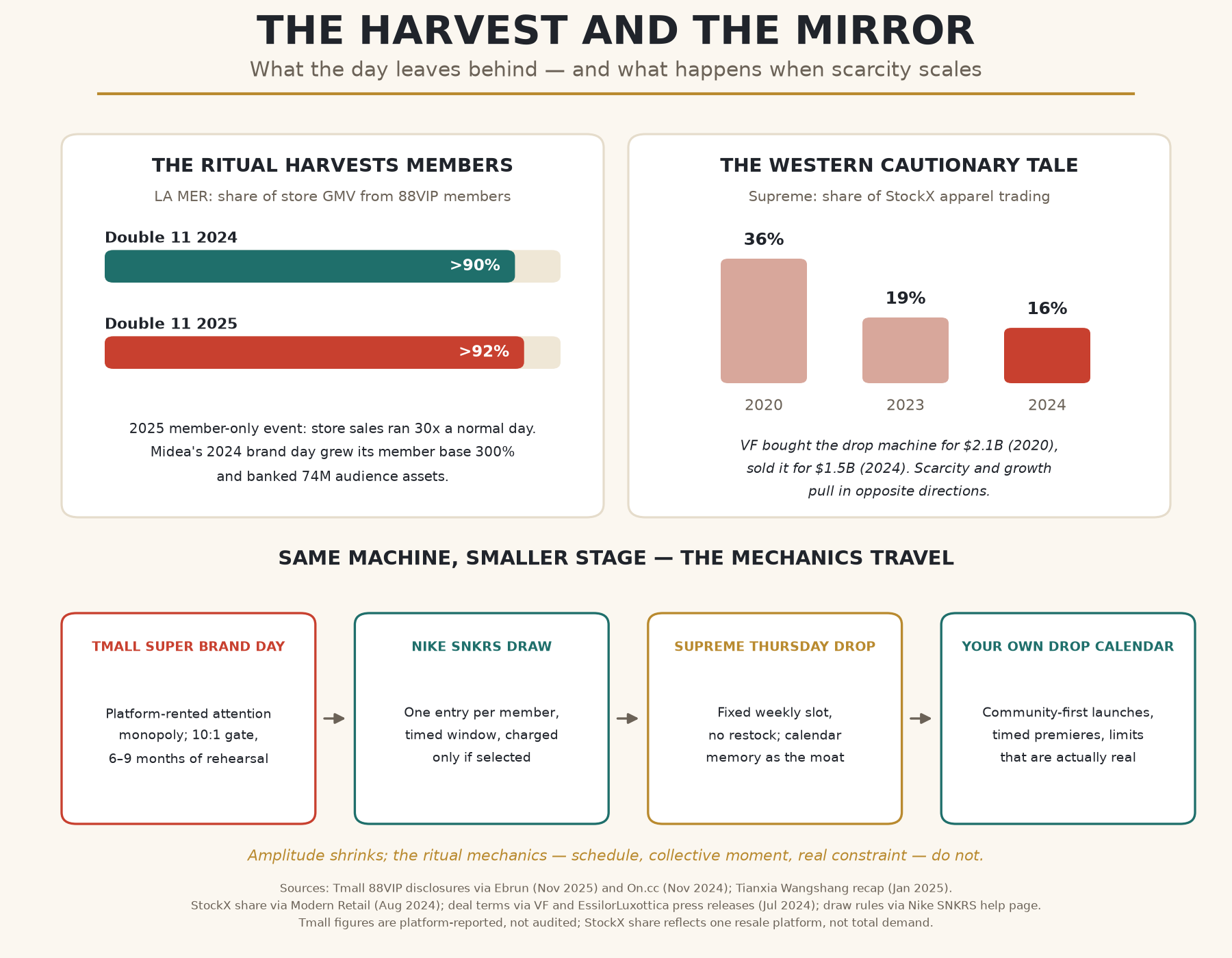
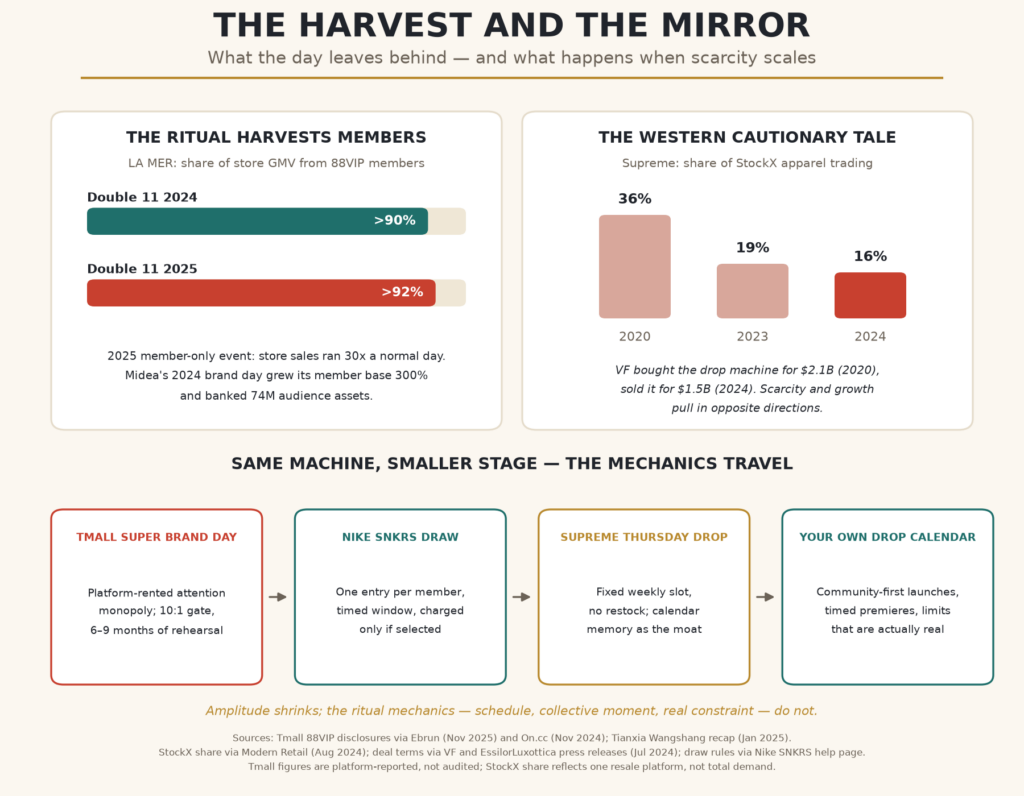
Fast-forward to the platform’s paid-membership era. During Double 11 2024, more than 90% of LA MER’s store transactions came from 88VIP members, and a members-only event that October cleared over RMB 1 billion in four days, according to On.cc’s coverage of Tmall’s disclosures. By Double 11 2025 the 88VIP share exceeded 92%, and a member-exclusive event drove store sales to 30 times a normal day, per trade outlet Ebrun. Across Tmall’s top brands that season, 70-plus percent of GMV came from 88VIP members.
A note on what these numbers are: the 88VIP figures describe Double 11 member events, not Super Brand Days — but they reveal the same underlying machine, where gated access converts a sales moment into a loyalty harvest. The brand that runs the ritual well isn’t buying a day of traffic. It’s filling the top of a relationship funnel it owns.
Midea’s 300% Member Jump
The pattern repeats outside beauty. Midea’s 2024 Super Brand Day reportedly grew its member base more than 300% versus the prior period and banked 74 million consumer-relationship assets in Alibaba’s data systems — again, platform-reported figures. Read them not as audited wins but as evidence of what the platform optimizes for: the day is an acquisition-and-enrollment engine wearing a festival costume.
The Western Mirror: Same Machine, Different Assembly
If this sounds exotic, look at your own market. The West runs the same ritual mechanics in fragments.
Supreme built a culture on the Thursday 11am drop: fixed slot, small batches, no restock — scarcity you could set a watch to. Nike industrialized the draw with SNKRS, launched in February 2015: one entry per member, a timed window, payment pre-authorized, charged only if selected. Amazon owns Prime Day; Starbucks owns the seasonal cup. The ritual ingredients — schedule, collective moment, real constraint — are identical.
China’s difference is platform industrialization. On Tmall, the ritual isn’t a brand’s bespoke invention; it’s a productized, bookable, year-round SKU of the marketplace itself, complete with a pitch process, a resource package and a decade of rehearsal. The machine that Supreme built by instinct, Alibaba sells by catalog.
What Supreme’s Sale Teaches About Scarcity’s Ceiling
There’s a warning label on the Western mirror, and it’s worth reading. VF Corporation bought Supreme in 2020 for $2.1 billion and sold it to EssilorLuxottica in July 2024 for $1.5 billion — a $600 million markdown on the church of scarcity, confirmed by both companies’ press releases and Reuters. Along the way, Supreme’s share of apparel trading on the resale platform StockX fell from 36% in 2020 to 16% in 2024, per StockX figures reported by Modern Retail. As one industry analyst put it in that coverage: scarcity and growth are oppositional forces.
The lesson isn’t that drops don’t work — it’s that the ritual’s power depends on rarity, and rarity has a ceiling. Tmall’s answer is structural: ration the slots. One day per brand per fiscal year, ten pitches per slot. The platform protects the scarcity it sells, because overscheduling would kill the very anticipation that makes the product valuable.
What Everyone Misunderstands
“It’s Just a Sale”
A sale competes on price. A ritual competes on meaning and timing. Super Brand Day offers are often not the year’s deepest — LA MER sold a RMB 17,200 cream on its day, and members paid near-peak prices for skincare because the event bundled exclusivity, premiere access and belonging. Price is the ticket, not the show.
“Anyone Can Run One”
The format requires platform-granted attention scarcity plus enough brand equity to fill a stage. Yicai’s reporting shows Tmall screening proposals against category trends, resource commitments and the completeness of the marketing plan — Shiseido’s preparation time stretched from three months to six-to-nine as the bar rose. Manufactured scarcity only works when the manufacturer controls the scarce resource. You can’t fake a homepage takeover.
“Manufactured Means Fake”
All festivals are manufactured. Valentine’s Day commerce, Black Friday’s retail history, Singles’ Day itself — invented dates, real behavior. The question isn’t authenticity of origin but reality of constraint: real limited stock, real one-day resources, real member benefits. Rituals with fake constraints collapse the moment shoppers refresh the page and the countdown resets. Tmall’s constraints are structurally enforced, which is why they hold.
“This Is a China-Only Trick”
It isn’t. The mechanics scale down and travel. What’s China-specific is the industrialized stage — the fact that a marketplace rents out ritual infrastructure as a product. The psychology underneath is universal, as the SNKRS queues and Supreme camping lines attest.
The Counterargument, and Where It Breaks
The strongest objection: it’s pay-to-play theater, and the GMV is bought, not earned. Brands commit serious budgets — Yicai described resource packages matched to the brand’s own marketing spend, with Tmall demanding co-branding, custom gift boxes, even logo placement inside the brand’s overseas stores.
Partly fair. But every media investment buys reach; the test is incrementality and what remains afterward. The member-harvest figures — Midea’s enrollment jump, LA MER’s 90%-plus member shares in gated events — suggest the ritual creates relationship value beyond rented traffic, though we’d want cohort data rather than platform headlines to settle it. And the fatigue objection is real: if every week has a mega day, none is mega. The synthesis is that the machine’s fuel is rarity plus rehearsal, which is precisely why the gate exists. The format favors big brands too — but a niche label’s community drop day runs the same ritual at smaller amplitude. The principle is size-agnostic even when Tmall’s stage isn’t.
What Marketers Should Actually Do
Build a calendar, not a campaign. The compounding asset is anticipation: one well-rehearsed annual or quarterly moment shoppers plan around beats twelve forgettable promotions. Oreo’s team starts negotiating next year’s day right after Double 11 ends — that’s how seriously the calendar slot is taken.
Make the constraints real. Limited editions actually limited, member-first actually first, deadlines that actually end. In review-dense markets, fake scarcity is detected within hours and burns the trust you’ll need for the next ritual.
Route the spike into the relationship. Judge the day on member enrollments and next-ritual anticipation, not GMV alone. The LA MER pattern — gated events feeding an owned member base — is the template.
And rent scarcity where you can’t own it. No Tmall? Manufacture attention scarcity on channels you control: a drop calendar, community-only launches, timed premieres. Smaller stage, same mechanics. Burberry proved the direction of travel early — its first Tmall Super Brand Day in September 2017 delivered roughly five times normal daily sales with half its runway pieces sold through, and it later brought runway livestreams into its flagship store. The brand borrowed the stage; the ritual logic was its own.
The Bottom Line
The Brand Day works because it industrializes what humans already do with festivals: anticipate, gather, participate, remember. Tmall manufactures three scarcities at once — one day, gated access, exclusive attention — and rents the bundle to one brand at a time, converting the bazaar into a stage. The sales spike is real, but the deeper yield is ritual memory and member harvest. Shoppers learn to wait for the brand’s day, and waiting is demand no discount can buy. In an economy of infinite feeds and permanent promotions, the scarcest thing a brand can manufacture is a moment people plan for.
The machine is ten years old. The psychology is ancient. And the brands still treating their calendar as an afterthought are leaving the most durable asset in marketing — scheduled anticipation — on the table.