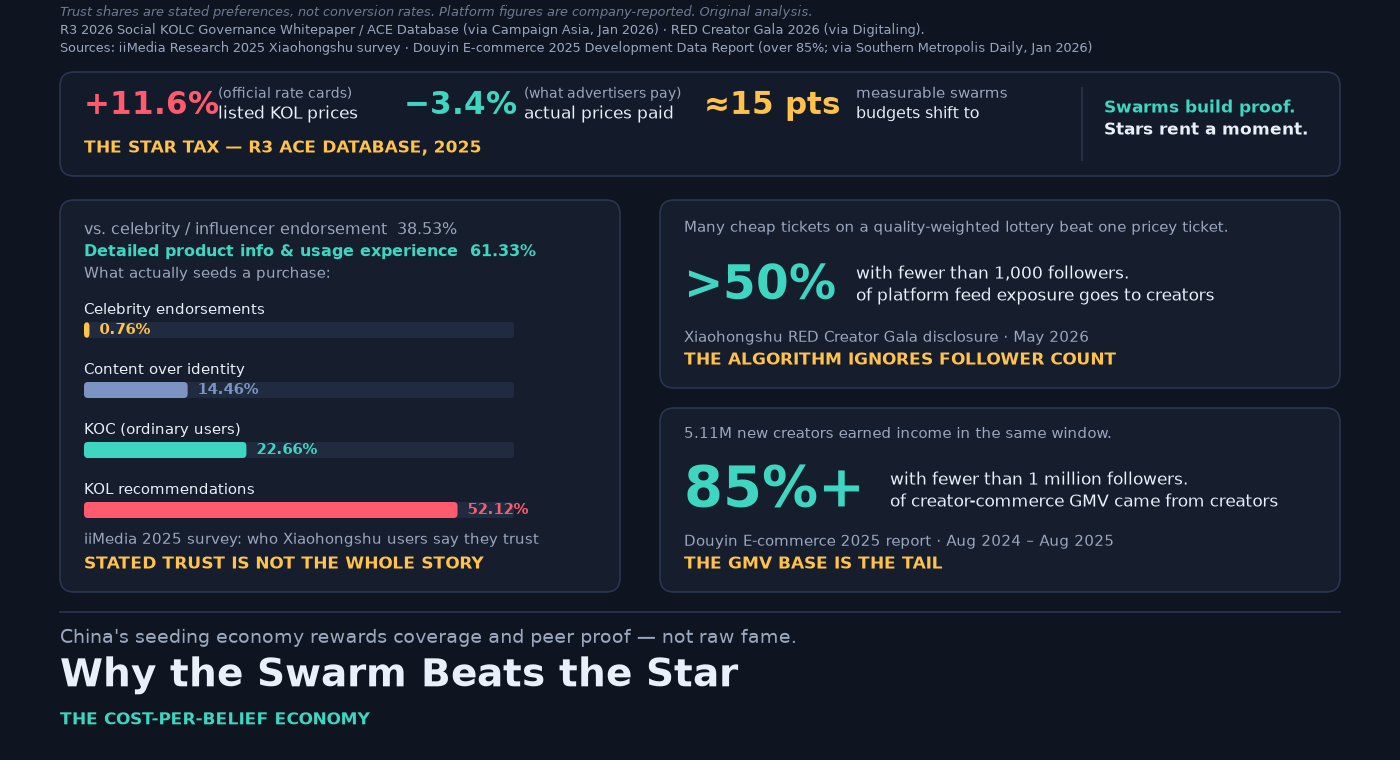
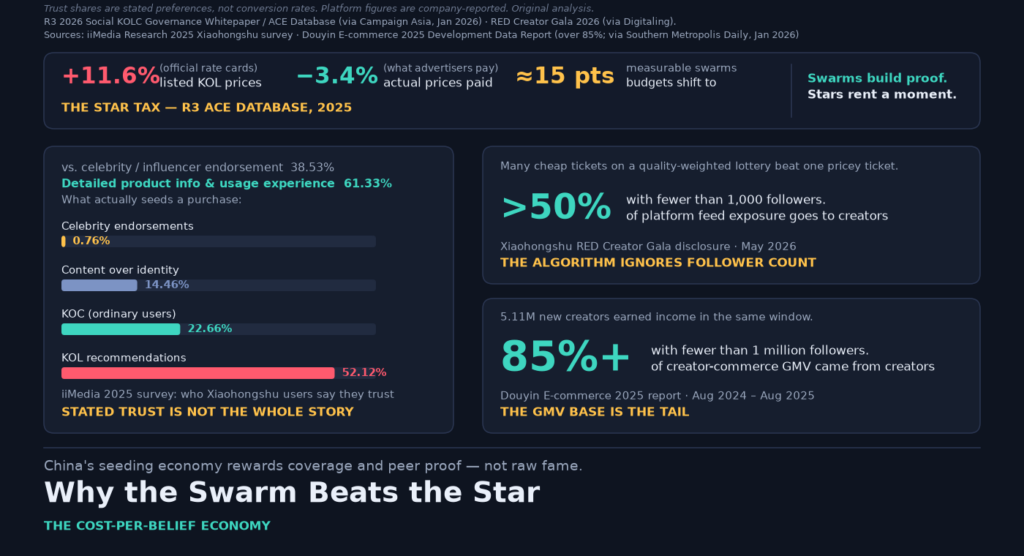
Here’s a number that should stop you: in iiMedia Research’s 2025 survey of Xiaohongshu users, 52.12% said they trust KOL recommendations when getting seeded on a product. Ordinary users — KOCs — drew just 22.66%. Celebrities? A rounding error: 0.76%.
So why are brands moving money toward the crowd instead of the stars?
The twist: stated trust isn’t the buying trigger
The same iiMedia survey asked what actually plants the purchase urge. Detailed product information and real usage experience won at 61.33% — well ahead of celebrity or influencer endorsements at 38.53%. People admire the expert; they buy on evidence. KOC notes are evidence-shaped: messy bathrooms, honest skin, the third week of use.
The tail already owns the register
Douyin’s official 2025 development report (August 2024–August 2025) found that creators with under one million followers drove over 85% of creator-commerce GMV, while 5.11 million new creators earned income. The long tail isn’t the experiment. It’s the business.
The machine ignores fame
At its 2026 RED Creator Gala, Xiaohongshu disclosed that over 50% of feed exposure goes to accounts with fewer than 1,000 followers. Distribution is a quality-weighted lottery. A swarm buys hundreds of cheap tickets; a star buys one expensive ticket and hopes.
Finance did the math
R3’s 2026 governance whitepaper, built on its ACE audit database, found listed KOL prices rose 11.6% in 2025 while prices actually paid fell 3.4% — a roughly 15-point opacity gap. Meanwhile, Totem’s 2025 survey of 42 Chinese brand managers found micro and mid-tier creators are the default choice for conversion, even though consumers rate mega-influencers warmer: 65% positive sentiment versus 31% for nano creators, per the Rakuten Insight consumer sample of 575.
The uncomfortable footnote
A CSCW 2025 study by University of Michigan researchers Yi and Xian — nine months of ethnography on RED — shows this authenticity is manufactured: sampling pipelines, brand briefs, labor deliberately disguised as spontaneous posting, often underpaid. The swarm works because peer proof is what buyers want. Keep it real — actual usage, honest briefs, disclosure — or you poison the very evidence layer AI answer engines now read.
Stars rent a moment of attention. Swarms build the record everyone checks before buying.