Watch a shopper in Shanghai buy a pair of sneakers. She sees a Douyin video, taps the embedded product card, confirms with her face, and goes back to scrolling. Forty seconds, no new tab, no card number, no second thoughts. Now watch a shopper in Chicago want the same shoes: leave the app, hunt down the site, create an account, type sixteen digits, pause at the returns policy.
Same desire. Different plumbing.
The usual explanation is cultural — Chinese consumers are impulsive. That’s lazy. China’s funnels are short because two infrastructure layers deleted the steps a Western funnel still asks shoppers to climb.
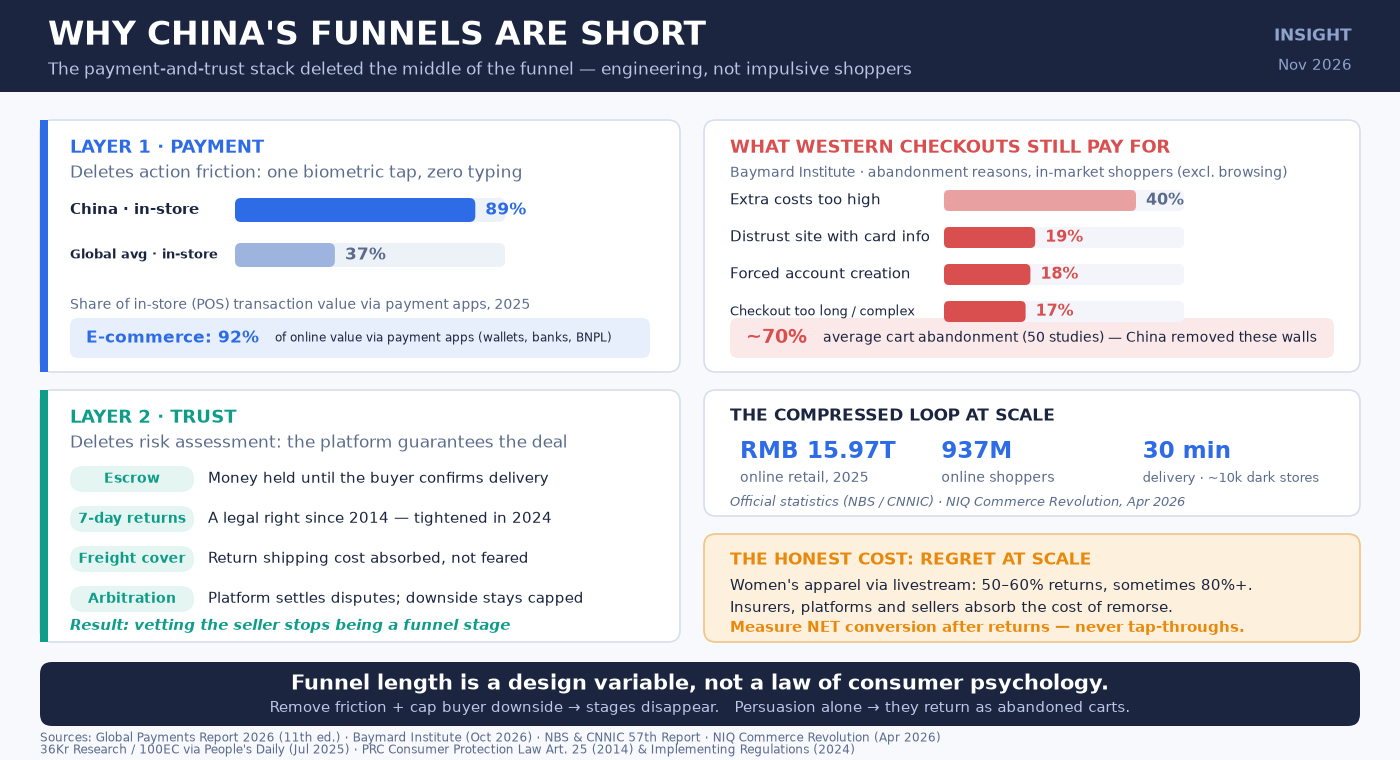
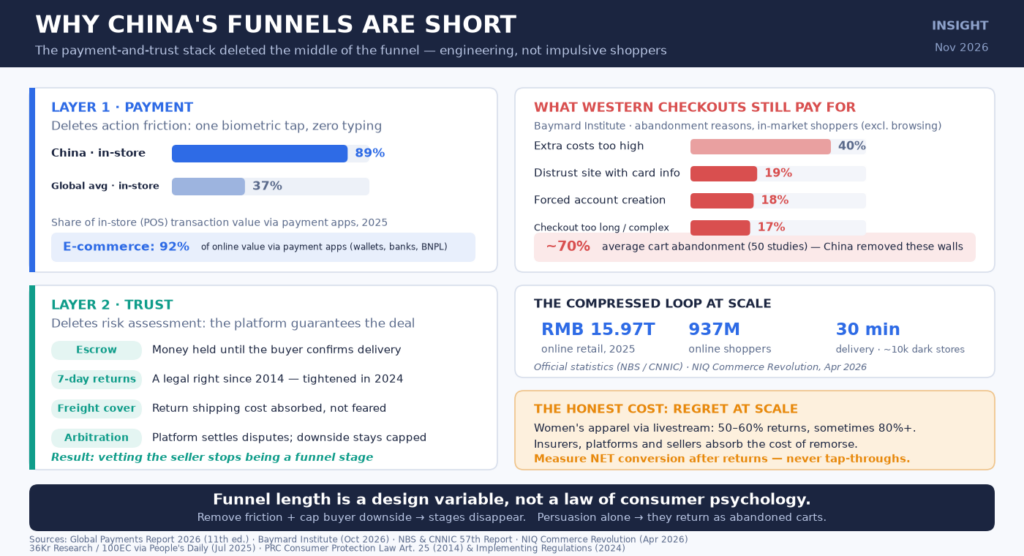
Layer one: payment. In 2025, payment apps — wallets like Alipay and WeChat Pay, plus bank apps and buy-now-pay-later — carried 92% of China’s e-commerce transaction value and 89% of in-store payments, both first among the 42 markets tracked in Global Payments’ 2026 report. The global in-store average is 37%. Stored credentials plus a biometric tap mean checkout has no fields left to fill. Every deleted field is a deleted funnel stage.
Layer two: trust. On Taobao, your money sits in escrow until you confirm delivery. Seven-day no-reason returns aren’t a seller’s favor — they’re national law, written into the Consumer Protection Law in 2014 and tightened by State Council regulation in 2024. Freight insurance and platform arbitration cap the downside of a bad purchase at nearly zero. When being cheated is structurally unlikely, vetting the seller stops being a funnel stage.
Here’s the satisfying part: Baymard Institute’s checkout research lists exactly these frictions as the West’s top abandonment drivers — after surprise fees, shoppers cite distrust with card details (19%), forced account creation (18%), and checkout complexity (17%). Roughly seven in ten Western carts die. China didn’t persuade shoppers to push through those walls. It removed the walls.
Add super-app identity (no new logins) and roughly 10,000 dark stores delivering in 30 minutes — NIQ’s April 2026 commerce report — and the last hesitations vanish. This machinery moves RMB 15.97 trillion in annual online retail for 937 million online shoppers.
But honesty demands the counter-metric. Short funnels manufacture regret at scale: women’s apparel bought via livestream sees return rates of 50–60%, sometimes above 80%. The stack survives this only because it absorbs the blow — insurers, platforms and sellers split the cost of remorse. Measure net conversion after returns, never tap-throughs.
The lesson travels better than the tactics. Funnel length is a design variable, not a law of consumer psychology. Western brands that delete steps without adding guarantees delete reassurance — and conversion falls. Borrow the components instead: wallets, guest checkout, escrow-grade buyer protection, returns you can actually use. Remove friction and cap the downside, and stages disappear on their own. Try to skip stages with countdown timers alone, and they reappear as abandoned carts.
The shopper isn’t impulsive. The stack is thorough.