How to Buy Belief: The Economics of China’s KOC Playbook
种草 — pronounced zhǒng cǎo, literally “planting grass” — is the Chinese practice of manufacturing desire through ordinary people’s recommendations before the buyer has formed any intent to buy. You seed the want, then wait. The purchase shows up later, wearing the costume of the buyer’s own idea.
If you keep only one sentence from this piece, keep this one: grass planting is not a channel. It is a sequence. Content arrives ahead of demand instead of chasing it, and every downstream number changes because of that ordering.
That single reversal explains why Chinese brands spend the way they do, why the platform where seeding happens also became a search engine, and why so many Western influencer budgets underperform when the playbook is transplanted without the surrounding machinery.
Why the metaphor is doing real work
The verb is species, to plant; The object is grass, grass. Together they describe a small, unglamorous act: dropping a seed somewhere it will sit quietly and then grow on its own. Nothing about the phrase suggests advertising, which is precisely why it spread.
In everyday use, the grammar bends toward the consumer, not the brand. People say I was planted with grass – grass was planted in me — when they mean a want has appeared and they are mildly annoyed about it. The undoing is Pulling weeds, pulling the grass out, which usually means the purchase happened. Occasionally it means the more disciplined act of talking yourself out of one.
Two things are worth noticing about how the term behaves. It is a consumer verb rather than a media term, so nobody needs a deck to use it. And it carries a faint accusation. To be grassed is to have been persuaded without quite noticing, and the phrase admits as much. A marketing vocabulary that names its own mechanism so bluntly is unusual, and it tells you the culture has already priced in the manipulation.
This is not influencer marketing with a different accent
The lazy translation is “Chinese influencer marketing”, and it will get you a campaign that looks right and converts like a billboard. Three structural differences matter.
The timing of intent. Most influencer marketing interrupts a person who is already in the market or nudges someone toward a click. Seeding is aimed at people who have no query yet. You are not bidding on a need; you are manufacturing one. That audience sits in an awkward middle: colder than a retargeting pool, warmer than a brand campaign. Almost nothing in a standard Western media plan is built for that temperature.
Who does the persuading. One authoritative voice against many ordinary ones. A single polished creator says the product is excellent; two hundred people say the packaging is annoying and the shade runs light, but they repurchased anyway. Volume, not authority, produces the effect you are paying for.
Where verification happens. This is the part most strategy decks miss. In most Western markets, discovery and verification live in different products: something creates curiosity on social, and the buyer leaves for a search engine to check. In China, the app that created the interest also answers the question. One company owns both moments, which collapses the distance between being persuaded and being reassured.
How the mechanism runs
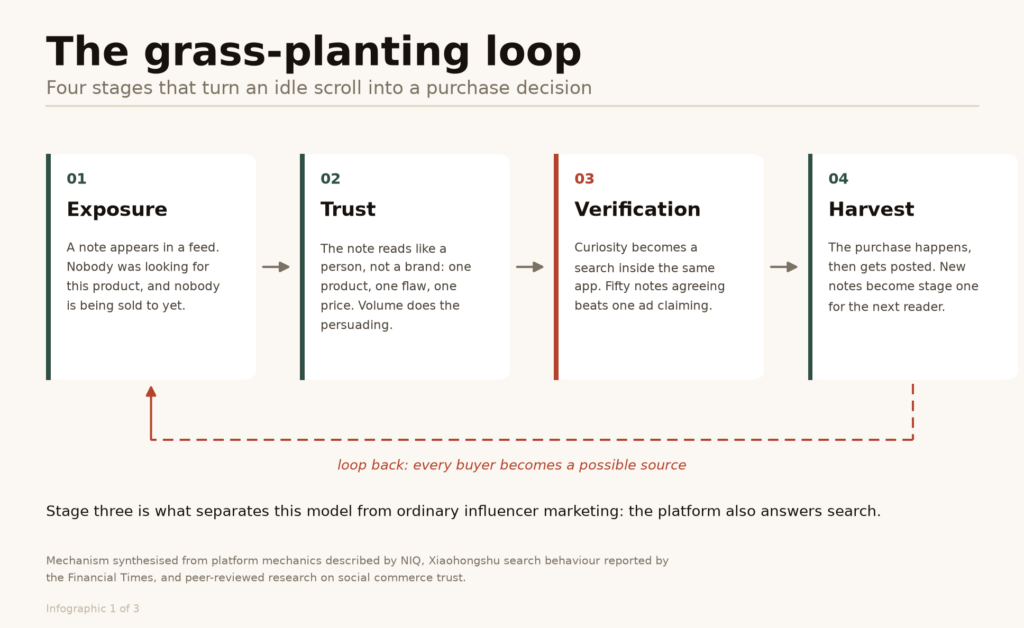
Four stages, and only the last one gets measured by default.
Stage one: exposure without intent
A note appears in a feed. Three photographs of a cluttered bathroom shelf, a price typed into the caption, an unsolicited complaint about the pump. Nobody in that moment is shopping. The note is not competing with rival products; it is competing with a video of somebody’s cat, and it wins on specificity.
Stage two: trust built from volume, not craft
Then the same product keeps appearing, from strangers, in different rooms, with different complaints. A pattern forms before an argument does. The reader is not evaluating a claim so much as noticing a recurrence, and recurrence feels like consensus. Production value is close to irrelevant here. A phone shot in bad light outperforms a studio shoot, because the studio signals budget, budget signals advertising, and advertising signals an interest that is not the reader’s.
Stage three: the search that happens inside the feed
Curiosity becomes a query. The reader taps the magnifier and never leaves the app. The Financial Times has reported that Xiaohongshu was handling close to 600 million searches a day by the fourth quarter of 2024, roughly half of Baidu’s search volume and double its own volume a year earlier. That is not a social network with a search box bolted on. It is a search engine with a feed attached, and the feed is what generates the demand for those queries.
The competitive consequence is already visible in earnings. Baidu’s search advertising revenue fell 19% year on year to 15.3 billion yuan in the quarter ended September 2025, with management attributing the decline to social platforms taking both users and marketing budgets. When the place people ask questions moves, the place brands buy attention moves with it.
Practically, this is where seeding gets its unfair advantage. The content that plants the desire is also the content that settles the objection, the comparison, and the price check. Nothing has to be handed off.
Stage four: the harvest, and the loop
The purchase happens, and then — more often than in Western markets — the buyer posts about it. Not because a brand asked, but because posting is a form of social participation. Those new notes become stage one for the next reader. The loop is why seeding compounds where advertising decays: each harvest reseeds the next, at no media cost.
Two jobs, not one: KOLs and KOCs
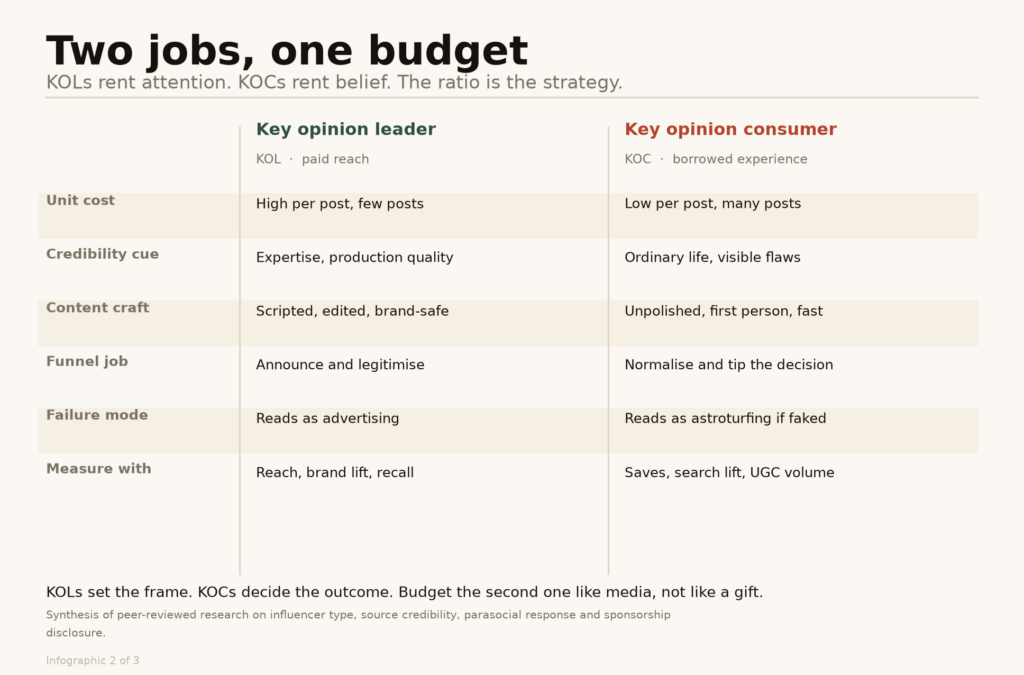
The Chinese vocabulary splits the work more cleanly than the English one does. A KOL, key opinion leader, is a professional voice with reach. A KOC, key opinion consumer, is a customer with a small audience and no performance style. The second is the one doing the seeding.
KOC is a genuine industry term, not a polite word for “micro-influencer”. The distinction is about where credibility comes from. A KOL’s authority comes from expertise, a track record, or celebrity, and it travels across categories. A KOC’s authority comes from having actually bought the thing, and from being willing to describe the bad parts as readily as the good. It does not travel — someone credible about skincare is nobody in kitchen appliances — and that confinement is exactly what makes the endorsement feel unbought.
A nine-month ethnography of creators on Xiaohongshu, published in the Proceedings of the ACM on Human-Computer Interaction in 2025, describes how that ordinariness is produced rather than found. KOC status emerges from continuous negotiation among creators, marketers, brands, and the platform itself. The people who supply the authenticity are working at it, often for small sums and on uncertain terms. Hold that in mind, because it explains both the model’s power and its fragility: authenticity that is manufactured can be un-manufactured by an audience at any moment, and audiences are good at spotting the seam.
A short glossary
| Term | What it actually means in use |
| 种草 (zhǒng cǎo) | To plant a want. Used as a verb by ordinary buyers, usually in the passive: I got grassed. |
| 拔草 (bá cǎo) | To pull the grass out. Usually means the purchase happened; occasionally means the want was talked out of. |
| KOL | Key opinion leader: paid reach, cross-category authority, expensive, fast. |
| KOC | Key opinion consumer: bought it themselves, small audience, narrow credibility, cheap, slow to coordinate. |
| Seeding | The best English verb for the activity, and the one this article uses after the first mention. |
What the evidence actually supports
Writing about Chinese marketing runs on assertion. The academic record is thinner than the conference circuit implies, but it does support three claims.
Trust is the load-bearing variable. A meta-analysis in SAGE Open covering the social-commerce literature found trust to be a consistent predictor of purchase intention across studies; platform and content factors change the size of the effect, not its direction.
The mechanism is relational rather than informational. Research in Computers in Human Behavior established that parasocial relationships — the one-sided sense of knowing someone — mediate the effect of digital personalities on both purchase and word-of-mouth intention, and later work in the International Journal of Consumer Studies found the same mediation at work in purchase decisions. People are not persuaded by the argument in the note. They are persuaded by someone they feel they have been following.
Authenticity is manageable, which cuts both ways. A 2024 study in the Journal of Business Research shows that creators actively manage authenticity and that the strategy shapes engagement with sponsored content. Managed authenticity still reads as authenticity — until the management becomes visible.
What the evidence does not support: any claim that seeding reliably beats performance media on return on ad spend, or that a specific creator-to-buyer ratio produces a predictable lift. Anyone quoting you a number for that is quoting their own case study, and case studies are how this field launders anecdotes.
What you are actually buying
Ordinary influencer math optimizes cost per thousand impressions. Seeding optimizes something less tidy: cost per doubt removed.
Think about what a buyer needs before a considered purchase. Not awareness — awareness is cheap. They need permission: permission to want something unnecessary, permission to spend at this price, permission to trust a brand they have never touched. One authoritative voice can grant that permission, but it grants it once, and the reader knows precisely what the voice was paid.
Two hundred small voices grant it differently. Each removes a specific doubt: the shade match, the delivery time, the smell, whether it survives a washing machine. The doubts differ, so the removal is additive rather than repetitive. And the cost per doubt is low, because the content is cheap to make and the creator is not pricing celebrity.
That is the whole economic case, and it also names the failure mode. If your seeding program answers the same doubt two hundred times, you have bought frequency at storytelling prices, and the audience will feel it.
Where the model breaks
Saturation
Seeding depends on the reader’s assumption that notes are written by people with nothing to sell. When every third note in a category is paid, that assumption dies — and it dies for the whole category, not just for the brand that overdid it. Beauty and home have already been through this cycle. Categories that seed late inherit the cynicism early.
Fabrication
Fake notes convert a trust asset into a liability faster than anything else. The economics are tempting, since a fabricated review costs less than a real creator and performs better in the short term. The payback is brutal and permanent, because there is no second act to a credibility collapse.
Platform dependence
Seeding lives inside one app’s recommendation system. Ranking changes, category policy changes, and audience migration all hit the same line item. The search behavior described earlier is a moat for the platform, not for you.
Category mismatch
Seeding works best where the product is visual, the price is low enough to buy on impulse after verification, and the doubts are describable by a stranger. High-ticket, low-frequency, invisible-benefit purchases — enterprise software, insurance, industrial components — generate far less usable note content. The model does not fail there; it simply has nothing to run on.
Disclosure and the fake-note problem
China’s internet advertising rules require paid promotional content to be identifiable as advertising, and platforms layer their own labels and penalties on top. Elsewhere the pressure comes from the FTC’s endorsement guides in the United States and from consumer-protection law in the European Union and the United Kingdom, all converging on one principle: if money changed hands, the reader is entitled to know.
For a marketer, this is not primarily a compliance question. It is a pricing question. Seeding’s advantage comes from a discount the reader grants by default — the assumption that the recommendation is unpaid. Disclosure removes part of that discount. The model does not stop working when content is labeled; it stops working when labeling is inconsistent, because then the unlabeled content inherits suspicion it did not earn.
Measuring seeding without last-click
Last-click attribution will always say seeding did nothing, because the purchase usually happens elsewhere, later, after a search. Four measures are more honest.
Search lift inside the platform. If seeding works, searches containing your brand or category terms rise before sales do. This is the leading indicator, and in-app search data is the cleanest version of it.
Saves and collections per note. A save is a private declaration of future intent, which is closer to a pipeline metric than a like will ever be.
Earned-to-paid ratio. How many unpaid notes appear per hundred paid ones? That is the compounding test. A campaign that produces only the content it paid for is a media buy with extra steps.
New-to-brand share of demand. Seeding is supposed to manufacture intent among people who had none. If your growth comes from people who already knew you, you are harvesting, not planting.
Then verify with an incrementality test: hold back seeding spend in a matched set of regions or audience cells for a full purchase cycle, and compare branded search and sales. Slower than a dashboard, and the only thing that survives an audit.
What to borrow if you sell outside China
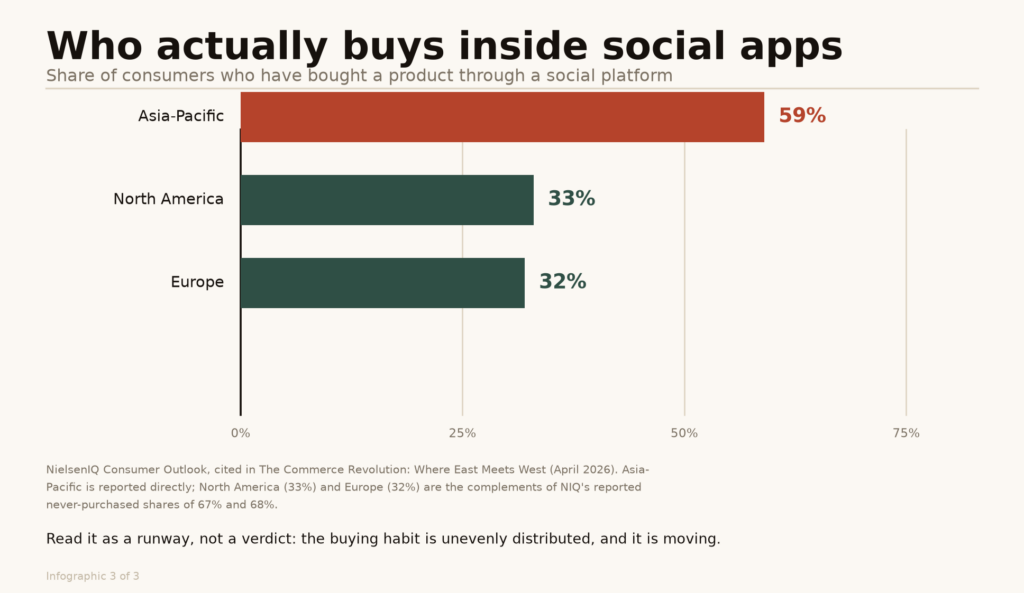
Start with the baseline. NielsenIQ’s April 2026 study of connected commerce puts China’s live-commerce market at roughly $900 billion in 2025, close to the scale of the entire United States e-commerce market. The same research finds that 59% of consumers in Asia-Pacific have bought something through a social platform, compared with a Western picture in which 67% to 68% of North American and European consumers have never done so. That gap is the opportunity and the constraint in one number: the behavior is learnable, and mostly unlearned.
Five principles transfer. One asset does not.
Seed where people are not shopping. Buy attention in entertainment and utility contexts, not in comparison contexts. The entire point is that no query exists yet.
Optimize for believability per dollar. Reach is a vanity metric. A hundred people who sound like customers beat one person who sounds like a media company, even at equal total impressions.
Build the search footprint your content creates. This is the step Western teams skip. If your short-form video sends people to a search engine, own the answers there: your own site, review platforms, retailer pages, third-party coverage. Discovery without a landing surface is a leak.
Let the comments write the next brief. The doubts people voice under a post are the highest-quality creative research available to you, and they are free. Most brands read them for sentiment and stop.
Plan seeding as a distribution, not a decision. Many small bets, judged as a spread of outcomes, because you cannot predict which note will travel — only that some will.
The asset that does not travel is the in-app search layer. Outside China, discovery and verification sit in different products owned by different companies, so the handoff has to be engineered, and it leaks. Budget for that leak instead of pretending your funnel is as tight as the Chinese one.
Key takeaways
- Grass planting is a sequence, not a channel: demand is created before a query exists, and the content that creates it also answers the verification that follows.
- Volume works on both ends — many small voices for trust, many notes for search. Production polish works against both.
- KOLs and KOCs do different jobs. Reach announces; ordinariness decides; and the second is cheaper per unit of belief.
- The model’s currency is the reader’s assumption of non-commerciality. Fabrication, saturation, and inconsistent disclosure each spend that currency faster than it can be earned.
- Measure with search lift, saves, earned-to-paid ratio, and new-to-brand demand, then confirm with a holdout. Last-click will always lie about the top of the funnel.
Frequently asked questions
Is grass planting just another word for influencer marketing? No. Influencer marketing buys attention from people who already have audiences; grass planting buys belief from people who sound like customers, and it aims at buyers before they express any intent. The two overlap in execution and differ in timing, in who is paid, and in what the audience believes is happening.
Why do Chinese brands use hundreds of small creators instead of a few large ones? Because the persuasion comes from recurrence rather than authority. Each small creator removes a different specific doubt, and cost per doubt is far below a celebrity fee. The trade-off is coordination: a hundred small partnerships is a logistics problem, and most brands underestimate that half of the job.
Does the model work outside China? Partly. The seeding principle travels: seed before intent, prioritize believability, plan for a spread of outcomes. The closed loop does not travel, because outside China the app that creates desire is usually not the app that answers the follow-up search. You have to build that bridge yourself, and it leaks.
How do you know it worked if the purchase happens weeks later? Use leading indicators instead of last-click. Rising in-platform searches for your brand, saves and collections on notes, unpaid notes appearing without payment, and a growing share of demand from new-to-brand buyers all move before revenue does. Confirm the effect with a regional holdout spanning a full purchase cycle.
What kills a seeding program fastest? Fake notes. Saturation is survivable, because it is gradual and category-wide. Fabrication is not, because it turns the one asset you were renting — the assumption that the recommendation is unpaid — into evidence against you.