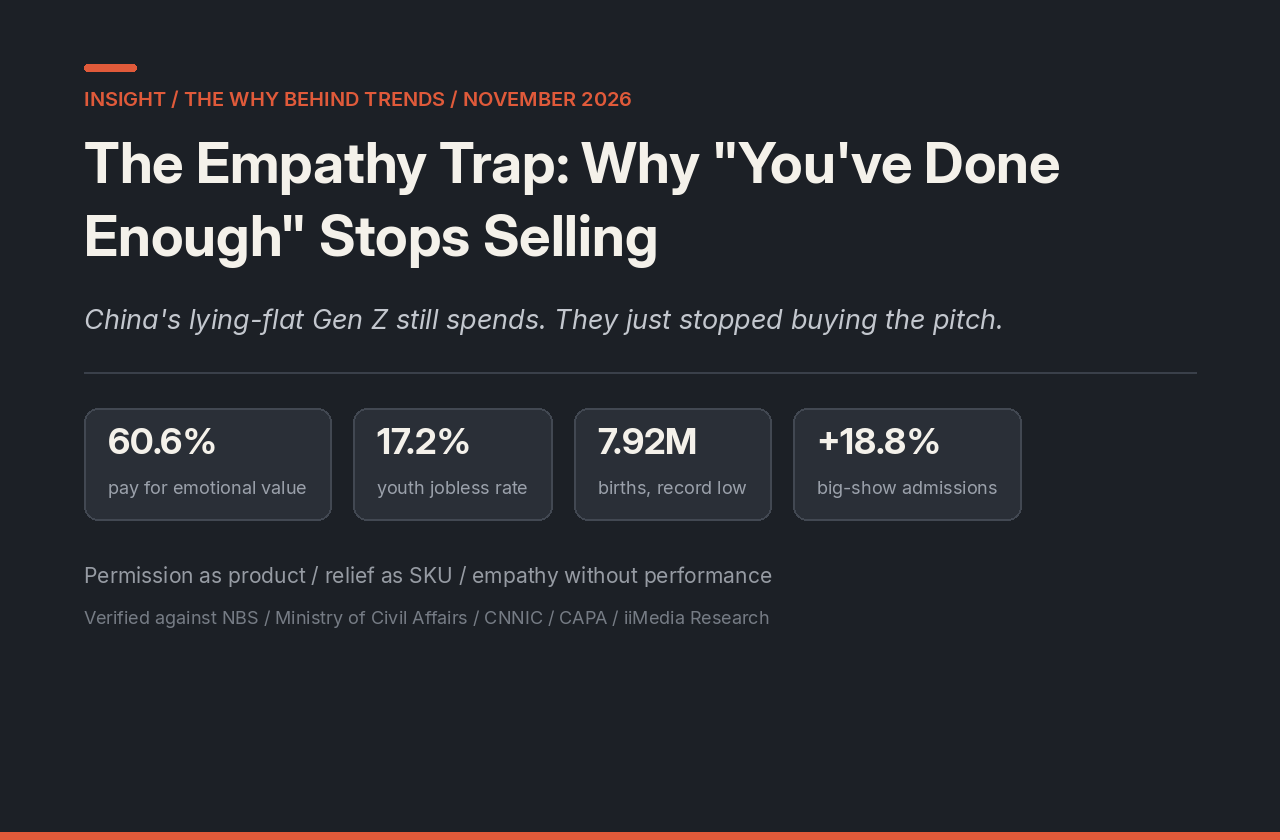
Here is a discovery worth sitting with: the brands that understood lying flat fastest are now the ones struggling hardest to convert it.
The logic seemed airtight. China’s Gen Z opted out of the status race — so sell them relief instead of ambition. Swap “achieve more” for “you’ve done enough.” Within two years, that line appeared in so many campaigns that it became wallpaper. And the cohort it was written for started scrolling past it.
Why does the correct message stop working? Because the message was never the product.
The mechanism: empathy performed is a new status claim
Lying flat is a refusal of neijuan — effort inflation without reward. What the cohort detects, with unusual sensitivity, is performance: effort that exists to be seen rather than to deliver. A brand that stages understanding is running the same play it claims to reject. “We see your exhaustion” becomes another ad about how virtuous the advertiser is. The cohort doesn’t read it as relief. They read it as the race wearing a costume.
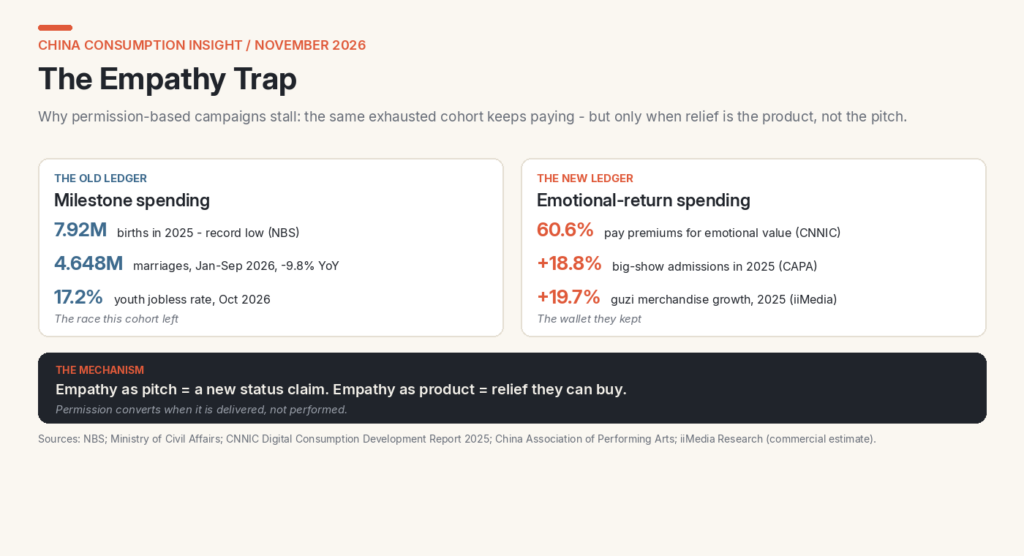
That is the trap: empathy as pitch is a status claim; empathy as product is relief. The first asks for credit. The second delivers a feeling and leaves.
The evidence: the wallet never closed
The numbers say this cohort is not unreachable — it is selectively reachable. CNNIC’s 2025 survey of 30,000 residents found 60.6% of online shoppers willing to pay premiums for hobbies and emotional value. Big-show admissions grew 18.8% in 2025, per the China Association of Performing Arts. Character merchandise grew 19.7%, per iiMedia Research’s estimate. Meanwhile births hit a record-low 7.92 million and youth unemployment sat at 17.2% in October 2026.
Read together, these are not the ledgers of people who stopped spending. They are the ledgers of people who stopped spending on claims — and kept spending on feelings that arrive immediately, with no audition required.
What converts instead
Three moves follow from the mechanism.
First, make the relief the SKU, not the slogan. A sleep product that demonstrably lowers stress converts; a campaign about how tired everyone is does not. The product must do the empathy.
Second, price in doses. Small formats, entry-price heroes, no annual commitment — the cohort buys units of feeling, and a contract reads as a milestone in disguise.
Third, leave the circle alone. Belonging purchases — fandom goods, shared experiences — work because they signal membership, not rank. A brand that inserts itself as the hero of that belonging re-introduces the very competition the purchase was meant to escape.
The uncomfortable conclusion: you cannot advertise your way into this cohort’s trust. You can only deliver something that feels like permission — and then get out of the way. The brands that stall are the ones still asking to be applauded for understanding. The brands that convert stopped asking.






