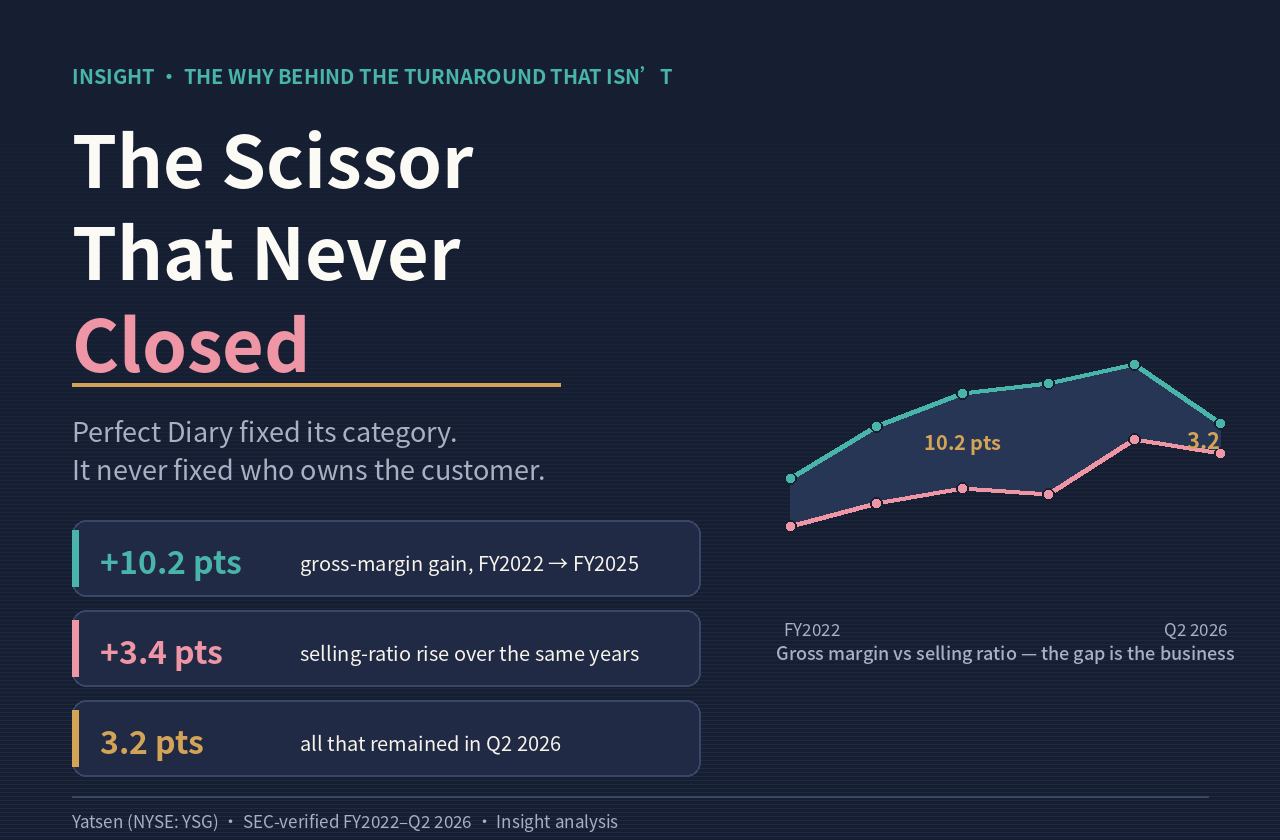
Why Perfect Diary’s skincare pivot improved every product metric — and almost none of the breathing room.
Here is a puzzle worth sitting with. Between FY2022 and FY2025, Yatsen lifted gross margin by 10.2 percentage points, from 68.0% to 78.2% — a climb most beauty CFOs would kill for. Skincare went from a third of revenue to 53%. The company booked its first non-GAAP annual profit. By every product-economics measure, the pivot worked.
So why did the market cap keep falling — to roughly $190 million by November 2026 — and why did losses widen again in 2026?
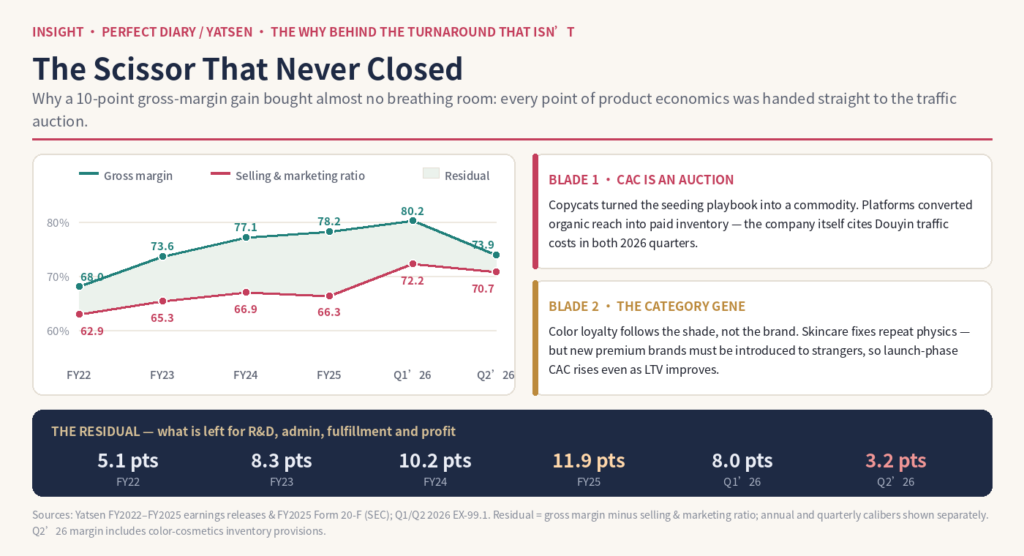
Because the two lines that matter moved together. Over the same FY2022–FY2025 window, the selling-and-marketing ratio rose from 62.9% to 66.3%. The residual — gross margin minus marketing, the slice that pays for R&D, administration, fulfillment and profit — widened from 5.1 points to 11.9. Real progress. Then Q1 2026 pushed the selling ratio to 72.2%, and Q2’s inventory provisions cut gross margin to 73.9%. The residual collapsed to 3.2 points. Three years of category upgrading, erased in two quarters.
The why sits in the incentive structure, not the execution. A traffic-native brand doesn’t own demand; it bids for it. When Yatsen’s margins improved, the improvement didn’t accrue to shareholders — it accrued to the auction. Douyin and Tmall price attention against what advertisers can pay. A company with 78% gross margins can outbid a company with 68% margins, and the platform’s auction mechanics make sure it does. The company’s own filings name the mechanism plainly: higher traffic acquisition costs, quarter after quarter. Better product economics raised the ceiling on what Yatsen could spend to acquire a customer — and competition, plus the platform’s take, pushed actual spend right up to that ceiling.
This is the uncomfortable general law: in an auctioned-attention market, margin gains are not retained; they are competed away unless something makes customers arrive without being bought. That something is brand pull, owned channels, or structural repeat — the three assets Yatsen is still building. Skincare’s replenishment cycles will help, eventually. But the acquired premium brands are new to most Chinese buyers, and introducing a stranger to a $60 serum costs more upfront than selling a $12 lipstick to a fan. The pivot raised lifetime value and launch-phase acquisition cost at the same time. The scissor didn’t close; it changed hands.
What would closing look like? Watch one number: the selling ratio falling while revenue grows. Not margin. Not mix. Until that happens, every improvement upstream is a gift to the auction — and the turnaround remains a lease renewal, not a purchase.






