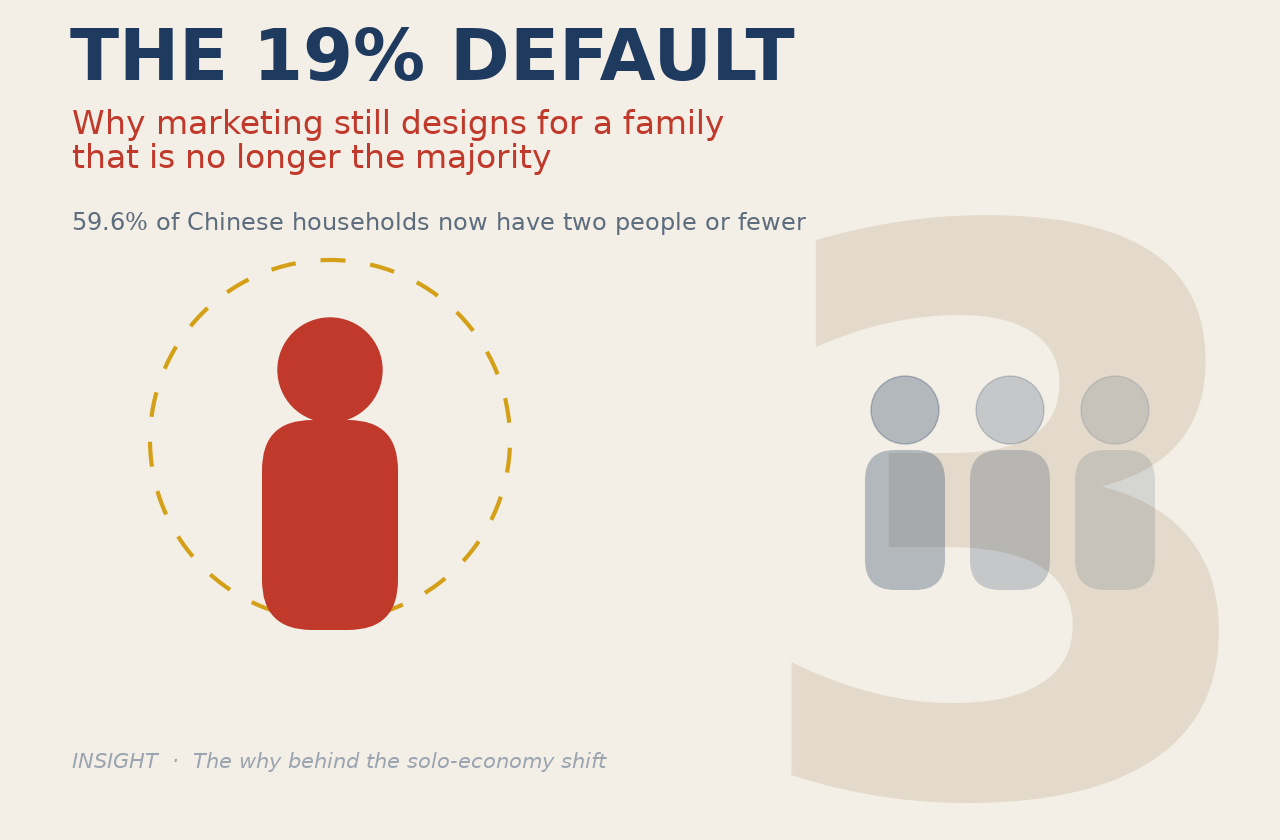
Open any Chinese supermarket aisle and the assumption is baked into the shelf: the family pack, the bulk SKU, the “share with loved ones” copy. Now open the census. One- and two-person households are 59.6% of all family households; the three-person family is down to 19.0%. The majority moved. The shelf didn’t. Why does a design default survive the demographic it was built for?
The answer is not ignorance. It is three locks, each rational on its own, that together keep the family pack in place long after its customers became a minority.
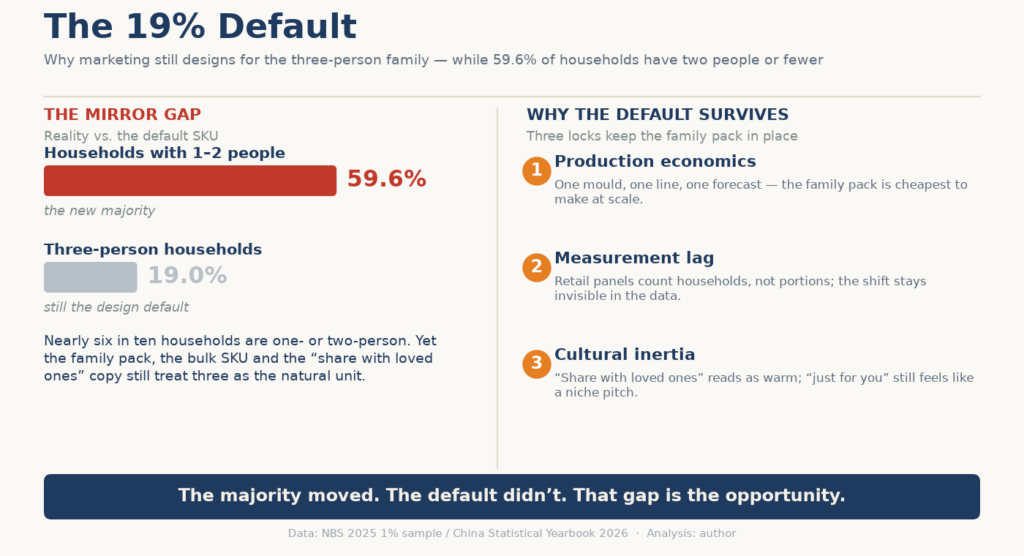
Lock one: production economics. A family pack is one mould, one line, one forecast. Splitting it into single-serve variants multiplies SKUs, packaging runs, and shelf negotiations — real cost today against a demand shift that shows up slowly. The cheapest thing to manufacture is still the thing the majority no longer needs. The default is not a belief about the customer; it is a bet on the factory.
Lock two: measurement lag. Retail panels and category reports count “households” and “volume sold,” not portion sizes or who actually eats the food. A solo buyer purchasing the family pack because nothing smaller exists registers as a family-pack sale. The data therefore confirm the default that created them. The shift is invisible precisely because the metric was designed for the old world. You cannot see a majority you never measure.
Lock three: cultural inertia. “Share with loved ones” reads as warm, aspirational, safe. “Just for you” still feels like a niche pitch — or worse, a pity pitch. So the autonomous soloist, who is often choosing this life (iiMedia found 45.9% of single respondents enjoy it or are in no hurry), gets addressed as either a family-in-waiting or a lonely heart. Both frames miss the buyer. The message that flatters the old default repels the new majority.
Here is the discovery underneath the three locks: the solo economy is not under-served because brands misread the customer. It is under-served because the customer is rational to keep buying the wrong product until a better one exists, and the system that makes products is rewarded for stability, not for noticing. The 19% default is a coordination failure, not a knowledge failure.
That reframes the opportunity. The brand that breaks the first lock — tooling for single-serve as the base run, not the variant — forces the other two to follow: new SKUs create new measurement, and new measurement legitimizes new messaging. The household-of-one is already the majority. The first mover to make it the default does not create demand. It simply stops taxing the demand that is already there.






