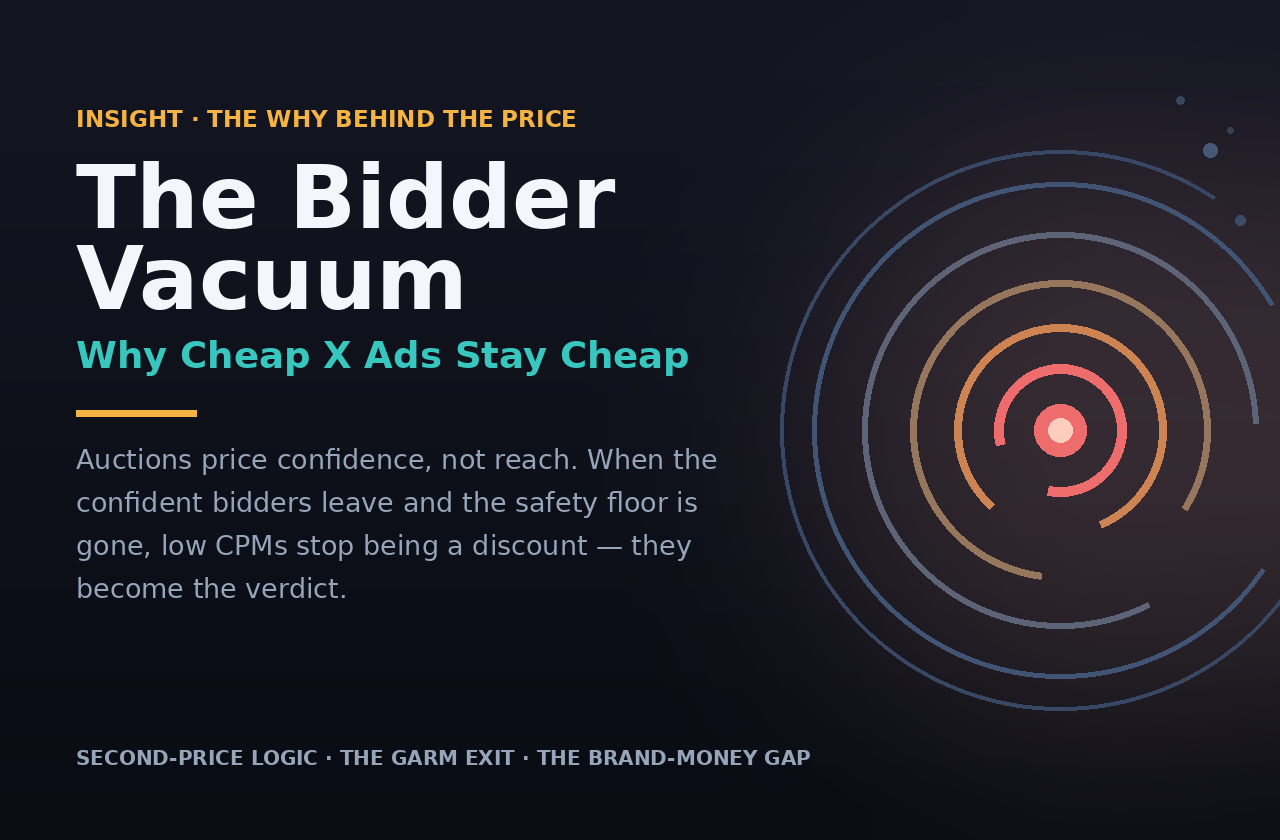
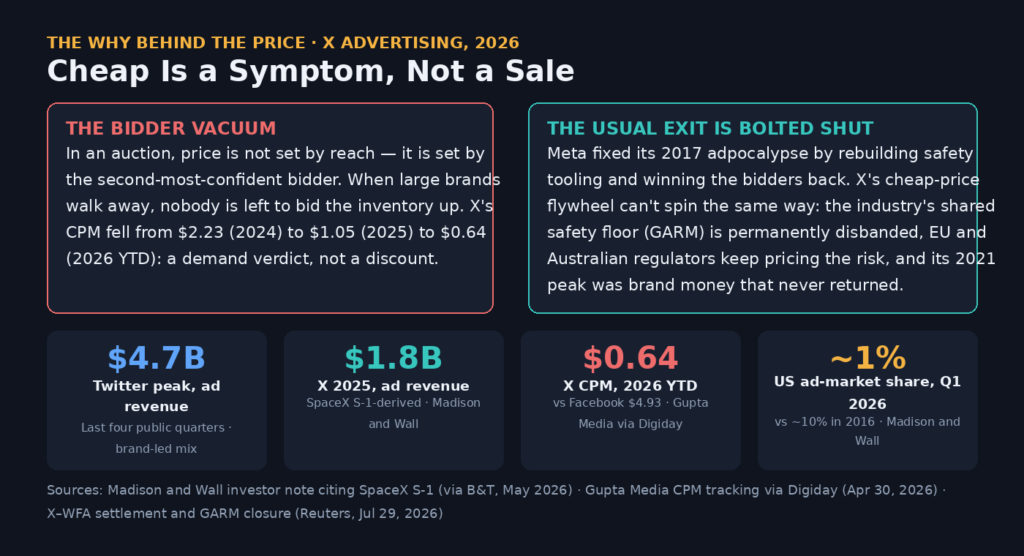
Every media buyer who has looked at X’s rate card in 2026 has had the same double-take: $0.64 CPM, against Facebook’s $4.93. Eight times cheaper. And almost nobody scales spend because of it. The standard explanation — brand risk — is true but incomplete. The deeper answer is mechanical, and once you see it, you can’t unsee it.
Auctions Price Confidence, Not Reach
Ad inventory is sold in auctions where the clearing price is set by the second-most-confident bidder. Reach determines how many impressions exist; confidence determines what they cost. When X’s largest brand advertisers walked away in 2022–23, they didn’t just remove revenue — they removed the competitive tension that held prices up. Gupta Media’s tracker shows the result with almost laboratory clarity: $2.23 average CPM in 2024, $1.05 in 2025, $0.64 in 2026 year-to-date. That is not a discount being offered. It is a verdict being rendered, quarter after quarter, by the bidders who remain.
The Repricing Escape Route Was Dismantled
Cheap inventory normally heals itself. Meta lived through its own adpocalypse in 2017, rebuilt measurement and safety tooling, and won the confident bidders back — prices recovered because trust recovered. X cannot run that play at full speed, because the machinery that re-certified trust at industry scale no longer exists. GARM, the WFA’s shared brand-safety framework, shut down days after X’s boycott lawsuit in August 2024; the July 2026 settlement made the closure permanent. Every advertiser now re-underwrites adjacency risk alone, contract by contract. And each regulatory event — the €120 million DSA fine, the Grok imagery probes, the Australian court penalty — resets that private underwriting back toward zero. The vacuum refills with fear-driven budgets and sports money, but fear bids timidly, and timid bids don’t raise clearing prices.
The Money That Would Reprice X Is the Money That Left
Here is the structural kicker. Twitter’s $4.7 billion peak was built disproportionately on brand budgets — awareness money that buys cultural adjacency. The buyers who returned are performance-minded: sports franchises, Samsung, SMBs testing cheap reach. Performance money bids on measured conversion, and X’s measured conversion is exactly what agencies call subpar. So the auction fills with the one buyer class that will never bid the inventory back to brand-era prices. Meanwhile the AI rebuild, genuinely promising, optimizes the same auction rather than repopulating it with confident bidders.
The lesson generalizes beyond X: in any auction market, a price collapse tells you who left, not what the product is worth. Cheap is information. Read it before you buy it.