Two creators post a video on the same Monday morning. One in Austin checks her YouTube Studio dashboard and watches ad revenue trickle in from a tutorial she filmed eight months ago. One in Hangzhou checks her Douyin dashboard and watches commissions land from orders closed during last night’s livestream — minus whatever gets returned this week. Same job title, same ring light, same hustle. But their income statements run on two different operating systems.
We keep comparing creator economies by size — follower counts, GMV, headline payouts. The more revealing comparison is by grammar: what event actually triggers a payment? In the West, the default answer is a view that carries a sold ad. In China, it is an order that survives the return window. Everything downstream — the skills creators build, the risks they carry, the way brands should brief them — follows from that one difference.
Two Income Statements, Two Theories of Value
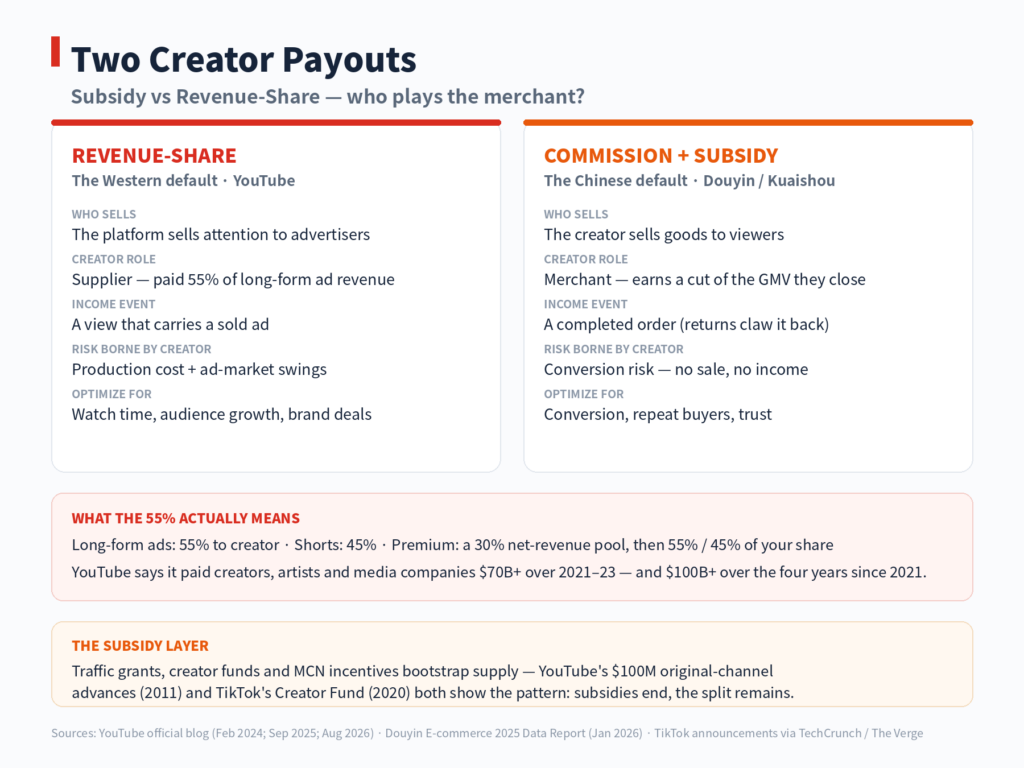
Start with the Western statement. YouTube’s official Partner Program explainer lays out the split: creators keep 55% of ad revenue on long-form videos and 45% on Shorts. In his February 2024 letter, CEO Neal Mohan disclosed that YouTube had paid over $70 billion to creators, artists and media companies over the prior three years, with more than 3 million channels enrolled in the Partner Program. By September 2025, at the Made on YouTube event, the official figure had grown to over $100 billion across the four years since 2021. Mohan’s line from that event is worth quoting because it is the whole thesis in one sentence: we didn’t just create a platform, we built an economy.
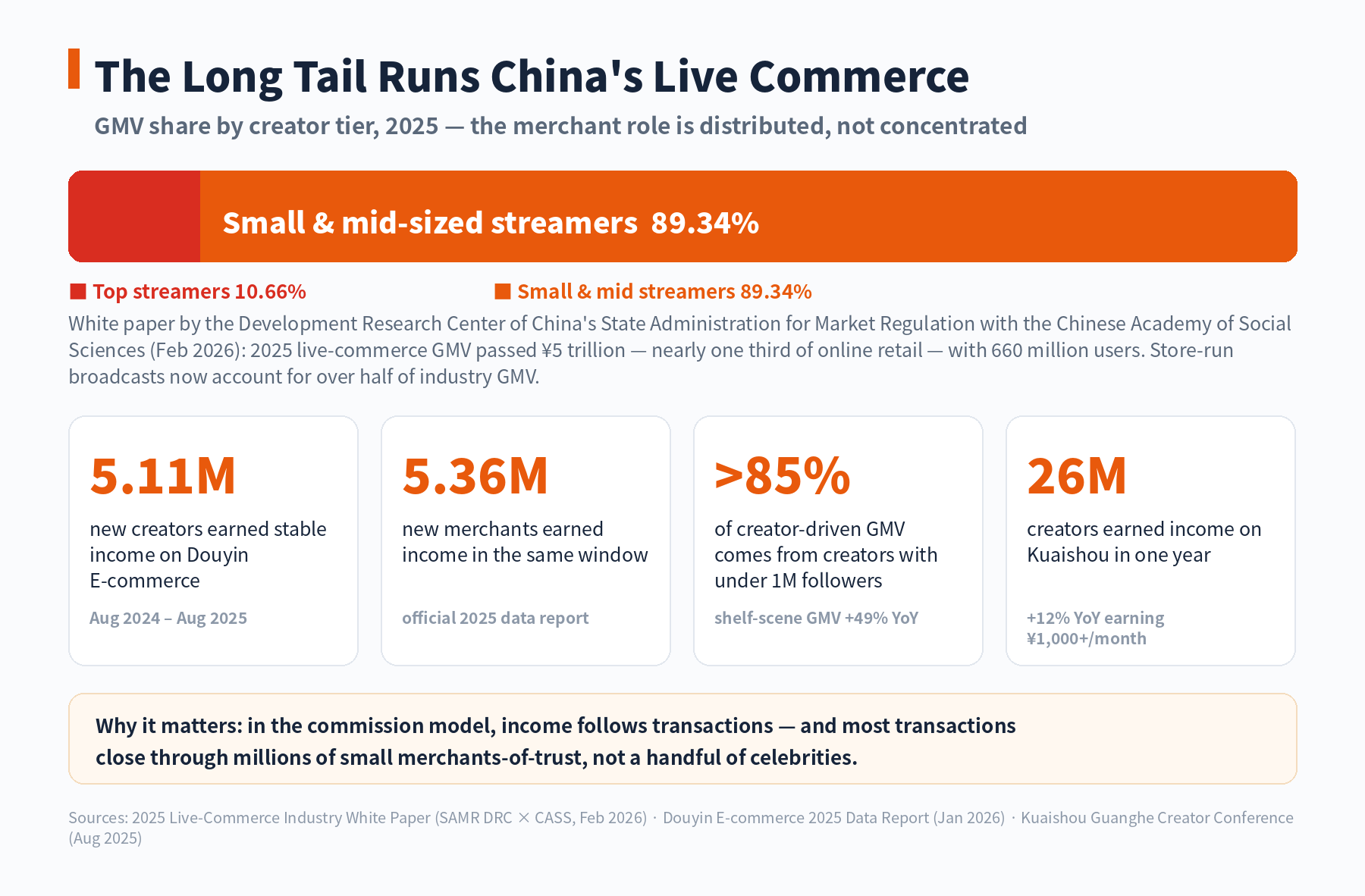
Now the Chinese statement. Douyin E-commerce’s 2025 data report, released in January 2026, says that between August 2024 and August 2025, more than 5.11 million new creators and 5.36 million new merchants earned stable income on the platform. The income event there is not the view — it is the transaction. Creators earn a commission on the GMV they generate, plus slot fees for livestream placements, plus gifting, plus whatever subsidy program they currently qualify for. At its September 2025 creator conference, Douyin disclosed that 1.25 million e-commerce livestreams go live on an average day, watched by more than 300 million people. That is not an audience. That is a marketplace with a heartbeat.
Here is the reframe this piece argues for: revenue-share makes the platform the merchant of attention and the creator a supplier. Commission makes the creator the merchant of goods and the platform a landlord. Two payout models, two assignments of the merchant role — and that assignment decides almost everything else.
The Merchant-Role Flip
Think about who stands behind the counter. On YouTube, the platform sells the audience to advertisers, collects the money, and pays the creator a majority cut. The creator never touches the advertiser’s invoice. On Douyin, the creator closes the sale herself — she picks the product, demos it, answers objections in real time, and the platform takes its cut of what she sells, the way a mall takes rent from a tenant who runs her own register.
This is why the same person can feel like a media business in one country and a retail business in the other. A Western creator’s pitch deck sells reach and engagement. A Chinese 带货 creator’s pitch deck sells conversion rate and repeat buyers. Neither is wrong. They are answers to different questions, asked by different paymasters.
Why the Models Diverged: Four Causes
The monetization object
Payouts follow what gets sold. The Western open web grew up on AdSense-style advertising, where attention is the unit of sale — so the natural payout is a share of ad revenue. China’s feed platforms matured alongside integrated commerce rails, where the transaction is the unit of sale — so the natural payout is a commission. The white paper on live commerce released in February 2026 by the Development Research Center of China’s market regulator, together with the Chinese Academy of Social Sciences, puts 2025 live-commerce GMV above ¥5 trillion, nearly a third of online retail, serving 660 million users. When a third of retail flows through content, content gets paid like retail.
The trust position
Western creators largely borrow trust — from the platform’s brand safety, from the sponsor’s logo. Chinese live-commerce creators are the trust layer: viewers buy because they believe the person, not the billboard. That is why the Chinese creator can capture commerce margin rather than just a media fee. Trust that converts is worth more than trust that merely reaches, and the payout model prices the difference.
The risk allocation
This is the quiet part. Revenue-share transfers monetization risk to the platform: if ads don’t sell, YouTube eats it, and the creator’s 55% is simply 55% of a smaller number. Commission transfers conversion risk to the creator: no sale, no income — and a returned sale can claw income back. Subsidies exist precisely to cushion that risk during cold-start. Different risk, different behavior. You can predict what a creator will optimize just by asking who eats the loss when a video flops.
The payout infrastructure
YouTube’s split runs on a global, automated advertising machine refined since 2007. Chinese commission settlement is commerce-rail-native: per-order attribution, escrow, wallets, return-window reconciliation. The plumbing follows the host stack. You cannot bolt a GMV commission system onto an ad server any more than you can run a department store on a billboard’s accounting.
The Subsidy Layer: Bootstrap, Not Salary
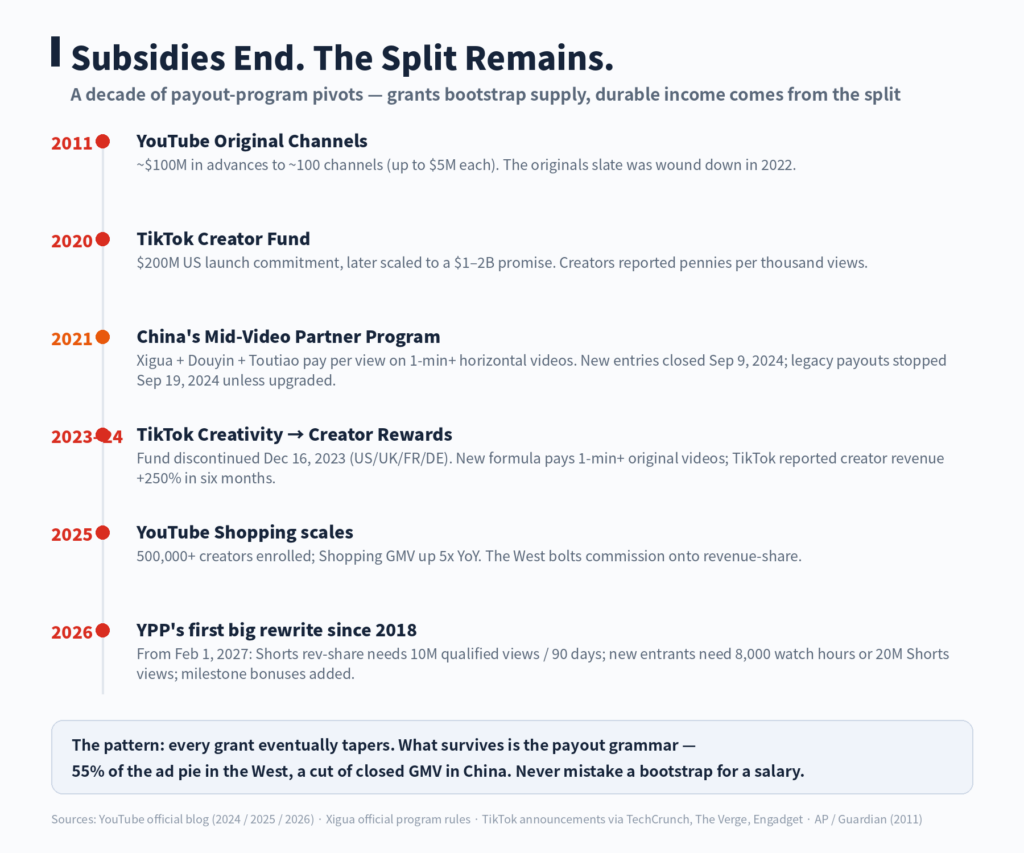
Every creator economy runs a subsidy layer, and every subsidy layer eventually tapers. YouTube’s original-channel initiative, announced in October 2011, advanced roughly $100 million to about 100 channels — up to $5 million each, per AP and Guardian coverage at the time. It was an advance against future ad revenue, not a grant in perpetuity, and the Originals slate was wound down in 2022. TikTok’s Creator Fund launched in July 2020 with a $200 million US commitment that later ballooned into a $1–2 billion promise, depending on which announcement you read. Creators famously reported earning pennies per thousand views — Hank Green publicly put his rate around 2.5 cents. The fund was discontinued in the US, UK, France and Germany on December 16, 2023.
China’s version followed the same arc. The Mid-Video Partner Program, launched in June 2021 by Xigua with Douyin and Toutiao, paid creators per view on horizontal videos of at least one minute. According to the program’s official rules page, new entries closed on September 9, 2024, and legacy payouts stopped on September 19, 2024 unless creators upgraded into the successor scheme — Douyin’s Creator Partner Program. The grant era ends; the split era remains. If your business plan depends on a creator fund, your business plan has an expiry date.
What Everyone Misunderstands
YouTube is generous — and it is still a business
The 55% split is genuinely generous as splits go. But notice the structure: YouTube takes 45% of a very large pie while bearing zero content-production cost. If a video flops, the platform loses nothing; the creator ate the filming budget. Mohan’s grow-the-pie framing is platform strategy, not charity — and it works. Generosity and risk-transfer coexist. Both things are true, and mature creators plan around both.
Chinese creators earn more — at the top, and only at the top
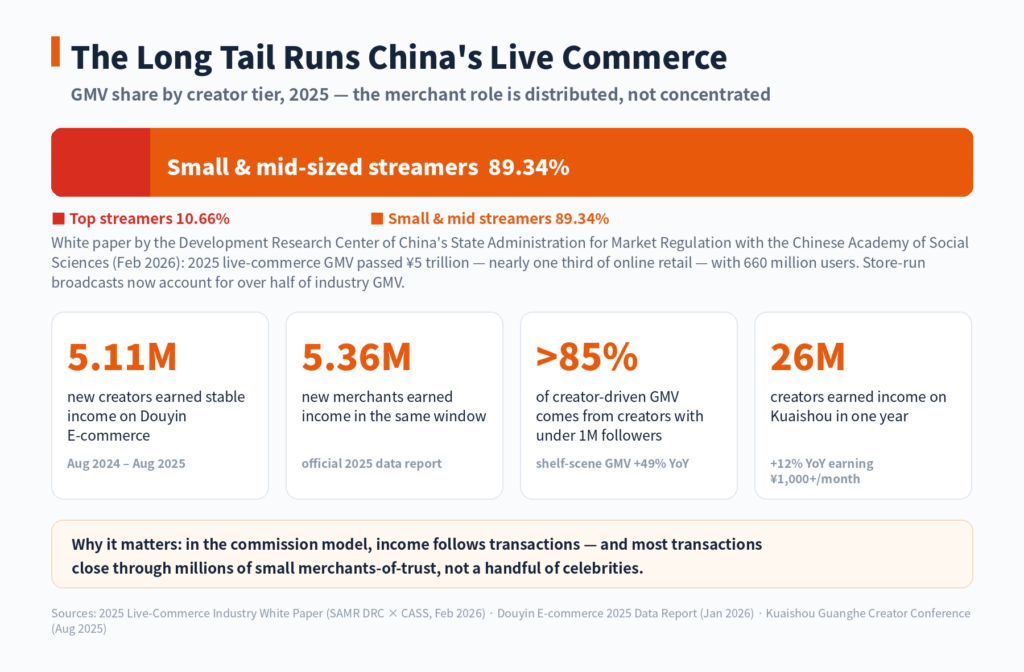
The blockbuster livestream numbers are real, but they are the visible tip of a brutal pyramid. The regulator-and-CASS white paper found that in 2025, top streamers accounted for just 10.66% of live-commerce GMV, while small and mid-sized players carried 89.34%. Douyin’s own report says creators with fewer than 1 million followers generate over 85% of creator-driven GMV. Kuaishou’s CEO said at the August 2025 Guanghe conference that 26 million creators earned income on the platform over the prior year — with the number earning over ¥1,000 a month up barely 12%. Millions earning something is not millions earning a living. Meanwhile, revenue-share’s per-view predictability is a real advantage Western creators enjoy, even when the ceiling looks lower.
The models stay separate — they are converging fast
YouTube has been bolting commerce onto its ad machine: by July 2025, more than 500,000 creators were enrolled in YouTube Shopping, with Shopping GMV up fivefold year over year. Mohan’s 2025 letter noted that over half of channels earning five figures or more already made money beyond ads and Premium, and cited a fashion creator who generated hundreds of thousands of dollars in affiliate sales from a single cardigan video. On the other side, TikTok replaced its fund with the Creator Rewards Program in March 2024 — paying on originality, play duration, search value and engagement for videos over a minute — and reported creator revenue up over 250% in six months, a platform-reported figure worth taking with the usual grain of salt. Both ecosystems are building hybrid income statements. The center of gravity still differs; the edges are merging.
The Stability Trade-off, Honestly Stated
Let’s not pretend one model wins. Revenue-share is smoother: income accrues per view, the back catalog keeps paying, and the platform absorbs the ad market’s mood swings. But it caps upside and makes you a tenant of the ad economy — when advertisers pull back, as they did in the 2017 adpocalypse and again in soft ad years since, your RPM falls and there is nothing you can do about it from the editing desk.
Commission is spikier: a viral livestream can print a month’s salary in an evening, and a wave of returns can erase it. But the creator who closes sales owns something the ad-share creator never touches — the customer relationship. Repeat buyers are an asset that survives algorithm changes. The honest synthesis: revenue-share trades upside for stability; commission trades stability for upside and ownership. Your skill set and risk tolerance decide the fit, not the headline payout number.
The income data backs the caution on both sides. Linktree’s 2022 survey of more than 9,500 creators — a vendor-run study of its own users, so read it as directional — found 46% of full-time creators earning under $1,000 a year and only 12% clearing $50,000. Goldman Sachs Research estimated in 2023 that only about 4% of the world’s roughly 50 million creators earn over $100,000, within a creator economy it sized at $250 billion and projected to approach $480 billion by 2027. TopKlout’s 2025 KOL report counted 15.47 million creators in China with 10,000-plus followers, but growth had slowed to 3.6%. Everywhere you look, the pyramid is steep. The payout grammar changes the shape of the opportunity, not the steepness.
One data conflict worth resolving openly: Goldman’s report, citing survey data, puts brand deals at roughly 70% of creator income, while Linktree’s sample found 70% of creators earning less than a tenth of their income from brands. Different samples, different definitions — professional-tier creators versus everyone with a link-in-bio. The lesson is not that one number is fake; it is that creator income statistics are meaningless without the sample attached.
What It Means for Brands and Marketers
If you brief creators for a living, the payout model should change your paperwork.
Match the incentive to the grammar. Revenue-share creators respond to sponsorship logic: flat fees, usage rights, audience fit. Commission creators respond to partnership logic: conversion economics, sample quality, supply reliability, return-rate management. Paying a commission merchant a flat media fee wastes what makes her valuable; paying a revenue-share supplier pure commission asks her to carry risk her business was built to avoid.
Support the risk your creator actually bears. For commission creators, creator-ops means product training, honest scripts, inventory guarantees — conversion support. For revenue-share creators, it means audience-growth support: thumbnails, formats, collabs. Same budget line, completely different job.
Budget for the hybrid. As YouTube adds Shopping and Douyin refines ad-share, total creator economics span both grammars. Negotiate against the whole income statement, not one line of it. And never mistake subsidy for loyalty: creators follow durable income. When the merchant-role economics shift, they move — build relationships that survive the platform’s next program rewrite.
The 2027 Rewrite: Convergence Has a Date
Here is the newest evidence that the two grammars are merging — and that platforms still hold the pen. In August 2026, YouTube announced the first major rewrite of its Partner Program since 2018, effective February 1, 2027. Shorts revenue-sharing will require 10 million qualified Shorts views in the trailing 90 days; new entrants will need 8,000 qualified watch hours in a year or 20 million Shorts views in 90 days. Below-threshold channels get milestone incentives instead — Shopping bonuses, brand-deal incentives, trend boosts. Subscription payouts get clarified into pools: 30% of net Premium revenue (60% for Premium Lite), distributed by watch time, then split 55/45.
Read that carefully. The revenue-share champion is adding thresholds and milestone bonuses — the vocabulary of Chinese subsidy programs — while pushing creators toward commerce. YouTube says it expects to pay creators more in 2027 than in 2026, and given Alphabet’s disclosure that YouTube’s ads-plus-subscriptions revenue passed $60 billion in 2025, the pie can plausibly keep growing. But the direction is unmistakable: even the West’s cleanest split is becoming a managed incentive system. The merchant-role question does not disappear. It just gets renegotiated every February.
Conclusion: Follow What Is Sold
Two payout models, two theories of what a creator is worth. Revenue-share pays for attention monetized by the platform — $100 billion-plus of it since 2021 — and makes the creator a supplier with a smoother ride and a lower ceiling. Commission-plus-subsidy pays for demand monetized by the creator, and makes her a merchant with a spikier ride, a higher ceiling, and a customer list. The models are converging at the edges, but the structural question survives every rewrite: what is being sold, who bears the risk, and who plays the merchant? Answer those three, and you can read any creator’s income statement — in any country, on any platform — like a native. And never, ever mistake a bootstrap subsidy for a salary.