Picture two beauty creators posting about the same serum. One films a get-ready-with-me video in Los Angeles, drops a #ad at the top of the caption, and links the product in her bio. The other writes a seeding note on Xiaohongshu, embeds a product card, and stamps the corner with a small label: “Ad.”
Same serum. Same honest review. Same disclosure, technically. And yet the two posts are built on opposite assumptions about what content even is.
The American post treats content and commerce as two separate rooms, with a labeled door between them. The Chinese post treats them as one room, with a label stuck on the furniture. That difference — not the label itself — is the real story. And once you see it, a lot of confused cross-border marketing starts to make sense.
Two Regimes, One Goal
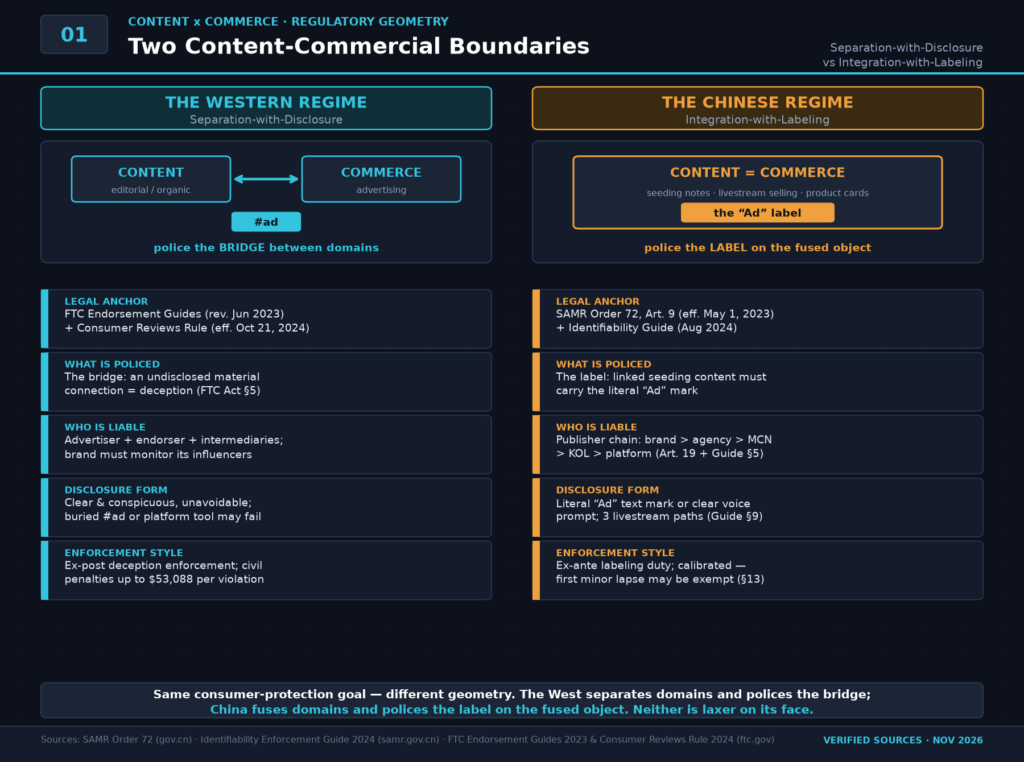
Here is the thesis, plainly. Western marketing runs a separation boundary: content and advertising are conceptually distinct domains, and the law polices the bridge between them through disclosure. China runs an integration boundary: content is commerce’s native language, and the law polices the label on the fused object.
Both want the same thing — a consumer who knows when they are being sold to. They just draw the geometry differently. One draws a line. The other draws a gradient.
The Western Rulebook: Police the Bridge
The American framework rests on the FTC’s Endorsement Guides, rewritten in June 2023 for the first time since 2009. The core idea is the material connection: if a creator is paid, gifted, employed, or otherwise tied to a brand in a way the audience would not expect, that tie must be disclosed clearly and conspicuously.
The 2023 revision sharpened what “clear and conspicuous” means. A disclosure has to be difficult to miss and easy to understand — unavoidable, in the FTC’s word. Tuck #ad behind a “more” button and it fails. Rely on a platform’s built-in paid-partnership tag and it might still fail, because the tag may not be prominent enough. The Guides also stretched the definition of an endorsement to cover virtual influencers and fake reviews, and made explicit that advertisers, endorsers, and the intermediaries between them can all be liable.
Then, in October 2024, the FTC added teeth. Its Consumer Reviews and Testimonials Rule banned fake reviews — including AI-generated ones from people who never existed — along with buying sentiment-conditioned reviews, undisclosed insider reviews, company-controlled “independent” review sites, review suppression, and fake followers. Crucially, it gave the agency civil-penalty authority. By late 2025 that meant up to $53,088 per violation, and in December 2025 the FTC sent warning letters to ten companies, its first public enforcement step under the rule.
The through-line: content and ads stay separate categories, and deception is what happens when the bridge between them is hidden.
The Chinese Rulebook: Label the Fused Object
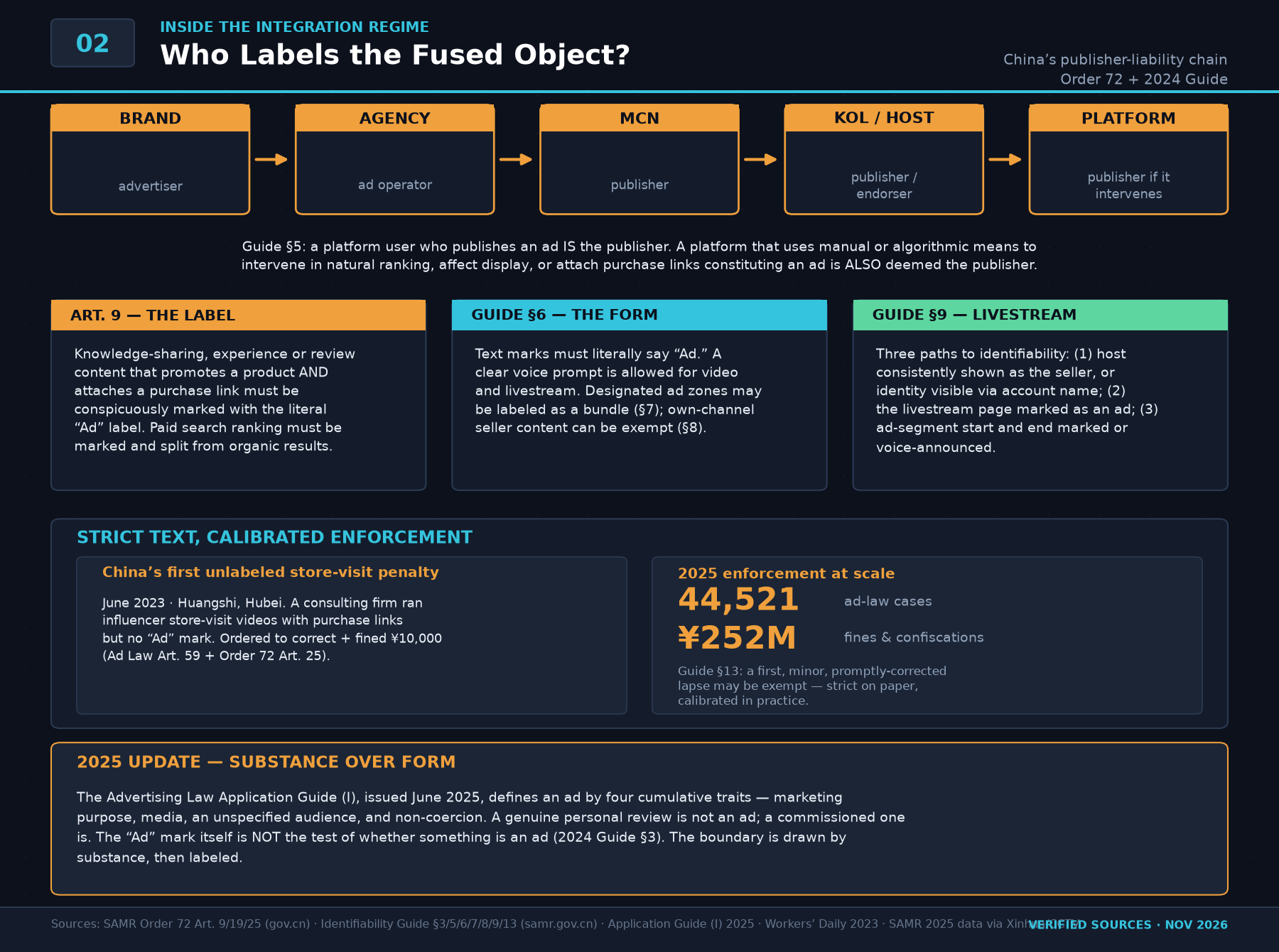
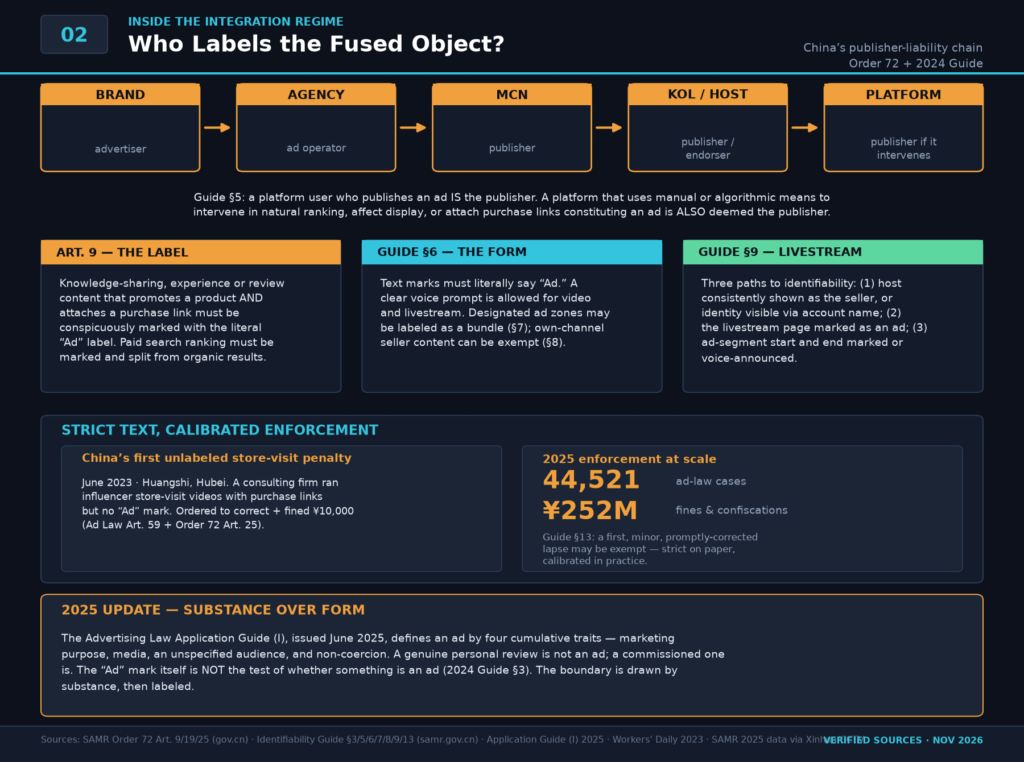
China’s anchor is SAMR Order 72, the Internet Advertising Management Measures, effective May 1, 2023. Article 9 is the provision worth memorizing. Internet ads must be identifiable. Paid search ranking must be conspicuously marked as advertising and split from organic results. And — the clause that matters for creators — knowledge-sharing, experience-sharing, or consumer-review content that promotes a product and attaches a purchase link must be conspicuously marked with the literal “Ad” label by the publisher.
Read that again. The law does not say “keep your review separate from your ad.” It says your review can be the ad, and when it is, label it. The boundary is drawn inside the content object, not between two objects.
Article 19 maps the livestream chain: a seller pitching products bears advertiser liability; a room operator or host engaged to design, produce, or publish the pitch bears operator and publisher liability; a host recommending in their own name or image bears endorser liability. The August 2024 Identifiability Enforcement Guide then answered the practical questions. Who labels? The publisher — and a platform that uses manual or algorithmic means to intervene in ranking, affect display, or attach purchase links is itself deemed a publisher. How? A literal “Ad” text mark, or a clear voice prompt for video and livestream. The Guide even lays out three identifiability paths for livestreams and allows designated ad zones to be labeled as a bundle.
Why the Geometries Differ
Four forces, stacked.
Platform architecture came first. China’s super-apps fused content and checkout structurally — the product card lives in the note, the buy button lives in the stream. Separation was never the default, so the law regulates labeling within fusion. The West’s open web kept editorial and commerce on different sites, so separation was the default and the law regulates the bridge.
The content economy’s job came second. Chinese seeding content is built to drive search-and-buy within days; commerce is the content’s purpose. Western content marketing builds affinity over time; commerce is downstream. Purpose decides geometry.
Regulatory tradition came third. China favors ex-ante administrative labeling — identifiability as a publication requirement. The West favors ex-post deception enforcement — an undisclosed material connection becomes a violation after the fact.
And the consumer decoding contract came fourth. Western audiences expect a mode-switching signal: this is an ad, now switch your skepticism on. Chinese audiences evaluate commercial content by usefulness and honesty, and accept commercial intent that delivers decision value. The trust test differs because the contract differs.
What Everyone Gets Wrong
The first error is assuming China is lax on ad labeling. On its face, Order 72 is stricter than #ad practice: linked seeding content must carry the literal “Ad” mark, with publisher liability and voice-disclosure rules. The difference is geometry, not laxity.
The second error is assuming Western separation is pure. Native advertising, influencer content, affiliate media, and AI-answer ads blur the Western boundary constantly. Separation is the ideal; the practice is negotiated. A wave of 2025 class actions — against brands including Revolve, Shein, and Celsius — alleged that #ad buried in long captions and hashtag piles was not clear and conspicuous at all.
The third error is reading Chinese acceptance of commercial content as gullibility. It is not. Deception, in that contract, is uselessness or dishonesty — not commerciality. A disclosed ad that helps you decide is fine. A “genuine” note that wastes your time is not.
The fourth error is assuming the boundaries stay put. They will not. AI is dissolving the authorship signal both regimes rely on, and that changes everything.
Strict Text, Calibrated Enforcement
A fair objection: China’s labeling is inconsistently enforced. True — and the system admits it. The 2024 Guide exists precisely because practice lagged text, and it explicitly allows a first-time, minor, promptly-corrected lapse to go unpenalized.
But strict text still bites. In June 2023, a consulting firm in Huangshi, Hubei, ran influencer store-visit videos with purchase links and no “Ad” mark. It became China’s first such penalty: ordered to correct, fined ¥10,000. At scale, SAMR handled 44,521 advertising-law cases in 2025, with ¥252 million in fines and confiscations. The honest read is strict on paper, calibrated in practice — which means brands should comply with the text, not bet on the laxity.
A June 2025 update sharpened the logic further. The Advertising Law Application Guide (I) defined an ad by four cumulative traits: marketing purpose, media, an unspecified audience, and non-coercion. A genuine personal review is not an ad; a commissioned one is. And the “Ad” mark itself is not the test of whether something is an ad — substance decides that first. The boundary is drawn by substance, then labeled.
The AI Rewrite: From Authorship to Provenance
Now the ground shifts. When no human wrote the content, “material connection” and “publisher liability” need new definitions. A synthetic reviewer has no connection to disclose and no name to endorse in. Both regimes are responding, and the response has a name: provenance.
China moved first and hardest. Its AI-Generated Synthetic Content Labeling Measures, effective September 1, 2025, require explicit labels users can perceive plus implicit labels in file metadata — content attribute, provider code, content ID. Platforms must verify the metadata and add prompts; users must declare; malicious removal or forgery of labels is banned. A mandatory national standard, GB 45438-2025, took effect the same day. Douyin, Xiaohongshu, WeChat Channels, Kuaishou, Bilibili, and Weibo rolled out creator declarations and platform back-labeling within weeks.
Europe followed with the AI Act’s Article 50, applicable August 2, 2026: deepfakes and AI-generated public-interest text must be disclosed, providers must add machine-readable marks, and fines reach €15 million or 3% of global turnover. The West’s platforms moved earlier but softer — YouTube’s altered-or-synthetic disclosure, Meta’s “AI info” tags built on C2PA content credentials, TikTok’s AI labels — voluntary and policy-driven, with patchy enforcement.
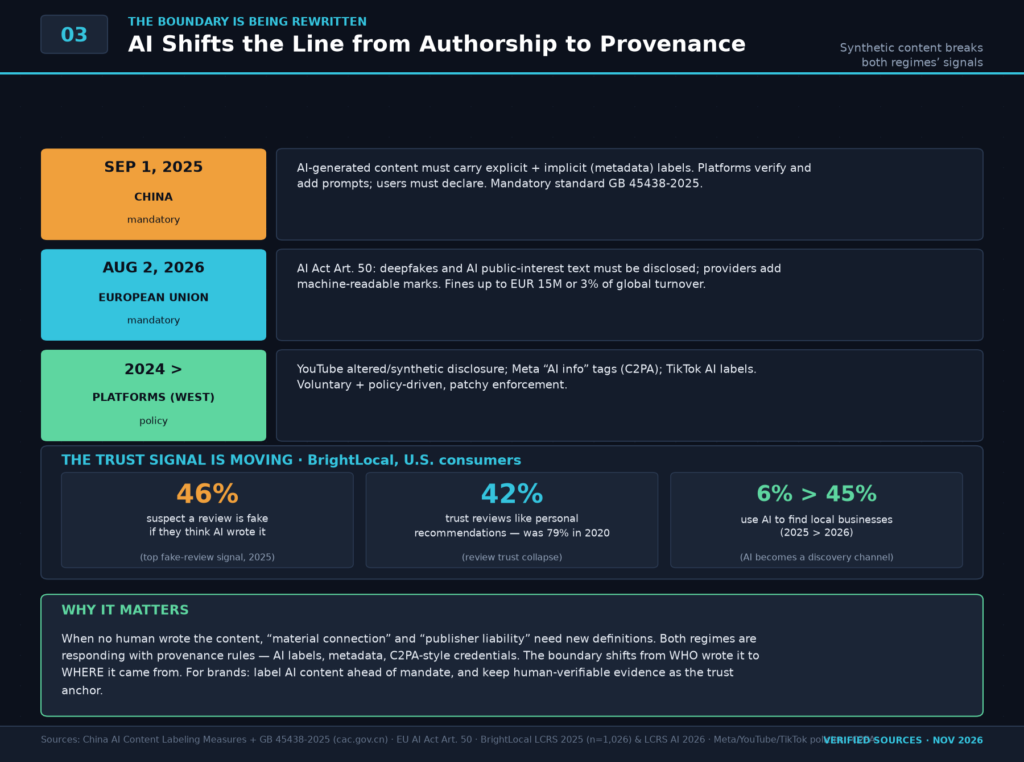
The consumer side explains the urgency. BrightLocal’s 2025 survey of 1,026 U.S. adults found that 46% would suspect a review is fake if they thought AI wrote it — the top fake-review signal. Trust in reviews as personal recommendations fell from 79% in 2020 to 42% in 2025. And by 2026, the share using AI to find local businesses had jumped from 6% to 45%. The boundary is shifting from who wrote it to where it came from, because “who” is no longer a reliable answer.
The Compliance Playbook for Brands
So what do you actually do?
Comply with the local geometry. In China, label the fused object — the literal “Ad” mark or a voice prompt on linked content — and assign publisher liability along the chain. In the West, disclose the material connection clearly at the bridge. Importing #ad habits into China under-complies; importing Chinese fusion into the West over-blurs.
Design for the local decoding contract. Western content earns trust by signaling its mode honestly. Chinese content earns trust by delivering decision value honestly. The creative brief’s trust job is not the same in both markets, and pretending it is wastes money.
Assign liability explicitly. Order 72’s chain and the Guide’s platform-intervention clause mean contracts must allocate the labeling duty — brand, agency, MCN, KOL, platform. Western FTC logic similarly reaches brands for influencer nondisclosure, so monitoring is a brand duty, not a creator courtesy.
And prepare for the provenance turn. Label AI content ahead of mandate — China already requires it — and keep human-verifiable evidence as the trust anchor. When authorship stops being a signal, provenance becomes the new disclosure.
The Bottom Line
Two content-commercial boundaries, two geometries. The West separates domains and polices the bridge with disclosure; China fuses domains and polices the label on the fused object. Order 72’s literal “Ad” requirement and livestream liability chain are stricter on their face than #ad practice, not laxer. Consumers decode accordingly — mode-signals in the West, usefulness-signals in China.
For brands, compliance means matching the geometry, assigning liability along the chain, and designing for the local trust contract. And AI is rewriting both regimes at once, shifting the boundary from who wrote it to where it came from. The line and the gradient are both being redrawn. The brands that win will be the ones that notice which room they are standing in.