Every product team that has ever shipped a “senior mode” believes it is being kind. Bigger buttons, simpler menus, a toggle labeled for the elderly — a separate, quieter corner of the app where nothing can confuse them. The intention is real. The economics are backwards.
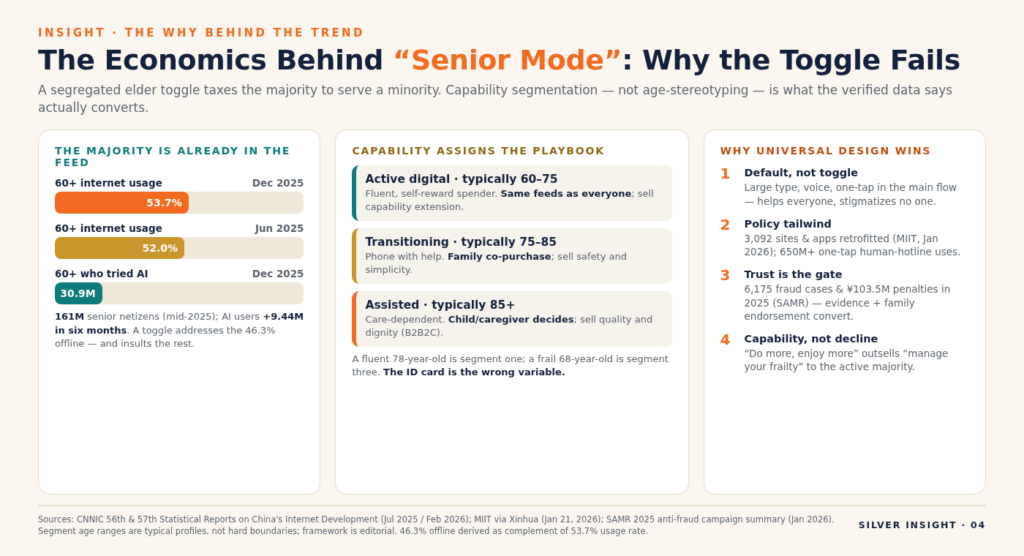
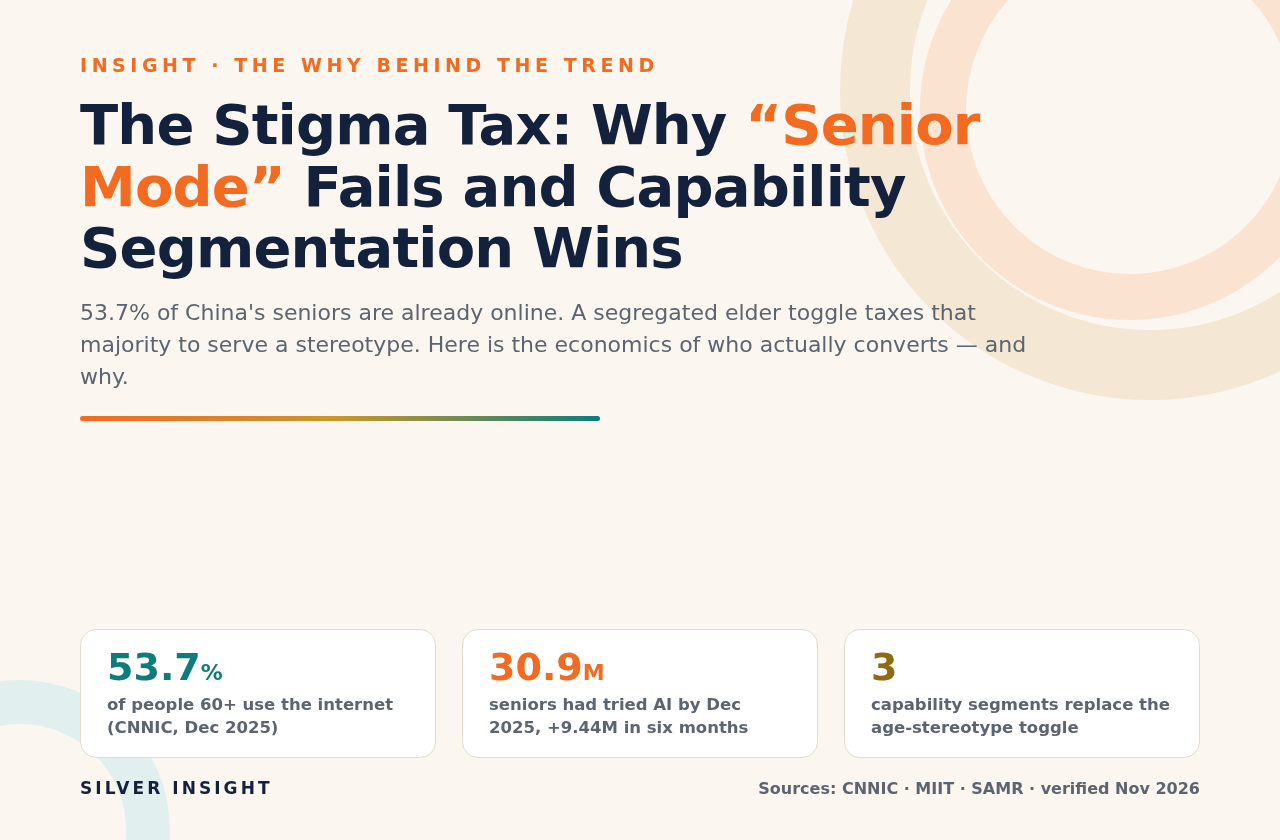
Start with who the toggle is actually for. CNNIC’s 57th report puts internet usage among China’s 60+ population at 53.7% as of December 2025; the previous report counted 161 million senior netizens. These users watch short video, argue in comment sections, and book train tickets in the same feeds as everyone else — 30.9 million of them had even tried AI, up 9.44 million in six months. A segregated mode addresses the offline minority while quietly telling the online majority: we think you are broken. That is a stigma tax, and customers pay it with their feet. The active 68-year-old who just enrolled in a photography course does not want the wheelchair entrance. She wants the front door, wide enough for everyone.
The deeper error is the segmentation variable. Age is a proxy; capability is the mechanism. A fluent 78-year-old behaves like a mainstream digital consumer — self-reward spending, hobby purchases, travel — and converts on capability-extension offers in ordinary feeds. A frail 68-year-old converts through a different machine entirely: an adult child who installs the apps, binds the payment card, and approves the order. One toggle cannot serve both, because the buyer is not even the same person. Segment by what the user can do — fluent, assisted-digital, care-dependent — and the channel, offer and message fall out automatically. Segment by birthday, and you will keep building products for a customer who does not exist.
There is also a compounding reason the default-design path wins: the state is subsidizing it. MIIT reports 3,092 senior-relevant websites and apps completed aging-friendly redesigns by January 2026, and the one-tap human-agent hotline has served over 650 million uses. Accessibility is becoming infrastructure, like ramps — expected in the main flow, not bolted on as charity. Meanwhile SAMR’s 2025 campaign against elder-targeted health fraud (6,175 cases, RMB 103.5 million in penalties) is removing the brands that treated seniors as marks. What remains is a market where trust is the conversion layer: verifiable claims, real certifications, and a skeptical daughter’s approval.
So the why is simple. “Senior mode” fails because it taxes the majority’s dignity to serve a minority’s stereotype, while the money flows to whoever designs for capability by default. The toggle is not kindness. It is a mispriced assumption — and the market is correcting it.