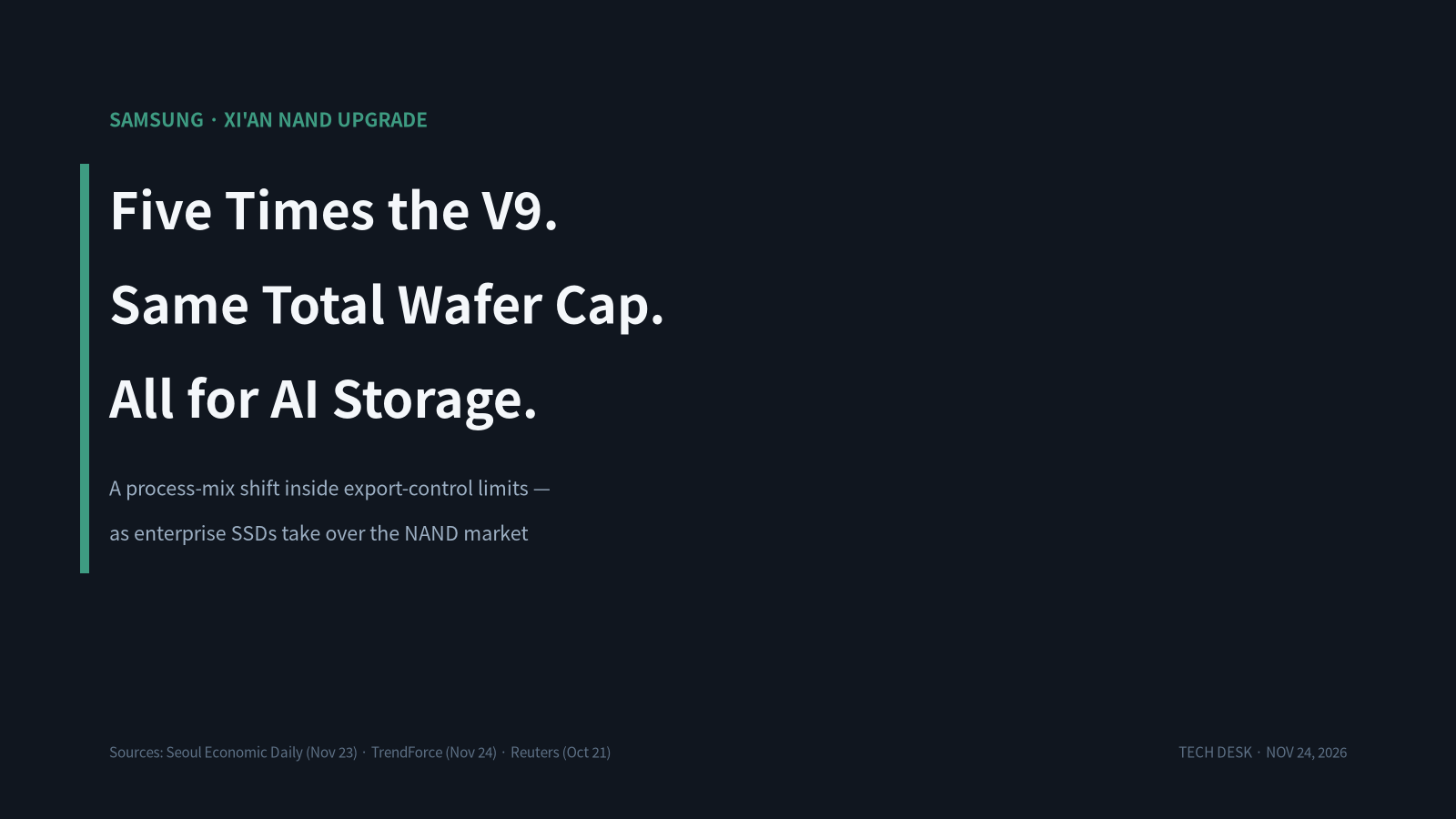
Samsung is reportedly retooling its Xi’an memory plant to produce roughly five times more of its most advanced NAND — without adding a single wafer of total capacity. Both halves of that sentence matter, and most coverage is dropping one.
The report, from Seoul Economic Daily on November 23 citing industry sources, says Samsung plans to lift V9 NAND output at its second Xi’an fab (X2) from about 10,000 to 50,000 300mm wafers per month — the Korean original cites a 50,000–60,000 target within a year. The mechanism is a mix shift, not a buildout: a new ~20,000-wafer line inside existing cleanroom space, plus converting 20–30% of current V6 lines to the newer process. Equipment move-in is slated for around February 2027, with conversion complete by November, per TrendForce’s account of the report.
Now the other half. Reuters reported in October that Samsung describes this upgrade as compliant with US export controls, aimed at serving global customers including American ones, with no capacity expansion and no new facilities. That is not a contradiction once you separate the meters: the “5×” refers to output of one process generation (V9) at one fab; Samsung’s statement refers to total installed wafer capacity and physical footprint. Same ceiling, richer mix. For anyone tracking export-control policy, this is the template to watch — advanced-node share rising inside a frozen capacity envelope, a pattern SK hynix is reportedly pursuing too, seeking to move its Dalian fab from 192-layer to at least 240-layer NAND as China’s YMTC ramps.
Why V9, and why now? The specs: 286 layers versus V8’s 236, roughly 50% higher TLC storage density per area, and 3.2 Gbps I/O — 33% faster. It already ships in the PM1763 enterprise SSD that entered mass production in July. Yields on some V9 products have reportedly reached the low 90s, about ten points above the previous generation — the kind of maturity that makes a large process conversion financially sane. (Yield figures are source-based, not officially confirmed.)
The demand data explains the urgency. TrendForce projects NAND demand for enterprise SSDs, measured by capacity, growing 84% in 2026 and another 55% in 2027, while PC SSD demand falls 12% and smartphone demand slips 1% next year. Enterprise SSDs go from 45% of total NAND demand this year to 57% next year — the market’s center of gravity moves from consumer devices to AI data centers in a single year. Samsung wants that mix shift reflected in its own fabs, and Xi’an matters: its two fabs there account for roughly a third of Samsung’s total NAND capacity, 100,000 wafers monthly against Pyeongtaek’s 200,000.
The competitive stakes are already visible in the numbers. Samsung’s enterprise SSD revenue share hit 35.1% in 2Q26, versus SK hynix group’s 21.1% and Micron’s 17.1% — its lead over SK hynix widened from about 12 points to 14 in one quarter. For buyers, the practical signal: enterprise storage supply is being deliberately re-pointed at AI workloads, while consumer NAND demand softens. If you’re procuring eSSDs for 2027 buildouts, the capacity exists — it’s being allocated. Lock contracts early; if you’re buying consumer SSDs, the softening demand side may finally be your leverage.