Your last LinkedIn post got eighteen likes and one comment, and the comment was from a coworker. You filed it under “disappointing” and moved on. Here is the part your dashboard will never show you: an AI assistant may have quoted that same quiet post to a buyer comparing vendors in your category. No click, no impression, no little red notification. Just your sentences, doing sales work in a conversation you will never see.
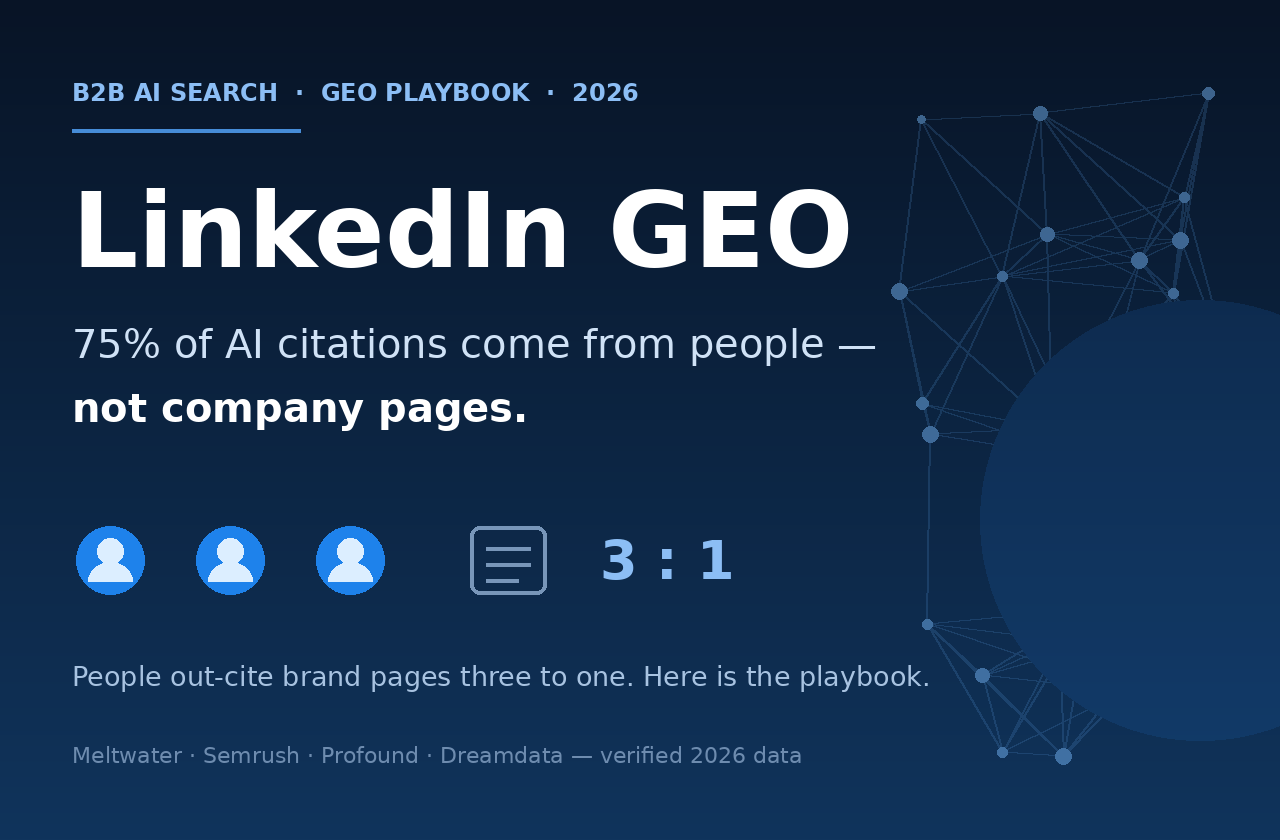
Three research programs published in 2026 — Meltwater with LinkedIn, Semrush with LinkedIn, and Profound — landed on the same uncomfortable conclusion for brand teams. The company page is not where AI visibility lives on LinkedIn. The people are. And the gap is not close: roughly three to one.
Let’s walk through what the data actually says, where the studies disagree with each other, and what a B2B team should do about it on Monday morning.
From #11 to #5: The Climb Nobody Announced
Profound, an AI analytics vendor, tracked 1.4 million citations across six platforms — ChatGPT, Gemini, Google AI Overviews, Google AI Mode, Microsoft Copilot, and Perplexity — between November 15, 2025 and February 15, 2026. In that window, LinkedIn’s domain rank on ChatGPT jumped from roughly #11 to roughly #5, measured on real user prompts. Profound called it the largest authority shift it had seen all year.
The same report crowned LinkedIn the #1 cited domain for professional queries across all six platforms. Read the methodology before you screenshot that: the #1 finding came from a synthetic basket of professional prompts run across the models, while the rank climb came from organic user behavior. Both are real measurements. They measure different things, and mixing them up is how exaggerated claims get made.
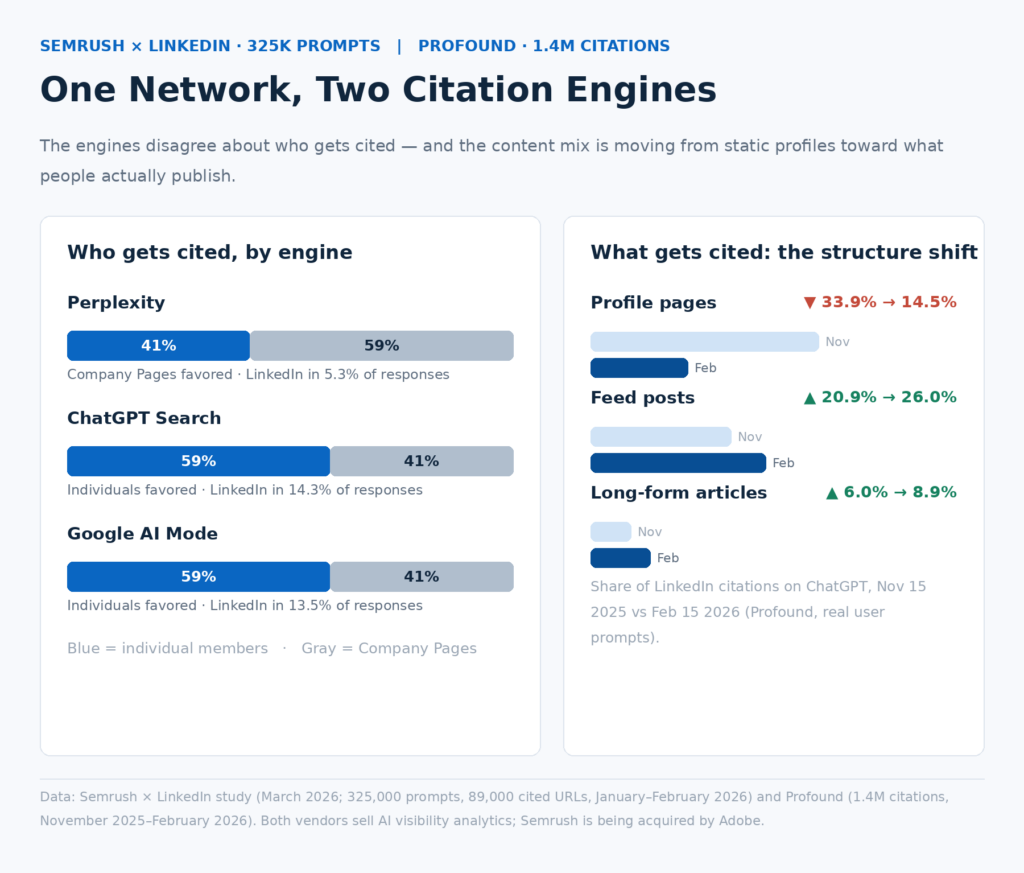
Semrush’s tracking tells a consistent story. A fall 2025 study of more than 230,000 prompts over thirteen weeks — over 100 million citations — found Google AI Mode citing LinkedIn in nearly 15% of responses. Then, in March 2026, Semrush published a study run with LinkedIn itself: 325,000 prompts and 89,000 cited LinkedIn URLs, collected in January and February 2026 across ChatGPT Search, Google AI Mode, and Perplexity. LinkedIn appeared in 11% of AI responses on average — 14.3% on ChatGPT Search, 13.5% on AI Mode, and 5.3% on Perplexity. That made it the second most-cited domain in that dataset, behind Reddit and ahead of Wikipedia, YouTube, and every major news publisher.
Meltwater’s May 2026 report, produced with LinkedIn, adds the widest-angle view: 9.5 million citations across six models and 16 B2B categories. LinkedIn ranked second overall in citation share at 0.53%, behind YouTube’s 1.52%, and landed among the top five cited domains in eight professional categories, including AI and data science, marketing, sales, consulting, fintech, HR, and SaaS.
One honest caveat before we go further. Meltwater sells AI visibility tracking, Semrush sells an AI visibility toolkit and is being acquired by Adobe, and Profound sells AI analytics. Their samples differ, which is why “second overall” means a 0.53% citation share in one study and an 11% response rate in another. The direction is consistent across all three. The exact numbers are not interchangeable, and anyone who blends them into one leaderboard is selling you something.
The 75/25 Rule: People Get Cited, Pages Get Skimmed
Here is the finding that should rearrange your content calendar. In Meltwater’s 9.5-million-citation dataset, roughly 75% of LinkedIn citations came from individual members. Company pages took about 25%.
And it is not just the platform’s loudmouths cashing in. More than half of all citations — 51% — came from members with fewer than 10,000 followers. Meltwater’s chief product officer, Chris Hackney, put the shift bluntly: for twenty years a brand’s job was to be discoverable, and in an AI-first world the job is to be the answer. The models, in his framing, are not looking for the loudest voice in the room. They are looking for the most credible one.
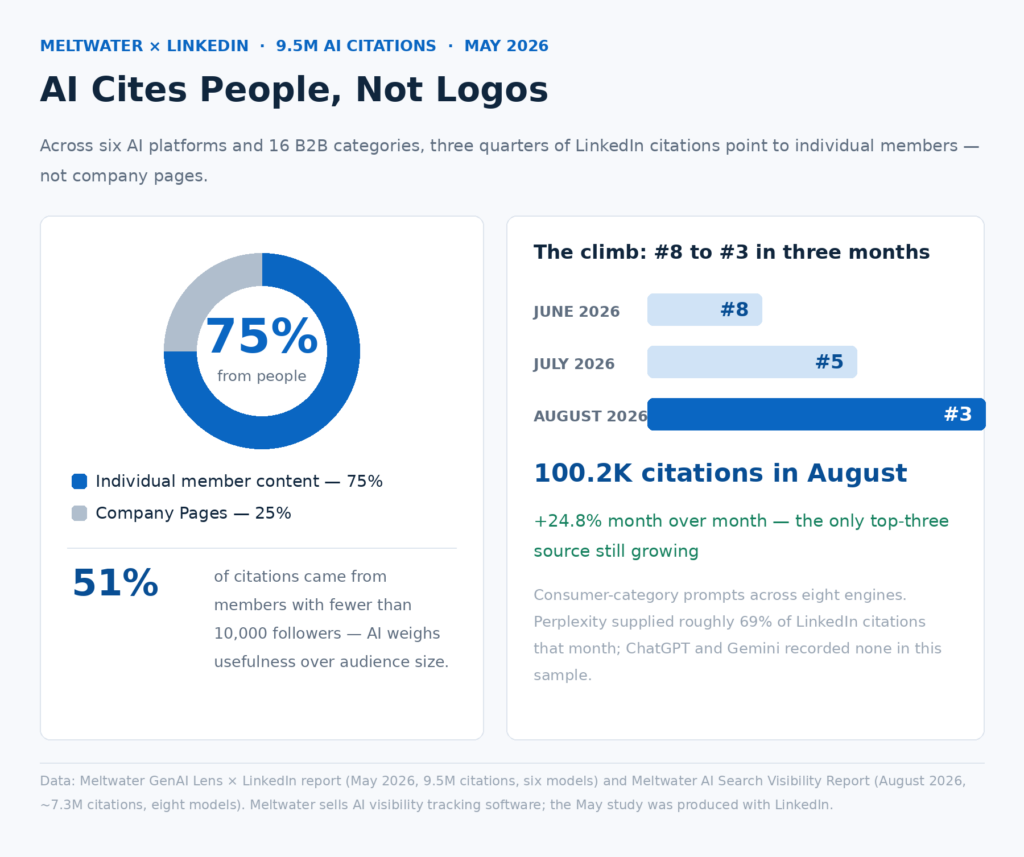
The momentum kept building after the May report. Meltwater’s August 2026 monthly snapshot — a separate sample of about 7.3 million citations across eight engines, built on consumer-category prompts with no brand names — logged 100,200 LinkedIn citations, up 24.8% month over month. LinkedIn rose from eighth in June to fifth in July to third in August, behind only YouTube at 212.5K and Reddit at 127K.
But open the engine breakdown before you celebrate. Perplexity generated 69,302 of those citations — roughly 69% of LinkedIn’s total in that sample. ChatGPT and Gemini recorded zero LinkedIn citations in the same tracked data. Different prompts, different retrieval behavior, different month. The lesson is not “LinkedIn wins everywhere.” The lesson is that LinkedIn’s rise is real and wildly uneven across engines, so you either measure per engine or you are not really measuring.
The Structure Shift: Profiles Are Losing, Posts Are Winning
What gets cited on LinkedIn is changing as fast as who gets cited. Profound’s data shows profile pages collapsing from 33.9% of LinkedIn citations to 14.5% in three months. Feed posts climbed from 20.9% to 26.0%, and long-form articles from 6.0% to 8.9%. Posts and articles combined went from 26.9% to 34.9% — from roughly a quarter of LinkedIn citations on ChatGPT to roughly a third.
Read that as a migration: AI engines are moving away from LinkedIn as a directory of resumes and toward LinkedIn as a publishing layer. Your job title is no longer the asset. What you wrote last Thursday is.
The Platform Split: Perplexity Wants Your Page, ChatGPT Wants Your People
Now the wrinkle that breaks single-channel strategies. In the Semrush × LinkedIn study, Perplexity drew 59% of its LinkedIn citations from Company Pages. ChatGPT Search and Google AI Mode did the exact opposite: 59% of their LinkedIn citations came from individual members, on each platform.
So a company-page-only program is optimized for one engine and underweight on the two biggest ones. A people-only program leaves Perplexity on the table. You need both lanes running.
There is a second finding here that most coverage skips, and it might be the most commercially important number in the whole study. Semrush measured semantic similarity — how closely an AI answer mirrors the source it cites. LinkedIn scored 0.57 to 0.60, versus 0.53–0.54 for Reddit and 0.435 for Quora in earlier Semrush studies. In plain English: when AI cites LinkedIn, it echoes you almost faithfully. Your positioning, your terminology, your framing survive the trip into the answer. Which also means vague positioning survives as vagueness. Write like someone will repeat your words verbatim to a buyer — because something will.
The 15-Like Paradox: Your Quietest Posts May Be Working Hardest
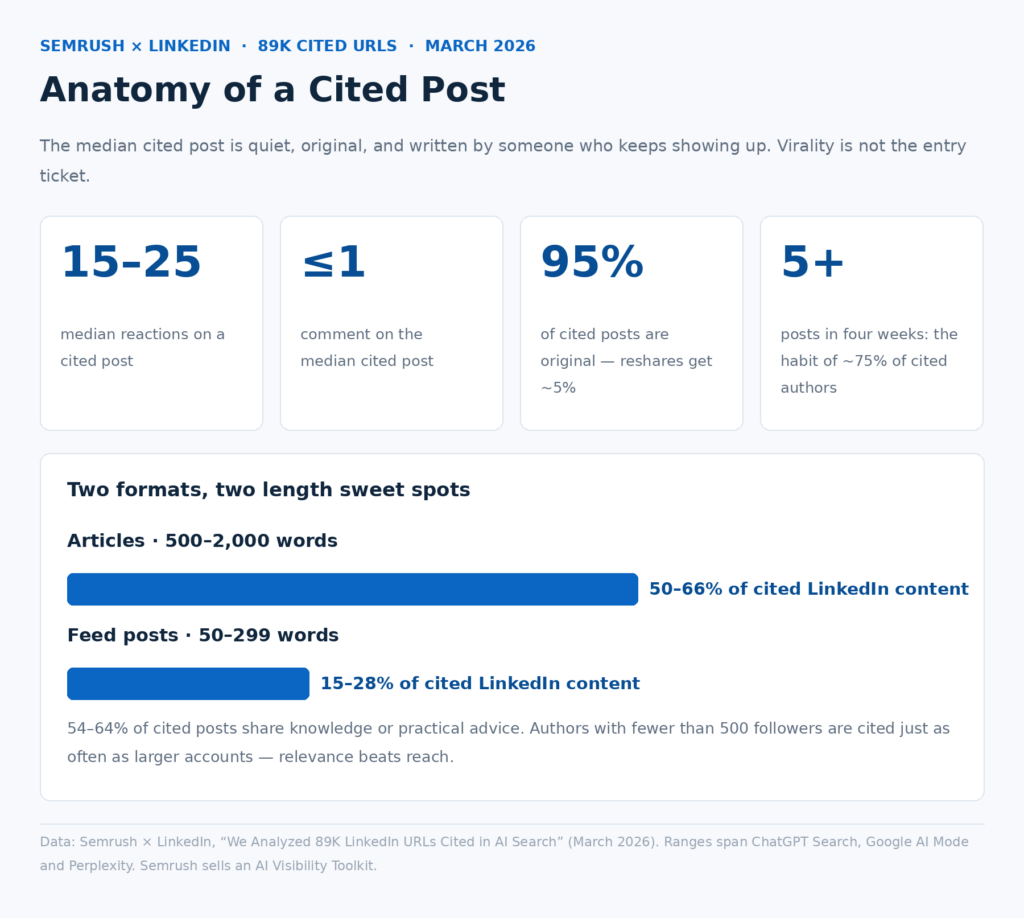
Time for the number that will annoy your social media manager. The median cited LinkedIn post in the Semrush study had 15 to 25 reactions and no more than one comment.
Not 1,500 likes. Not a viral carousel. Fifteen to twenty-five reactions — the kind of post you almost apologize for in the weekly meeting.
Semrush found the same pattern in its earlier Reddit research: the threads AI tools cited most were often older, quieter discussions with clear, direct answers, not the ones with thousands of upvotes. Citation worthiness and virality are different games with different scoreboards. The feed algorithm rewards hooks and social proof. AI retrieval rewards a complete, specific, well-structured answer to a real question.
If your team judges LinkedIn content by engagement alone, you are systematically undervaluing the exact posts that carry your brand into AI answers. That is not a metaphor. That is a measurement bug in your reporting stack.
The 95% Original Rule and the Frequent-Poster Habit
What do cited posts have in common, if not applause?
First, originality. About 95% of cited posts were original content; reshares accounted for roughly 5%. Forwarding an industry article with “great read!” above it is nearly invisible to AI retrieval.
Second, usefulness. Between 54% and 64% of cited posts shared knowledge or practical advice — close to two-thirds on Google AI Mode. Product promotion gets cited too, but at a distant second place.
Third, format discipline. Long-form articles took 50–66% of cited LinkedIn content, with a sweet spot of 500 to 2,000 words. Feed posts took 15–28%, and the winning length band was 50 to 299 words. Comprehensive enough to answer a question, focused enough to stay extractable.
Fourth, rhythm. Around 75% of cited post authors had published more than five posts in the previous four weeks; for article authors it was around 60%. Meanwhile, members with fewer than 500 followers were cited just as often as — sometimes more often than — members with larger audiences, even though nearly half of cited authors had 2,000-plus followers. Translation: an established audience helps at the margin, but consistency and expertise are the entry ticket. Your solutions engineer with 380 followers is not disqualified. She is, potentially, your best citation asset.
Real Names, Real Jobs: Why AI Trusts LinkedIn
Why LinkedIn and not just any social platform? The structural answer: every post is attached to a named professional with a visible employment history, credentials, and industry context. When someone writes about evaluating a data warehouse or running a clinical trial, the byline itself carries verifiable evidence that this person does the work. Reddit offers authenticity but anonymity. LinkedIn offers authenticity with a receipt.
Buffer’s director of growth offered a sharper framing, which he explicitly labels his own hypothesis: LinkedIn is becoming a professional version of Reddit. AI engines learned that real practitioners giving grounded opinions beat polished marketing copy, and LinkedIn is where professionals do exactly that — about tools, vendors, and markets, under their real names. Treat it as a hypothesis, not a law, but it fits the data uncomfortably well.
Meltwater’s findings add the formatting layer: the most-cited LinkedIn content consistently uses clear structure — headings, bullet points, numbered lists, named entities, and quantitative data. Verifiable identity gets you considered. Clean structure gets you extracted. You need both.
The 272-Day Journey: LinkedIn Works Before Sales Ever Calls
Why does any of this matter for revenue? Because of when buyers meet you now.
Dreamdata’s 2026 LinkedIn Benchmarks Report — aggregated from thousands of B2B companies, over 66 million sessions, and 3.5 million customer journeys — puts the average B2B customer journey at 272 days, up from 211 a year earlier. The buying committee now averages 10 stakeholders, 88 touchpoints, and 4 channels. And 81% of the journey happens before the sales pipeline even begins, up from 70%. Buyers spend roughly the first 220 days — seven months — educating themselves through content before they ever raise a hand.
Now overlay the AI layer. In 6sense’s 2025 Buyer Experience Report, a survey of roughly 4,000 B2B buyers evaluating deals averaging about $250,000 a year, 94% said they used large language models during the purchase process. Before you panic about robots replacing your sales team, note the balance in the same research: buyers still had around 16 interactions with the vendor they ultimately chose. AI is mediating the research, not closing the deal.
Put the two together and the picture is clear. During those seven months of self-education, your buyer is asking an AI assistant which vendors are credible — and the answer increasingly quotes LinkedIn posts from named practitioners. Your employees’ content enters the room months before your website does. Dreamdata, which is a LinkedIn Marketing Partner and therefore has an interest in the platform looking good, also reports LinkedIn delivering 121% ROAS versus 67% for Google Search and 51% for Meta, and holding 41% of B2B paid-social budgets — paid-social specifically, not all paid media. Vendor data, disclosed interest, consistent direction.
Employee Advocacy Engineering: Five Steps, Not Ghostwritten Slop
If people are the citation engine, the operational question becomes: how do you run people at scale without turning them into puppets? Treat it as engineering, not a poster campaign.
Step one: build the question inventory. Collect the 20 to 30 questions your buyers actually ask AI tools — category comparisons, evaluation criteria, “is X worth it,” implementation gotchas. Use a fixed prompt panel, not vibes.
Step two: map questions to credible internal experts. Who at your company has genuinely done the thing being asked about? Match topics to people whose employment history backs the answer.
Step three: support publishing in their own voice. Give experts talking points, editorial help, and a schedule — not finished corporate copy with their name stamped on it. Two posts a week beats one polished manifesto a quarter.
Step four: run the Company Page as the structured complement. Positioning, research summaries, product facts — the reference layer Perplexity leans on. The page and the people are complementary lanes, not competitors.
Step five: measure citations weekly, per engine. Track a fixed prompt set across ChatGPT, AI Mode, and Perplexity, log who gets cited — person or page — and report it separately from feed engagement. If your AI visibility report lives inside your likes-and-comments dashboard, you will keep making the 15-like mistake.
The Red Lines: Slop, Fake Voices, and Borrowed Opinions
Three failure modes will quietly sink this program.
The first is AI slop at scale. Mass-generated posts read as generic to humans and, per the citation data, generic content is exactly what retrieval skips — 95% of cited posts were original, and knowledge-sharing dominated. Use AI to sharpen a draft your expert actually thought, not to manufacture thought.
The second is unreviewed ghostwriting. Marketing support is fine — the Semrush study explicitly recommends editorial guidelines and content support for SMEs. The line is authenticity of opinion: the expert must own the take, review the final text, and publish under their own name. A fabricated persona spouting views nobody holds is a trust liability with your audience and your lawyers, and it defeats the verifiable-identity mechanism that makes LinkedIn citable in the first place.
The third is vocabulary drift. If five experts describe your category five different ways, you dilute the entity association AI systems build between your brand and the topic. Keep a shared glossary of product and category terms, and let opinions vary while terminology stays consistent.
The 90-Day Cold Start: Five Experts, Two Posts a Week
You do not need a fifty-person advocacy platform rollout to test this. Here is a cold-start model sized for a mid-market B2B team.
Days 1–15: pick five experts across functions — one executive, one product or engineering voice, one customer-facing lead, one technical specialist, one wildcard with a genuine point of view. Build the 20–30 question panel and assign topic ownership.
Days 16–90: each expert publishes two feed posts a week in the 50–299 word band, answering one question per post, main point in the first lines. Each expert also ships one 500–2,000 word article per month. That is roughly 40 posts and 5 articles a month — comfortably inside the frequent-poster profile that dominates citations.
Every week: run the fixed prompt panel across the three engines, log citations by source type, and note which questions you do not yet answer. Every month: retire questions you now win, add the ones competitors are winning, and adjust topic assignments.
Judge the pilot on citation coverage and answer accuracy, not applause. The feed scoreboard will call most of these posts mediocre. The machines, quietly, will not.
The Bottom Line
LinkedIn has become one of AI search’s primary sources for professional questions, and the citation flow runs through people, not logos: 75/25 in Meltwater’s data, 59% individuals on ChatGPT Search and AI Mode, quiet original posts from consistent authors beating viral brand broadcasts. The engines disagree enough that you must run both lanes — people and page — and measure each engine separately. Inside a 272-day buyer journey where 81% happens before sales, your employees’ expertise is the earliest, most credible touchpoint you own. Stop treating LinkedIn as a broadcast channel with disappointing engagement. Start treating it as citation infrastructure — and staff it with real humans who have something true to say.