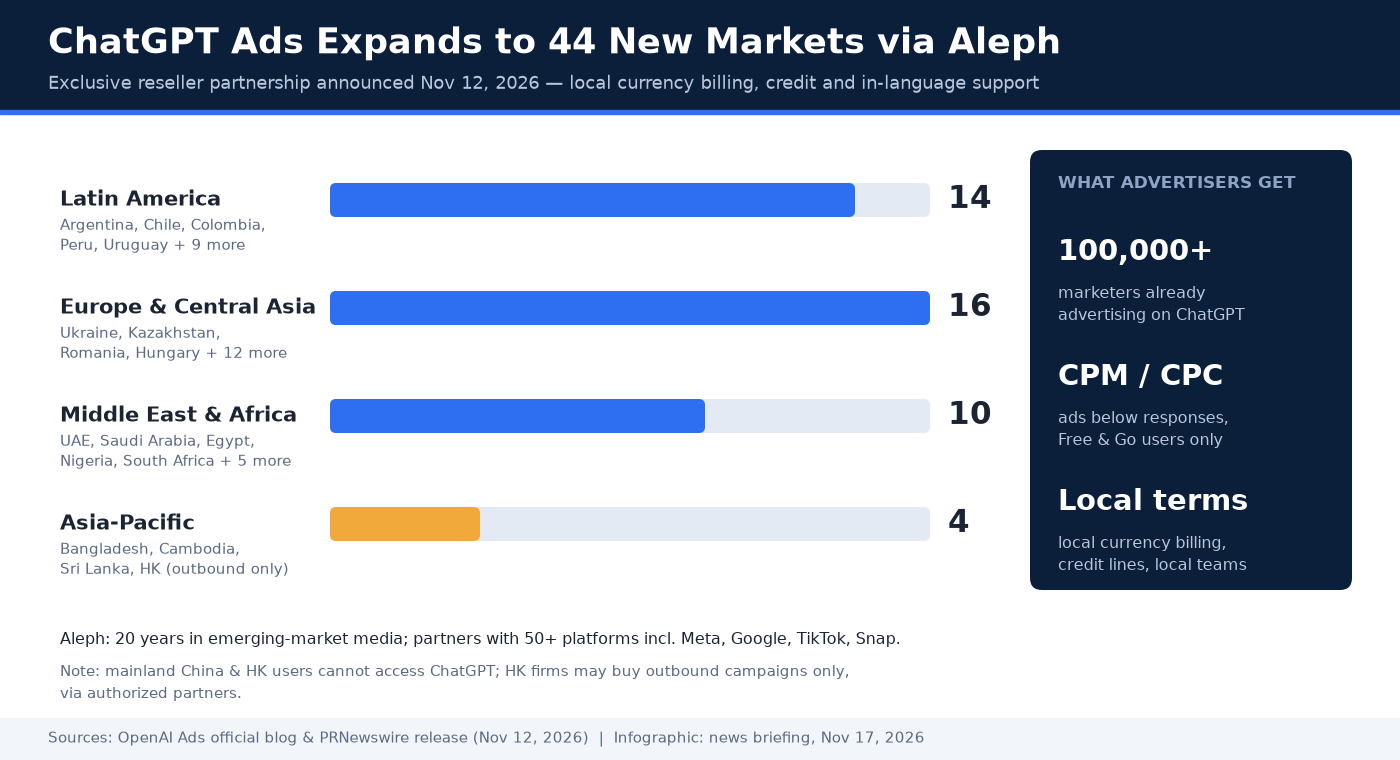
OpenAI is no longer treating ChatGPT advertising as an American experiment. On November 12, the company announced an exclusive reseller partnership with Aleph, the Dubai-based emerging-market media group, that extends ChatGPT Ads into 44 additional countries across Latin America, Europe and Central Asia, the Middle East and Africa, and Asia-Pacific. It is the largest single international expansion of the product since ads first appeared inside ChatGPT, and it answers a question media buyers have been asking for months: how do brands outside the US actually buy this inventory?
The answer, for now, is: through a middleman who speaks your language and takes your currency. Under the agreement, advertisers in the new markets can contract with OpenAI through Aleph’s local teams, get billed in their own currency, and access credit lines — three unglamorous details that matter more than they sound. Anyone who has tried to run Meta or Google campaigns from Lagos, Cairo or Bogotá knows that dollar-denominated billing and prepaid-only terms have quietly shaped which brands could participate in global digital advertising at all. Aleph built a twenty-year business on removing exactly those frictions.
The regional breakdown, confirmed in both OpenAI’s official blog post and the PRNewswire announcement, tells you where the company sees demand. Latin America gets 14 markets, including Argentina, Chile, Colombia, Peru and Uruguay. Europe and Central Asia gets 16, spanning Romania, Hungary, Kazakhstan and Ukraine. The Middle East and Africa gets 10, with the UAE, Saudi Arabia, Egypt, Nigeria and South Africa anchoring the list. Asia-Pacific gets four: Bangladesh, Cambodia, Sri Lanka and — with an asterisk that deserves attention — Hong Kong.
The Hong Kong footnote is the detail China-facing marketers should read twice. OpenAI’s blog explicitly states that its models and ChatGPT are not available to users in mainland China or Hong Kong, so ads cannot run in-market there. What businesses based in those markets can do is buy outbound campaigns: advertising to ChatGPT users in countries where ads are live, through authorized partners, subject to eligibility requirements. In other words, a Shenzhen or Hong Kong consumer brand can now, through proper channels, place its products inside the AI conversations of shoppers in São Paulo or Warsaw. For cross-border e-commerce teams that have spent two years watching AI recommendation traffic grow without a way to buy into it, that is a genuinely new door.
Scale context helps explain the timing. OpenAI says more than one hundred thousand marketers have already advertised on ChatGPT. The ad product itself remains deliberately conservative: ads appear below responses rather than inside them, labeled with the advertiser’s name and favicon, and shown only to Free and Go tier users — not Plus, Pro or Business subscribers, and not minors. Buying supports both CPM and CPC models, according to OpenAI’s help documentation. The company is clearly trying to grow revenue without detonating the trust that makes ChatGPT a recommendation engine in the first place.
Aleph’s side of the ledger explains why OpenAI chose a reseller rather than building local sales operations market by market. Founded in 2005, Aleph describes itself as operating across more than 130 high-growth markets with over 90 offices and commercial relationships with more than 50 platforms, including Meta, Google, TikTok, Snap, Spotify and X. Founder and CEO Gastón Taratuta framed the deal in plainly commercial terms: “AI is giving businesses a new way to connect with people. Starting today, advertisers in 44 markets can work with OpenAI through a local team that speaks their language, bills in their currency and extends credit. That is what Aleph does best: turning global technology into local growth.”
That quote is worth sitting with, because it captures the strategic logic on both sides. OpenAI gets distribution without headcount; Aleph gets exclusivity on what may become the fastest-growing ad surface of the next decade. The risk is symmetrical: if ChatGPT Ads underperform, Aleph has staked its AI portfolio on a single supplier, and OpenAI has outsourced the advertiser experience in dozens of markets to one partner’s execution quality.
For media buyers, the practical questions come next. First, measurement. ChatGPT Ads remains a young platform, and independent early-stage comparisons of conversational ad performance versus paid search have shown wide gaps in conversion efficiency — which cuts both ways: cheap clicks mean little if intent quality is low, but a CPC advantage can justify testing for upper-funnel objectives. Second, creative fit. Ads sit below answers to specific user questions, which means the winning creative strategy looks less like keyword-matched search copy and more like being the sensible next step after a recommendation conversation. Brands already investing in generative engine optimization — making sure AI assistants mention them organically — now have a paid lever to pull in the same environment.
Third, sequencing. The 44 markets did not all open with equal commercial maturity. Gulf markets like the UAE and Saudi Arabia combine high ChatGPT penetration with strong advertiser budgets; Latin American markets bring volume and Aleph’s deepest institutional experience. A sensible test plan starts where Aleph’s local teams are strongest, runs small CPM-branding and CPC-traffic cells in parallel, and insists on clean UTM discipline from day one, because attribution inside AI surfaces is still an industry-wide weak point.
The competitive frame is unavoidable. Google’s AI Mode has been slower to monetize, and Meta’s ad machine keeps compounding while search growth cools. OpenAI’s move suggests it intends to build the international advertiser base before Google fully wires ads into its own AI answers. Forty-four markets, local billing, credit lines and a partner with two decades of emerging-market muscle — it is less a product announcement than a land grab conducted in the boring, decisive language of payment terms.
Whether the inventory converts is the open question. But the door is now open in 44 more countries, and for global marketers, the cost of finding out has never been lower.






